Key takeaways
- Brand consistency is about meaning, not just design. Customers trust brands that act and communicate the same way everywhere.
- Consistency reduces effort and raises ROI. Customers choose familiar brands, giving the latter a free hand to charge more.
- When used as a strategy, consistency drives growth. It builds long-term customer loyalty instead of short-term attention.
Marketers consider 'BRAND CONSISTENCY' to be purely visual.
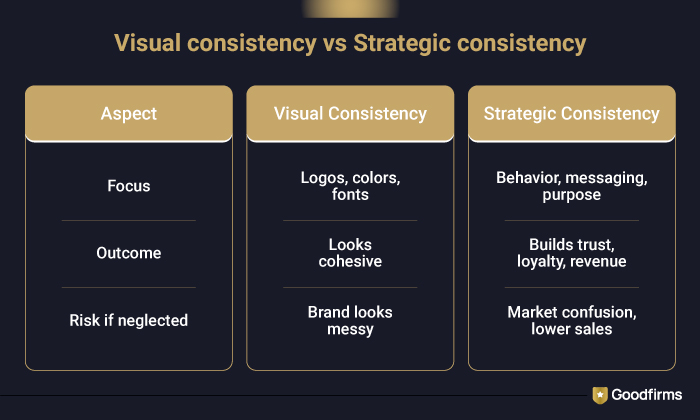
This means they focus on logos, fonts, and colors. But then, building brand consistency purely through visuals isn't enough.
Winning brands build familiarity and trust among customers, not simply because of their consistent looks, but because of their consistency in meaning and behavior across different touchpoints. In short, consistency is partially aesthetic, but mainly strategic. It decides whether your customers relate to your brand and trust you.
Today, users are checking your brand across platforms and devices, and consistency is what keeps your message meaningful, irrespective of the scale.
Brand consistency is a business strategy, not just visual design. Connect with top branding companies on Goodfirms to put that consistency into action.
Consistency in Meaning Builds Mental Shortcuts and Trust
Consistency breeds comfort. When your brand looks, sounds, and behaves the same across social, email, websites, and events, customers recognize patterns and trust.
The consistency across all channels helps customers reduce the mental effort required to process information, resulting in a smoother experience.
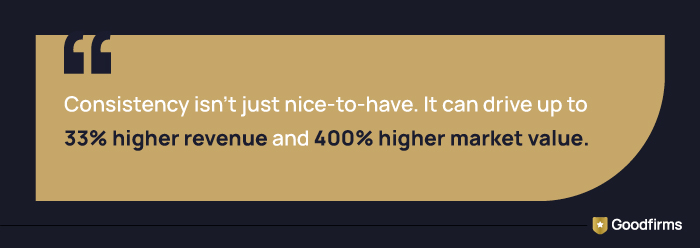
- Consistent brand presentation increases revenues by 23-33%.
- Brands ranked highly for trust outperform their peers by as much as 400% in market value, according to Deloitte.
- 88% of consumers purchase from brands they trust, just behind value for money (91%) and quality (89%), as per Edelman Trust Barometer data.
Apple no longer needs to explain its design philosophy at every launch. Thanks to its consistent branding, whether in visuals or product experience, Apple has trained users to expect simplicity and elegance every time they buy an Apple product, reinforcing familiarity and trust.
IKEA's story isn't about selling furniture. It sells the experience of assembling furniture as a value-creation tool. Referred to as the 'IKEA effect,' the brand story conditions customers to view assembly as a positive, do-it-yourself experience rather than a negative, do-it-yourself obstacle.
These brands' intelligible, consistent experiences turn them into mental shortcuts.
Customers these days don't ask "Who are you?" but "Do I trust you?" The shift makes marketing more efficient and growth more durable.
The Problem with Treating Brand Consistency as a Visual Exercise
Most organizations treat brand inconsistencies at the surface level: logos, typography, and layouts get tweaked time and again. In one sense, that's understandable because visual deviations are visible and, not to mention, easy to edit, too.
But then, visuals cover surface-level brand issues. True brand consistency lives in behavior and belief.
A brand that looks visually appealing but renders cheap services creates a disconnect. A brand that claims higher values but never stands by them weakens itself. Researchers have found that inconsistent branding experiences cause confusion among 71% of consumers, affecting purchase intent.
Starbucks faced this issue during its rapid global scaling. In less than 10 years, Starbucks scaled from fewer than 1000 stores to more than 13000 stores globally. s stores increased, their visual consistency never suffered; however, the experience got diluted. Its share price declined by 77%.
Its recovery didn't start with a redesign. CEO Howard Schultz refocused the organization on experiential consistency:
“One cup. One customer. One partner. One experience at a time. We had to get back to what mattered most.”
CEO Howard Schultz, Starbucks
The lesson was not about logos. It was about restoring alignment between what Starbucks promised and what customers actually received.
In fintech, Stripe's consistency is primarily behavioral rather than visual. The app adopts clarity, transparency, and technical precision across developer documentation, product interface, and pricing. This unified experience helps reduce perceived risk, a major shortcoming of financial decision-making, by making the system feel predictable and trustworthy at every touchpoint.
Brand consistency is therefore not about repeating design. It is about aligning:
- What the brand says
- What the brand shows
- What the brand does
When those drift apart, credibility collapses — and costs are real.
Repetition Isn't Boring. It Forms Meaning
Consistency allows creativity to compound. Without it, campaigns feel episodic — each one starts from ground zero. With it, every campaign adds weight to a shared narrative.
Nike continues to build on its reputation by staying true to its core values of effort, speed, victory, and athletic achievement. Even its swoosh stands for all these qualities. It isn’t inventing new categories. It's not launching a ton of new brands. It’s selling sneakers and athletic apparel just as it has been doing for many, many years.
Nike's consistency in messaging contributed to its rise as one of the most valuable global brands, ranked #12 worldwide by Interbrand's Global Brands report.
Dove's" Beauty" campaign, launched in 2004, is considered a favorite among medical marketers. The campaign offers a great insight into the core tension that women face - between who they are and what society expects them to be.
The campaign, no doubt, has been updated 11 times to keep up with new cultural and tech realities, yet its messaging still resonates with marketers and creatives even after 20 years.
The users found the campaign relatable because it featured simple messaging, strong emotion, and active empathy grounded in reality. The one thing that stood out was the use of 'real' people.'
Lesson: Consistency with creativity builds memory and measurable business impact.
When Consistency is Set by Brand Behavior, Not Marketing
Many companies consider brand consistency as a marketing task. But then, that's a mistake. Marketing can't develop brand meaning; behavior does.
Atlassian's brand centers around customer experience, openness, and collaboration - brand behaviors that shape trust and coherence, not just visuals.
Airbnb's 'Anywhere' repositioning focuses on a consistent emotional promise (belonging, human connection) across experiences, messaging, product, and visuals.
This justifies the point that brand consistency is about how a company behaves and communicates across systems, and is not just about smarter marketing visuals.
Consistency as a Growth Strategy
When treated as a growth strategy rather than decoration, consistency creates measurable strategic advantage.
Marketing efficiency: Familiar brands can do with less explanation and have lower acquisition costs. Think Nike's Logo, there's no brand name beneath it.
Premium pricing: Consumers don't mind paying premiums for brands they recognize and trust.
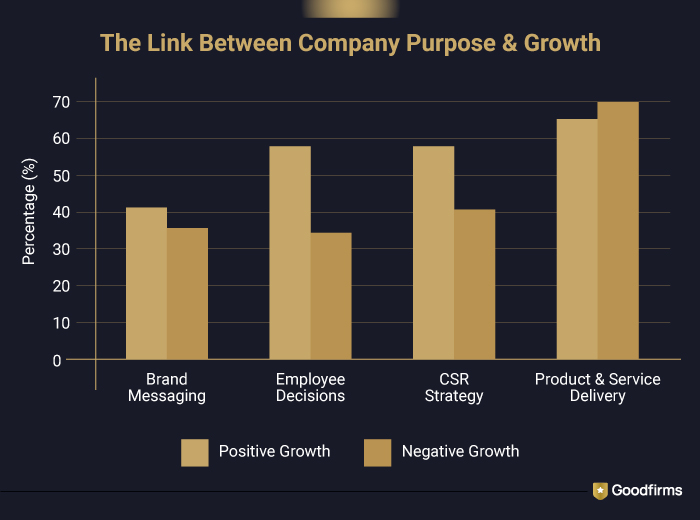
Market Entry without Pushback: High-growth brands are 66% likely to use purpose to guide employee decision-making, and 41% are likely to drive CSR strategy, which helps build trust and reduces friction during market expansion. Source: Deloitte's brand valuation research.
Why Most Brands Fail at Consistency
Brands fail at consistency because they confuse:
- Uniformity with unity - Looking the same everywhere (uniformity) won'won'tfice; true unity comes from shared meaning and purpose across all touchpoints.
- Assets with belief - Having logos, colors, and templates (assets) cannot replace the need for a strong brand belief that guides brand behavior.
- Control with coherence- Strictly enforcing rules (control) won't create a coherent brand experience unless the team understands and acts on the brand's principles.
Companies generally enforce templates rather than communicate the real value of their brands. They are more focused on correcting fonts instead of shaping brand behavior.
Brand drift is seldom a design problem. It's a decision-making problem. Decision architects need data, not just rules, to justify consistency as a strategy.
A New Definition of Brand Consistency
Brand consistency is not about being identical everywhere. It's about:
- Recognizable Purpose
- Predictable values
- Coherency in experience
It is the difference between "That looks like them," and "That feels like them."
The first is design. The second is brand.
How to Ensure Brand Consistency (Without Reducing It to Design)
Before thinking of visual updates, companies should focus on messaging and behavior. For guidance on when to update your look or redefine your brand, read brand refresh vs. rebrand.
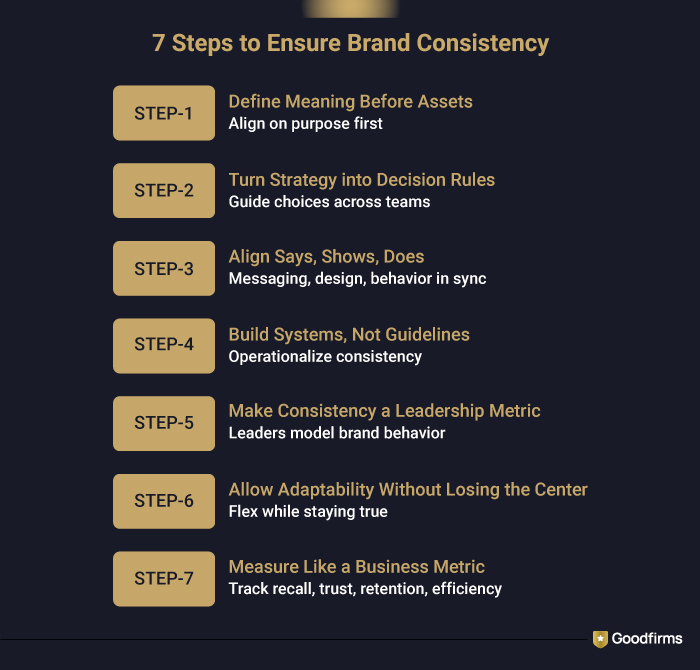
Here are 7 ways to ensure brand consistency across all touch points.
1. Define Meaning Before You Define Assets
As mentioned, strong consistency begins with strong messaging; shared colors can come later. Brands with clear, cut-and-dry messaging and a defined set of values achieve faster recognition and a stronger emotional bond, making repetition meaningful rather than mechanical.
As per the familiarity principle, repeated exposure to the same underlying message nurtures a sense of familiarity and, at the same time, enhances consumer liking and trust.
2. Turn Strategy into Decision Rules
Consistency requires clear rules for making brand decisions. It simply cannot rely on visual guidelines. Strong brands use behavioral principles to guide how they speak, design, and behave across all channels. This will help businesses make aligned decisions as they grow.
3. Match What the Brand Says, Shows, and Does
Consistency breaks when messaging, design, and customer experience all look and feel different. Strong brands build trust by ensuring their promises are reflected in their appearance and behavior.
4. Build Systems, Not Just Guidelines
Consistency cannot depend on memory or approval. Sc lable brands operationalize consistency using design systems, messaging frameworks, and shared knowledge repositories.
Companies with strong brand governance systems can uphold their brand promise and amplify their brand reach and performance across millions or billions of individual touchpoints.
5. Make Consistency a Leadership Metric
Brand meaning gets shaped by the decisions leaders make on a day-to-day basis. When brand strategy and leadership behavior mismatch, no amount of storytelling can help. Organizations with leadership-aligned brand values achieve stronger employee support and customer trust.
6. Allow Adaptability Without Losing the Center
Consistency is crucial for building trust; however, adaptability ensures your brand remains relevant in an evolving marketplace. Adaptability doesn't leave your brand's promise on the wayside; contrarily, it means aligning it with the current context. Without adaptability, even the strongest brands risk becoming outdated.
McDonald's customizes its menu for each country based on cultural preferences and ingredient availability. For instance, in India, McDonald's has removed beef, mutton, and pork items from its menu to align with religious and cultural values.
7. Measure Consistency Like a Business Metric
Companies that invest in strong brands cultivate customer loyalty to the point that they enjoy premium pricing
For instance, fashion brands enjoy high pricing power due to their relentless commitment to quality and brand reputation.
In short, measure consistency across recall, trust, retention, and efficiency.
Brand consistency cannot be enforced through templates. Instead, it can be sustained through shared meaning and leadership behavior. When consistency is treated as a growth strategy rather than decoration, it compounds rather than constrains.

Wrapping Up: Consistency Is the Strategic Growth Driver
In overcrowded markets, attention is easy to come by. Trust takes time.
Brand Consistency:
- Turns messages into memory
- Experiences into belief
- Builds mental shortcuts through familiarity
The brands that endure are not the loudest or the cleverest. They are consistent
They don't look the same. They mean the same.
And in this economy shaped by trust, meaning is the only thing that scales.
Brand Consistency in Marketing - FAQs
1. What does brand consistency really mean?
Brand consistency is about delivering a unified brand experience across web, mobile, and social platforms through visuals, messaging, behavior, and customer interactions. It ensures that what a brand says, shows, and does aligns with its core values and purpose, helping customers to instantly recognize and trust the brand.
2. Why is brand consistency critical for business growth?
Brand consistency reduces mental effort in processing messages, creates familiarity, resulting in stronger loyalty, increased revenue by 23-33% and better pricing power.
3. How does brand consistency build customer perception?
When brands are consistent in their messaging, behavior, and design, customers count upon them as professional and trustworthy. Inconsistent brands create confusion, affecting purchase intent and relationships.
4. What is the difference between brand consistency and brand uniformity?
Brand uniformity is about looking the same everywhere, logos, colors, and fonts.
Brand consistency goes deeper: it's ait's shared purpose, values, and behavior across all touchpoints. Uniformity alone doesn't work; consistency ensures that every interaction reinforces the brand's image.
5. Can a brand consistency exist without a visual identity?
Yes. Visuals are just one part of the consistency puzzle. A brand can ensure consistency through messaging, tone, behavior, and customer experience. For instance, Stripe establishes consistency largely through clarity, transparency, and technical precision in its product interface, pricing, and documentation, rather than through logos and color schemes.