Key takeaways
- Kalshi operates as a U.S. Commodity Futures Trading Commission (CFTC)-regulated exchange- the single biggest reason it's trusted by mainstream users and institutions alike.
- You can build a prediction market through Kalshi's API, a white-label solution, or from scratch, depending on your budget, timeline, and regulatory strategy.
- Building a platform like Kalshi requires five core pieces: a matching engine, a wallet/payment layer, a settlement/oracle system, compliance tooling, and a clean trading interface.
Kalshi processed $17 billion in trading volume in May 2026 alone. A year earlier, that number was under $5 billion. If you're wondering whether there's still room to build something in this space, the answer is yes, and the window is shrinking fast.
Prediction markets are experiencing unprecedented growth. Bernstein, the investment research firm, estimates market volume will hit $240 billion in 2026 — a 370% jump from last year — on a path toward $1 trillion by 2030.
Take Kalshi's own 2026 FIFA World Cup Winner market as an example of how this plays out in real time. Spain led the odds for most of the past year, but in the final stretch, France surged past it to 29.9%, with Argentina close behind at 21.4%, and Spain dropping to 10.8% — that single market alone has traded more than $704 million in volume.
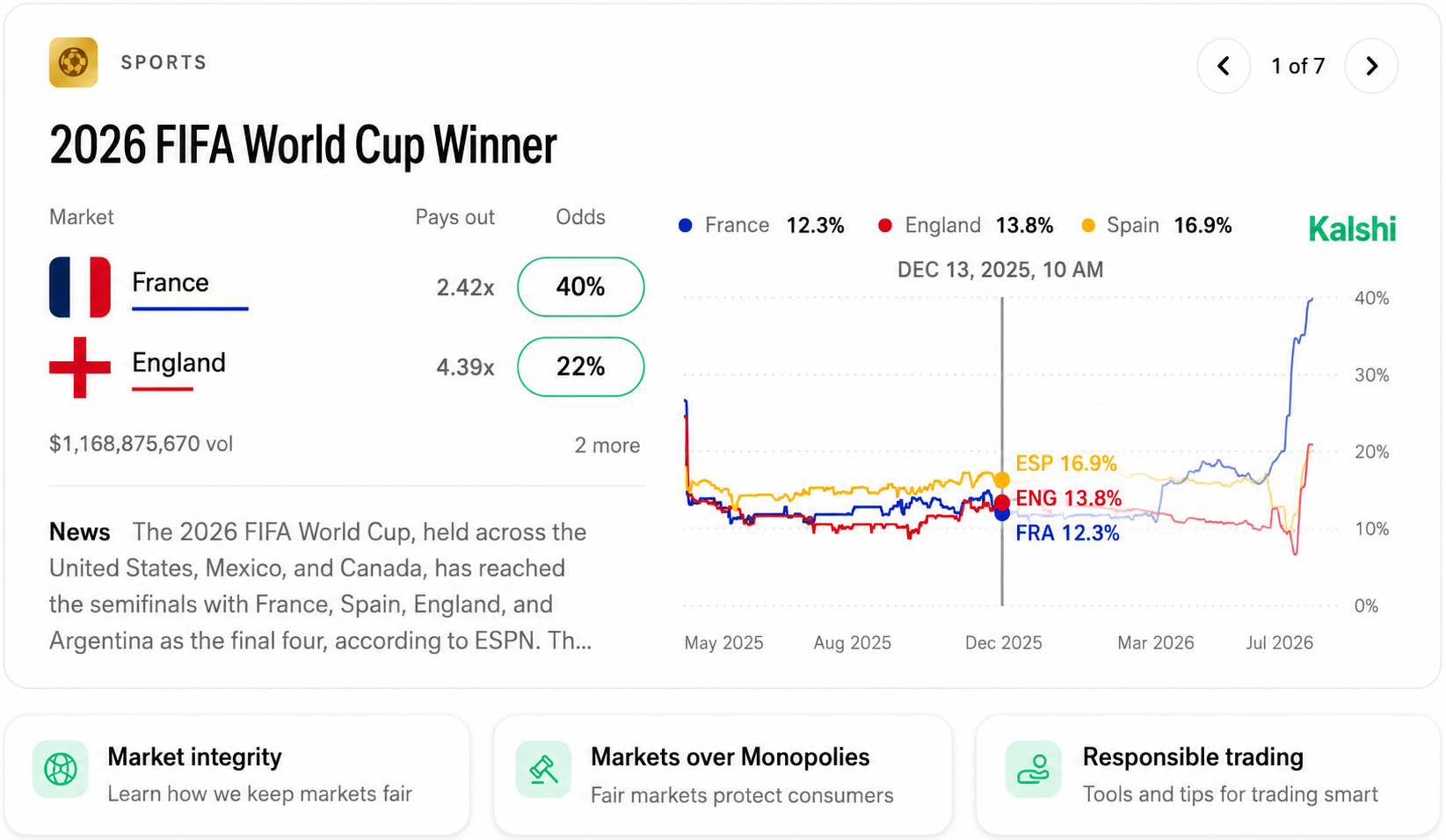
Kalshi's 2026 World Cup Winner market: Kalshi's 2026 World Cup Winner market, showing how France, England, and Spain's odds have shifted over the past year. Captured July 13, 2026. Source: kalshi.com
That price movement isn't a forecast someone typed in — it's the live output of thousands of people putting money behind their belief, updating in real time as news, form, and results come in. That's the mechanism behind every prediction marketplace, and it's worth understanding properly before you try to build one.
This blog gives a practical roadmap for building one yourself. That's the one-line version. To actually build one, though, you need to understand how that price moves and what makes it trustworthy — so let's break it down properly.
Explore vetted Prediction Marketplace solution providers on Goodfirms, ranked by real client reviews.
What Exactly Is a Prediction Market, Anyway?
Picture this. Instead of trading stocks or crypto, people are trading their confidence in how a real-world event will turn out. That's how prediction marketplaces work in a nutshell. Someone asks a question — "Will the Fed cut rates in March?" or "Will Chicago see snow this weekend?" — and traders buy contracts based on what they think will happen.
Each contract settles at either $1 (if the event happens) or $0 (if it doesn't). The price of that contract at any given moment — say, 65 cents — reflects what the crowd collectively believes the odds are: roughly a 65% chance. This is one of the clearest prediction market examples of how collective belief converts into a tradable number.
Take the 2026 World Cup as a live one. On Polymarket and Kalshi right now, France is trading around 23 to 27 cents in the "World Cup Winner" market, with Argentina close behind, around 16 to 22 cents. That price isn't a pundit's gut call or a TV analyst's hunch — it's what emerges when thousands of traders each decide whether France is worth betting on at that price. If you genuinely believed France only had a 15% shot, paying 27 cents would be a losing bet on average, so you'd sit it out or bet against them. Multiply that calculation across every trader in the market, and the price settles exactly where collective belief lands. When France scores a big win or suffers an upset, that price shifts within minutes, the same way a stock reacts to breaking news.
Kalshi turned this idea into a fully regulated, mainstream product by getting approval from the U.S. Commodity Futures Trading Commission (CFTC). That single move changed everything for the industry — it meant prediction markets could be marketed and operated the same way a stock exchange or futures exchange is, rather than existing in a legal gray area.
The basic premise is that prediction marketplaces allow you to trade on information.
All markets follow a similar lifecycle:
Market creation → Market movement → Market resolution
Now that the mechanics are clear, the next question is timing — and the numbers make a strong case for right now.
Why build a Prediction Market Platform in 2026?
The real story isn't just the World Cup we mentioned above—it's the amount of investment flowing into companies like Kalshi. In May 2026, the company raised $1 billion at a $22 billion valuation, backed by investors including Coatue, Sequoia Capital, Andreessen Horowitz, and Morgan Stanley. Just a couple of months later, reports suggested it was already seeking another funding round that could push its valuation to around $40 billion.
When investors of that caliber move that quickly across a single category, that's a signal in itself. Coatue, Sequoia, Andreessen Horowitz, and Morgan Stanley don't typically chase speculative bets — they back infrastructure they expect to last.
Part of that institutional pull stems from what these contracts actually represent.
"Those are tradable assets now that people can directly trade upon, as opposed to trading on a derivative of those," said Andy Ross, Kalshi's head of institutional. "So you've got better hedging."
User behavior has shifted, too. Many people are tired of sorting through countless opinions online. They want a straightforward way to understand what might happen next. Prediction marketplaces provide this by showing a single probability based on what thousands of participants think.
The growth story is convincing, but growth alone won't help you ship. Here's what actually has to exist under the hood.
The Core Components You'll Need to Build
Let's get practical. A prediction marketplace runs on five core systems working together. Each plays a separate role, but the system only holds together when all five work in sync. If you remove even one, things will start falling apart fast.
1. The Matching Engine
This is where trades actually happen. When a buyer's "Yes" order and a seller's "No" order line up on price, the system pairs them instantly. Most platforms run on a central limit order book (CLOB), the same matching model that stock exchanges have relied on for decades. It keeps a running list of every open buy and sell order and connects them as soon as two prices meet.
2. Market Creation and Resolution Logic
This is the system that allows markets to be created around future events.
Every market needs an unambiguous question. A question like “Will it rain in NYC tomorrow?” may sound simple. But it has to be defined by which weather station measured rain, at what threshold, and by when?
Vague questions will create disputes, and disputes destroy trust faster than almost anything else on a trading platform.
This is where oracles come in. It gives trusted data feeds from government APIs, verified news sources, or on-chain oracles networks like Chainlink that automatically confirm the outcome. Humans don't have to judge every market and determine the answer.
3. Wallets and Payments
Users need a simple way to fund their account and cash out their winnings. The right setup here depends on who you're trying to reach.
Some platforms stick to bank transfers and debit cards, so the whole experience feels closer to a regular investment app than anything crypto-related. Others go the opposite direction, partnering with cryptocurrency exchange development companies to build around crypto wallets and stablecoins, appealing to a more global, digitally native crowd.
A growing number of platforms try to support both, rather than forcing users to pick a side.
4. Compliance and Risk Infrastructure
These are among the most important parts of a prediction market and also among the easiest to underestimate. They often determine whether the business can survive in the long term.
Traders must verify their identity before participating. KYC software screens for fraud and ensures platforms comply with financial regulations. Position limits and similar controls act as a backup layer, limiting the harm any one trader can cause, whether through reckless betting or an attempt to game the system.
Trade records matter too. Every transaction should be logged and easily retrievable later, if needed, especially by regulators or legal teams. Platforms also need to be upfront about which kinds of markets they'll allow in the first place — political event contracts, for instance, tend to draw heavier scrutiny than most.
For platforms operating in the U.S., there are really only two paths forward: go through the full regulatory approval process yourself, which takes real time and real money, or team up with a company that's already licensed and inherit its compliance standing.
5. The Trading Interface
The trading interface is what users actually interact with, and it often shapes their first impression of the platform.
Kalshi works well because it has an intuitive interface, more like a simple finance app than a casino. It shows clear odds, easy buy and sell options, basic price charts, and a countdown for when the market will settle.
If the interface looks too complex, new users who are interested in prediction markets may get confused or put off by something that feels like a professional trading tool.
Once those five systems make sense, you hit the real fork in the road — and there are three branches.
How to Build a Prediction Marketplace Like Kalshi
Once you understand the pieces, you've actually got three realistic ways to move forward.
-
Building directly on Kalshi's own infrastructure
You don’t have to create a prediction market exchange yourself. Instead, you connect your product to Kalshi’s system using their API and other tools.
They already handle the hard parts, like matching trades, running the market, and complying with regulations. Your job is just to plug into that system and pull in live, real markets.
That said, your task is not over here. You'll still need to build the layer users actually see and interact with: the interface, the sign-up flow, real-time price updates, and so on. The exchange itself, though, isn't something you have to build or maintain.
This route makes the most sense if you're trying to bolt prediction markets onto an existing platform, such as an app, a website, or a community — and if that platform is a fintech or banking product, a neobank development complete vendor recipe is worth reviewing before you scope the integration. You focus on the experience you're building, not running an exchange from the ground up.
-
Going white-label
White-labeling means using a ready-made prediction market system built by another company, then adding your own branding and settings on top.
Providers like Shift Markets — which has built trading infrastructure for exchanges and brokerages since 2009 — and Azuro, a decentralized protocol layer for permissionless market creation, are two examples of how this looks in practice. For a fuller list of options, Goodfirms' rundown of prediction marketplace development companies is worth a look before you commit.
It's the fastest way to launch a product that looks and feels like your own. But it has its fair share of limitations: the core technology still belongs to someone else, so you have to work within their system and rules.
-
Building from scratch
Building a prediction market from scratch means you control everything — the matching engine, the resolution logic, compliance rules, and the platform's financial operations. Building your own platform takes more time and effort, but it gives you complete control.
Each path comes with tradeoffs, so here's a side-by-side look at all three
The Three-Path Comparison Table
Here's how the three approaches stack up side by side, so you can quickly see which one fits your goals, timeline, and risk appetite.
|
Criteria |
Build on Kalshi's API |
White-Label |
Build From Scratch |
|---|---|---|---|
|
Best for |
Embedding markets into an existing product (brokerage, media, community) |
Launching fast under your own brand |
Competing directly with Kalshi at scale |
|
Speed to market |
Fast — weeks to a couple of months |
Fast — typically weeks |
Slow — 9 to 18 months |
|
Regulatory burden |
Inherited from Kalshi's CFTC-regulated core |
Depends on the vendor's licensing setup |
Full responsibility falls on you |
|
Control over the platform |
Low — limited to product/UX layer |
Medium — branding and configuration only |
Full — every layer is yours |
|
What do you still build |
UX, onboarding, caching, real-time streams |
Branding, configuration, integrations |
Everything, including the matching engine |
|
Biggest risk |
Dependency on Kalshi's API, policies, and access rules |
Less architectural flexibility |
Highest cost, complexity, and operational burden |
|
Ideal team type |
Product-focused teams with a distribution advantage |
Startups validating demand quickly |
Well-funded teams aiming for a long-term moat |
Choosing a path is only half the decision. You also need to know what it will cost.
How Much Does It Cost to Build One?
Pricing depends entirely on which path you picked above, and it is genuinely scattered across the industry.
Build on Kalshi's API: $20,000–$70,000
-
Discovery & planning (4–8 weeks): defining your UX, onboarding flow, and how you'll surface Kalshi's live markets — roughly $5,000–$15,000.
-
Core build (remaining budget): the actual interface, sign-up flow, and real-time data handling that sits on top of Kalshi's exchange.
White-label/licensed solution: $15,000–$60,000
-
Configuration & branding (2–4 weeks): theming, market category selection, and fee setup.
-
Launch & testing (2–4 weeks): integration testing, compliance checks, and go-live.
-
Customization beyond the vendor's roadmap costs extra, on top of the base license fee.
Full custom build: $80,000–$300,000
-
Discovery & architecture (4–8 weeks): market validation, regulatory research, technical planning.
-
MVP development (4–6 months): core trading engine, wallet integration, compliance modules, admin tools.
-
Advanced features (3–6 months): analytics, social trading, liquidity incentives, institutional APIs.
-
Testing & compliance validation (remaining timeline): security audits, penetration testing, beta launch.
Ongoing costs: Regardless of which path you choose, don't forget hosting, data/oracle feed subscriptions, compliance monitoring, customer support, and liquidity incentives to keep markets active. A platform with no trading volume is just an expensive-looking spreadsheet.
Since pricing depends heavily on scope and compliance needs, it's worth getting a tailored quote from a development partner before locking in a budget.
Numbers like these tell you what you'll spend, but not which path actually makes sense for you. That's the part I want to dig into.
Goodfirms Take - Start With Legal, Not Product
I'd start with the legal question before the product question. Everyone jumps to "build vs white-label vs partner," but that decision is actually downstream of a bigger one: what's my regulatory strategy? That includes your banking, your payment processors, and the states you can even operate in.
Kalshi is a good example of why this matters. By some accounts, it costs roughly $2 million to complete the full CFTC approval process. That's not pocket change or a quick weekend project, and it's a big part of why most solo operators or small teams realistically can't go this route themselves. So if you're starting today, white-label or plugging into an existing platform is the only move that makes sense — you're renting someone else's compliance work instead of building it from scratch.
Goodfirms Rough Roadmap
- Skip sports. Most regulated, most contested (tribal gaming rights alone are a mess), most crowded.
- Test demand first using something like Kalshi's market creator program before spending any money on infrastructure or lawyers.
- Only go white-label once you've proven people actually want your niche — that's when jurisdiction/corporate structure decisions start to matter.
- Save "build from scratch" for later, only if you've got something genuinely unique, no existing rail supports.
The bigger question I keep coming back to
Think about how Stripe became the go-to company for online payments, instead of every business building their own payment system from scratch. I'm wondering if prediction marketplaces go the same way — a few big, fully-regulated platforms like Kalshi end up being the only ones who can legally operate at scale. Everyone else just plugs into them as partners instead of competing directly. If that's where this is headed, the smartest place to build right now isn't a new exchange — it's the rails everyone else will eventually need to plug into.
Whichever path you land on, the underlying technology doesn't change much — so let's look at what's actually running under the hood.
The Tech Stack Behind a Platform Like Kalshi
If you’re curious about how a prediction marketplace like Kalshi works behind the scenes, it’s basically made of a few key parts:
-
Core engine
The system that matches buyers and sellers. It has to be very fast because prices can change in seconds when big news breaks, and it is often built in low-latency languages like Go, Rust, or Java for the order-matching core.
-
Database
You actually need two types working together here. One handles everything happening live, like open orders, and needs to be fast above all else — something like Redis usually fills that role. The other is your system of record: a relational database (PostgreSQL is the common choice) that holds historical trades, user accounts, and audit logs for the long haul.
-
Oracle/Data Feeds
Think of these as your "source of truth" — government data, official sports results, or other verified inputs that determine how a market actually resolves.
-
Frontend
Usually built in React or something similar, with mobile as the real priority. The bar here is basically zero tolerance for lag — even a half-second delay in price updates gets noticed right away, so speed isn't optional.
-
Compliance Layer
This covers both sides of the same job: confirming traders are who they say they are, and keeping the platform within regulatory limits. In practice, that means bringing in a third-party KYC/AML provider during onboarding — Persona and Sumsub are two names that come up a lot — paired with internal tools that monitor transactions and flag anything that looks off.
-
Payments
Traditional money movement gets handled through banking partners or payment processors. If crypto funding is also on the table, that's where custodial or non-custodial wallet infrastructure comes in.
The important thing is: you don’t have to build everything from scratch. Many of these pieces already exist as ready-made services. That’s why many companies mix custom-built parts with plug-and-play tools instead of reinventing everything — and for the custom-built pieces, it's worth thinking through vibe coding vs. traditional coding to decide which approach fits your timeline and risk tolerance.
All this groundwork means nothing if you hand it to the wrong team. This is the step where most projects succeed or stall out.
How to Choose the Right Development Partner for Building a Marketplace like Kalshi
Prediction market platforms sit at the intersection of fintech, trading infrastructure, and regulatory complexity — a rare combination of skills that not every development shop that says "we do blockchain" actually understands.
Before you sign anything, there are a few things worth digging into.
- First, check whether they've actually worked on trading systems before, not just standard web or app projects. Ask to see examples — order books, real-time pricing engines, anything exchange-style — rather than taking their word for it.
- Second, find out how familiar they are with the regulatory side, even if you're not chasing full licensing right away. That means knowing frameworks like the CFTC in the U.S., the FCA in the U.K., or whatever the equivalent body is wherever you're operating.
- Experience with Oracle integration, since automated, dispute-free settlement is central to user trust.
- Post-launch support model — trading platforms aren't "build it and walk away" products. Security monitoring needs to be ongoing, uptime has to be reliable, and the platform will keep needing new features long after launch.
If you're looking for a development partner for this, Goodfirms maintains a list of companies that specialize in prediction market platforms. It's a decent way to compare options based on actual reviews, past work, and pricing, rather than just going with whoever gives the best pitch.
Once you look beyond the technology and development costs, it's clear that prediction marketplaces are about more than just placing bets.
Final Thoughts
Something has changed. A few years ago, checking the odds meant looking at the sports page. Today, it might mean opening Kalshi to see what the market thinks about interest rates, elections, or even the weather.
That's the bigger story. Prediction markets turn uncertainty into real-time prices that update as new information comes in. For traders, that creates opportunities, because the market is still new and less efficient than stocks or options.
For builders, the category isn't settled yet — which means the standard architecture, compliance playbook, and pricing model are still being written. If you're going to build in this space, now is the moment when that's still true.
FAQs - Guide to Building a Prediction Marketplace Like Kalshi in 2026
Is it legal to build a prediction market platform in 2026?
It depends entirely on your jurisdiction and how your contracts are structured. In the U.S., platforms offering event contracts typically need to operate under CFTC oversight, either through their own registration or by partnering with an already-licensed entity. Always consult legal counsel familiar with derivatives and commodities law before launching.
How long does it take to build a platform like Kalshi?
Building on Kalshi's API can go live in a couple of weeks to a couple of months, since you're skipping the exchange core entirely. A white-label deployment typically takes 4 to 8 weeks to launch. A fully custom build with in-house compliance infrastructure takes 9 to 18 months, depending on scope and regulatory requirements.
Do I need blockchain technology to build a prediction marketplace?
Not necessarily. Kalshi, for instance, runs on standard fintech infrastructure rather than a blockchain. Some platforms — typically the more decentralized ones — do rely on on-chain settlement for added transparency. Which way you go really comes down to who you're building for and how you're approaching regulation, not because the prediction market model itself demands one or the other.
What's the difference between a white-label solution and building from scratch?
Going white-label means you're licensing someone else's already-built, already-tested matching engine and compliance setup, then branding and configuring it to look like your own. It's the faster, cheaper route, but you're working within someone else's limits when it comes to customization. Building from scratch is the opposite trade-off — you get full say over the architecture and every feature, but it'll cost you a lot more time, money, and technical talent in-house.
How do I find a reliable development company for this kind of project?
Skip the agencies that only know general app development and look for ones that can actually show experience with trading systems, regulatory compliance, and Oracle integrations. Goodfirms' prediction marketplace platform page is a useful place to start — you can compare vetted companies by reviews, portfolio, and pricing before you contact anyone.