Key takeaways
- Building a prediction marketplace platform costs between $25,000 and $150,000+, depending on the development approach, platform complexity, and feature set.
- Smart contracts, trading engines, liquidity mechanisms, blockchain integration, and security audits account for a significant share of the overall development budget.
- Launching with an MVP can reduce the initial investment while allowing businesses to validate their product before scaling.
- Besides development, businesses should also budget for compliance, infrastructure, liquidity, marketing, and post-launch maintenance.
Prediction markets have quietly become one of the fastest-growing segments of the blockchain economy. What started as a niche concept for forecasting election outcomes has evolved into a multi-billion-dollar ecosystem covering finance, sports, cryptocurrencies, entertainment, and even real-world events.
The numbers tell the story. According to Dune Analytics, monthly trading volume across prediction markets has surged from roughly $100 million to more than $13 billion within two years, reflecting just how quickly user adoption has accelerated.
For entrepreneurs and blockchain businesses, this growth presents a compelling opportunity. A well-designed prediction marketplace can generate recurring revenue through trading fees, attract highly engaged communities, and scale across multiple industries. It's no surprise that more startups and enterprises are exploring platforms similar to Polymarket.
But excitement alone isn't enough to launch a successful product.
Before selecting a blockchain, hiring developers, or planning features, one question needs a clear answer.
Planning to build a prediction market platform? Explore top Prediction Marketplace Development Companies and discover the key features of a Prediction Marketplace Platform on Goodfirms.
Why is Prediction Marketplace Development More Expensive Than Traditional Apps?
A standard SaaS application stores data, manages users, and delivers information. A prediction marketplace processes financial transactions, interacts with blockchain networks, settles outcomes automatically, and relies on external data sources to verify real-world events.
Every prediction placed on the platform triggers a series of technical processes happening behind the scenes.
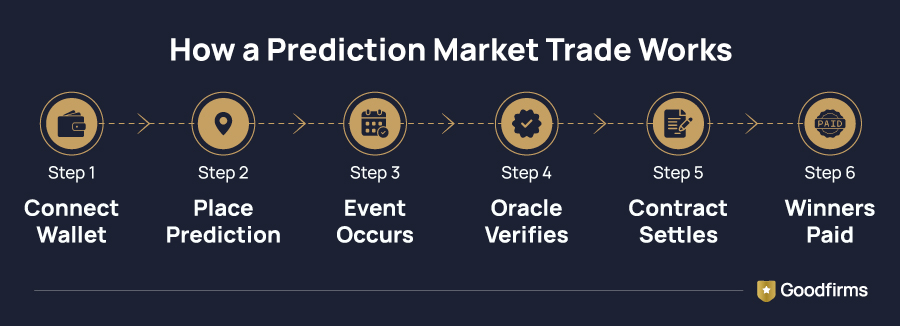
A user connects their wallet and joins a prediction market. Platforms that support multiple wallets often rely on specialized crypto wallet development companies to ensure seamless user onboarding and secure wallet integrations. Once the trade is confirmed, a smart contract securely locks the funds until the event concludes. The platform then relies on an oracle service to retrieve the verified outcome from the real world. Finally, the smart contract automatically settles the market and distributes rewards to the winning participants.
Although this process appears seamless to users, each step requires specialized infrastructure, rigorous testing, and multiple security layers.
That's one of the biggest reasons prediction marketplace development costs more than building a conventional marketplace or social platform.
Prediction Marketplace Development Cost Breakdown (2026)
If you're looking for a quick estimate before diving into the details, here's what businesses spend on prediction marketplace platform development.
|
Development Approach |
Estimated Cost |
|---|---|
|
MVP Platform |
$25,000 - $50,000 |
|
Advanced MVP / White-label Platform |
$50,000 - $100,000 |
|
Fully Custom Platform |
$100,000 - $150,000+ |
If you are evaluating different approaches, our comprehensive guide to prediction marketplace platform development explains the technologies, features, architecture, and business models required to launch a successful platform. For a more detailed breakdown, keep reading.
What Factors Affect Prediction Marketplace Development Cost?
Every prediction marketplace has its own technical requirements, but there are a handful of factors that consistently have the greatest impact on development costs.
|
Cost Driver |
Estimated Cost |
|---|---|
|
Smart Contract Development |
$8,000 - $20,000 |
|
UI/UX Design |
$5,000 - $15,000 |
|
Technology Stack |
$10,000 - $30,000 |
|
Security & Smart Contract Audits |
$5,000 - $25,000 |
|
Overall Platform Complexity |
$25,000 - $150,000+ |
How Platform Architecture Affects Prediction Marketplace Development Cost
One of the earliest decisions you'll make is choosing how your platform will operate.
Some businesses prefer a centralized platform because it's quicker to build and easier to manage. Others choose a decentralized architecture where smart contracts automate trading, settlement, and fund management without relying on a central authority.
A third option, which is becoming increasingly popular, combines both approaches. Hybrid platforms deliver the speed and user experience of centralized systems while using blockchain technology to ensure transparent settlements.
Decentralized platforms generally require more blockchain engineering, extensive smart contract development, and multiple security audits, making them significantly more expensive than centralized alternatives.
Working with experienced smart contract development companies can help reduce security risks and avoid costly vulnerabilities during implementation.
Centralized vs Decentralized vs Hybrid: Which Costs More?
Not all prediction marketplaces are built the same. The platform architecture you choose has a direct impact on development effort, security requirements, scalability, and ultimately, your budget.
A centralized platform is generally the least expensive option because a single authority manages user accounts, trades, and market settlements. These platforms are faster to develop and easier to maintain, making them a practical choice for startups testing a new business model.
Decentralized prediction marketplaces sit at the other end of the spectrum. Since smart contracts automate trading, fund management, and settlement, they require significantly more blockchain engineering, security audits, and infrastructure planning. The additional complexity naturally increases development costs but also delivers greater transparency and user trust.
Many businesses now prefer a hybrid architecture that combines centralized speed with decentralized settlement. This approach offers a balance between performance and transparency, although it also requires a more sophisticated technical design.
|
Platform Type |
Development Cost |
Best Suited For |
|---|---|---|
|
Centralized Platform |
$25,000 - $70,000 |
Startups and private marketplaces |
|
Hybrid Platform |
$50,000 - $150,000 |
Growing businesses needing flexibility |
|
Decentralized Platform |
$70,000 - $150,000+ |
Enterprise blockchain platforms |
How Blockchain Choice Affects Prediction Marketplace Development Cost
The blockchain network you select affects development complexity, wallet compatibility, scalability, smart contract implementation, and even future maintenance costs.
- Ethereum remains one of the most mature ecosystems for blockchain development, offering strong security and a vast developer community.
- Polygon has become a popular alternative for businesses looking to reduce transaction costs while maintaining compatibility with Ethereum.
- Networks such as Arbitrum and Base are also gaining attention because they combine lower fees with high throughput.
Selecting the wrong blockchain at the beginning can create unnecessary development work later. Experienced Web3 development companies evaluate factors such as ecosystem maturity, transaction fees, scalability, wallet compatibility, and long-term maintenance requirements before recommending a blockchain network for prediction marketplace platforms. That's why experienced teams evaluate long-term business goals before recommending a network rather than simply choosing the cheapest option.
Features That Increase Prediction Marketplace Development Costs
It's tempting to think that adding one more feature won't change the overall project cost very much.
In reality, every new capability creates additional design, development, testing, and maintenance work.
That's why experienced product teams will often recommend launching with essential functionality first and introducing advanced features based on real user feedback.
| Features | Cost |
|---|---|
|
Trading Engine |
$10,000 – $15,000 |
|
Live Price Data Feeds |
$5,000 – $8,000 |
|
Collective Intelligence Engine |
$10,000 – $15,000 |
|
User Engagement Protocols |
$4,000 – $8,000 |
|
Multi-Device Compatibility |
$2,500 – $5,000 |
|
Liquidity Mechanisms |
$7,000 – $15,000 |
|
Smart Contract Automation |
$8,000 – $18,000 |
|
Market Management Tools |
$6,000 – $15,000 |
|
Fraud Detection Systems |
$5,000 – $13,000 |
|
Security Integrations |
$7,000 – $15,000 |
|
Trading Engine |
$10,000 – $15,000 |
This approach not only reduces upfront investment but also helps avoid building features that customers may never use.
Want to understand how leading platforms are built? Read our in-depth guide on how to build a prediction marketplace like Polymarket to learn about its architecture, feature set, blockchain integrations, and development process.
Which Prediction Marketplace Development Approach Fits Your Budget?
Now that you understand what drives development costs, the next step is deciding how you want to build your prediction marketplace.
- Should you launch an MVP to validate your idea?
- Would a white-label platform get you to market faster?
- Or does your business require a fully customized solution from day one?
Each approach comes with its own investment, timeline, and long-term advantages.
MVP Prediction Marketplace Development Cost
Estimated Cost: $25,000 - $50,000
Timeline: 8 to 12 weeks
If you are entering the prediction market for the first time, an MVP is often the most practical starting point.
Think of it as building the foundation rather than the finished house.
The focus is on creating a functional platform that lets users register, connect wallets, participate in prediction markets, and receive automated settlements via smart contracts. Everything beyond that can be added after you've gathered feedback from real users.
Launching an MVP also reduces one of the biggest risks in product development: investing heavily in features customers may never use. Many successful blockchain products began with relatively simple versions and expanded only after understanding how users interacted with the platform.
For startups working with limited funding, this approach offers another advantage. It allows founders to demonstrate traction before raising additional capital, making future investment conversations much easier.
White-Label Prediction Marketplace Development Cost
Estimated Cost: $50,000 - $100,000
Timeline: 12 to 16 weeks
Not every business wants to build an entirely new platform.
Many companies already know what they want to offer, but don't want to spend months developing core functionality that's already available. That's where white-label development fits in.
Rather than writing every line of code from the ground up, developers customize an existing prediction marketplace framework to match your brand, workflows, and business requirements. The underlying trading logic, wallet integration, and administrative tools are already in place, allowing the team to focus on personalization instead of rebuilding proven components.
For businesses that value speed, this often provides the best balance between cost and functionality. The initial investment is higher than an MVP, but the result is a far more polished product that's ready to compete in the market sooner.
Custom Prediction Marketplace Development Cost
Estimated Cost: $100,000 - $150,000+
Timeline: 16 to 24 weeks
Unlike an MVP or white-label solution, every component is designed specifically for your business. The frontend, backend, smart contracts, APIs, security architecture, and administrative systems are developed around your product vision rather than adapted from an existing template.
Naturally, this requires more engineering effort, more testing, and a larger investment. It also gives you complete ownership of the platform and the flexibility to evolve without being constrained by someone else's architecture.
Businesses planning to operate at scale often find this investment worthwhile because it eliminates the need for major platform rebuilds as the product grows.
Prediction Marketplace Development Cost Breakdown by Module
When founders receive a proposal for $100,000 or more, one question almost always comes up.
"Where is all that money going?"
The table below shows how the investment is distributed across major development modules.
|
Platform Module |
Estimated Cost |
|---|---|
|
UI/UX Design |
$2,000 - $15,000 |
|
Smart Contract Development |
$3,000 - $20,000 |
|
Technology Stack & Backend |
$10,000 - $30,000 |
|
Trading Engine & Market Logic |
$10,000 - $15,000 |
|
Oracle Integration |
$5,000 - $8,000 |
|
Security & Audits |
$3,000 - $10,000 |
How Long Does It Take to Build a Prediction Marketplace?
Development timelines vary from one project to another, but most prediction marketplace platforms follow a similar sequence.
The process usually begins with research and product planning before moving into interface design, smart contract development, backend engineering, testing, and finally deployment.
|
Development Phase |
Estimated Timeline |
|---|---|
|
Discovery & Planning |
1 to 2 Weeks |
|
UI/UX Design |
3 to 4 Weeks |
|
Smart Contract Development |
3 to 4 Weeks |
|
Core Platform Development |
5 to 7 Weeks |
|
Testing & Quality Assurance |
1 to 2 Weeks |
|
Deployment & Launch |
2 to 4 Weeks |
Although these phases appear sequential, experienced development teams often run parts of them in parallel. Designers can finalize interfaces while backend engineers prepare the platform architecture, helping reduce the overall project timeline without compromising quality.
If you are inspired by regulated prediction markets, check out our guide on how to build a prediction marketplace like Kalshi, where we break down its business model, core features, technology stack, and development considerations.
Hidden Costs of Building a Prediction Marketplace
The first mistake businesses make is overlooking the costs that begin after the platform goes live.
For example, prediction marketplaces rely on oracle providers to fetch verified event outcomes, and these services charge recurring fees. Liquidity also requires continuous attention. A marketplace with too few active participants quickly becomes unattractive to new users, which is why many businesses allocate capital to bootstrap liquidity during the early stages.
Infrastructure is another area that grows with success. As trading volume increases, server capacity, blockchain nodes, monitoring tools, and storage requirements all expand alongside it.
Businesses should also budget for platform upgrades, third-party integrations, and ongoing infrastructure scaling in addition to their initial development investment.
Planning for these operational expenses early helps prevent unpleasant surprises after launch and gives founders a more realistic picture of the platform's total cost of ownership.
Compliance and Licensing Costs for Prediction Marketplace Platforms
Depending on the countries you plan to serve, you may need business registrations, legal reviews, licensing approvals, compliance documentation, and ongoing regulatory monitoring before your platform can operate legally.
Businesses should allocate approximately $15,000 to $30,000 for legal and regulatory compliance, although the exact amount depends on the jurisdictions where the platform will be available.
|
Compliance Activity |
Estimated Cost |
|---|---|
|
Licensing |
$4,000 - $12,000 |
|
Legal Setup |
$2,000 - $6,000 |
|
Legal Audits |
$1,500 - $4,000 |
|
Regulatory Updates |
$1,000 - $3,000 |
|
Regional Access Licenses |
$1,500 - $5,000 |
Beyond avoiding legal complications, strong compliance practices also increase investor confidence and help establish credibility with users who are trusting your platform with financial transactions.
Prediction Marketplace Development Costs by Region
Hourly rates vary widely across regions due to differences in labor costs, technical expertise, and market demand. That doesn't automatically mean the least expensive region offers the best value, but understanding these differences can help businesses plan more effectively.
|
Region |
Average Hourly Rate |
|---|---|
|
Europe |
$70-$130 |
|
India |
$20-$30 |
|
Japan |
$80-$140 |
|
North America |
$80-$200 |
|
Australia |
$50-$90 |
|
UAE |
$40-$110 |
These figures represent market ranges for blockchain development in 2026 and can vary based on the team's experience, project complexity, and technology stack.
Many companies choose a hybrid engagement model by working with experienced offshore development teams while keeping product strategy and project management in-house. This approach often provides a good balance between cost efficiency and technical quality.
Of course, hourly rates tell only part of the story. An experienced team charging more per hour may complete the project faster and with fewer revisions, reducing the overall cost of ownership.
Post-Launch Costs of a Prediction Marketplace Platform
Development is usually the largest upfront expense, but launching a successful prediction marketplace requires much more than writing code.
Think about the last successful crypto platform you came across. Chances are, you didn't discover it because of its technology. You found it through online communities, industry news, influencers, search engines, or recommendations from other users.
Prediction marketplaces work the same way.
Without a marketing strategy, even the best platform can struggle to attract traders and build liquidity during its early stages.
The reference pricing guide estimates that businesses may spend $60,000 or more on launch and growth marketing, depending on their acquisition strategy.
Instead of treating marketing as a single expense, it's helpful to think of it as a series of investments.
|
Marketing Activity |
Estimated Budget |
|---|---|
|
Brand Building |
$5,000 - $7,000 |
|
Landing Page Optimization |
$3,000 - $6,000 |
|
Community Building |
$5,000 - $10,000 |
|
Paid Advertising |
$10,000 - $20,000 |
|
Influencer Marketing |
$8,000 - $12,000 |
|
PR & Media Outreach |
$5,000 - $8,000 |
|
Content Marketing & SEO |
$3,000 - $7,000 |
A strong marketing plan helps generate visibility, attract early adopters, and build the liquidity that's essential for any prediction marketplace to succeed.
How Prediction Marketplace Platforms Generate Revenue
Trading fees are the primary driver of revenue. A small percentage is charged whenever users place or settle predictions, allowing earnings to grow alongside platform activity.
Many businesses also introduce premium subscriptions that provide access to advanced analytics, exclusive markets, portfolio insights, or enhanced trading tools.
Some platforms earn additional income through featured markets, sponsored events, API access for enterprise customers, or strategic partnerships within the blockchain ecosystem.
Diversifying revenue sources makes the business more resilient and reduces dependence on trading volume alone.
How to Choose a Prediction Marketplace Development Company
The final decision is choosing the team that will build your platform.
Price should certainly be part of the evaluation, but it shouldn't be the only factor. Blockchain projects involve technical challenges that aren't common in traditional software development, so experience matters.
When evaluating a development company, consider questions such as:
- Have they built blockchain or fintech platforms before?
- Can they demonstrate expertise in smart contract development?
- Do they follow secure development practices and conduct independent audits?
- Will they provide ongoing maintenance and support after launch?
- Can the platform scale as your user base grows?
Businesses often evaluate multiple blockchain development companies before selecting a partner with proven experience in prediction markets, decentralized finance, and blockchain infrastructure. A development partner should do more than estimate costs. They should help you identify risks, recommend practical solutions, and guide product decisions that improve the platform's long-term success.
Conclusion: How Much Does Prediction Marketplace Development Cost in 2026?
Building a prediction marketplace platform in 2026 is a significant investment, but it's also an opportunity to enter one of blockchain's fastest-growing sectors.
Most businesses can expect development costs to range between $25,000 and $150,000+, depending on the scope of the project, the chosen development approach, blockchain architecture, feature complexity, and long-term business goals.
If you're planning to launch a prediction marketplace, focus on building a solid foundation first. The right architecture, experienced development team, and thoughtful product decisions will create far more value than simply trying to reduce the initial development budget.
FAQs - Prediction Marketplace Development Cost
How much does it cost to build a prediction marketplace platform?
The cost of developing a prediction marketplace platform ranges from $25,000 for an MVP to $150,000 or more for a fully customized enterprise solution. The final investment depends on the platform's complexity, blockchain network, smart contract requirements, security measures, and feature set. Businesses should also budget for post-launch expenses such as infrastructure, maintenance, oracle services, and liquidity management.
How long does it take to develop a prediction marketplace platform?
Most projects take between 8 and 24 weeks. An MVP can often be completed within two to three months, while a custom enterprise platform requires four to six months or longer. The timeline depends on the number of features, blockchain integrations, testing requirements, and the overall scope of the project.
Which blockchain is best for a prediction marketplace?
There isn't a single best blockchain for every project. Ethereum remains a popular choice because of its mature ecosystem and strong security, while Polygon, Arbitrum, and Base offer lower transaction costs and improved scalability. The right choice depends on your business goals, expected transaction volume, and long-term growth strategy.
What are the biggest ongoing costs after launch?
Beyond development, businesses should plan for recurring expenses such as cloud infrastructure, blockchain node management, oracle service fees, security audits, platform maintenance, customer support, liquidity management, and feature updates. These operational costs are essential for maintaining platform performance, security, and user trust over time.
Should startups build a custom platform from the beginning?
Not always. Many startups benefit from launching an MVP first to validate market demand before investing in a fully customized platform. This approach reduces initial risk, helps gather real user feedback, and provides valuable insights that shape future product development. Once the business model has been proven, additional features and infrastructure can be added as the platform scales.