Key takeaways
- Marketplace fraud prevention has to cover two sides at once. Buyer fraud and seller fraud need different signals and different rules.
- Most platforms still design for single-merchant risk, which leaves seller-side fraud like fake listings and payout abuse largely unwatched.
- A working marketplace fraud prevention strategy spans onboarding, real-time scoring, payout holds, and dispute handling, not just checkout.
- Fraud prevention and trust and safety are the same job on a growing platform. One bad incident can undo months of growth.
Multi-vendor platforms deal with fraud from both directions. For example, buyers can pay with stolen cards. Sellers can fake listings, collect payouts, and disappear before anyone notices. And the things we mentioned till now are just the tip of the iceberg; there are so many more frauds. Yet still, most platforms treat marketplace fraud prevention as a checkout problem, borrowing rules built for single-seller stores. That approach misses where the real risk sits: onboarding, seller behavior, and payout timing. This piece breaks down exactly where multi-vendor platforms get fraud prevention wrong, and lays out a strategy that actually covers both sides of the marketplace.
Many fraud issues originate from how a marketplace is designed. If you're launching or scaling a multi-vendor platform, compare ecommerce marketplace solutions or hire experienced ecommerce development companies to build verification, risk scoring, payout controls, and trust mechanisms into the platform from the start.
What Marketplace Fraud Prevention Actually Covers
Here's a quick gut-check before we go further. If a platform can't say confidently how it handles each row below, that's usually where fraud is quietly eating into margins.
|
Fraud Type |
Where It Happens |
What Most Platforms Miss |
|---|---|---|
|
Fake seller accounts |
Onboarding |
No identity or business document verification at signup |
|
Listing fraud (fake or counterfeit items) |
Product upload |
Listings go live with no review step |
|
Triangulation fraud |
Checkout |
Orders fulfilled using a stolen card from a separate source |
|
Account takeover |
Login and account changes |
No monitoring when payout details or saved addresses change |
|
Refund and return abuse |
Post-purchase |
No pattern tracking across repeat buyers |
|
Buyer-seller collusion |
Reviews and repeat orders |
Fake orders used to launder funds or boost seller rankings |
|
Payout fraud |
Vendor settlements |
Payouts released before the dispute window closes |
Marketplace fraud prevention is the set of checks a platform uses to stop buyers and sellers from defrauding each other, or the platform itself. It's a broader job than standard ecommerce fraud prevention, since a marketplace has two customer types instead of one, and each comes with its own risk profile.
Fraud on a marketplace usually falls into three buckets. Buyer fraud includes stolen-card purchases, account takeover, and overpayment scams. Seller fraud includes fake listings, counterfeit goods, and sellers who collect payment without shipping. Collusion fraud is when a buyer and seller account work together, often run by the same person, to move stolen funds through fake orders.
Return abuse alone isn't small change either. The National Retail Federation puts fraudulent returns at roughly 9% of all retail returns, which adds up fast once order volume climbs. On a marketplace, that same pattern shows up across dozens of sellers at once, so it's easy to miss unless someone's actually tracking it.
A single-seller store has one point of failure: the buyer. A marketplace has thousands, since every new seller, listing, and payout route adds another way for fraud to slip in. This is why marketplace fraud prevention strategies need to look different from standard ecommerce fraud rules. The fraud isn't only happening at checkout. It's spread across the whole vendor lifecycle.
Where Multi-Vendor Platforms Get Marketplace Fraud Prevention Wrong
Here's where most of it actually goes wrong, and it usually isn't just one thing.
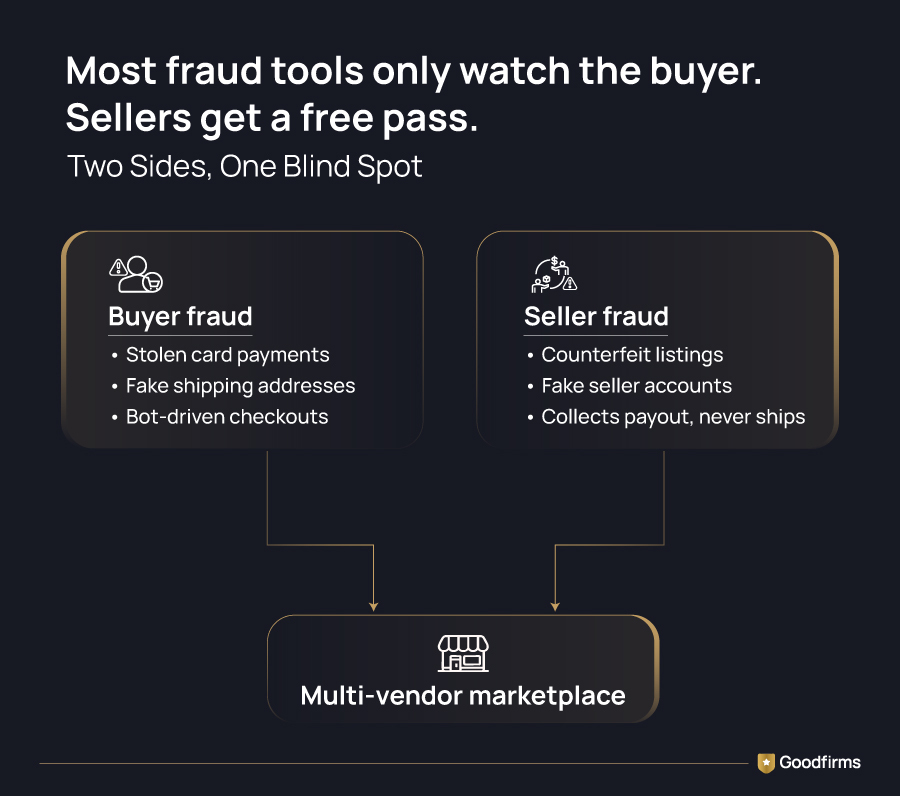
1. Treating buyer fraud and seller fraud as the same problem.
Most fraud tools are built for buyer-side risk: stolen cards, fake shipping addresses, bot checkouts. Seller-side fraud, like fake profiles or listing manipulation, needs its own detection logic entirely.
2. Skipping verification at onboarding.
Plenty of platforms let sellers list products right after signing up, with nothing more than an email and a password. This single gap is where a large share of online marketplace fraud prevention efforts fail before they even begin.
3. No real-time risk scoring across both flows.
Static, rule-based checks rarely catch buyer-seller collusion or triangulation fraud. Fraud caught days later, after a chargeback lands, is fraud that has already cost money.
4. Releasing payouts too early.
Paying a seller before a return or dispute window closes gives fraudulent sellers a clean way to collect funds and vanish. And the cost adds up faster than most platforms expect.
LexisNexis Risk Solutions found that retail and ecommerce businesses now lose over five dollars in total costs for every one dollar of direct fraud, once chargebacks, manual review, and lost customers are counted in. Marketplaces with high order volume feel this the most, since delayed detection at scale means the fraud is often gone before finance even flags it.
5. No visibility across the vendor lifecycle.
Onboarding, listings, transactions, and payouts often live in separate systems. Nobody watches the full picture, so fraud patterns that span multiple stages go unnoticed.
6. Ignoring account-level changes after approval.
A verified seller isn't a permanently safe seller. Sudden listing spikes, payout detail changes, or a push to move buyers off-platform are all signals that a once-legitimate account may now be compromised or turning fraudulent.
7. Relying on customer support to catch fraud manually.
A lot of platforms still lean on support agents to spot patterns from complaint tickets. That works fine at low volume, but it falls apart fast once order counts climb into the hundreds a day. By the time a support team notices a pattern, the fraud has usually already repeated across dozens of orders.
Building a Marketplace Fraud Prevention Strategy That Actually Works
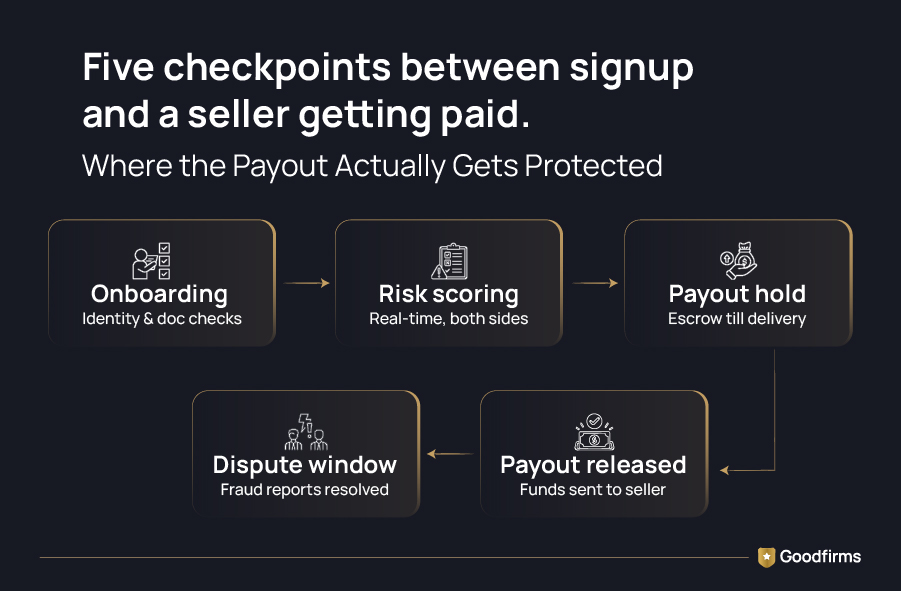
A working marketplace fraud prevention solution isn't a single tool. It's a layered setup that follows both the buyer and seller journey from start to finish.
1. Fix the platform foundation first. A lot of this comes down to how the marketplace itself is built. Platforms that keep bolting fraud rules onto a rigid, outdated structure eventually hit a wall. Rebuilding around Custom Marketplace Development & Storefront Architecture creates room to plug fraud checks in at every stage, instead of forcing them in after the fact.
2. Verify sellers properly, not just buyers. Identity checks, business document verification, and a short review period before high-risk categories go live cut down fake seller accounts significantly. This is one of the clearest gaps most online marketplace fraud prevention setups leave open.
3. Score risk in real time, on both sides. Every signup, listing, order, and payout should carry a risk score built from account history, device signals, and behavior patterns, not a static rule list. Buyer risk and seller risk need separate scoring logic since the fraud patterns don't overlap.
4. Cross-reference data to expose fraud rings. Fraudsters reuse the same email, device, or payout details across multiple accounts. Linking those shared signals exposes a whole network instead of one isolated account, which matters more in a marketplace than a single-merchant store.
5. Design the interface to support trust signals. Buyers trust what they can see. Verified badges, seller ratings tied to real order history, and clear dispute status often require expertise from User Experience Design Companies, not just backend fraud logic.
6. Connect systems instead of isolating them. Fraud patterns often span onboarding, checkout, and payouts. A Headless Commerce & API-First Development approach lets fraud signals move freely between these systems instead of getting stuck in silos.
7. Watch API and webhook traffic closely. Third-party plugins and payment integrations are another place fraud slips through unnoticed. Many businesses work with API Development Companies to ensure marketplace API traffic remains monitored, validated, and secure.
8. Hold payouts based on risk, not blanket rules. Automated split-payment systems can hold a seller's share in escrow until delivery is confirmed, giving the platform a window to catch and block suspicious sellers before funds move. Release funds fast to sellers with a clean track record, and apply longer holds only to new vendors, high-value items, or higher-risk categories.
9. Loop finance systems in too. Fraud that touches payouts, tax reporting, or vendor settlements needs to be visible to finance, not just the risk team. ERP Consulting Companies help connect fraud alerts, payouts, and financial records so risks remain visible across accounting and operations teams.
Fraud caught after the payout is fraud you're not getting back. Everything above is really about catching it before that point.
Fraud Detection Software and Choosing the Right Provider
Even with a solid architecture, most platforms still need dedicated tools to catch fraud as it happens. This is where fraud detection software comes in, using behavior analysis and machine learning to flag suspicious orders, fake accounts, and unusual payout patterns before they turn into losses.
There's no single best marketplace fraud prevention provider for every platform. The right fit depends on order volume, seller count, and how complex the payment flows are. When comparing marketplace fraud prevention software or shortlisting among marketplace fraud prevention providers, a few things matter more than a long feature list:
- Separate risk models for buyer and seller flows, not one blended score
- Cross-account link analysis to catch fraud rings, not just isolated accounts
- Real-time scoring at signup, checkout, and payout, not just at checkout
- Native payout hold and escrow features, instead of needing custom builds
- Clean API integration with existing checkout and payout systems
- Pricing that scales sensibly as order volume grows
Providers built for single-merchant ecommerce often leave a structural gap on the seller side, so it's worth asking directly how a tool handles fraud and abuse prevention on the marketplace's vendor side before committing.
The same AI-driven approach is reshaping fraud detection across fintech and ecommerce more broadly. For a deeper look at how AI models catch patterns human review would miss, this piece on AI fraud detection in fintech and ecommerce breaks it down well.
Fraud Prevention is a Trust and Safety Problem too
For a scaling platform, fraud prevention marketplace trust safety work isn't just about stopping losses. It's about keeping buyers and sellers confident enough to keep coming back. One viral scam-seller story or a payout dispute gone public can undo months of growth in customer trust.
Startups scaling fast often push trust and safety to "later." By the time fraud shows up as a wave of refund requests and support tickets, it's already expensive to fix. Building this in early, even in a lightweight form, costs far less than retrofitting it after a fraud spike hits.
This also affects seller acquisition, not just buyer trust. Good sellers watch how a platform handles disputes and payouts before committing serious inventory to it. A platform known for slow payouts or weak fraud controls will struggle to attract the vendors it actually wants, even if buyer-side trust looks fine on the surface.
The Bottom Line on Marketplace Fraud Prevention
Marketplace fraud prevention isn't one feature or one vendor. It's the right mix of onboarding checks, real-time scoring across both buyer and seller flows, payout controls, and systems that talk to each other instead of sitting in silos. Platforms that treat fraud as a checkout-only problem will always be a step behind. The ones that build fraud prevention into every stage of the vendor and buyer journey are the ones that scale without losing trust along the way.
None of this needs to happen all at once. Most platforms start with one or two gaps, usually onboarding verification or payout timing, and build outward from there. What matters is treating fraud prevention as part of how the marketplace is built, not as a patch added after something goes wrong.
The platforms that get this right end up with a quieter advantage, too. Sellers stick around longer when payouts feel safe and predictable, and buyers keep coming back when they trust who they're buying from. That trust is hard to win back once it slips, so it's worth building it in early, while it's still cheap to do.
FAQ’s - Marketplace Fraud Prevention
1. What is marketplace fraud prevention?
Marketplace fraud prevention covers the tools and processes that multi-vendor platforms use to stop fraud from buyers, sellers, or both. It spans identity verification, real-time transaction scoring, and payout controls across the whole platform, not just checkout. Platforms that only cover one side, usually the buyer, end up blind to fraud coming from the seller pool.
2. What should I look for in marketplace fraud prevention software?
Look for separate risk models for buyer and seller activity, real-time scoring at signup and payout, and cross-account link analysis that exposes fraud rings instead of flagging isolated accounts one at a time. It also helps if the tool integrates cleanly with existing checkout and payout systems, so risk data doesn't sit stuck in a separate dashboard.
3. How is fraud and abuse prevention on a marketplace different from a regular online store?
A regular store only manages buyer-side risk. Fraud and abuse prevention on a marketplace also has to cover seller onboarding, listing accuracy, payout timing, and collusion between buyer and seller accounts. That extra layer is exactly why generic ecommerce fraud tools tend to fall short on marketplaces.
4. What should a platform look for among marketplace fraud prevention providers?
Prioritize how well a provider handles seller-side risk, not just buyer fraud. Native payout hold and escrow features, clean API integration, and pricing that scales with order volume matter more than a long feature list. It's also worth asking how the provider handles fraud rings, since isolated account checks alone tend to miss connected, repeat offenders.
5. Can small marketplace platforms delay fraud prevention until they scale?
It's tempting, but risky. Fraud patterns are easier and cheaper to fix when a platform is small. Waiting until order volume grows makes fraud harder to trace and far more expensive to clean up later, especially once fraud has already spread across a wider base of sellers and buyers.