Key takeaways
- A prediction market platform lets people trade on the outcome of real-world events, not just place bets on them.
- You can build it as a centralized platform or a decentralized prediction market platform on blockchain, and each option comes with different costs and compliance needs.
- The real work sits in nine steps: research, architecture, blockchain choice, design, smart contracts, oracles, wallets, security testing, and launch.
- The cost to build a prediction market platform depends on your architecture, feature list, blockchain fees, and compliance requirements.
- You can build a custom or use a Polymarket clone script. Budget, timeline, and how much control you want over the code will decide which path fits you.
Over the years, we all know that Prediction markets have gone from a niche experiment to a real, successful business model. To prove that, here is the stat - according to a Pew Research Center analysis of data from The Block, the combined monthly trading volume on Polymarket and Kalshi jumped from under $5 billion in September 2025 to about $24 billion by April 2026.
Platforms like Polymarket handle significant trading volume for entertainment, sports, and other real-world events, with prices set by the market rather than a bookmaker.
And now, if you are exploring how to build a prediction market platform like Polymarket in 2026, this guide walks you through the architecture choices, core features, costs, and development steps involved. Whether you go centralized, build a decentralized prediction market platform, or start from a clone script, the basics stay the same: reliable data, secure settlement, and a team that has actually done this before.
Ready to Build a Prediction Market Platform Like Polymarket? Compare leading Prediction Marketplace Development Companies and explore proven Prediction Marketplace Platform Solutions to find the right technology partner for your launch.
Quick Snapshot: What Goes Into Building This
|
What You're Deciding |
Your Options |
|---|---|
|
Platform type |
Centralized platform or decentralized prediction market platform |
|
Building blocks |
Market engine, order book or AMM, oracle feed, wallet system, smart contracts |
|
Popular blockchains |
Ethereum, Polygon, Solana |
|
Route to market |
Fully custom-built or a Polymarket clone script |
|
What drives cost |
Architecture, feature count, blockchain fees, compliance scope |
|
Who this is for |
Startups, fintech teams, and Web3 founders are entering event trading markets |
What Is a Prediction Market Platform Like Polymarket?
A prediction market platform lets users buy and sell shares based on how an event turns out. Prices move with demand, not a bookmaker's odds, which is what makes it feel like trading instead of gambling.
Polymarket earned its reputation with this exact setup: on-chain settlement, you can verify, stablecoin trading, and odds that update the moment new information comes in. When people talk about building something like Polymarket, this mix of transparency, speed, and trust is usually what they mean.
How to Build a Prediction Market Platform: Step-by-Step
This is really the core of the whole process, so let's go through each step in detail.
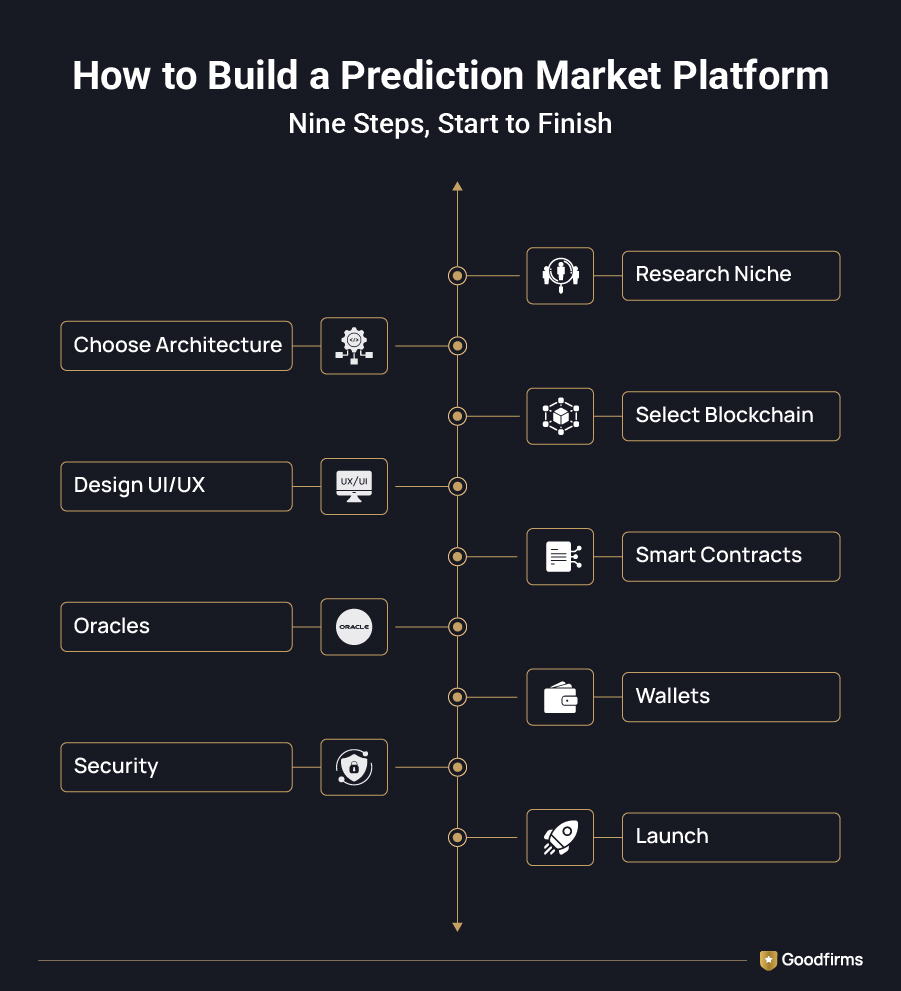
Step 1: Research your niche
Decide whether you're targeting sports, finance, entertainment, or a general-purpose market that covers all of them. Your niche shapes almost everything downstream, from the oracles you'll need to the kind of users you'll attract. A finance-focused platform needs different data feeds than a sports-focused one, so nail this down before you touch any code.
Step 2: Choose your architecture
Choose a centralized, decentralized, or hybrid model, depending on how much regulatory exposure and custody responsibility you want to handle. A hybrid setup lets trading happen off-chain for speed while settlement happens on-chain for transparency, and it's becoming a popular middle ground for teams that want both benefits.
Step 3: Select a blockchain network
Ethereum, Polygon, and Solana are the go-to choices for decentralized builds, mainly because of gas costs and transaction speed. Choose based on how much trading volume you expect and how much your users care about fees. Fast-trading platforms usually pick Polygon or Solana for lower costs, while Ethereum still wins on security and trust.
Step 4: Design the UI/UX
Keep market discovery and trade execution simple. Most platforms lose users right at the point where they get confused between buying a share and placing a bet, so your interface needs to make pricing and outcomes clear at a glance. Think about how Polymarket displays live odds as a simple percentage; that clarity is a big reason people trust the platform enough to trade real money on it.
Step 5: Develop and audit smart contracts
This step is non-negotiable for decentralized platforms. Your contracts need to cover market creation, trade matching, and payout logic, and are built by smart contract development companies who then run an independent security audit before anything touches mainnet. A single bug here can drain user funds, so budget real time and money for this step rather than treating it as a checkbox.
Step 6: Integrate oracles
Your platform is only as trustworthy as the data source that resolves your markets. Use a decentralized oracle network wherever possible to avoid single points of failure or manipulation. This is also where a lot of prediction markets run into disputes, so build a clear resolution process for edge cases where the outcome isn't obvious right away.
Step 7: Set up wallets and liquidity
Wallet integration covers deposits, withdrawals, and holding position shares securely. This is usually handled by Cryptocurrency Wallet Development Companies, since liquidity and trading engine logic overlap heavily with exchange infrastructure. Getting liquidity right early matters more than people expect. Thin liquidity means wide spreads, and wide spreads mean traders go elsewhere.
Step 8: Test and audit for security
Run a comprehensive security audit before launch, covering smart contracts, wallet integrations, and the trading engine. Penetration testing should happen before any real funds move through the platform, and it's worth running a public bug bounty program once you're closer to launch to catch anything your internal team missed.
Step 9: Launch and stay compliant
Monitor regulatory requirements in every region you plan to operate in, since prediction markets still sit in a legal gray area in several countries. Compliance isn't a one-time check before launch; it needs ongoing reviews as regulations shift, especially around anything that touches real money and event outcomes tied to politics or sports.
Features to Build a Prediction Market like Polymarket
Every prediction market platform relies on a combination of user-facing, administrative, and security features to deliver a easy trading experience. While the exact feature set varies by business model, these are the core capabilities that form the foundation of a platform like Polymarket.
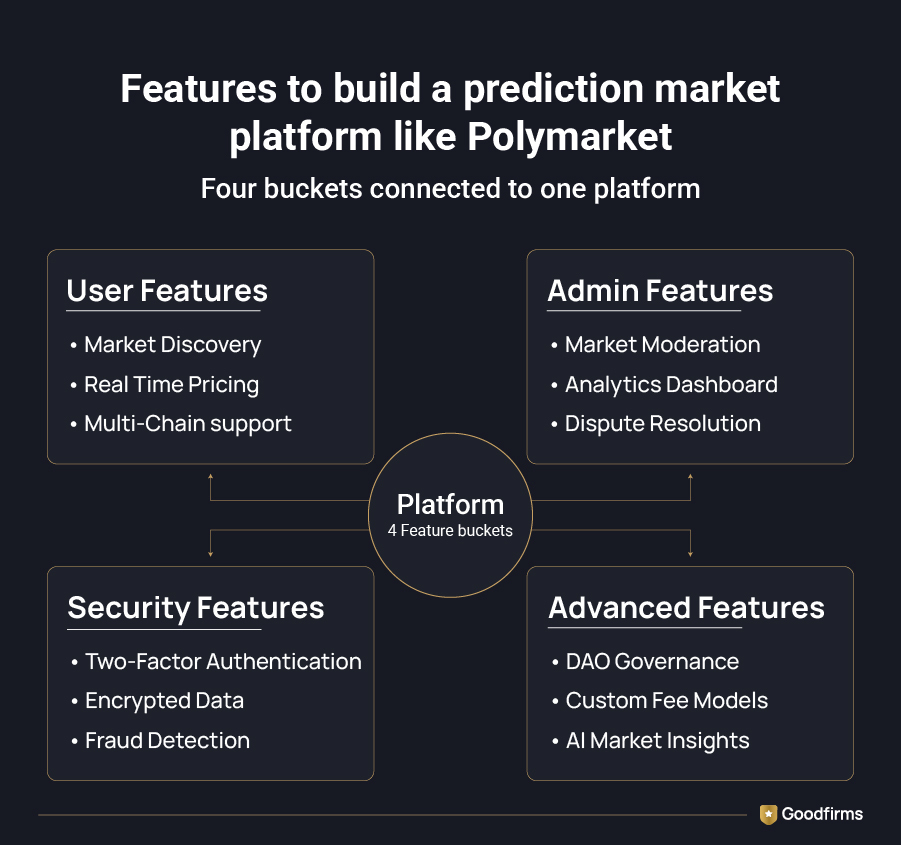
User features
- Market discovery and search
- Real-time pricing and odds display
- Position tracking and trade history
- Multi-currency and multi-chain support
Admin features
- Market creation and moderation tools
- Analytics dashboard for volume, users, and liquidity
- Dispute resolution workflow for contested outcomes
Security features
- Two-factor authentication
- Encrypted data transmission
- Ongoing fraud detection and monitoring
Advanced features
- DAO governance for community-driven market approval
- Custom fee models per market type
- Advanced market types like scalar, conditional, and multi-outcome markets
- Geo restriction controls for regulatory compliance
- AI-powered market insights
- Token or NFT-based incentives to improve user retention
Not every platform needs all of these on day one. Most teams launch with the core set and layer in advanced features once they have real trading volume to justify the build.
Cost to Build a Prediction Market Platform Like Polymarket
Cost depends on a handful of moving parts:
|
Cost Driver |
Lower Cost When... |
Higher Cost When... |
|---|---|---|
|
Architecture |
Centralized, no blockchain layer |
Decentralized, with smart contracts and audits |
|
Feature scope |
Core trading features only |
Advanced features like DAO governance, AI insights, and multi-chain support |
|
Blockchain fees |
Low-gas networks like Polygon or Solana |
High-gas networks or multi-chain deployment |
|
Compliance scope |
Single region, lighter regulatory requirements |
Multiple regions with licensing and KYC/AML needs |
|
Build path |
Clone script or MVP |
Fully custom-built from scratch |
For cost context, the guide on how to start a crypto exchange breaks down similar trading engine and compliance costs. The White-Label Neobanks cost breakdown is worth a look too, since wallet and compliance costs follow a similar pattern even though the platforms themselves serve different purposes.
Once you have a rough idea of the cost drivers, the next decision is how you want to build the platform. Your development approach will have the biggest impact on budget, timeline, scalability, and long-term flexibility.
MVP, Clone Script, or Custom Build?
Whichever route you choose, the outcome ultimately depends on the team building it. The right development partner can help you avoid costly mistakes, accelerate time to market, and deliver a platform that's secure and scalable.
|
Features |
MVP |
Clone Script |
Custom Build |
|---|---|---|---|
|
Speed to market |
Fastest |
Fast |
Slowest |
|
Typical timeline |
A few weeks to a couple of months |
A bit longer than an MVP |
Several months |
|
Upfront cost |
Lowest |
Low to moderate |
Highest |
|
Customization |
Minimal, just enough to test demand |
Limited, built on someone else's framework |
Full control over codebase and token economics |
|
Best for |
Validating your niche before committing |
Getting to market quickly with proven logic |
Long-term ownership and flexibility |
An MVP is worth considering if you're not fully sure which niche or market type will actually get attraction. It lets you test demand with a stripped-down version before spending on a full clone script or custom build.
When comparing vendors for either route, look for a track record of live deployments rather than demos. That's really the difference between the best Polymarket clone script development company and one that's still learning on your budget. It's also worth checking whether the team has handled the wallet and liquidity side of things before, since that's where a lot of first-time builds run into trouble.
Whichever route you choose, the outcome ultimately depends on the team building it. The right development partner can help you avoid costly mistakes, accelerate time to market, and deliver a platform that's secure and scalable.
Choosing the Right Partner
- Prior blockchain and smart contract experience, not just a general app development background
- Live platforms they've actually shipped, not just prototypes
- Security audits handled in-house or through a named third party
- Transparent pricing and clear post-launch support terms
A good starting point is any list of web3 development companies working on prediction marketplaces. If your build also needs exchange-grade infrastructure like liquidity systems or compliance tooling, look for resources that break down the technology layers involved, many of which overlap directly with what a prediction market platform needs.
Common Challenges to Watch For
A few problems come up again and again for teams building their first prediction market platform, so it's worth planning for them early.
- Liquidity is usually the biggest one. A market with no active traders on both sides means wide spreads and bad pricing, which drives users away before the platform even gets a chance to prove itself. Solving this often means seeding markets yourself in the early days or partnering with a market maker.
- Dispute resolution is another common pain point. Real-world events aren't always clean cut, and someone has to decide what happens when an outcome is ambiguous or contested. Build a clear resolution process before launch rather than figuring it out during your first controversial market.
- Regulatory uncertainty is the third big one. Prediction markets touch gambling law in some places, and financial trading law in others, and the classification can shift depending on how your platform is structured. Get legal advice specific to each region you plan to operate in, rather than assuming one framework covers everywhere.
Conclusion
Building a prediction market platform like Polymarket in 2026 really comes down to a handful of decisions. Centralized or decentralized architecture. Custom build or clone script. And which development partner you trust to actually execute it well. Get those three right, and everything else, the features, the cost, the compliance work, tends to fall into place around them.
Whether you're entering sports, politics, or finance markets, the platforms that end up winning are the ones that got the fundamentals right early, clean architecture, audited code, and a partner who can point to something they've actually shipped. Start there, and the rest of the build becomes a lot more manageable.
FAQ's - How to Build a Prediction Market Platform
1. How do I build a decentralized prediction market platform like Polymarket?
Start by picking your blockchain network based on gas costs and transaction speed, then build out the market creation engine, an AMM or order book for pricing, and oracle integration so markets resolve against reliable real-world data. Smart contracts need to be audited independently before anything touches mainnet, since this is where bugs are most costly. Once those pieces are solid, add wallet integration and whatever compliance work your target regions require before you launch.
2. How much does it cost to build a prediction market platform like Polymarket?
Cost varies quite a bit based on your architecture, how many features you're building, and blockchain fees. Centralized platforms generally cost less than decentralized ones, since you skip smart contract audits and on-chain gas costs. Licensing a clone script will cost less than a fully custom build from scratch, though you trade away some flexibility. An MVP is the cheapest way to test demand before committing to either route.
3. What is the best Polymarket clone script development company?
There's no single answer here; it really depends on your budget, target blockchain, and how much customization you need. When comparing vendors, look at their live deployments and audit practices instead of just going with whoever quotes the lowest price. A vendor that has actually shipped a working platform, with real users and real liquidity, is a safer bet than one that only shows demos or mockups.
4. How do I create a prediction market platform in 2026?
Start by defining your niche, whether that's sports, politics, finance, or a general-purpose market, since this shapes your oracle and data needs. Then choose your architecture, build out the core features like the market engine, AMM, oracle, and wallet system, and run a full security audit before launch. Compliance requirements should be mapped out early, too, since prediction markets are regulated differently depending on where you plan to operate.
5. Is prediction market trading legal?
It depends heavily on the jurisdiction and how your platform is structured. Some regions treat it closer to financial trading, while others classify it under gambling law, and the line between the two is still being worked out by regulators. Regulatory treatment varies a lot from country to country and is still evolving, so it's worth checking compliance requirements for each region you plan to operate in before you launch, not after.
6. Do I need blockchain to build a prediction market platform?
Not necessarily. A centralized platform can run without blockchain entirely, and it's often faster and cheaper to build that way. You only need blockchain if you're building a decentralized prediction market platform with on-chain settlement and wallets that users control themselves, since that's what gives users verifiable custody of their funds instead of trusting a single company to hold them.