Key takeaways
- Prediction markets are expanding beyond elections and sports into commodities, weather, economic indicators, and business risks.
- Trading activity remains substantial, with Kalshi, Polymarket, and Polymarket US recording $45.33 billion in combined August 2026 volume.
- Regulatory battles are intensifying, particularly over whether sports prediction contracts fall under federal financial regulation or state gambling laws.
- Market integrity is a growing concern, with recent CFTC enforcement cases involving insider trading and manipulation.
- The business opportunity remains strong, but profitability isn't guaranteed. High trading volume shows demand, not necessarily company profits.
- Prediction markets were once associated mainly with election forecasts and niche political speculation. In 2026, that description is no longer enough.
Kalshi and Polymarket are now operating at a scale that has drawn the attention of financial regulators, state governments, sports organizations and mainstream financial companies. In August 2026 alone, Kalshi recorded $37.17 billion in trading volume, while Polymarket and Polymarket US recorded a combined $8.16 billion, according to The Block. Together, the three platforms recorded $45.33 billion in monthly volume.
That figure was actually lower than July's combined volume, which fell 14.5% month over month. Yet August volume remained well above the $25.66 billion recorded in May.
At the same time, the industry is facing serious legal challenges. State regulators are arguing that some prediction-market contracts are effectively gambling and should fall under state gaming laws. The Commodity Futures Trading Commission (CFTC), which oversees federally regulated derivatives markets, has taken the opposite position in several cases and has defended its authority over prediction markets.
The result is an unusual situation: prediction markets are expanding commercially while their legal boundaries are still being fought over in court.
The prediction-market opportunity is growing, but building one means getting the technology, compliance, liquidity, and market infrastructure right from the start. Explore Goodfirms’ Prediction Marketplace Platform to compare providers, technology requirements, costs, and launch timelines for your platform.
Prediction Markets in 2026: Key Numbers
Prediction markets have reached a scale that is difficult to dismiss as a niche market. Recent trading data, new product categories, and regulatory actions show how quickly the industry is evolving.
-
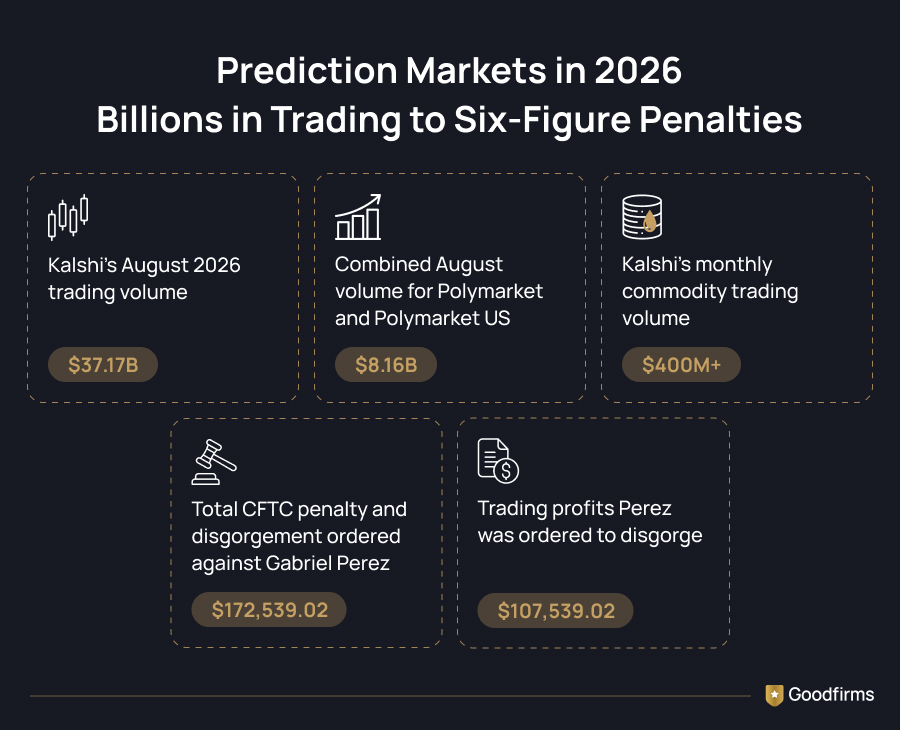
$45.33 billion—Combined August 2026 trading volume across Kalshi, Polymarket, and Polymarket US. The figure was 14.5% lower than July, marking the first month-over-month decline in a year.
-
$37.17 billion—Kalshi's August 2026 trading volume, accounting for the majority of the combined volume reported across the three platforms.
-
$8.16 billion—Combined August 2026 trading volume on Polymarket and Polymarket US.
-
$400 million+—Kalshi's monthly commodity trading volume, reached just seven months after launching its commodities platform.
-
$172,539.02—Total amount Gabriel Perez was ordered to pay in a CFTC insider-trading case involving prediction-market event contracts. The amount included $107,539.02 in disgorged trading profits and a $65,000 civil monetary penalty.
-
$107,539.02—Trading profits Perez was ordered to disgorge after the CFTC found that he had used material, nonpublic information to trade presidential “mention market” contracts.
Prediction markets have moved beyond elections
The prediction-market model is no longer limited to questions such as who will win an election.
CFTC records show federally regulated event contracts covering subjects including weather and airport passenger numbers. Kalshi has also expanded into commodities, while Reuters reported in September 2026 that the platform's monthly commodity trading volume had exceeded $400 million only seven months after its commodities platform launched.
The expansion is important because it changes the business case for prediction markets.
A platform that only offers political contracts depends heavily on the political calendar. A platform that can create markets around sports, weather, economic indicators, commodities, and other measurable events has more opportunities to keep users trading throughout the year.
The CFTC's own product records illustrate how wide these markets can become. Recent certified contracts include weather-index contracts for regions such as the San Francisco Bay Area and Puget Sound, as well as contracts linked to passenger numbers at major U.S. airports.
Kalshi is also seeking to expand further into financial products. For businesses considering a similar platform, Goodfirms' guide on building a prediction marketplace like Kalshi breaks down the available development approaches, technology requirements, and trade-offs.
Reuters reported in September that the company planned to file with the CFTC for a perpetual West Texas Intermediate crude-oil contract, following filings involving perpetual products tied to areas including equity indexes, metals, foreign exchange and interest rates.
This expansion raises an important question: Are prediction markets becoming a new type of financial marketplace, or are they simply a new way to offer bets on events?
In 2026, regulators and courts are still arguing over that question. As prediction marketplaces expand into new event categories, businesses looking to enter the space can also compare prediction marketplace development companies with experience building these platforms.
Sports have become the biggest regulatory battleground
Sports are one of the biggest reasons prediction markets are now facing state-level legal challenges.
The dispute centers on a basic question: When a platform offers a contract tied to the outcome of a sporting event, is that a financial product regulated by the federal government or gambling that can be regulated by individual states?
There is no single answer from the courts yet.
In August 2026, the Ninth Circuit ruled that Kalshi could not block Nevada from enforcing its gaming laws against the company. The court concluded that the Commodity Exchange Act did not preempt Nevada's requirement that Kalshi obtain a gaming license for its sports contracts.
That decision came after the Third Circuit reached a different conclusion in the dispute involving New Jersey. The Third Circuit had ruled in Kalshi's favor, finding that federal law preempted New Jersey's attempt to regulate the company's sports event contracts.
Two federal appeals courts reaching different conclusions created a much bigger question for the industry.
Who gets the final say?
The federal government?
State gaming regulators?
Or does the answer depend on the type of contract being offered?
Prediction markets also face a market-integrity problem
Regulatory uncertainty is only one challenge.
Prediction markets have to deal with the same basic problem that exists in other financial markets: What happens when someone has information that other traders do not have?
The CFTC issued a prediction-markets enforcement advisory in February 2026 after enforcement cases involving misuse of nonpublic information and fraud. The agency specifically noted that it has authority to police illegal trading practices on federally regulated markets, including prediction markets.
One of the more striking cases came in August.
The CFTC ordered Gabriel Perez to pay $172,539.02 after finding that he had used material, nonpublic information obtained through his work as a White House teleprompter operator to trade presidential "mention market" contracts. According to the CFTC, Perez had access to presidential speeches before they were delivered and used that information to trade contracts tied to words or phrases the President might use. The agency said his trading generated more than $107,500 in profits. Perez also received a three-year trading ban.
The case shows why prediction markets cannot rely solely on the idea that their contracts are simply bets on public events.
The information available to traders can matter enormously.
The industry is still attracting mainstream partnerships
Despite the legal disputes, prediction markets are not retreating from mainstream sports.
On August 31, the United States Tennis Association announced a multi-year agreement naming Kalshi the Official Prediction Market Partner of the US Open. The partnership began with the 2026 US Open Singles Main Draw and includes Kalshi branding across US Open digital platforms and on-court signage.
The agreement also includes an integrity framework.
The USTA said markets involving issues such as umpire decisions, player injuries and code violations would be restricted because of integrity concerns. Kalshi also entered into a confidential data-sharing agreement with the International Tennis Integrity Agency for real-time market surveillance.
That detail is worth paying attention to.
Reuters reported in August that U.S. small businesses were using prediction-market-style contracts to hedge against specific risks. One example involved Western Grazers, which obtained a custom contract tied to California legislation affecting its goat-herding operations.
This is a different proposition from sports trading.
A business facing a specific regulatory, weather or market risk may care less about entertainment and more about whether a contract can offset part of the financial impact of an uncertain event.
That does not mean prediction markets will replace insurance or traditional hedging products. The available evidence does not support such a claim.
It does show, however, that companies are experimenting with event contracts as tools for managing particular forms of uncertainty.
For founders considering a decentralized or blockchain-based model, Goodfirms' guide on building a prediction market like Polymarket covers the technology, development process, costs, and architecture choices involved.
Regulation could determine who wins
The next phase of prediction markets may depend less on how many new contract types platforms can create and more on whether they can operate within an acceptable regulatory structure.
The legal disputes are already forcing companies to address questions around:
- licensing and jurisdiction
- market surveillance
- insider trading
- participant eligibility
- contract design
- sports integrity
- state versus federal authority
The Perez enforcement case shows the consequences when confidential information enters a prediction market. The U.S. Open agreement shows how sports organizations are responding through contract restrictions and market surveillance. The state lawsuits show that platforms also have to contend with regulators who do not accept the federal-market classification for every type of event contract.
For technology companies entering this space, that creates a different opportunity from simply building another betting interface.
Businesses taking this route may also need expertise that spans fintech and blockchain, making the choice of a blockchain fintech development partner especially important.
The infrastructure behind these platforms has to support identity checks, trading controls, market surveillance, contract settlement, data feeds, and regulatory reporting.
The technology and compliance requirements also have a direct impact on development costs. Businesses planning to enter this space can explore the prediction marketplace platform development cost to understand the major cost drivers, timelines, and expenses involved.
Is the Prediction Market Business Still Viable in 2026?
The evidence points to yes as a business opportunity, but with an important qualification.
Prediction markets have demonstrated substantial trading activity, expanded into new categories, and attracted partnerships outside their original political niche. Kalshi's more than $400 million in monthly commodity volume and the $45.33 billion combined August volume reported for Kalshi, Polymarket and Polymarket US show that the market is operating at a scale that would have been difficult to dismiss as a niche experiment.
But growth does not remove the industry's problems.
The Ninth Circuit's decision involving Nevada conflicts with the earlier Third Circuit decision involving New Jersey. New Jersey has now asked the Supreme Court to intervene. The CFTC continues to defend its jurisdiction, while state governments continue to challenge it.
At the same time, enforcement cases show that prediction markets need controls against insider trading and manipulation.
So the real question for 2026 is what prediction markets will become once regulators, courts, sports organizations, and financial companies finish deciding what these markets are allowed to be.
For now, the industry is doing something unusual: building at scale while the rulebook is still being contested.
FAQs - Prediction Markets
1. What are prediction markets?
Prediction markets let people trade contracts tied to the outcome of future events. Those events can range from elections and sports to weather, commodities, and economic indicators.
2. How do prediction markets work?
Think of them as markets built around questions about the future. Traders buy or sell contracts based on what they think will happen, and prices move as market expectations change. When the event is settled, the contract pays according to the outcome.
3. Are prediction markets legal in the U.S. in 2026?
There isn't a single answer yet. The CFTC considers certain event contracts to fall under federal oversight, while several states are challenging sports-related contracts under their gambling laws. Court decisions in 2026 have gone in different directions, and the dispute could reach the U.S. Supreme Court.
4. Are prediction markets gambling or financial markets?
That's exactly what regulators and courts are trying to determine. Prediction-market platforms argue that their contracts are financial products, while some state regulators see sports contracts as gambling. The distinction matters because it determines which laws and regulators apply.
5. How do prediction market platforms make money?
Most platforms can earn money by charging fees on trades. But don't confuse trading volume with revenue: a platform can process billions of dollars in contracts without earning billions in fees.
6. What are the biggest prediction market platforms in 2026?
Kalshi and Polymarket are two of the biggest names in the space. In August 2026, Kalshi recorded $37.17 billion in trading volume, while Polymarket and Polymarket US recorded $8.16 billion combined.
7. What are prediction markets used for besides sports and elections?
Quite a bit more than they were a few years ago. Contracts now cover areas such as weather, commodities, and airport passenger numbers, while businesses are also experimenting with event contracts to manage specific risks.
8. Why are prediction markets controversial in 2026?
Prediction markets are controversial in 2026 because of high-profile insider trading cases, ongoing regulatory battles over whether certain contracts fall under federal financial regulation or state gambling laws, and concerns about market integrity. The debate has become more complicated as prediction markets expand beyond elections and sports into commodities, weather, and other event-based contracts.
References
- The Block — Kalshi and Polymarket's combined volume falls 15% in August
- Reuters — Kalshi's $400 million-plus monthly commodity trade volume
- Reuters — New Jersey takes fight over Kalshi's prediction market to U.S. Supreme Court
- CFTC — CFTC Reaffirms Exclusive Jurisdiction Over Prediction Markets
- CFTC — CFTC Enforcement Division Issues Prediction Markets Advisory
- CFTC — CFTC Orders Gabriel Perez to Pay for Insider Trading of Mention Market Event Contracts
- CFTC — Prediction Markets: You've Got Options
- U.S. Open / USTA — Kalshi Named the Official Prediction Market Partner of the US Open
- Reuters — Prediction Markets Take a Swing at Hedging for U.S. Small Businesses
- CFTC — Prediction Markets, Advance Notice of Proposed Rulemaking