Key takeaways
- Marketplace development costs vary widely based on scope. A focused marketplace can start at $60,000, while fully custom marketplaces can reach $300,000+.
- Development approach has a major impact on the budget. SaaS solutions cost $100 to $1,000 per month, open-source marketplaces range from $30,000 to $80,000, and custom development generally falls between $80,000 to $300,000+.
- Features account for a significant portion of the investment. A custom marketplace requires approximately 2,800 development hours.
Building a marketplace is rarely as expensive or as inexpensive as you expect.
Some might assume a need for a budget like Amazon's before you can begin. Others believe a few off-the-shelf tools are enough to launch and scale. The reality is neither.
The cost of building an eCommerce marketplace depends on decisions made long before development begins: the type of marketplace you want to create, the features you prioritize, the technology powering the platform, and the scale you intend to support.
A focused MVP can be launched for around $60,000, while a feature-rich, enterprise-grade platform can exceed $300,000. The difference lies in the complexity required to bring that idea to life.
The sections below break down where that investment goes, what drives costs up or down, and how to plan a marketplace budget that supports both your immediate goals and long-term growth.
Before you commit to a development budget, compare the marketplace platforms and providers shaping the industry. Explore and compare trusted marketplace solutions and providers on Goodfirms to make an informed decision.
Core Cost Drivers That Influence Marketplace Development Costs
Platform complexity, feature requirements, technology choices, third-party integrations, etc., influence the overall eCommerce marketplace development cost. Understanding these cost drivers helps businesses estimate budgets more accurately and make smarter development decisions.
1. Development Approach
The first decision that impacts cost is determining how the marketplace will be built.
Businesses generally choose between SaaS solutions, open-source platforms, or fully custom development.
- SaaS platforms offer speed and lower upfront investment. Subscription costs range from $100 to $1,000 per month. This makes them suitable for testing concepts and for quick launches. However, flexibility and scalability are often limited.
- Open-source frameworks provide greater control while reducing licensing costs. While the software itself may be free, customization, deployment, and maintenance usually bring total costs to approximately $30,000 to $80,000 for a production-ready marketplace.
- Custom development demands the highest investment but offers unmatched scalability and ownership. Depending on scope and complexity, fully custom marketplaces generally range from $80,000 to $300,000+.
Quickly browse Goodfirms curated list of top eCommerce marketplace development companies to find your development partner.
2. Feature Complexity
Features are often the largest contributor to development costs. If you choose custom development, you will need around 2800 hours of development. Here is the breakdown of which features will need approx how many hours.
|
Feature |
Hours |
|---|---|
|
Landing page |
55 |
|
Authentication |
100 |
|
User profiles |
155 |
|
Search and filters |
200 |
|
Listing management |
135 |
|
Listing page |
120 |
|
Checkout |
150 |
|
Payment system |
170 |
|
Order management |
130 |
|
Admin panel |
220 |
|
In-app messaging & notifications |
225 |
|
Reviews |
90 |
|
Project coordination |
500 |
|
Quality assurance |
600 |
|
Total hours |
2850 |
Source: Clockwise Software
Each enhancement increases development time, testing requirements, and future maintenance obligations.
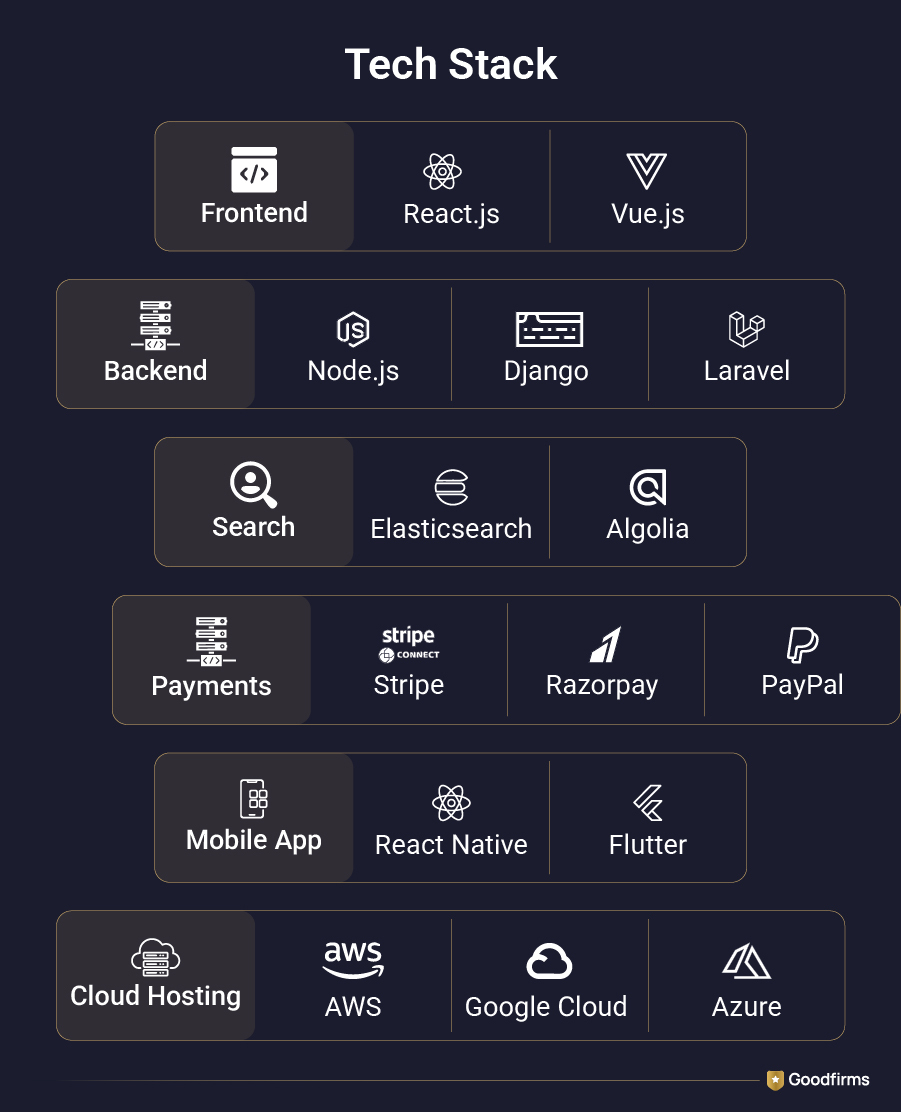
3. Technology Stack
The technologies selected influence both upfront development costs and long-term operating expenses.
Choosing proven technologies helps minimize technical debt while supporting future growth.
4. Integrations
Integrations frequently include:
- Payment gateways
- Shipping providers
- CRM systems
- Analytics tools
- Authentication services
For instance, integrating multiple payment gateways generally costs between $5,000 and $10,000. Find the secure payment gateway companies on Goodfirms and compare based on pricing and verified reviews. On the other hand, logistics integrations can add another $3,000 to $8,000, depending on complexity.
5. Infrastructure Requirements
Smaller marketplaces may operate efficiently on cloud environments costing $100–$300 per month, while enterprise-grade platforms can exceed $10,000 monthly as traffic and transaction volumes increase.
Beyond hosting, businesses also need to budget for infrastructure components such as DevOps setup, CI/CD pipelines, load balancing, and monitoring tools. While these systems work behind the scenes, they play a critical role in maintaining performance, enabling smoother deployments, and ensuring the marketplace remains reliable as it grows.
How Marketplace Type Impacts Development Costs
The type of marketplace you build has a direct impact on development costs. While all multi-vendor platforms require core features, each marketplace model introduces its own technical complexities.
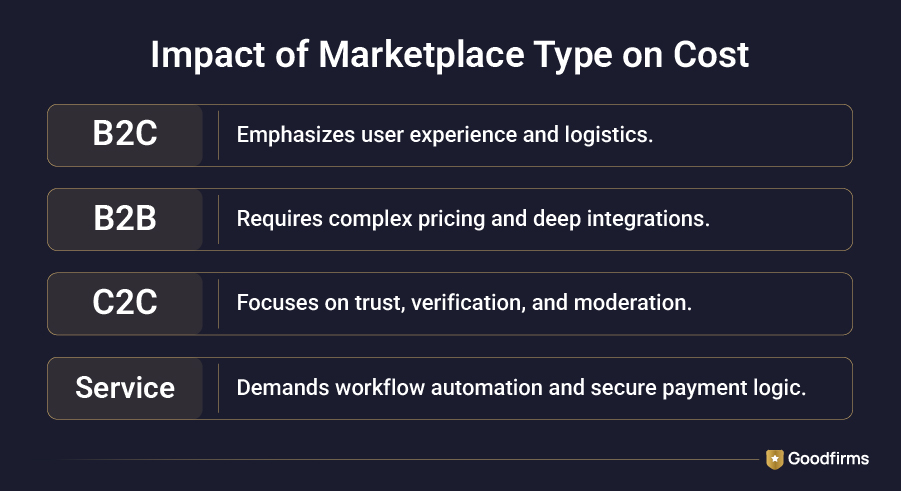
1. B2C Marketplaces: Focus on Customer Experience
B2C marketplaces such as Amazon and Flipkart prioritize seamless shopping experiences, fast search, personalized recommendations, and reliable delivery. Features like AI-driven recommendations, advanced filtering, logistics integrations, and multi-channel selling increase development complexity and long-term maintenance needs.
Estimated Cost: $80,000–$250,000, depending on whether you're building a regional MVP or a large-scale marketplace.
2. B2B Marketplaces: Built for Complex Transactions
B2B platforms like Alibaba and IndiaMART support bulk purchasing, negotiated pricing, and long-term supplier relationships. They often require tiered pricing, RFQ systems, MOQ management, tax compliance, multi-currency support, and ERP integrations.
These enterprise-level requirements make B2B marketplaces more expensive to develop.
Estimated Cost: $120,000–$300,000+.
3. C2C Marketplaces: Trust Comes First
C2C platforms such as eBay, Etsy, and OLX depend heavily on trust and user safety. Features like identity verification, seller ratings, content moderation, dispute resolution, and secure messaging are essential. Many also rely on escrow payment systems to protect both buyers and sellers.
Escrow integration cost: $5,000–$15,000.
Estimated Cost: $70,000–$200,000.
4. Service Marketplaces: Workflow-Driven Platforms
Service marketplaces like Upwork and Fiverr require more than simple transactions. They must support project posting, bidding, milestone tracking, escrow payments, messaging, and review systems. Advanced platforms also use AI-powered matching algorithms to connect clients with suitable service providers.
AI matching systems can add: $20,000–$50,000 to development costs.
Estimated Cost: $100,000–$250,000.
Multi-Vendor Marketplace Feature Cost Breakdown
The final cost of a multi-vendor marketplace depends largely on the features you choose to include. The table below highlights the estimated development costs for key feature categories and advanced capabilities, helping you understand where your budget is likely to be allocated.
|
Feature Category |
Estimated Cost |
|---|---|
|
User Features (Frontend) |
$40,000–$70,000 |
|
Vendor Registration & Onboarding |
$4,000–$8,000 |
|
Product Listings & Catalog Management |
$8,000–$15,000 |
|
Search, Filters & Sorting |
$10,000–$20,000 |
|
Reviews & Ratings System |
$5,000–$10,000 |
|
Real-Time Chat & Messaging |
$8,000–$20,000 |
|
Checkout & Payment Gateway Integration |
$10,000–$25,000 |
|
Admin Features (Backend) |
$30,000–$60,000 |
|
Vendor Management |
$6,000–$12,000 |
|
Order Tracking & Fulfillment Monitoring |
$8,000–$15,000 |
|
Dispute Resolution System |
$6,000–$10,000 |
|
Analytics & Reporting Dashboard |
$10,000–$20,000 |
|
Vendor Panel Features |
$35,000–$60,000 |
|
Product Upload & Editing Tools |
$5,000–$10,000 |
|
Dynamic Pricing & Discount Management |
$6,000–$12,000 |
|
Inventory & Stock Management |
$8,000–$15,000 |
|
Order & Delivery Tracking |
$5,000–$10,000 |
|
Performance Analytics & Reports |
$7,000–$15,000 |
|
Buyer Features |
$30,000–$60,000 |
|
Personalized Recommendations |
$10,000–$25,000 |
|
Wishlist & Favorites |
$4,000–$8,000 |
|
One-Click Checkout |
$6,000–$10,000 |
|
Loyalty & Reward Programs |
$8,000–$15,000 |
|
Advanced Features |
|
|
AI-Based Search & Recommendations |
$20,000–$40,000 |
|
Smart Product Recommendations |
$10,000–$30,000+ |
|
AR Product Previews |
$25,000–$50,000 |
|
Voice Search & Commands |
$15,000–$30,000 |
|
Multi-Language Support |
$10,000–$20,000 |
|
Multi-Currency Integration |
$10,000 |
|
Overall Marketplace Cost Estimates |
|
|
Essential MVP Marketplace |
$60,000–$100,000 |
|
Mid-Tier Marketplace |
$120,000–$180,000 |
|
Full-Scale Intelligent Marketplace |
$200,000–$300,000+ |
Source: Aalpha Information Systems
Cost of Hiring a Marketplace Specialist
Building a marketplace requires more than developers alone. UI/UX designers, business analysts, QA engineers, DevOps specialists, solution architects, and project managers all play a critical role in shaping the final product and its overall cost.
The table below outlines average hourly rates for marketplace specialists across different regions, giving you a clearer picture of potential hiring expenses and helping you plan your budget more accurately.
|
Online marketplace specialists |
CEE |
Western Europe |
North America |
South America |
Asia |
Australia |
|---|---|---|---|---|---|---|
|
Software developers |
$30-$100 |
$50-$150 |
$60-$180 |
$30-$80 |
$15-$70 |
$40-$140 |
|
UI/UX designers |
$40-$80 |
$70-$120 |
$80-$140 |
$40-$70 |
$20-$60 |
$60-$100 |
|
Business analysts |
$50-$90 |
$80-$130 |
$90-$150 |
$50-$80 |
$30-$70 |
$70-$120 |
|
Solution architects |
$60-$110 |
$90-$160 |
$100-$180 |
$60-$90 |
$40-$80 |
$80-$140 |
|
QA engineers |
$25-$70 |
$40-$100 |
$50-$120 |
$30-$60 |
$10-$50 |
$30-$90 |
|
DevOps experts |
$40-$90 |
$60-$130 |
$70-$150 |
$40-$70 |
$20-$60 |
$50-$110 |
|
Project managers |
$50-$100 |
$70-$140 |
$80-$160 |
$50-$80 |
$30-$70 |
$60-$130 |
Source: Cleveroad
FAQs - eCommerce Marketplace Development Cost
How much does it cost to build an eCommerce marketplace in 2026?
Marketplace development costs range from $60,000–$100,000 for MVPs, while enterprise-grade platforms can exceed $300,000.
How much should businesses budget for maintenance?
Annual maintenance generally represents 15–25% of the original development investment.
Which development approach is best?
The answer depends on business objectives. SaaS works well for validation, while custom development provides maximum scalability.
Can startups afford marketplace development?
Yes. Starting with essential functionality and expanding gradually helps manage costs effectively.
What is the biggest factor affecting marketplace development costs?
Feature complexity is the largest cost driver. The number of integrations, the type of marketplace (B2B, B2C, C2C, or service-based), custom workflows, and scalability requirements all have a significant impact on the final budget.
Is it cheaper to build a marketplace from scratch or use an existing platform?
SaaS and open-source solutions require a lower upfront investment and are ideal for validation. Custom development involves higher initial costs but provides greater flexibility, ownership, and scalability as the business grows.
Can I start with an MVP and add features later?
Yes. Many successful marketplaces launch with essential functionality first and expand based on user feedback and market demand. This phased approach helps control costs, reduce risk, and prioritize features that deliver the highest business value.
Final Thoughts on eCommerce Marketplace Development Costs
The rise of digital marketplaces has transformed the way consumers buy and businesses sell. But building a successful marketplace requires far more than launching a website.
The true investment extends across technology, infrastructure, security, integrations, and long-term scalability.
Say, for example, you are validating an idea with an MVP or planning an enterprise-grade ecosystem. Understanding the cost drivers behind marketplace development allows you to allocate resources strategically and avoid expensive surprises later.
For a successful marketplace, large budgets are not enough. The marketplace is built with a clear roadmap, the right technology choices, and a development strategy designed for sustainable growth.