Key takeaways
- Online marketplaces account for more than 67% of global ecommerce sales in 2026 and are still growing.
- A multi-vendor marketplace earns through commissions, listing fees, or subscriptions; the platform owns no inventory.
- The cold start problem, no buyers without vendors, no vendors without buyers, is the hardest non-technical challenge at launch.
- In 2026, AI features in marketplaces are no longer optional: search, personalization, fraud detection, and dynamic pricing are becoming baseline expectations.
- Platform choice depends on scale: CS-Cart and Mirakl for enterprises, Yo!Kart and Sharetribe for startups, Dokan for WordPress users.
Have you ever heard of Amazon, Flipkart, Etsy... ok, kidding, you obviously have. But here is a fact you might not have stopped to think about: online marketplaces now account for more than 67% of global ecommerce sales. And that is not the only thing those three have in common. They are all multi-vendor marketplaces.
Here is what that actually means. Amazon does not build most of what it sells. Etsy does not make anything. What they built was infrastructure, and then let thousands of independent vendors fill it. That is the model. And in 2026, it is replacing traditional ecommerce at scale.
This guide covers how to build it, which platforms hold up, and what it will realistically cost, based on verified data from Goodfirms' listings, not a vendor pitching their own software.
Want to explore the full technology stack behind marketplace platforms? Check out Goodfirms' eCommerce marketplace platform solutions guide.
What is a Multi-Vendor Marketplace?
In simple words, a multi-vendor marketplace is an online platform where multiple independent sellers list and sell their products or services, all under one roof. The platform owner, or marketplace operator, does not sell anything directly. Instead, they build and manage the infrastructure, handle the transactions, and earn through commissions, listing fees, subscriptions, or a mix of all three.
Think of it this way: Amazon do not build or stock most of what it sells. Thousands of independent vendors do. Buyers browse, compare, and buy without thinking twice about which vendor ships it. Amazon just takes its cut. That is the multi-vendor marketplace model working at full scale.
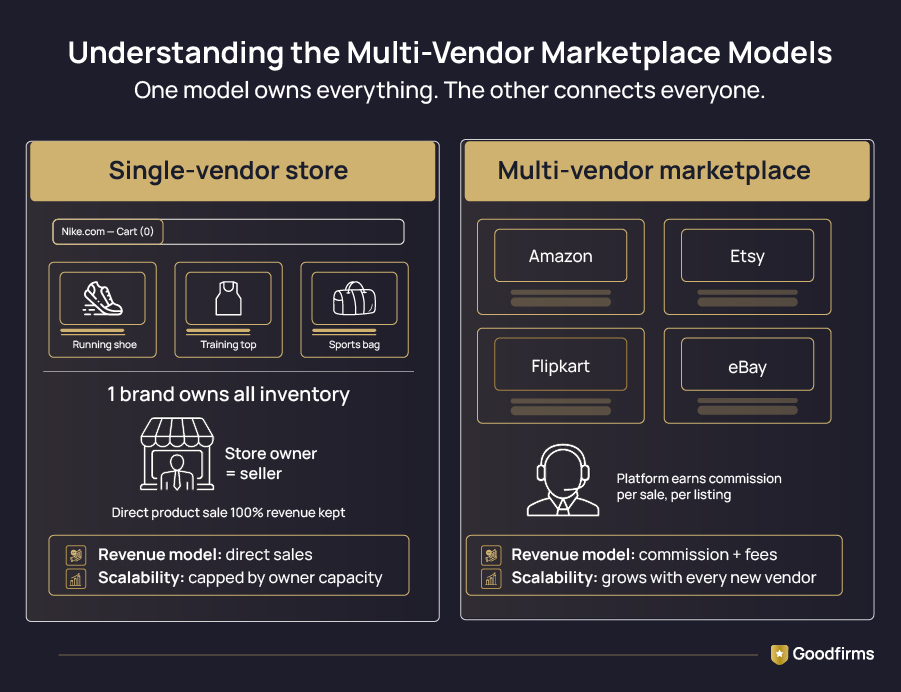
This is very different from a single-vendor ecommerce store like Nike, for example, one brand, one inventory, one seller. In a multi-vendor setup, the platform itself owns nothing; vendors do. And that is exactly what makes it so scalable, and yes, more complex to build.
|
Feature |
Single-Vendor Store |
Multi-Vendor Marketplace |
|---|---|---|
|
Sellers |
Just the store owner |
Multiple independent vendors |
|
Inventory |
The owner manages everything |
Each vendor manages their own |
|
Revenue model |
Direct product sales |
Commission, fees, subscriptions |
|
Scalability |
Capped by owner capacity |
Grows with every new vendor |
|
Examples |
Nike.com, Apple Store |
Amazon, Etsy, Flipkart, eBay |
Now, hopefully the air is clear, and you understand the difference between single and multi vendor, so let's move to the next step, actually creating it.
How to Build a Multi-Vendor Marketplace - Step by Step
If you are wondering how to create a multi-vendor marketplace website from scratch or evaluate existing platforms, one thing is true for both paths: this is not a weekend project. It needs a clear plan across business strategy, tech, design, and operations. Here is the six-step framework we have seen work:
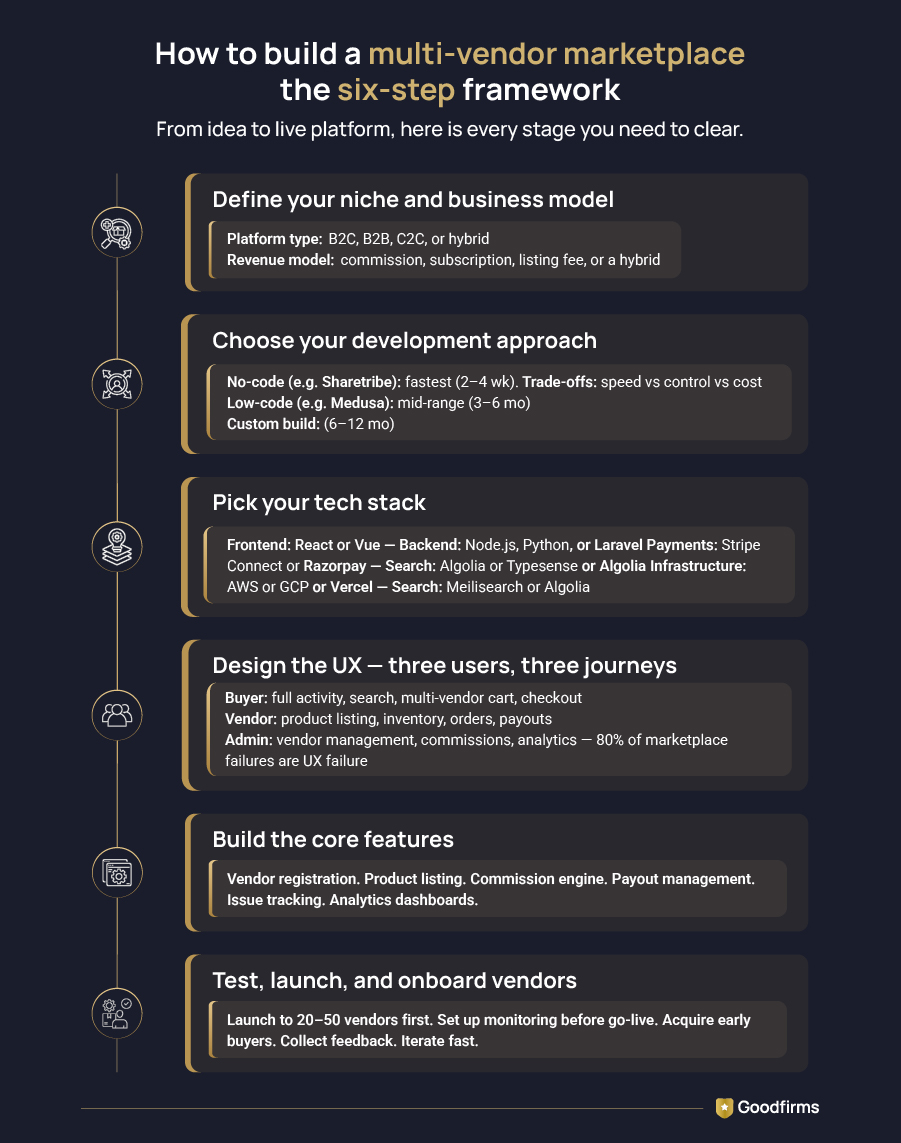
Step 1: Define Your Niche and Business Model
The first and foremost rule is to define your niche. The biggest mistake first-timers make is not to define their model. Trying to be everything to everyone right out of the gate. Etsy went deep into handmade goods. Houzz owns home design. Faire took wholesale. They all dominated their niche before going broad, and that is exactly the playbook to follow.
Ask yourself:
- What problem does my marketplace solve for buyers?
- What kind of vendors am I going after: B2C retailers, artisans, B2B suppliers, service providers?
- Am I building horizontal (multiple categories, like Amazon) or vertical (one niche, like Reverb for music gear)?
Once that is locked in, pick a revenue model. The four that work:
- Commission model - Take a cut of every sale. Amazon, Etsy. Most scalable.
- Subscription model - Vendors pay monthly or annually. Predictable revenue.
- Listing fee model - Charge per product listed, like eBay. Works well for high-volume categories.
- Freemium model - Free to start, pay for premium features. Great for onboarding vendors early.
Step 2: Choose Your Development Approach
Here is where it gets practical. There are four main ways to build a multivendor ecommerce platform, each with different trade-offs on cost, speed, and control:
|
Approach |
Best For |
Time to Launch |
|---|---|---|
|
SaaS platform (e.g. Sharetribe) |
MVP, fast validation |
2–8 weeks |
|
Shopify + multi-vendor plugin |
Small to mid-scale, quick setup |
4–12 weeks |
|
Open-source customization |
Tech-savvy teams, more control |
2–4 months |
|
Custom development |
Enterprise, complex requirements |
4–12 months |
For many startups and growing businesses, it is ideal to start with open-source or a proven multi-vendor marketplace software and customize it. The smartest path is with a vetted ecommerce development company, which balances speed, cost, and control without locking you into a SaaS vendor's limitations.
Step 3: Pick Your Tech Stack
If you are going custom, here is a proven tech stack, including headless commerce approaches, that scales well for marketplace platforms:
- Frontend: React.js or Vue.js, fast, component-based, great for dynamic UIs
- Backend: Node.js, Laravel (PHP), or Django (Python), all battle-tested
- Database: MySQL for structured data, MongoDB for flexible product catalogs
- Search: Elasticsearch or Algolia is non-negotiable for multi-vendor product discovery
- Payments: Stripe Connect, Razorpay, or PayPal handles split payments to vendors
- Cloud: AWS, Google Cloud, or Azure for hosting and CDN
- Mobile: React Native or Flutter for cross-platform marketplace apps
Step 4: Design the UX - Three Users, Three Journeys
Here is something a lot of builders miss: a multi-vendor marketplace has three completely different user types. Admins, vendors, and buyers all need their own experience. You cannot build one UI and expect it to work for all three.
- Admin dashboard: Full visibility - vendors, orders, commissions, disputes, analytics
- Vendor dashboard: Easy product listing, inventory management, order tracking, payout history
- Buyer experience: Intuitive search, clean vendor profiles, smooth checkout, order tracking
In 2026 Mobile-first ecommerce web design is non-negotiable. Over 60% of marketplace traffic comes from mobile. If your platform is not built for small screens, then you are surely losing buyers in seconds, simple as that.
Step 5: Build the Core Features
Do not launch without these. Every multi-vendor marketplace ecommerce development project needs this baseline:
- Vendor registration and onboarding with document verification
- Individual vendor storefronts with branding options
- Product listings with bulk import capability
- Automated commission calculation and split payment processing
- Order management with vendor-specific fulfillment workflows
- Customer review and rating system for vendors and products
- Dispute resolution and refund management tools
- Admin analytics - real-time revenue, GMV, vendor metrics
Step 6: Test, Launch, and Onboard Vendors
The hardest part of launching a marketplace is not the tech; it is the chicken-and-egg problem. No buyers without vendors. No vendors without buyers. Here is how successful marketplaces crack it:
- Start with supply: Recruit 20–50 strong vendors before launch. Offer free listings or lower commission for the first 3–6 months.
- Run a private beta: Bring in a small group of buyers before going public. Their feedback will save you from embarrassing issues.
- Launch in a niche: One city, one category, one vertical. Own it before you expand.
- Use content: SEO content (like this blog) targeting your buyers and vendors works.
- Use your vendors: Your early sellers are your best sales team. Incentivize them to bring more vendors in.
That is everything you need to build a multi-vendor marketplace, from idea to live platform.
Best Multi-Vendor Marketplace Platforms in 2026
Not everyone needs to build from scratch. The fastest way to create a multi-vendor marketplace is with purpose-built marketplace software. Here are the top platforms verified by Goodfirms user reviews and ratings in 2026:
|
Platform |
Best For |
Deployment Type |
Starting Price |
|---|---|---|---|
|
CS-Cart Multi-Vendor |
SMBs and enterprises needing deep customization |
Self-hosted |
$61/month or $3,590 lifetime |
|
Yo!Kart |
Startups launching quickly on a budget |
Self-hosted |
$999 one-time |
|
Dokan Multivendor Marketplace |
WordPress and WooCommerce users |
WordPress Plugin |
Free; paid plans from $149/year |
|
IXXO Multi-Vendor |
Entrepreneurs seeking a standalone or WordPress-based marketplace |
Standalone / WordPress |
From €99.90/month |
|
MultiMerch |
B2B and B2C operators wanting white-label control |
Self-hosted |
From $1,450 |
|
iScripts MultiCart |
Small to medium businesses needing a ready-made solution |
Hosted / Self-hosted |
$349 one-time |
|
Shuup |
Developers and enterprises requiring maximum flexibility |
Open Source |
Free (commercial support available) |
|
Mirakl |
Founders and startups needing a fast, scalable launch |
SaaS |
Custom / Enterprise pricing |
|
Sharetribe |
Large enterprises running high-volume B2B/B2C marketplaces |
SaaS |
From $39/month |
1. CS-Cart Multi-Vendor
Cs-cart multi vendor is probably the most feature-complete option out there. It has 500+ built-in ecommerce features and 2,000+ add-ons, like vendor onboarding, advanced promotions, no-code design tools, REST API, and open-source code. It is self-hosted, so you keep full control of your data.
- Best for: SMBs and enterprises needing a mature, customizable platform
- Pricing: Subscription from $61/month or lifetime license from $3,590
2. Yo!Kart
Yo!kart is built specifically for startups wanting to launch an Amazon or Flipkart-style marketplace fast. Comes with multi-currency, multi-language, and a built-in mobile app builder right out of the box.
- Best for: Startups on a budget who need speed
- Pricing: One-time license from $999
3. Dokan Multivendor Marketplace
The go-to for WordPress users. Dokan multivendor marketplace powers over 60,000 marketplaces worldwide. It turns any WooCommerce store into a full multi-vendor platform with vendor dashboards, commission management, and payout automation.
- Best for: WordPress/WooCommerce users
- Pricing: Free core plugin, paid plans from $149/year
4. IXXO Multi-Vendor
IXXO multi-vendor is a good option for entrepreneurs wanting to launch an Amazon or AliExpress-style marketplace quickly. Supports unlimited vendors, categories, and products with full admin control.
- Best for: Entrepreneurs needing a standalone solution or WordPress plugin
- Pricing: One-time purchase, Starter from € 99 .90/mo
5. MultiMerch
A white-label B2B/B2C multivendor marketplace solution with lifetime updates. MultiMerch has an invite-only community for marketplace owners, solid for first-time builders who need a strong support ecosystem.
- Best for: B2B and B2C operators wanting white-label control
- Pricing: Subscription with lifetime updates from $1,450
6. iScripts MultiCart
iScripts MultiCart is a web-based multi-vendor shopping cart software. You can build your own Etsy or Amazon-style marketplace with multi-language support, multiple shipping methods, and integrated payments.
- Best for: Small to medium operators wanting a hosted solution
- Pricing: One-time license at $349
7. Sharetribe
Sharetribe is a purpose-built marketplace platform designed for entrepreneurs who want to launch and scale a marketplace without building everything from scratch. It includes vendor management, payments, booking capabilities, customizable workflows, and APIs for extending functionality as the business grows.
- Best for: Founders and startups looking for a fast, scalable marketplace launch
- Pricing: Plans from $39/month
8. Shuup
Shuup is an open-source and fully customizable platform. It handles everything from a niche store to a large-scale marketplace, physical products, services, rentals, and digital goods, all supported.
- Best for: Developers needing maximum flexibility
- Pricing: Open source, free with commercial support options
9. Mirakl
Mirakl is an enterprise-grade marketplace platform that handles seller onboarding, product catalog management, order management, and payment processing, and integrates directly with existing ecommerce infrastructure like Adobe Commerce, Shopify, and Salesforce Commerce Cloud.
- Best for: Large enterprises running high-volume B2B or B2C marketplace operations
- Pricing: Plan starts from $699/month
Multi-Vendor Marketplace Development Cost in 2026
Even before one thinks to build a Multi-vendor marketplace, "How much does it cost to build a multi-vendor marketplace?" This is the question we hear most. Multi-vendor ecommerce development costs vary significantly depending on your approach. Here is a clear framework:
|
Development Approach |
Estimated Cost |
Timeline |
Best For |
|---|---|---|---|
|
SaaS platform (e.g. Sharetribe) |
$39 – $299/month |
2–8 weeks |
MVP, idea validation |
|
Shopify + multi-vendor plugin |
$5,000 – $15,000 |
4–12 weeks |
Small to mid-scale |
|
Open-source customization |
$15,000 – $50,000 |
2–4 months |
Growing businesses |
|
Custom development |
$50,000 – $250,000+ |
4–12 months |
Enterprise needs |
Source: Sharetribe Pricing, Sharetribe Changelog Pricing, Stripe Connect Pricing
Key Factors That Affect Your Budget
- Number of features: Basic checkout vs AI-powered recommendations, very different budgets
- Design complexity: Custom UI/UX vs pre-built theme
- Third-party integrations: Shipping APIs, payment gateways, ERP systems, CRM tools
- Team location: According to the U.S. Bureau of Labor Statistics, US-based developers cost $62–$90/hr on average, while South Asian development teams typically run $15–$30/hr
- Mobile app: Adding iOS and Android can double your development cost
- Ongoing maintenance: Budget 15–20% of initial dev cost annually
Most of the marketplace launches take between 6 and 12 months when you factor is platform setup, payment integrations, logistics infrastructure, and vendor onboarding. If someone is promising you a full-featured marketplace in 6 weeks, you should probably ask more questions.
AI Features in Multi-Vendor Marketplaces - What to Expect in 2026
AI is no longer a premium add-on for marketplace platforms. In 2026, buyers building or evaluating marketplace platforms should expect these capabilities as part of any serious build.
Here is what each one actually means in practice.
AI-Powered Search
Standard keyword search breaks down fast in a multi-vendor environment, too many products, too many vendor naming conventions, too much inconsistency in how things are listed. AI-powered search uses semantic understanding to surface what the buyer actually means, not just what they typed.
That includes natural language queries ("blue running shoes under 3,000 for flat feet"), synonym matching, and vector-based similarity search that finds relevant products even when the exact words do not match. Platforms like Algolia and Elasticsearch both now offer AI layers on top of their core engines.
Personalization at Scale
Multi-vendor marketplaces generate an unusually rich dataset, including browsing behavior, vendor preference, cart abandonment, category affinity, and repeat purchase patterns. AI models trained on this data can power real-time personalization: customized homepages, ranked search results by buyer history, and dynamic product recommendations that shift based on what a buyer has been doing in the session. The output is a higher conversion without changing the product catalog at all.
Fraud Detection
Marketplaces are higher-risk environments than single-vendor stores because you have more entry points, vendor onboarding, buyer accounts, payment flows, and review systems. AI-based fraud detection monitors patterns across all of these simultaneously: unusual vendor listing behavior, payment anomalies, fake review clusters, and account takeover signals. The practical value is catching problems before they become chargebacks or reputation damage, not after.
Dynamic Pricing
In a multi-vendor environment, pricing is fragmented by definition — every vendor sets their own. AI dynamic pricing tools can surface recommendations to vendors based on competitor pricing on the platform, demand signals, inventory levels, and seasonal patterns. For marketplace operators, this creates an opportunity to offer pricing intelligence as a premium vendor feature, which also makes the platform stickier. For buyers, it can mean surfacing the best-value option at the right moment.
These four capabilities are not futuristic. They are already available through platforms like Mirakl, through API integrations with tools like Algolia and Stripe Radar, and through custom builds using open-source ML libraries. The question in 2026 is not whether to include AI; it is which layer to prioritize first, given your budget and your vendor base.
Types of Multi-Vendor Marketplaces
Looking at Multi-vendor marketplace examples like Amazon, Alibaba, and Etsy makes one thing clear: not all marketplaces are built the same way. Here are the main types:
B2C Marketplace
In B2C path, businesses sell directly to consumers. Examples: Amazon, Flipkart. Revenue is driven by transaction commissions and sponsored listings. The most familiar model.
B2B Multi Vendor Marketplace
A B2B multi-vendor marketplace model connects businesses selling to other businesses. Examples: Alibaba, IndiaMART, ThomasNet. etc. Here, they provide Bulk ordering, credit terms, complex procurement, and more; also, it is the fastest-growing segment in 2026.
C2C Marketplace
In this model, Individuals sell to individuals. Examples: eBay, OLX, Vinted. Trust features, verified profiles, buyer protection, and dispute resolution are everything here.
Service-Based Marketplace
Here, Vendors offer services, not products. Examples: Fiverr, Upwork, Airbnb, Uber. It needs strong booking, scheduling, and review systems.
Niche or Vertical Marketplace
A niche or Vertical marketplace is strongly focused on one category. Examples: Etsy (handmade), Reverb (music gear), Houzz (home design), Faire (wholesale gifts). This model has higher conversion rates, a stronger community, and niche wins.
Key Features of a Multi-Vendor Marketplace Platform
A multi-vendor e-commerce marketplace has to serve three different user groups at once. Here is what each needs:
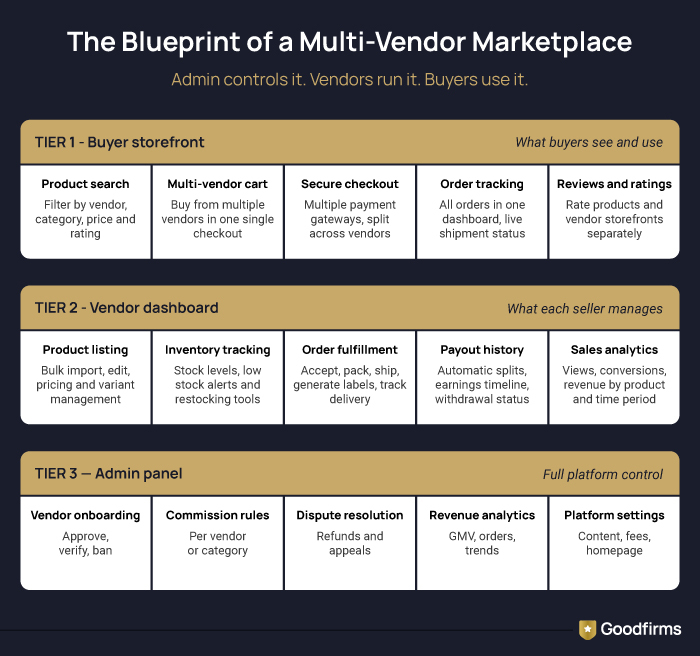
Admin Features
- Vendor onboarding, verification, and approval workflows
- Commission and fee management with flexible rules
- Central order management across all vendors
- Revenue analytics, GMV tracking, and financial reporting
- Dispute resolution and refund tools
- Content management and homepage curation
Vendor Features
- Dedicated storefront with branding options
- Product listing with bulk import/export
- Inventory tracking and low-stock alerts
- Order fulfillment dashboard with shipping labels
- Payout history and automatic payment processing
- Sales analytics, views, conversion rates, revenue
Buyer Features
- Advanced search with filters by category, price, vendor, and rating
- Multi-vendor cart, buy from multiple vendors in one checkout
- Secure payment processing with multiple gateway options
- Order tracking across all vendors in one dashboard
- Product and vendor reviews and ratings
- Wishlist and saved vendor functionality
Challenges in Multi-Vendor Marketplace Development
Let us be honest, building a marketplace is rewarding, but there are real challenges that single-vendor stores never deal with. Knowing these upfront saves you time, money, and frustration.
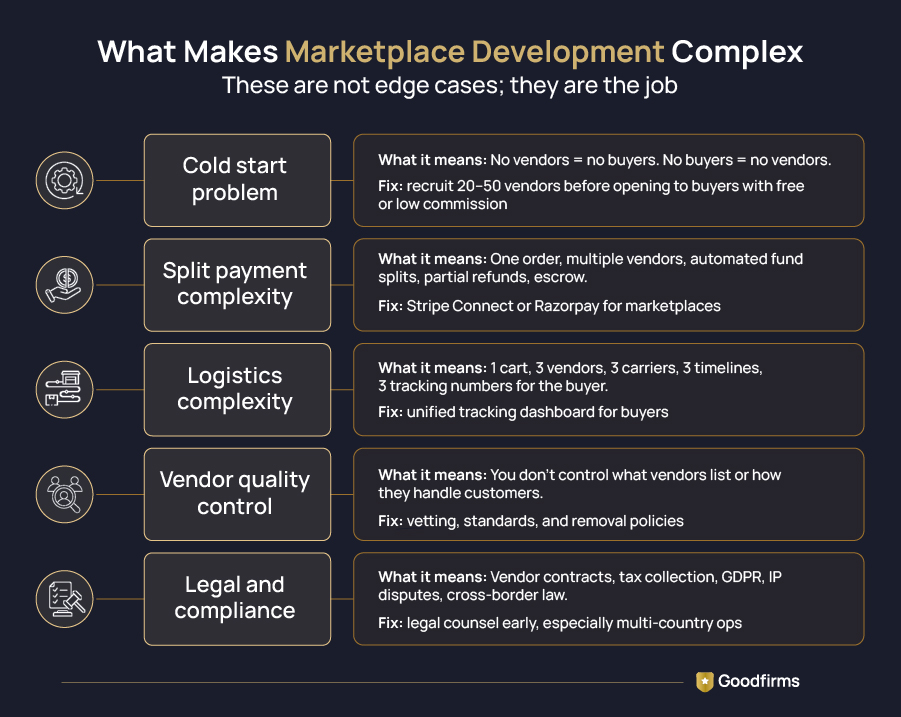
The Cold Start Problem
One cannot launch a platform with no buyers without products. Solve supply first, recruit strong vendors before launch, offer early incentives (free listings, lower commission), and let the demand side follow.
Vendor Trust and Quality Control
In a multi-vendor marketplace, one needs strict rules, because here you do not control inventory, maintaining quality and vendor behavior becomes your biggest operational challenge. You need solid vetting, clear standards, and the ability to remove bad actors.
Split Payment Complexity
Orders spanning multiple vendors require infrastructure that automatically splits funds, handles partial refunds, manages escrow, and routes payouts to individual accounts. Stripe Connect handles much of this, but integration needs planning.
Logistics and Shipping
One cart, three vendors, three shipments, each with its own carrier and timeline. You need a clear policy on whether vendors handle their own shipping or you provide centralized logistics.
Legal, Tax, and Compliance
In marketplaces, the issue of vendor contracts, cross-border tax collection, GDPR compliance, IP disputes, etc, stacks up fast. It is essential to budget for legal counsel early, especially if you are operating across multiple countries.
ERP and API Integrations
Enterprise-grade marketplaces often need to integrate with ERP systems, CRM platforms, warehouse management systems, and complex logistics networks, requiring experienced API development companies.
Online Multi-Vendor Marketplace Business Ideas for 2026
Looking for a direction, ideas, a eureka moment for your business? Here are some of the most promising online multi-vendor marketplace business ideas right now, especially strong in underserved geographies:
- Hyperlocal grocery marketplace — Connect local farmers and vendors with urban buyers for same-day delivery.
- D2C artisan products marketplace — An Etsy-style platform for local craftmakers and independent designers.
- B2B industrial parts marketplace — MRO components for manufacturing businesses. High-order values are massively underserved online.
- Freelance niche marketplace — Go vertical instead of competing with Fiverr. Legal professionals, financial advisors, and sustainability consultants.
- Equipment rental marketplace — Create a multi-vendor marketplace like eBay, but for renting construction gear, photography equipment, and event furniture.
- EdTech course marketplace — Independent educators and tutors, for a specific subject or demographic.
- Sustainable products marketplace — Eco-certified, fair-trade, or sustainable vendors only. Consumer demand is growing fast.
- Local service marketplace — Plumbers, electricians, cleaners, all bookable on one platform for a specific city or region.
Shopify Multi-Vendor Marketplace: Is It a Good Option?
Here is the honest answer: Shopify development powers the world's most popular ecommerce platform, but it was not built to be a multi-vendor marketplace. Natively, Shopify supports a single vendor only. To run a multi-vendor setup, you need third-party plugins on top.
Top Shopify Multi-Vendor Plugins
- Webkul Multi Vendor Marketplace — Most widely used. Adds vendor storefronts, commission management, and product approval workflows.
- Multi-Vendor Marketplace by AppStle — Newer option, competitive pricing, modern vendor dashboard.
- Shipturtle — Focused on dropshipping and multi-vendor fulfillment with strong logistics features.
Pros
- Fast setup - functional marketplace in 4–8 weeks
- Massive app ecosystem for payments, shipping, marketing
- Reliable hosting - Shopify handles performance at scale
- Strong built-in SEO tools
Cons
- Transaction fees - 0.5%–2% on every transaction unless you use Shopify Payments
- Limited vendor control compared to purpose-built platforms
- Costs stack up at scale, a monthly subscription plus plugin fees
- Plugin dependency: if a key plugin breaks, your whole marketplace feels it
Shopify works well for validating your concept, or if you are already on the platform. For serious, scalable operations? A purpose-built platform or a custom build will serve you better long term.
Conclusion
As we have learned and seen from the blog, building a multi-vendor marketplace in 2026 is more accessible than it is, but that does not mean it is easy. The platforms are better, the tools are sharper, and the demand from buyers and vendors is real. But the main challenge is still the same: picking the right niche, choosing the right tech partner, and building something that vendors trust and buyers keep coming back to.
The good news is you do not have to figure it all out alone. Whether you are choosing between platforms, finding a dev partner, or evaluating the right multi-vendor marketplace solution for your budget, Goodfirms has the data, reviews, and verified listings to help you make confident decisions.
FAQ - Multi-Vendor Marketplace
1. What is a multi-vendor marketplace?
A multi-vendor marketplace is an online platform where multiple independent sellers list and sell products or services to buyers through a single storefront. The platform operator earns through commissions, listing fees, or subscriptions, without owning or managing inventory. Examples: Amazon, Etsy, Flipkart, eBay.
2. What is multi-vendor ecommerce?
Multi-vendor ecommerce is an online selling model where multiple independent sellers operate simultaneously through one platform. Unlike a traditional single-seller store, a multi-vendor ecommerce platform like Amazon or Etsy allows hundreds or thousands of vendors to list, sell, and fulfill, all under one storefront.
3. How much does it cost to build a multi-vendor marketplace in 2026?
Costs range from $39/month for a basic SaaS setup to $250,000+ for a fully custom enterprise platform. A realistic startup budget using open-source with customization falls between $15,000 and $50,000. Custom development for a feature-rich, scalable platform typically runs $50,000–$250,000, depending on scope, integrations, and team location.
4. What is the best platform for a multi-vendor marketplace in 2026?
Depends on your needs. CS-Cart Multi-Vendor is a mature self-hosted solution. Yo!Kart for startups on a budget. Dokan for WordPress/WooCommerce users. Shuup for open-source flexibility. Compare 150+ verified marketplace platforms on Goodfirms' marketplace software directory.
5. How long does it take to build a multi-vendor marketplace?
A SaaS-based marketplace can go live in 2–8 weeks. Open-source customization takes 2–4 months. Custom development takes 4–12 months. Most marketplace launches take 6–12 months when you factor in integrations, vendor onboarding, and compliance.
6. What is the difference between a single-vendor and a multi-vendor marketplace?
Single-vendor: one seller, the store owner, selling directly to buyers. Multi-vendor: many independent sellers, one platform, the operator earns a fee. Key differences include inventory ownership, scalability, revenue model, and operational complexity.
7. Can I build a multi-vendor marketplace on Shopify?
Yes, but it is not native. You need plugins like Webkul or AppStle for vendor management, dashboards, and commissions. Shopify works well for MVPs and smaller scales. For larger, more complex operations, a purpose-built platform like CS-Cart is the better long-term call.
8. What are the main revenue models for a multi-vendor marketplace?
Commission (percentage per sale), subscription (vendors pay monthly), listing fees (per product listed), and freemium (free base, paid premium). Most successful marketplaces combine two or more, a base commission plus optional promoted listings is the most common combo.