Key takeaways
- Global eCommerce is growing from $4,408B in 2025 to $4,940B in 2026 at 12.1% CAGR — the architecture you pick today will determine how much of that growth your store can capture.
- If your store is under $1M GMV, headless is likely too early — the cost and complexity only start making sense once you hit meaningful transaction volume.
- A headless store takes 3–9 months to build, while a traditional store can go live in days — know which timeline your business can actually afford before you decide.
- Slow page speed is one of the top 10 reasons shoppers leave without buying — headless architecture can fix this by enabling web pages to load under 2 seconds.
- Shoppers love personalized recommendations more than almost any other feature — and headless is the only setup that delivers them consistently across your website, app, and every other channel.
For every 100 milliseconds of improvement in page load time, eCommerce conversion rates measurably increase. In 2026, the stores performing well aren't just selling better products; they are built on the right architecture from day one.
In short, the architecture decision, whether headless or traditional, determines the success of your ecommerce store. As in the architecture determines how fast your store loads, how far it scales, and whether you can sell across multiple channels without going back to the drawing board every single time.
Planning to launch an eCommerce store? Explore Goodfirms' vetted list of top headless commerce development companies to find an agency that matches your technical requirements, budget, and growth stage.
This guide will serve as a practical decision framework—not a technical lecture—to help you choose the architecture that fits where your business actually is today. And if you are still not sure which tech stack is right, Goodfirms lists verified eCommerce development companies you can evaluate by budget, tech stack, and client reviews.
Headless Commerce vs Traditional Commerce: A Quick Verdict Before the Deep Dive
- Headless commerce works better for brands requiring frequent changes in customer experiences, and omnipresence without disrupting the core commerce operations.
- Traditional eCommerce still stays relevant for online stores requiring a quick launch and is managed by non-technical teams.
Key Insight: Traditionally architected stores can soon get obsolete when omnipresence is required, or speed needs to be improved during traffic spikes in holiday seasons.
Choosing between headless and traditional ecommerce shapes your store's performance ceiling, your team's day-to-day velocity, and your ability to expand into new channels — making it one of the most consequential decisions an online business can make.
And, Why This Decision Matters More Than Ever?
As per the eCommerce Market Size, Trends, and Growth Analysis Report 2026, the eCommerce market size has grown rapidly in recent years. And is likely to grow from $4408.14 billion in 2025 to $4940.24 billion in 2026 at a compound annual growth rate (CAGR) of 12.1%.
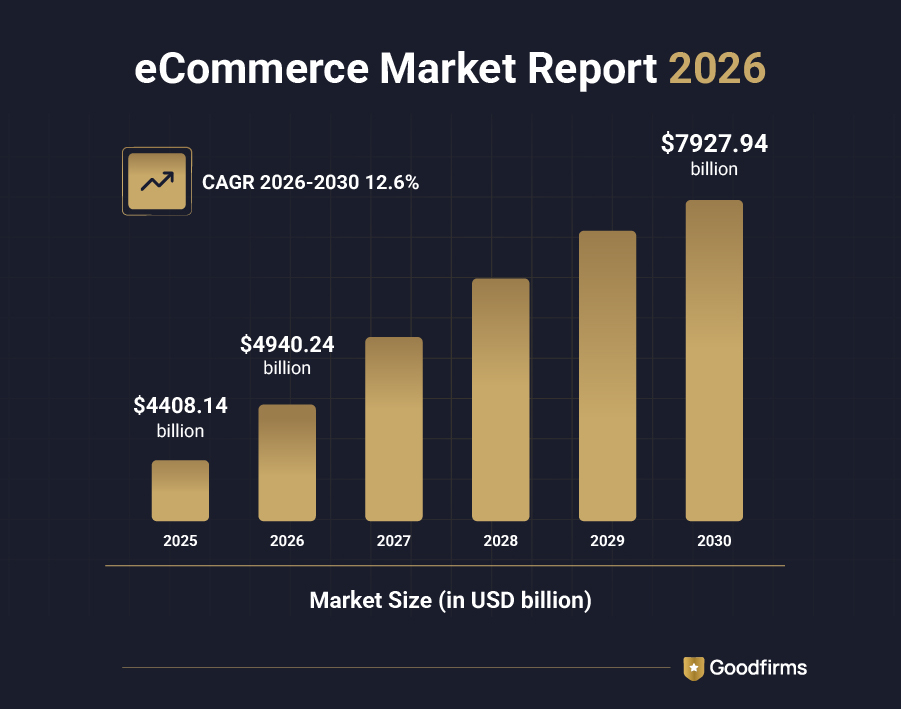
A booming market rewards businesses that build correctly from the start and that makes the choice between headless and traditional commerce more critical. Before you can make the right call for your business, you need to understand what each architecture actually means in practice.
What Is Traditional eCommerce?
Traditional eCommerce platforms couple the frontend (what shoppers view) and the backend (where product data, orders, and inventory live). The backend and frontend of a traditional eCommerce platform share the same codebase and are deployed as a single unit.
Real-world examples - Shopify (standard themes), WooCommerce, and Magento 2 in its classic setup
For a solo founder launching a first store or a small brand selling a tight product catalog, this setup works well. Everything is pre-configured. Themes are drag-and-drop. Checkout, payment gateways, shipping rules, and product pages come wired together out of the box. You do not need a backend engineer to go live.
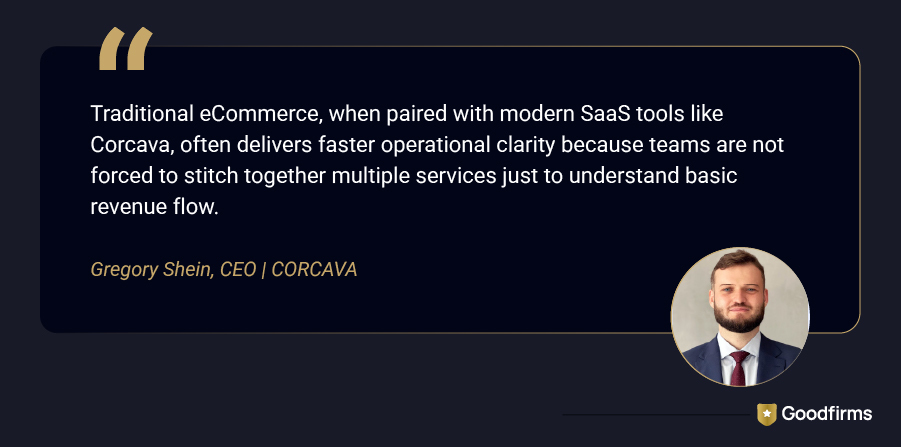
The problem arises when your business outgrows the defaults. Customizing the storefront beyond what the theme system allows is not possible with traditional eCommerce platforms. Adding a second sales channel — a mobile app, a kiosk, a voice interface — means duplicating your content and logic and adding an extra development cost. The frontend and backend, glued together, start to feel like a constraint as an eCommerce store grows and expands.
What Is Headless Commerce?
Headless commerce separates the frontend presentation layer from the backend commerce engine. The backend — product catalog, pricing rules, inventory, cart, checkout, and order management — continues to run on a commerce platform such as Shopify Plus, BigCommerce, or Commercetools. The frontend, however, is built independently, using any framework the development team chooses: Next.js, Nuxt, Astro, Remix, or a custom React application.
The two layers communicate through APIs — typically REST or GraphQL. The frontend requests product data, cart state, and checkout tokens from the backend. The backend does not care what renders those responses. It could be a website, a mobile app, a smart mirror, or a voice assistant.
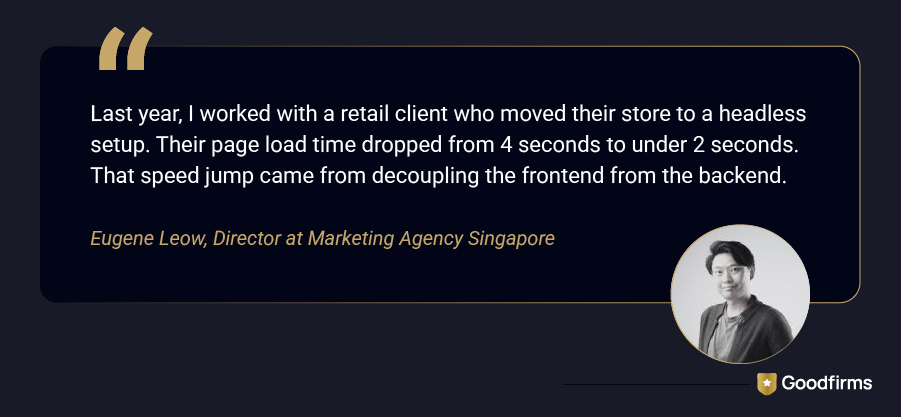
This decoupling is exactly what gives headless commerce its reputation for flexibility. Developers are no longer working inside the constraints of a theme engine. Designers are no longer inheriting spacing rules and component libraries that belong to someone else. The brand controls the entire experience, top to bottom.
If you are new to decoupled architecture altogether, read: Headless CMS vs Traditional CMS — What is the Difference? It can help you understand headless vs traditional cms for e-commerce better.
One of the most popular real-world implementations of headless architecture is - Headless Shopify.
What is Headless Shopify?
Headless Shopify uses Shopify purely as the commerce backend while a custom frontend connects via the Storefront API. Shopify's Hydrogen framework makes this transition more structured for development teams. It is the most practical entry point into headless commerce for businesses already on Shopify that have outgrown theme-based customization.
Definitions explain what each architecture is. The headless commerce vs traditional commerce diagram below shows how each one actually works in practice.
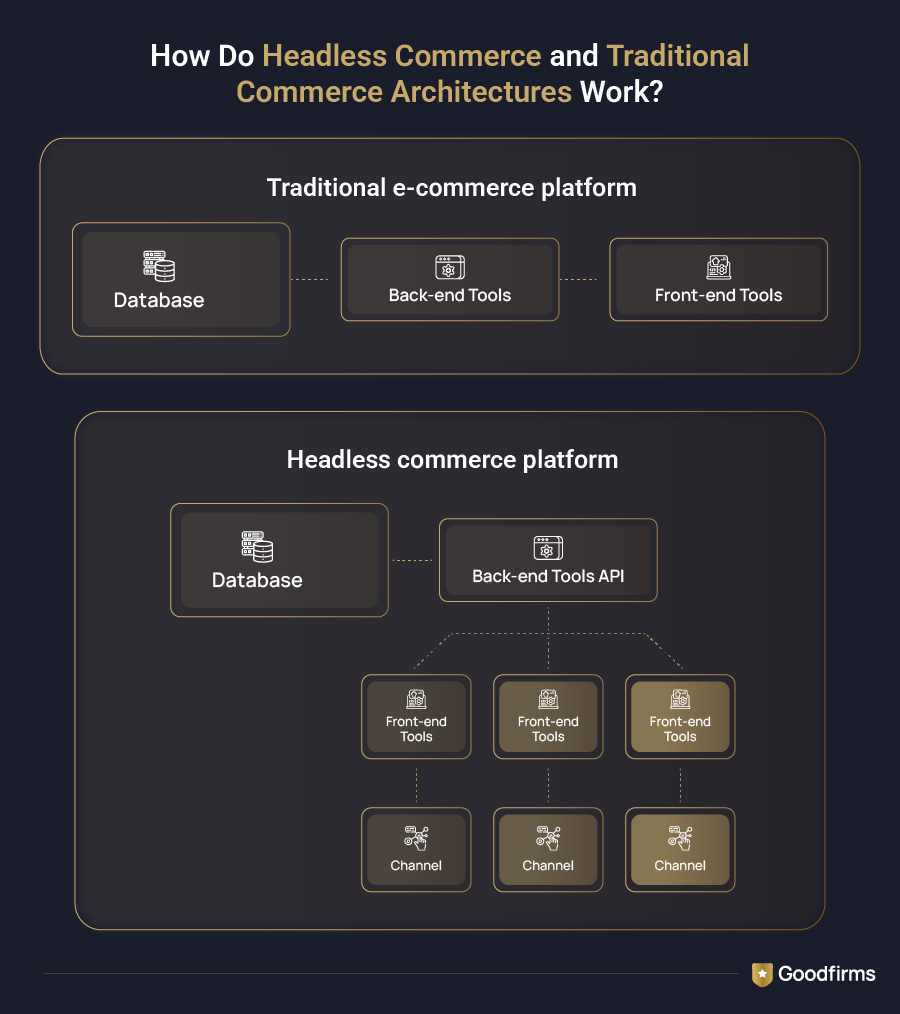
Now we know what headless commerce and traditional eCommerce mean. To get more clarity on this subject, let’s have a look at what actually happens behind the scenes when a shopper visits your store under each architecture.
How Each Architecture Handles a Customer's Journey
Understanding the difference in experience delivery makes the architectural choice clearer.
Traditional commerce — a tightly coupled journey
A shopper lands on a product page. The platform renders the page server-side using its own templating system, pulls product data from its own database, applies the active theme's HTML, and returns a fully assembled page. Every page request follows this path. Personalization, A/B testing, or performance tuning requires either platform-native tools or third-party plugins — and those plugins share the same runtime as the rest of the store.
Headless commerce — a decoupled journey
The same shopper lands on a product page. The frontend — a Next.js application, for instance — was statically generated at build time and is served from a CDN edge node close to the shopper. The page loads in milliseconds. Dynamic elements like stock status or personalized recommendations are fetched asynchronously after the initial render. The backend commerce API has no opinion on how the page looks. It just answers requests.
With both journeys mapped out, a structured side-by-side view makes the trade-offs easier to evaluate for your specific situation.
Headless vs Traditional Commerce: Side-by-Side Summary
|
Dimension |
Traditional eCommerce |
Headless Commerce |
|---|---|---|
|
Performance and Page Speed |
Server-side rendering creates latency, especially for international shoppers; plugin-heavy stores slow down further |
Pre-built pages served from CDN edges; consistently stronger Core Web Vitals and faster LCP scores |
|
Design and Customization Flexibility |
Theme system limits differentiation; deviating from defaults creates technical debt |
Complete frontend freedom; animations, layouts, and interactions built exactly as designed |
|
Omnichannel and Multi-Touchpoint Selling |
Built primarily for the web, each additional channel requires separate integrations |
Channel-agnostic by design; one backend powers web, app, kiosk, and voice simultaneously |
|
Developer Experience and Tech Stack Freedom |
Locked into platform-specific languages like Liquid or PHP narrows the hiring pool |
Works with any modern JavaScript framework; teams use tools they already know |
|
Cost and Total Investment |
Low upfront cost; predictable at small scale; hidden costs emerge as the business grows |
Higher upfront investment; requires senior engineering; strong ROI for businesses above $1M GMV |
|
Security Posture |
Larger attack surface; plugin vulnerabilities and exposed admin endpoints are recurring risks |
Reduced attack surface; no direct database access from frontend; all operations run through authenticated API calls |
The side-by-side view tells you where the two architectures differ. The detailed comparison below tells how these differences can impact your eCommerce business.
Headless Commerce vs Traditional eCommerce: A Detailed Comparison
The right architecture is not the most advanced one — it is the one that fits your business conditions. These six dimensions reveal where each one holds up and where it does not.
Performance and Page Speed
Traditional platforms render pages on a central server and deliver the result to the browser. This works fine at moderate traffic, but creates latency — particularly for international shoppers far from the origin server. Plugin-heavy stores compound this because every installed extension adds code that runs on each page load.
As per Goodfirms’ Survey - Effective Ways to Improve eCommerce Conversion Rate, slow loading is one of the top 10 reasons for low eCommerce conversion rate.
Also, according to McKinsey’s State of the Consumer 2025 report, consumer tolerance for friction and inconvenience continues to decrease, and their expectations for speed and prompt services increase.
This is where headless architecture plays a significant role in eCommerce.
Headless frontends are commonly built with static site generation or incremental static regeneration, meaning most pages are pre-built and served from CDN edges. Google's Core Web Vitals scores — Largest Contentful Paint in particular — tend to be significantly better on headless storefronts. For every 100ms of load time improvement, conversion rates measurably increase. That connection is well-established in ecommerce analytics.
Design and Customization Flexibility
Traditional platforms give merchants a theme system — a constrained design environment. Most themes share the same structural patterns, which is why stores built on the same platform often look similar. Developers who need to deviate from what the theme system allows must either hack around it or use platform-specific custom code, which creates technical debt that compounds with every platform update.
Headless removes that ceiling. The frontend developer writes whatever HTML, CSS, and JavaScript the design calls for. Headless frontends support complex animations and micro-interactions without platform workarounds. Editorial-style layouts that traditional themes cannot produce are built directly in code.
Omnichannel and Multi-Touchpoint Selling
Traditional eCommerce was designed for the web. Selling through a native mobile app, an in-store kiosk, a smart TV application, or a conversational commerce interface requires either separate integrations for each channel or rebuilding the experience from scratch on each platform.
Headless, by contrast, is channel-agnostic from the ground up. Because the commerce logic lives in the API, any frontend — web, app, kiosk, voice — can call the same product, cart, and checkout endpoints. A brand running a website, an iOS app, and an in-store digital screen does not need three separate commerce backends. It needs one headless backend and three frontends.
Personalized Recommendations
Traditional ecommerce platforms handle personalization through native tools or third-party plugins. Those plugins operate within the same runtime as the rest of the store, which limits how deeply they can access behavioral data across sessions and channels. Recommendations are typically based on basic signals — browsing history or purchase data from a single channel — and are constrained by what the platform's plugin ecosystem supports.
Headless commerce gives personalization engines direct API access to unified customer data across every touchpoint. Because the frontend is custom-built, recommendation logic can be embedded anywhere in the experience — product pages, landing pages, post-purchase flows, or app screens — without plugin limitations. A shopper browsing on mobile, then returning on desktop, receives consistent and connected recommendations because the backend is the same regardless of the frontend they are using.
As per Goodfirms' survey on The Ultimate Guide To E-Commerce Apps, personalized product recommendations rank among the most loved features by shoppers in eCommerce apps — and headless architecture is uniquely positioned to deliver that capability consistently across every channel from a single backend.
Developer Experience and Tech Stack Freedom
Traditional platforms lock developers into platform-specific templating languages and component systems. Shopify's Liquid, for instance, is a proprietary templating language that developers must learn. WooCommerce ties teams to the WordPress PHP ecosystem. These are not inherently bad choices, but they narrow the hiring pool and limit the tools teams can use.
Headless lets teams work in whichever JavaScript framework they are strongest in. A team already building in Next.js for other projects can apply that expertise directly to the commerce frontend. This matters for recruitment, for velocity, and for long-term maintainability.
Cost and Total Investment
Traditional eCommerce has a lower initial cost. A Shopify store with a paid theme can be launched by a single person in a week. WooCommerce requires hosting and some configuration, but is still accessible to small teams. The cost curve is predictable at low scale.
Headless Commerce carries a higher upfront investment. Building a custom frontend requires at least one experienced frontend developer, a clear component architecture, and an ongoing maintenance budget. The commerce platform itself (Shopify Plus, Commercetools, Elastic Path) often costs significantly more than entry-level plans. For businesses generating substantial revenue and needing the flexibility headless provides, this investment has a clear ROI. For businesses under $1M GMV, it can be premature.
Security Posture
Traditional CMS-based ecommerce stores are common targets precisely because their architecture is well-understood. Plugin vulnerabilities, outdated themes, and exposed admin endpoints are recurring attack vectors. Merchants are responsible for keeping plugins updated and monitoring for compatibility issues that arise after security patches.
Headless Commerce reduces the attack surface meaningfully. The frontend has no direct database access. There is no admin panel exposed on the same domain as the storefront. All commerce operations route through authenticated API calls. This architecture does not eliminate security concerns — API key management and access control still require discipline — but the threat model is different and generally more contained.
The detail is important. So is having a clean summary of what you are actually gaining and giving up with each choice.
Headless Commerce vs Traditional Commerce: Pros and Cons
Here is an honest look at the pros and cons of each architecture in detail.
Headless Commerce Pros
- Total front-end freedom: Build with React, Vue, Next.js, or any framework without platform constraints.
- True omnichannel: A single back-end powers web, mobile app, kiosk, voice, AR/VR, and IoT touchpoints simultaneously.
- Performance gains: JAMstack and edge-rendered storefronts routinely achieve sub-second LCP, directly boosting conversion.
- Independent scaling: Front-end and back-end scale separately; a traffic spike doesn't impact the commerce engine.
- Best-of-breed stack: Swap CMS, search, PIM, or payment providers without re-platforming the entire storefront.
- Faster iterations: Design and UX teams deploy front-end changes without waiting on platform release cycles.
Headless Commerce Cons
- High Initial Investment: Custom front-end development demands senior engineers and a larger discovery budget.
- Operational Complexity: More vendors, more contracts, more integration points to monitor and maintain.
- Longer Time to Launch: A greenfield headless build typically takes 3–9 months versus weeks on a traditional platform.
- Ownership Burden: You own the presentation layer entirely; no vendor patches broken components for you.
- Overkill for Smaller Catalogs: The architectural overhead rarely pays off below a meaningful transaction volume.
Traditional Commerce Pros
- Fast Time to Market: A Shopify or WooCommerce store can be live in days using themes and built-in tooling.
- Lower Upfront Cost: Pre-built templates, app marketplaces, and managed hosting reduce development spend significantly.
- Non-Technical Friendly: Merchants manage content, products, and promotions without engineering involvement.
- Mature Plugin Ecosystems: Thousands of integrations for tax, shipping, loyalty, and marketing are one click away.
- Single Vendor Support: Platform bugs, security patches, and PCI compliance are largely the vendor's responsibility.
- Proven Checkout Flows: Platform-native checkouts carry optimization learnings from millions of stores.
Traditional Commerce Cons
- Customization Ceiling: Deep UX differentiation is blocked by platform templates, theme APIs, and proprietary liquid/template languages.
- Performance Compromises: Shared infrastructure and heavy theme JavaScript can limit page-speed scores at scale.
- Vendor Lock-in: Migrating data, URLs, and integrations to a different platform is painful and expensive.
- Weak Omnichannel: Extending the same commerce engine to mobile apps or IoT requires hacks or third-party middleware.
- Scaling Limits: High-traffic flash sales can expose shared-infrastructure ceilings that enterprise headless setups handle natively.
After going through these pros and cons of both architectures in use, the decision comes down to one practical question: Which architecture fits where your business actually is right now?
When Traditional eCommerce Still Makes More Sense
Traditional eCommerce is not a legacy choice waiting to be replaced. It is the right architecture for a specific set of business conditions. Consider sticking with it when:
-
Your business operates primarily on a single web channel with no near-term plans to expand to native apps or other touchpoints.
-
Your team does not include experienced JavaScript frontend developers.
-
You need to move quickly — a product launch, a seasonal expansion, a pivot that cannot wait six months for a frontend rebuild.
-
Your marketing team needs daily content control without developer involvement.
-
Your current annual revenue does not justify the overhead of a custom frontend build and ongoing maintenance.
When Headless Commerce Is the Smarter Bet
The businesses that benefit most from headless commerce share recognizable characteristics. The investment pays back when:
-
You are selling across multiple channels — web, mobile app, kiosk, marketplace — and maintaining separate experiences for each is creating real operational overhead.
-
Your brand requires a bespoke, editorial-quality frontend that existing theme systems cannot produce.
-
Page speed is a measurable constraint on conversion, and you have exhausted traditional optimization options.
-
You have an in-house development team or a reliable agency partner with headless project experience.
-
You anticipate integrating multiple third-party systems — a PIM, an ERP, a CDP — and need a composable architecture that can accommodate those connections cleanly.
After this detailed comparison, here are a few commonly asked questions that are worth addressing before you make your move.
FAQs: Headless Commerce vs Traditional Commerce
Can a Business Migrate from Traditional eCommerce to Headless Without Losing SEO Rankings?
Yes, but it requires careful URL preservation, proper redirect mapping, and maintaining crawlable content during transition. A well-executed headless migration using server-side rendering or static generation can actually improve Core Web Vitals scores, which positively influences organic rankings over time.
Does Headless Commerce Work Well for B2B eCommerce Stores?
Absolutely. B2B stores often need custom pricing tiers, account-based catalogs, and ERP integrations — all of which headless handles cleanly via APIs. It also supports complex buyer workflows like quote requests and multi-approver checkouts without fighting a monolithic platform's opinionated defaults.
Which Headless Commerce Backend Platforms are Most Widely Adopted in 2026?
Commercetools, Shopify Plus (via Storefront API), BigCommerce, and Elastic Path lead adoption. Each suits different scales and use cases — Commercetools for enterprise, Shopify Plus for brands wanting a familiar backend with a custom front-end.
How Does Headless Commerce Affect Third-Party App Integrations Like Loyalty Programs Or Reviews?
Third-party tools built for traditional platforms may not offer native headless support. Brands must verify API availability before choosing tools. Most modern loyalty, reviews, and personalization vendors now offer JavaScript SDKs or REST APIs that integrate cleanly into headless frontends.
Is Headless Commerce Viable for Small Businesses Planning Significant Growth?
It depends on the growth timeline. Building headless prematurely strains early budgets. A practical approach is launching on a traditional platform first, then re-platforming to headless once revenue justifies the investment — typically when omnichannel needs or performance bottlenecks become real constraints.
Conclusion: Headless or Traditional CMS? What Stays Relevant for eCommerce in 2026?
Choosing between headless and traditional eCommerce is a decision that can help your online business to scale and improve conversion rate.
Traditional platforms remain genuinely strong for brands prioritizing speed to market, lean teams, and single-channel selling. Headless commerce earns its complexity when brand experience, performance, and omnichannel reach are non-negotiable growth drivers — particularly for businesses where mobile app development is already part of the roadmap.
Neither architecture is universally superior. The right choice depends on your current revenue, team capabilities, channel ambitions, and how much your storefront experience actually differentiates you from competitors.
Start with where your business is today — not where you hope it will be. If your existing platform is limiting measurable growth, that is your signal to explore headless. If it is serving customers well, optimize what you have.