Key takeaways
- $35,000 to $70,000 can cover a theme-based Magento Open Source build, while enterprise or B2B implementations can reach $250,000 to $600,000+.
- $22,000 to $190,000+/year is the published planning range for Adobe Commerce licensing, while Magento Open Source has no platform license fee.
- $10,000 to $150,000+ may go toward integrations, depending on the Magento edition and complexity of systems such as ERP, CRM, PIM, and OMS.
- Magento migration can range from $20,000 to $80,000 for platform migration to $50,000 to $200,000 for complex Magento 1 or legacy migrations.
- Hosting, extensions, upgrades, maintenance, security, and payment processing can continue adding to Magento's total cost after launch.
Magento development cost in 2027 depends on much more than the cost of coding a storefront. The platform you choose, design, custom development, extensions, hosting, integrations, migration, security, maintenance, and payment processing can all affect the final budget.
This guide breaks down Magento development costs into individual expenses so you can see what you are actually paying for.
Pricing note: Magento and third-party pricing can change. Always confirm the current price with the provider before signing a contract.
The right development partner can make a major difference to the cost, complexity, and long-term performance of your store. Compare top Magento development companies, review their expertise and portfolios, and then shortlist the right team for your project.
Magento Development Cost in 2027 at a Glance
A theme-based Magento Open Source build at $35,000 to $70,000, a mid-market store at $100,000 to $250,000, and an enterprise or B2B implementation at $250,000 to $600,000+.
Goodfirms provides another useful benchmark for developer costs. Its current Magento directory reports a $37/hr median hourly rate worldwide.
For freelance hiring, Upwork currently reports $18 to $39/hr for Adobe Commerce (Magento 2) developers based on certain historical contracts worldwide.
What Makes Up Magento Development Cost?
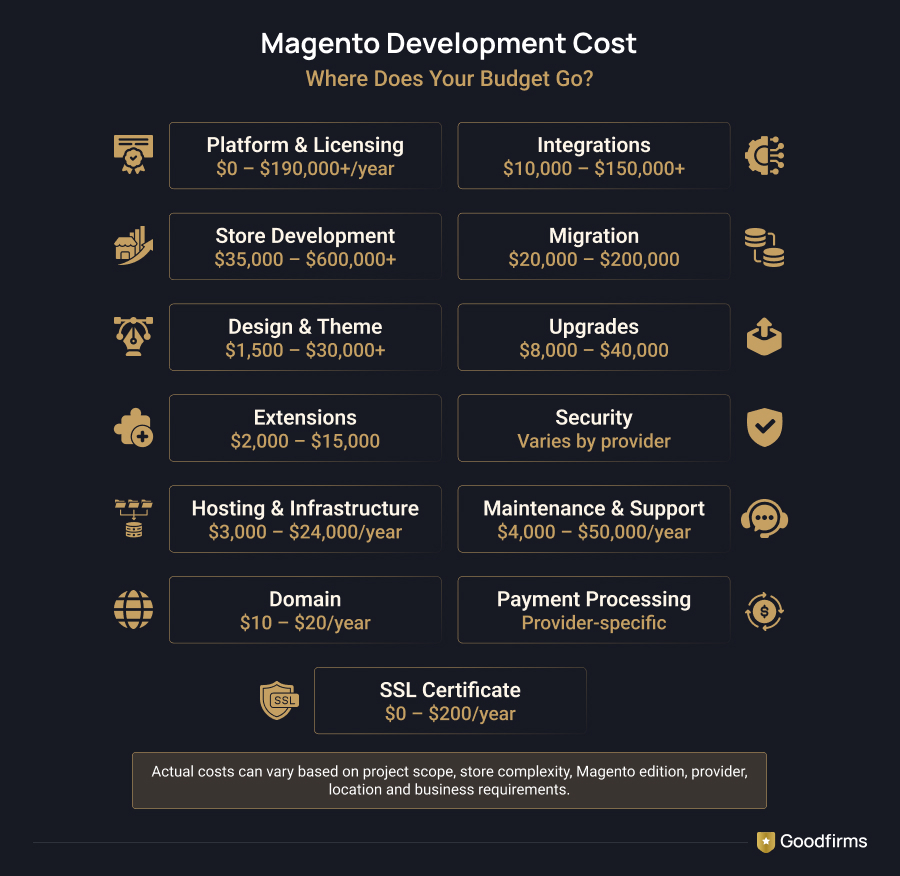
A Magento budget can contain the following expenses:
|
Cost component |
What it covers |
Estimated cost |
|---|---|---|
|
Magento platform |
Open Source or Adobe Commerce license |
$0 for Open Source; 22,000–190,000+/year for Adobe Commerce |
|
Development |
Backend, frontend, custom functionality and implementation |
35,000–70,000 for a theme-based store; 100,000–250,000 for a mid-market store; 250,000–600,000+ for enterprise/B2B |
|
UI/UX and theme |
Theme customization or custom storefront design |
1,500–8,000 for theme customization; 8,000–30,000+ for a custom theme |
|
Extensions |
Third-party modules and additional functionality |
2,000–15,000 |
|
Hosting |
Servers, cloud infrastructure and related services |
3,000–24,000/year |
|
Domain |
Store domain registration |
10–20/year |
|
SSL |
HTTPS certificate |
0–200/year |
|
Integrations |
ERP, CRM, PIM and other business systems |
10,000–50,000 for Magento Open Source; Adobe Commerce integrations can reach 25,000–150,000+ |
|
Migration |
Products, customers, orders, URLs and other data |
20,000–80,000 for platform migration; 50,000–200,000 for Magento 1/legacy migrations |
|
Upgrades |
Core, extension and custom-code updates |
8,000–40,000 |
|
Security |
Patching, monitoring and security-related work |
Varies by store and provider |
|
Maintenance |
Bug fixes, updates, support and ongoing improvements |
4,000–24,000/year for Open Source; Adobe Commerce maintenance can be 15,000–50,000/year |
|
Payment processing |
Transaction and payment-method charges |
Provider-specific |
Here are the top 13 factors you need to consider when it comes calcualting magento development costs in 2027.
1. Magento Open Source vs Adobe Commerce Cost
The first decision is the platform edition.
Magento Open Source
Magento Open Source is Adobe's free eCommerce platform. It provides the core platform without a commercial software license.
The platform is free, but you still pay for development, hosting, design, extensions, integrations, security work, upgrades, and maintenance.
Adobe Commerce
Adobe Commerce is the commercial edition of the platform. It is aimed at businesses that need additional enterprise commerce capabilities, support, and deployment options.
Adobe Commerce license prices are not publicly available. You need to contact Adobe for a quote.
Magento Open Source vs Adobe Commerce
|
Expense |
Magento Open Source |
Adobe Commerce |
|---|---|---|
|
Platform license |
Free |
Quote from Adobe |
|
Development |
Required |
Required |
|
Hosting |
Merchant-managed unless using a provider |
Depends on deployment |
|
Extensions |
Free and paid options |
Free and paid options |
|
Custom development |
Optional, depending on requirements |
Often required for custom requirements |
|
B2B functionality |
Extensions/custom development may be required |
Adobe Commerce provides dedicated B2B capabilities |
|
Maintenance |
Merchant or development partner |
Merchant/partner plus Adobe support options |
|
Enterprise support |
Not included as a commercial Adobe service |
Available through Adobe |
If you're still evaluating platforms or need help choosing the right technology for your store, browse top eCommerce development companies to compare providers with experience across different commerce platforms.
For a wider industry benchmark, see Goodfirms' 2026 website development cost survey, which examines project pricing, development timelines, hourly rates, and other budget considerations.
2. Magento Development Cost by Store Type
The project scope has a much larger effect on development cost than the Magento installation itself.
|
Store type |
Estimated Cost |
|---|---|
|
Theme-based Magento Open Source store |
$35,000 to $70,000 |
|
Mid-market store with custom design and integrations |
$100,000 to $250,000 |
|
B2B or enterprise implementation |
$250,000 to $600,000+ |
These figures are source-reported estimates, not prices published by Adobe.
Basic Magento Store
A simpler Magento store may use the following:
- Magento Open Source
- A ready-made or lightly customized theme
- Standard product/catalog functionality
- Standard checkout
- Payment and shipping extensions
- Limited third-party integrations
- Basic SEO configuration
The more closely the project stays to existing Magento functionality, the less custom engineering is required.
Custom Magento Store
A custom store may include:
- Bespoke UI/UX
- Custom theme development
- Custom checkout
- Product configurators
- Custom customer journeys
- Bespoke Magento modules
- ERP or PIM integration
- Advanced search
- Multiple storefronts
At this stage, development effort becomes much more important than the platform license.
Magento B2B Store
B2B stores can require:
- Company accounts
- Buyer roles and permissions
- Custom catalogs
- Customer-specific pricing
- Negotiable quotes
- Purchase orders
- Requisition lists
- Quick ordering
- ERP integration
Adobe's current documentation identifies these as part of Adobe Commerce B2B functionality.
Multi-Store Magento Development
Magento can support multiple websites, stores, and store views from one installation. This allows businesses to manage different markets, languages, currencies, domains, and catalogs within a shared platform structure.
The cost depends on what is shared and what needs to be customized for each storefront.
3. Magento Developer Cost
Magento development cost is heavily influenced by who builds the store.
You can hire:
- Freelance Magento developers
- A Magento development company
- A dedicated development team
- An in-house team
Magento Developer Hourly Rates
Upwork currently reports $18 to $39/hr for Adobe Commerce (Magento 2) developers based on certain historical contracts worldwide.
Goodfirms currently reports a $37/hr median hourly rate across its Magento development company listings.
Experience, location, project scope, technical specialization, and engagement model can all change the quote.
Freelancer vs Magento Development Company
A freelancer can make sense for:
- Small customizations
- Bug fixes
- Extension configuration
- Limited feature work
- Ongoing technical tasks
A development company may be better suited to projects involving:
- Custom architecture
- UX and frontend development
- Multiple integrations
- Data migration
- QA
- DevOps
- Security
- Long-term support
The comparison should not be based only on the hourly rate. Ask what is included in the quote.
4. Magento Theme and Design Cost
The storefront is another cost area. You can choose between:
Free Theme
A free theme can reduce the initial licensing expense. You still need development work to configure, brand, test, and customize it.
Premium Theme
Premium themes are sold by third-party vendors. The price varies by vendor and license.
Custom Magento Theme
A custom theme requires design and frontend development work. The final cost depends on the number of templates, custom components, responsive requirements, checkout changes, accessibility requirements, and integration work.
5. Magento Extension Cost
Extensions allow merchants to add functionality without building everything from scratch.
Adobe's Commerce Marketplace contains both free and paid extensions. Adobe also reviews Marketplace extensions through its Extension Quality Program, which examines areas such as code quality, security, performance, scalability, and compatibility.
Extension expenses can include:
- Purchase price
- Subscription
- Renewal
- Support
- Customization
- Compatibility work
- Integration work
Some Adobe-provided extensions are available at no additional cost. Others require specific Adobe Commerce licensing or account arrangements.
Free Magento Extensions
Free does not always mean zero project cost.
Your developer may still need to:
- Install the extension
- Configure it
- Test it
- Connect it to other systems
- Resolve conflicts
- Check compatibility after upgrades
Paid Magento Extensions
Paid extensions can have different pricing models:
- One-time license
- Annual license
- Subscription
- Usage-based pricing
- Quote-based enterprise pricing
Always check the vendor's current pricing page before adding an extension to the project budget.
6. Magento Hosting Cost
Adobe's current system requirements for its latest Commerce release include services such as PHP, OpenSearch, MariaDB/MySQL, RabbitMQ, Valkey, Varnish, and nginx, depending on the deployment configuration.
That is one reason Magento hosting requirements can become more involved as the store grows.
Your hosting budget may include:
- Compute resources
- Database
- Search
- Cache
- Object storage
- CDN
- Backups
- Monitoring
- Staging environment
- Managed support
For a production Magento store, compare the actual infrastructure specification rather than choosing a host only because its entry-level plan is cheap.
7. Domain and SSL Cost
A Magento store also needs a domain and HTTPS.
GoDaddy's May 2026 pricing data lists a .com domain at $22.99/year at its standard annual rate, excluding promotional pricing.
GoDaddy also lists country-code domains at different prices. For example, its published annual rates include $12.99 for .in and $19.99 for .us.
SSL pricing varies widely.
Some certificate options are free, while commercial certificates can carry an annual fee. The important point is that Magento requires a valid security certificate for HTTPS. Adobe's current system requirements state that self-signed SSL certificates are not supported for production use.
Do not add an arbitrary SSL price to a Magento budget. Select the certificate provider first and use its current price.
8. Magento Integration Cost
Integrations are often where Magento projects become expensive.
Common integrations include:
ERP Integration
Magento may need to exchange:
- Product data
- Inventory
- Orders
- Customers
- Pricing
- Tax information
CRM Integration
- CRM integrations can synchronize:
- Customer records
- Leads
- Purchase history
- Segmentation data
PIM Integration
A PIM can manage detailed product information before it reaches Magento.
OMS Integration
An order management system can coordinate orders across warehouses, stores, and sales channels.
Shipping Integration
Shipping integrations can handle:
- Rates
- Labels
- Tracking
- Carrier selection
- Delivery rules
Marketplace Integration
Businesses selling through external marketplaces may need to synchronize products, inventory, orders, and pricing.
Payment Integration
Payment integration has two separate costs:
- Development and configuration
- Transaction processing
Do not combine them into one number.
9. Magento Migration Cost
Migration is another major cost that often gets buried inside a development quote.
A migration can involve:
- Products
- Categories
- Customers
- Orders
- Reviews
- Product attributes
- Images
- Customer passwords
- URLs
- Redirects
- Store configurations
The difficulty depends on the platform you are moving from and the quality of the existing data.
Shopify to Magento
The technical challenge is not simply copying products. The new Magento structure may require data mapping, URL planning, customer migration, order migration, and integration changes.
Before migrating, review your existing checkout requirements and third-party tools. Our guide to Shopify extensions can help you assess the checkout functionality your business currently relies on.
WooCommerce to Magento
WooCommerce and Magento organize products, attributes, customers, orders, and extensions differently. The migration therefore requires data mapping and testing.
Magento 1 or Legacy Magento Migration
Older Magento implementations can contain custom modules and outdated integrations that make migration more involved.
SEO Migration
A migration can also create SEO costs.
Your project may require:
- URL mapping
- Redirects
- Metadata migration
- Canonical configuration
- XML sitemap checks
- Robots.txt checks
- Search indexation testing
10. Magento Upgrade Cost
Magento upgrades can require more than replacing the core version.
Adobe's current documentation shows that each Commerce release has specific tested software dependencies. For example, its current 2.4.9 system requirements include PHP 8.5, OpenSearch 3, MariaDB 12.3, Composer 2.10, RabbitMQ 4.3, Valkey 9, Varnish 8, and nginx 1.30.
That means an upgrade can affect:
- Core Magento code
- PHP
- Database
- Search
- Cache
- Extensions
- Custom modules
- APIs
- Hosting configuration
Testing is also part of the cost.
Before upgrading, check:
- Extension compatibility
- Custom-code compatibility
- Theme compatibility
- Payment integration
- ERP integration
- Checkout
- Search
- Customer account functions
An upgrade quote should specify which tests are included.
11. Magento Maintenance and Support Cost
Launching the store is not the end of Magento expenditure.
Ongoing work may include:
- Security patches
- Magento upgrades
- Extension updates
- Bug fixes
- Performance monitoring
- Backup management
- Server maintenance
- Integration fixes
- Minor feature changes
- Emergency support
Some businesses use hourly support. Others use a monthly retainer.
Do not assume that maintenance is included in the development quote unless the contract explicitly says so.
12. Magento Security Costs
Security should be budgeted separately.
Magento security work can include:
- Security patches
- HTTPS
- Access controls
- Admin authentication
- Vulnerability monitoring
- Malware detection
- Web application firewall
- Backup and recovery
- Payment-page monitoring
- Dependency updates
Adobe's current system requirements require a valid security certificate for HTTPS and specify supported software combinations.
Security also becomes more important when a store uses many third-party extensions. Adobe notes that extensions can run inside the Commerce application and require careful management during upgrades.
13. Magento Payment Processing Costs
Payment processing is an operating expense rather than a Magento development expense.
For example, Stripe's current US standard pricing lists card payments at 2.9% + 30¢ per successful transaction. Stripe also lists an additional 1.5% for international transactions and 1% when currency conversion is required.
Other gateways have completely different pricing.
Your budget should therefore separate:
Payment gateway integration cost
from
Payment processing fees
The first is a development expense. The second is a recurring cost tied to sales.
How to Reduce Magento Development Cost
Cutting cost does not have to mean cutting important functionality.
- Choose the right Magento edition
- Use existing functionality where possible
- Be selective with extensions
- Plan integrations early
- Keep migration requirements clear
- Test early
- Plan maintenance from day one
FAQs - Magento Development Cost in 2027
How much does Magento development cost in 2027?
Theme-based Magento Open Source builds at $35,000 to $70,000, a mid-market implementation at $100,000 to $250,000, and an enterprise or B2B build at $250,000 to $600,000+. These are third-party estimates and should be used for planning rather than treated as official Magento pricing.
Is Magento Open Source free?
Yes. Adobe describes Magento Open Source as a free ecommerce platform. However, businesses still need to budget for development, hosting, extensions, integrations, security, maintenance, and other operating expenses.
How much does Adobe Commerce cost?
Adobe does not publish a standard public price for Adobe Commerce licenses. Businesses need to contact Adobe for a quote.
How much does it cost to hire a Magento developer?
Upwork currently reports $18 to $39/hr for Adobe Commerce (Magento 2) developers based on certain historical contracts worldwide. Goodfirms currently reports a $37/hr median across its Magento development company listings. Actual rates vary by location, experience, technical requirements, and engagement model.
How much does a Magento theme cost?
There is no single Magento theme price. Themes can be free or paid, and custom theme development is priced according to the design and development work involved. The cost of the theme license should also be separated from the cost of implementing and customizing it.
How much do Magento extensions cost?
Magento extensions can be free or paid. Adobe's Commerce Marketplace currently offers both free and paid extensions. The total cost may include the extension license, renewal, customization, integration, and future compatibility work.
Is Magento more expensive than Shopify?
It depends on the store and the requirements. Magento can require more technical development and infrastructure management, while Shopify uses a hosted model. The better comparison is total cost for the features, integrations, customization, and operational control your business needs.
What is the cheapest way to build a Magento store?
Magento Open Source removes the commercial platform license cost. Using existing functionality, limiting custom development, selecting extensions carefully, and avoiding unnecessary integrations can also reduce the project budget.
What is included in Magento development cost?
A development quote may include discovery, design, frontend development, backend development, extension configuration, custom modules, integrations, data migration, testing, deployment, and project management. The exact inclusions vary by vendor, so the statement of work should be reviewed line by line.
Final Word on Magento Development Cost in 2027
Magento pricing becomes much easier to understand once you stop looking for one universal project price.
Magento Open Source can be free at the platform level. Adobe Commerce is quote-based. Development depends on the team and scope. Hosting depends on infrastructure. Extensions depend on the functionality you add. Integrations and migration depend on your existing systems. Payment processing depends on the provider.
That is the real Magento development cost equation.
Ask every vendor to break the quote into development, infrastructure, extensions, integrations, migration, launch, and ongoing support. Then compare like with like.