Key takeaways
-
GEO is more than traditional SEO, combining technical optimization, authoritative content, entity clarity, citation building, and AI visibility tracking to improve how brands appear in AI-generated answers.
-
The best-value GEO service depends on business needs, with costs varying by scope, technical complexity, content requirements, industry competition, and the level of ongoing support required.
-
Businesses should compare providers based on measurable outcomes rather than promises, prioritizing transparent reporting, relevant expertise, realistic expectations, and proven improvements in AI-search visibility.
AI-powered platforms like ChatGPT, Gemini, Perplexity, and Google AI Overviews are changing how customers discover businesses. This is where AI search visibility optimization services, commonly known as Generative Engine Optimization (GEO), come into the picture. It’s a strategy focused on how AI platforms discover and cite brands. Even the market reflects this shift: GEO is valued at $1.09 billion in 2026 and is projected to grow at a 40.6% CAGR through 2036, reaching approximately $32.92 billion.
Top Generative Engine Optimization Services at a Glance
|
Agency |
Key GEO Strength |
Best For |
Headquarters / U.S. Presence |
|---|---|---|---|
|
Searchbloom |
Entity optimization + AI visibility + authority |
Mid-market & enterprise |
South Jordan, Utah, USA |
|
First Page Sage |
GEO research + SEO/content + thought leadership |
B2B & SaaS |
San Francisco, California, USA |
|
Single Grain |
AI-citable content + technical optimization + authority |
B2B & growth brands |
Los Angeles, California, USA |
|
Sequence Commerce |
AEO/GEO/LLMO + AI search for commerce |
eCommerce & consumer brands |
New York, New York, USA |
|
Genevate |
GEO + digital PR + reputation management |
B2B & growth brands |
New York, New York, USA |
|
Elsner Technologies |
Entity optimization + Knowledge Graph + technical GEO |
Enterprise & growth brands |
Ahmedabad, India; U.S. offices in California & Florida |
|
RGray |
Multi-platform AI visibility + AI search optimization |
AI, SaaS & technology companies |
London, UK; U.S. presence |
|
Naveck Technologies |
GEO + AI search visibility + digital marketing |
SMBs & growth companies |
New Delhi, India; U.S. offices in New York & San Francisco |
|
Siana Marketing |
Citation strategy + GEO/SEO integration + vertical expertise |
AEC & real estate brands |
Miami, Florida, USA |
|
Focus Digital |
Technical SEO + GEO + AI visibility |
Small & growing businesses |
Greensboro, North Carolina, USA |
The selection includes generative engine optimization companies in United States listed on Goodfirms, as well as other established GEO and AI search specialists.
Ready to boost your brand’s AI visibility? Browse vetted generative engine optimization (GEO) agencies on Goodfirms.
How We Evaluated GEO Providers
The 10 agencies were selected to represent the range of ways GEO gets delivered — from framework-driven specialists to full-service agencies where GEO is one piece of a broader offering. The evaluation was based on the following five criteria.
1. Scope of service
Each provider had to combine technical optimization, entity-focused content, and ongoing AI visibility tracking — not just content publishing. Agencies that simply relabeled traditional SEO as "GEO" were excluded.
2. Demonstrated AI-search focus
A track record specific to generative engines, not general digital marketing with GEO as an afterthought — shown through published frameworks, AI-platform-specific case studies, or work that visibly prioritized citation over rankings.
3. Verifiable client outcomes
Preferences were given to agencies with named clients, third-party recognition, or measurable visibility data over self-reported claims alone.
4. Business-size and industry coverage
The list represents different buyer needs — enterprise versus SMB budgets, vertical specialists versus generalists — rather than ranking one "best overall" winner.
5. Goodfirms-verified presence
Where possible, claims were cross-checked against each provider's Goodfirms listing and client reviews.
The result isn't a strict best-to-worst ranking, but a set of providers matched to different stages and needs.
Best Generative Engine Optimization Services
Each of these providers brings a different strength to the table.
1. Searchbloom
Searchbloom runs its GEO work through a proprietary framework called MERIT (Mentions, Evidence, Relevance, Inclusion, Transformation) and cross-checks its visibility numbers against both Peec AI and Ahrefs Brand Radar, rather than relying on a single data source.
2. First Page Sage
A 2023 launch date puts First Page Sage among the earliest formal GEO offerings, per its own account — the agency's focus stays on long-form thought-leadership content for enterprise names like Salesforce and Logitech rather than high-volume publishing.
3. Single Grain
GEO isn't standalone at Single Grain. It's folded into the agency's existing performance marketing work, with AI visibility signals feeding back into paid channels such as Google Performance Max.
4. Sequence Commerce
Product consistency is the real challenge Sequence Commerce is solving for — the same listing showing up correctly across Shopify, Amazon, Walmart, and retailer feeds, not just on a single website. Clutch recognized the agency across eight categories in its 2025 awards.
5. Genevate
Genevate was founded by a PR industry veteran, and leans on earned media and reputation management — its client list includes ZipRecruiter and CBRE — rather than adding GEO onto an existing SEO or content practice.
6. Elsner Technologies
Elsner Technologies says it brings 19+ years of experience and more than 6,200 clients globally, with its GEO work centered on knowledge-graph and schema implementation at a scale most boutique agencies don't attempt.
7. RGray
RGray started as a startup growth agency, so GEO sits alongside paid media, web development, and positioning work rather than standing alone. Its multi-platform AI visibility work is primarily focused on AI, SaaS, and technology companies.
8. Naveck Technologies
Naveck Technologies operates primarily as an offshore software development and digital marketing company, with GEO offered as one service within custom app development and broader digital marketing rather than as a dedicated specialty.
9. Siana Marketing
Construction and real estate are where Siana Marketing has built its GEO practice — founded by an architect-turned-marketer, with citation strategy shaped around the specific publications and databases AI tools trust in those industries.
10. Focus Digital
No long-term lock-in is the structural difference at Focus Digital. Contracts run month-to-month, and the agency says AI search has been part of every campaign since 2024, not an add-on.
Let’s now take a look at exactly what GEO services include and how they differ from traditional SEO.
What Are AI Search Visibility Optimization Services?
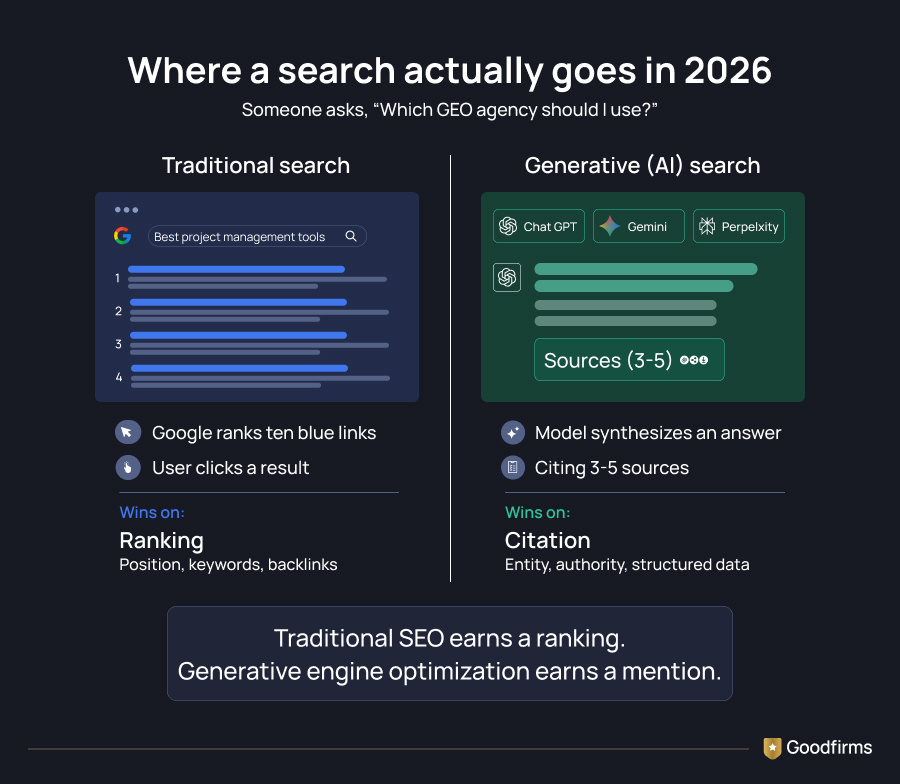
Generative engine optimization, or GEO, is the practice of improving how AI-powered platforms understand, retrieve, and cite a brand when someone asks a question rather than typing a keyword.
A GEO provider typically delivers a mix of technical, content, and measurement services, including audits to ensure AI crawlers can read and parse a website, as well as structured data and schema that help models identify entities accurately.
A business that already has hundreds of high-quality pages may benefit more from improving existing content than creating hundreds of new articles. A newer company, on the other hand, may need to focus first on building authority and establishing a stronger presence across trusted sources online.
GEO vs. Traditional SEO
One of the biggest differences between a traditional SEO agency and a GEO provider lies in how success is evaluated. SEO commonly measures rankings, organic traffic, backlinks, and conversions. GEO adds metrics such as brand mentions in AI responses, citation frequency, share of AI answers, source visibility, competitor presence, and the specific prompts that trigger a brand recommendation.
Traditional SEO pricing was built around manual, repetitive labor like keyword density and link volume. On the other hand, GEO is closer to an engineering problem, since it optimizes for how retrieval-augmented generation systems pull and rank source material in the first place.
Understanding what GEO involves is only the first step; businesses also need to determine what makes one service more valuable than another.
What Does Best Value Mean for GEO?
Best value does not necessarily mean the lowest number on a quote. Two agencies might offer the same number of articles every month while providing completely different levels of strategic and technical work.
A strong provider should be able to explain what it will change, why those changes matter for AI visibility, and how the results will be measured.
If a company already has pages ranking well in traditional search, those pages can provide a useful foundation for GEO. Improving authoritative content can often be more efficient than starting a completely new content library.
Weighing value means looking past the deliverables and focusing on three things instead:
- the outcomes a provider can actually evidence (citations gained, not just content shipped)
- the breadth of the scope (technical plus content plus tracking, not just one of the three)
- the depth of expertise behind it (does the team understand retrieval-augmented generation, or are they applying old SEO playbooks with new vocabulary).
Once value is defined by outcomes, expertise, and scope, the next consideration is how much businesses should expect to invest.
How Much Do GEO Services Cost?
GEO service costs vary depending on the level of strategy, technical optimization, content creation, monitoring, and ongoing support involved. Current pricing benchmarks place many agency-led GEO engagements between $3,000 and $25,000 or more per month, with costs increasing as businesses require more comprehensive content programs, advanced monitoring, digital PR, and multi-market optimization.
Based on current GEO agency pricing benchmarks, monthly engagements can broadly fall into the following ranges:
|
GEO Engagement Level |
Typical Monthly Investment |
Common Deliverables |
|---|---|---|
|
Foundational GEO |
$3,000–$6,000 |
AI visibility audits, website improvements, and structured data optimization |
|
Growth GEO |
$6,000–$12,000 |
Content creation, entity optimization, AI-search monitoring, and citation improvement |
|
Enterprise GEO |
$12,000–$25,000+ |
Advanced tracking, competitor analysis, digital PR, and multi-platform GEO strategy |
These figures are indicative market benchmarks rather than fixed industry rates. Actual pricing can vary by provider and scope.
For businesses that are not ready to commit to a monthly retainer, one-time GEO audits and technical projects can be a practical starting point. These may include a technical audit, AI visibility baseline, competitor analysis, and a 90-day action plan outlining the key GEO improvements to prioritize and implement.
Businesses should also examine very low-cost GEO packages carefully. If a service mainly involves publishing generic articles and providing a monthly report, it may be conventional SEO packaged under the newer GEO label rather than a comprehensive AI-search optimization strategy.
Price alone does not reveal the quality of a GEO program, so it is important to look at what businesses actually receive for their investment.
What Does a GEO Agency Actually Deliver?
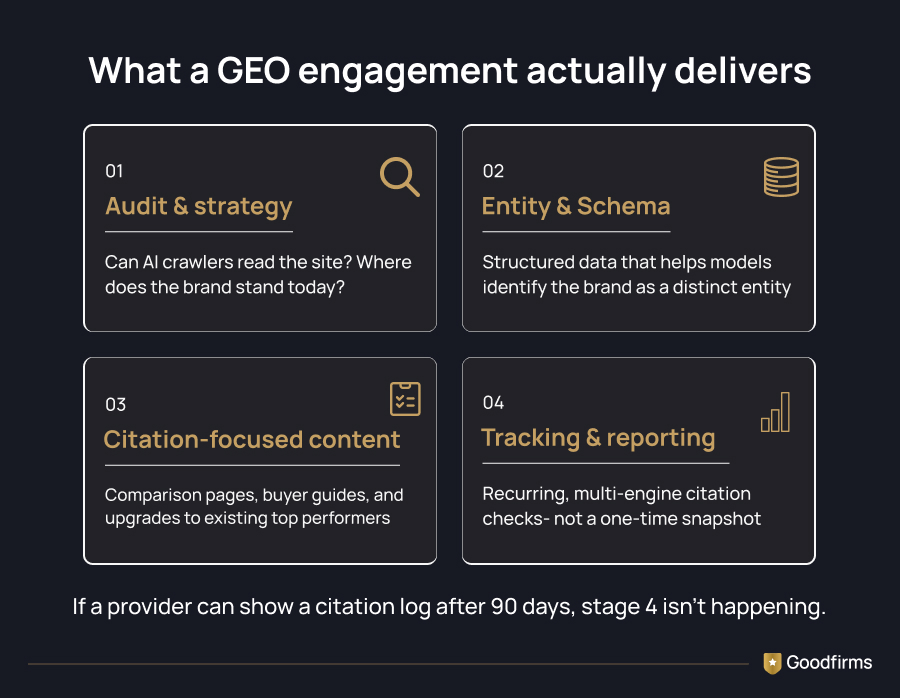
A comprehensive GEO engagement typically involves the following stages.
1. Audits and strategy
A serious GEO engagement should begin with an audit and strategy rather than immediately producing content. It checks whether AI crawlers can access and parse a site. It also assesses where a brand currently stands (or doesn't) across ChatGPT, Perplexity, Gemini, and Google AI Overviews.
The provider should establish how often the company is currently mentioned, which competitors are mentioned instead, which sources AI systems cite, and whether technical or entity-related issues could be limiting visibility.
2. Entity and schema
Structured data and schema markup help AI models identify a brand as a distinct entity. Keeping company information consistent across its website, business profiles, directories, reviews, and other trusted sources helps AI systems build an accurate picture of the business.
Providers typically implement Organization, Service, and FAQ schema, plus "sameAs" links that tie the website to verified profiles and review sites. This helps AI systems recognize scattered mentions as a single company and avoid confusing them with similarly named businesses.
3. Content optimization and citation building
This covers structured data and schema for entity clarity, rewriting or upgrading existing high-performing pages for AI comprehension, and new citation-focused content such as comparison guides and buyer-intent listicles — the formats AI engines cite most often when someone asks, “Who should I use for X.”
Comparison pages, buyer guides, use-case content, original research, expert commentary, and detailed industry resources can all provide useful sources for AI-generated answers.
4. Tracking, reporting, and ongoing management
Keeping company information consistent across its website, business profiles, directories, reviews, and other trusted sources helps AI systems build an accurate picture of the business.
Since GEO's value depends on measurable citation gains, ongoing programs need recurring, multi-engine tracking rather than a one-time snapshot — where AI search visibility tools come in.
Finally, measurement should be ongoing. This matters more than most businesses realize: research shows only 14% of marketers track AI visibility, leaving most brands unsure whether they even appear in the AI-generated answers customers see.
Not every business needs a full-service agency, however, and AI visibility tools can offer a practical alternative for teams with in-house expertise.
GEO Tools for AI Search Visibility
GEO agencies and AI visibility tools serve different purposes. Agencies generally perform the optimization work, while software helps businesses measure, monitor, and diagnose their presence in AI-generated answers.
Here are a few top tools for AI search visibility optimization.
|
Tool |
Best for |
Starting Price* |
Key Capabilities |
|---|---|---|---|
|
OtterlyAI |
Small businesses and marketing teams |
$29/month |
AI search visibility monitoring, brand mentions, citations, and tracking across major AI search platforms |
|
Peec AI |
SEO teams, agencies, and marketing teams |
$80/mo |
AI visibility analytics, competitor benchmarking, prompt tracking, and performance analysis |
|
Semrush AI Visibility |
Teams already using Semrush |
$99/month per domain |
AI visibility, citations, competitor analysis, prompt research, and AI-readiness insights |
|
Profound |
Growing and enterprise marketing teams |
$99/month |
AI visibility, citations, sentiment analysis, competitive intelligence, and AEO capabilities |
|
AthenaHQ |
Brands focused on AI recommendations |
$295/month |
Multi-model monitoring, visibility tracking, competitor analysis, source insights, and content recommendations |
Prices are based on providers' current published pricing and are subject to change. Annual billing, usage limits, and enterprise plans may affect the final cost.
These tools are beneficial because AI visibility is difficult to evaluate manually. A marketing team can use them to establish a baseline, monitor competitors, identify which prompts generate mentions, and see which sources recur in AI responses.
However, measurement alone does not guarantee improvement. If a platform identifies that competitors are consistently being cited while your company isn't, someone still needs to determine why and implement the appropriate content, technical, entity, or authority changes.
Once you know what a comprehensive GEO program should include, you can use those deliverables to compare providers more effectively.
How to Choose a GEO Provider
The best way to compare providers is to give each one the same business context and ask for a clearly defined scope. This makes it easier to compare actual work rather than sales presentations.
A good provider should explain which AI platforms matter for your audience (ChatGPT, Gemini, Perplexity, AI Overviews, Copilot, and others don't behave identically, so monitoring everything isn't always necessary) and how those platforms will be tracked. Ask whether they'll optimize existing high-authority content before recommending new content at scale — improving what already works often outperforms starting from scratch.
For reporting, a strong 90-day report should show AI visibility trends, citations earned, competitor performance, tracked prompts, and where your content is appearing as a source — not just a list of published articles.
As you evaluate providers, there is one important red flag to watch for.
GEO Red Flags
Businesses should be cautious of any agency guaranteeing a specific position in ChatGPT, Gemini, Perplexity, or Google AI Overviews. AI platforms control their own retrieval systems and can change them at any time — no provider can guarantee a specific citation or recommendation.
A credible provider sets measurable baselines, works toward improving visibility over time, and acknowledges that AI search results are dynamic and can fluctuate.
Final Thoughts
GEO is becoming an essential part of modern search strategy, but the best results come from combining technical SEO, authoritative content, entity clarity, third-party credibility, citation strategy, and ongoing measurement.
"GEO stops being a marketing budget line and starts being a P&L imperative."
Kunal Singh, Senior Analyst
Source: Market Decipher
The right investment depends on the business’s size, goals, and visibility gaps—so rather than simply spending more, businesses should measure where they stand, identify what needs improvement, and invest accordingly in AI search visibility optimization services
FAQs- Best GEO Services for U.S. Businesses
How long does it take to see results from a GEO program?
Early signals, such as initial citations or entity recognition, often appear within 60–90 days. Meaningful, sustained visibility gains across AI platforms usually take 6–12 months, since AI models refresh their sources more slowly than search engines update rankings.
Can a business handle GEO in-house instead of hiring a provider?
It's possible with strong technical SEO and content skills already in place. Most in-house teams, though, lack dedicated AI visibility-tracking tools and the bandwidth to consistently monitor citations across multiple platforms.
Does a business still need GEO if it already ranks well on Google?
Not necessarily. Ranking well on Google doesn’t automatically mean a business will appear in AI search results. Platforms like ChatGPT and Perplexity consider other factors, including how clearly a business is described, how well its information is structured, and whether trusted third-party sources mention it. So, a business can have strong Google rankings yet limited visibility on AI platforms.
Are AI search visibility tools enough?
They can be sufficient for businesses with strong internal SEO and marketing capabilities. Tools can measure AI visibility and identify opportunities, but they generally don't replace the people needed to implement technical, content, entity, and authority improvements.
Can a GEO agency guarantee placement in ChatGPT or Google AI Overview?
No credible agency can guarantee a specific AI-generated recommendation or citation. AI platforms control their own systems and can change how they retrieve and present information. Providers should focus instead on measurable improvements in visibility, mentions, citations, and source coverage.


.jpg)