Key takeaways:
- AI search engines like ChatGPT and Perplexity don't rank websites the way Google does. They pull from verified, third-party sources, and Goodfirms is one of the two platforms they trust most for agency queries.
- Goodfirms captures 14.9% of agency citations in ChatGPT and 29.9% in Perplexity. If your profile is incomplete, you are invisible in those answers.
- The content of your reviews shapes how AI describes your business. Vague reviews produce no recommendations.
- Only 14% of marketers currently track AI citation visibility. Most businesses are still optimizing for a search experience that is rapidly becoming secondary.
- Consistency across your Goodfirms profile, website, and other platforms is something AI systems actively cross-reference. Gaps hurt your chances of being cited.
The next time someone asks ChatGPT for the best web development agency in their city, an AI will answer in seconds. It won't Google anything. It won't browse ten websites. It already has an opinion built from sources it learned to trust long before that question was ever typed.
The question worth asking is: did it learn to trust yours?
Reviews are the raw material AI systems use to decide which businesses they are willing to vouch for and which ones they quietly skip. Star ratings and reputation management are secondary. The real game is whether AI engines have enough verified, structured information about your business to confidently recommend you when it matters.
Goodfirms helps businesses strengthen their online reputation through verified reviews, detailed company profiles, and industry visibility. As AI search continues to grow, these trust signals are becoming increasingly important for earning citations and recommendations. Create or optimize your Goodfirms profile today and position your business for the future of search.
The Way AI Search Works is Different from Google Rankings
Before getting into Goodfirms specifically, let us understand how AI search engines decide what to surface.
Traditional Google ranking was mostly about backlinks, keyword optimization, and domain authority. AI search engines like ChatGPT, Perplexity, and Google's AI Overview operate differently. They pull from structured, verified sources. They favor content that signals trust, expertise, and consistency across multiple platforms.
Domain authority correlates with AI citation probability at just r = 0.18. This means DA explains roughly 3% of the variation in whether AI engines cite your brand. By contrast, E-E-A-T signals correlate at r = 0.81 in the same study.
In short, the thing SEOs optimized for a decade means far less in AI search than most people assume.
Meanwhile, 47% of AI Overview citations now come from pages ranking below position #5, proving that AI Overviews operate on fundamentally different ranking logic than traditional search.
Google rankings still matter, but AI citations increasingly determine who gets mentioned before users ever click a search result.
In fact, many businesses are discovering that strong rankings alone no longer guarantee traffic, as AI-generated answers increasingly satisfy users before they ever click a search result.
This shift has fueled the rise of GEO-focused practices in helping brands become part of AI-generated answers rather than simply ranking webpages.
That's the environment where Goodfirms reviews now carry real weight.
Goodfirms is One of the Two Platforms AI Engines Actually Trust for Agency Queries
A Hall analysis of 456,570 citations from ChatGPT, Perplexity, Google AI Overviews, and Microsoft Copilot between May and June 2025 found that Goodfirms captures 14.9% of citations in ChatGPT, making it the second platform with meaningful representation.
That's not a small number. If someone asks ChatGPT, "What's the best web development agency in the US?" the answer is almost certainly drawn from Goodfirms. AI systems are treated as credible for service provider evaluation.
In Perplexity, Goodfirms secures 29.9% of citations.
So now the question is whether your Goodfirms profile is complete for AI systems to pull from.
What Makes a Goodfirms Profile AI-Readable?
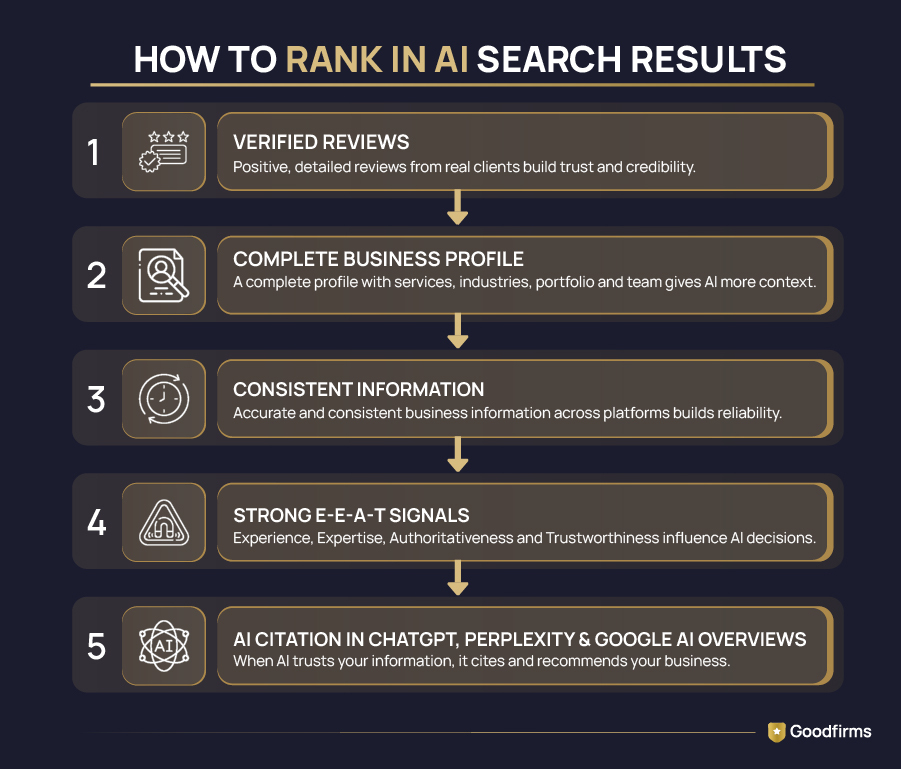
Verified and structured data. AI systems need to trust that the information they are referencing is accurate. Structured, verified data helps AI models confidently surface your company in response to queries. Without verified reviews, ratings, and credentials, AI tools are less likely to recommend your services.
A half-completed Goodfirms profile with no verified reviews doesn't give AI engines much to work with. A fully built-out profile with verified client testimonials, service categories, portfolio entries, and accurate company details is something an AI can actually parse and reference with confidence.
Review volume and recency. Pages updated within 30 days earn 3.2 times more ChatGPT citations. The same logic applies to review platforms. A profile that was active in 2022 and hasn't been touched since is less likely to be cited than one with recent reviews and fresh activity.
Consistent business information. If your Goodfirms profile says one thing about your services and your website says another, that creates a trust gap. AI engines cross-reference. Consistency across the website, Goodfirms, LinkedIn, and Google Business Profile signals reliability.
Reviews Specifically Shape What AI Says About You
There's a level beyond just being cited. The actual content of your reviews influences how AI describes your business.
Reviews help determine the tone and content of AI-generated search summaries. They also influence future search queries by becoming part of the training data for large language models, meaning your reputation can echo in AI responses for months or years.
Think about what that means practically. If your Goodfirms reviews consistently mention that you deliver projects on time and communicate clearly, those phrases become part of how AI systems characterize your agency when someone asks for recommendations. If your reviews are vague or sparse, the AI has less to work with and may simply skip your profile in favor of one with clearer info. This is why the quality of reviews matters as much as the quantity.
The Broader AI Search Landscape You are Competing In
Goodfirms is one piece of a larger system. To properly rank in AI search results, it helps to understand how each platform operates differently.
Only 11% of domains are cited by both ChatGPT and Perplexity.
ChatGPT favors Wikipedia and encyclopedic content (47.9% of top citations), Perplexity heavily cites Reddit (46.7%), and Google AI Overviews prefer YouTube and multi-modal content (23.3%).
For businesses that want to rank higher in AI-generated search results across multiple platforms, Goodfirms is part of a broader strategy that should also include your website's structured data, content depth, and off-site brand presence.
Find out how LLM SEO is changing search behavior and why specialized optimization strategies are emerging for AI-powered search engines.
How to Rank Higher in AI Search Results Through Goodfirms
Here's what makes a practical difference, based on how AI citation systems work.
Get real, detailed reviews. Ask clients to describe the project, the outcome, and your working style. Detailed reviews give AI systems specific language to work with.
Keep your profile current. Update your services, portfolio, and team information. Consistently publishing useful content alongside an active review profile can strengthen your AI visibility, especially when supported by modern AI-powered SEO tools that help identify content gaps and topical opportunities.
Stale profiles get deprioritized. An active profile signals that the business is operating and the data is reliable.
Respond to reviews. It signals engagement and adds fresh content to your profile.
Make sure your profile categories match your actual services.
Align your profile with your website. The name, services, and location on your Goodfirms profile should match what's on your site. Discrepancies between platforms can reduce confidence in AI citation systems.
E-E-A-T Connection
Google's framework of Experience, Expertise, Authoritativeness, and Trustworthiness is not just for blog content. The growing overlap between SEO and AI visibility is forcing marketers to rethink long-standing optimization tactics and adopt strategies designed for the age of AI Search.
Adopting an E-E-A-T approach has become essential in creating quality content that can help improve the SEO of a website. A Goodfirms survey shows that around 78.6% of surveyed businesses believe they have a holistic SEO approach for Google and AI search engines.
Goodfirms reviews directly support three of these four signals. Verified client reviews establish trustworthiness. A track record of completed projects demonstrates experience. Category rankings and featured spots build authority. The expertise signal is harder to convey through a review platform alone, and so your own content needs to carry weight.
Businesses that approach Goodfirms strategically tend to build stronger E-E-A-T profiles across the board. That flows into how AI systems rank and cite them.
One Thing Many Businesses are Missing Right Now
Goodfirms' 2026 survey found only 14% of marketers currently use AI citation tracking, despite 43% naming AI search optimization as a core 2026 strategy.
Most businesses are still optimizing for traditional search rankings. They haven't started tracking where their brand shows up in AI responses. This means there's a real window right now to get ahead, particularly in niche verticals where the competition for AI citations is relatively thin.
If you are a legal services provider, a development agency, a design firm, or really any B2B service business, your Goodfirms profile is already being checked by AI systems when users ask about providers in your category. The question is whether it gives those systems enough to work with.
FAQs - Rank in AI Search
How do I rank in AI search results?
To rank in AI search results, focus on building trust and authority. AI search engines like ChatGPT, Perplexity, and Google AI Overviews prefer businesses with strong reviews, accurate business information, credible content, and consistent online profiles. A well-maintained Goodfirms profile can improve your chances of being cited in AI-generated answers.
Does having more reviews on Goodfirms guarantee I'll rank in AI search?
Not by itself. Reviews are one signal among several. But they are a significant one for B2B service providers, given how heavily ChatGPT and Perplexity draw from Goodfirms for agency-related queries. A strong profile with detailed, recent reviews improves your odds — it doesn't guarantee a specific placement.
Does it matter which AI platform I'm trying to rank on?
Yes, more than most people realize. Perplexity and ChatGPT both cite Goodfirms for agency queries. But Google AI Overview operates differently, drawing more from pages with strong organic rankings and multimodal content. If your goal is specifically to rank in Google AI search, you will need to pair your Goodfirms presence with solid on-site SEO and structured data.
How long before Goodfirms reviews affect my AI visibility?
Training data updates at different intervals depending on the platform. Some AI engines like Perplexity retrieve in real-time, so fresh reviews can matter quickly there. For ChatGPT, which relies more heavily on training data, it may take longer for new reviews to influence citation patterns. Maintaining consistent activity over time is more reliable than relying on a single review for a quick spike.
Are Goodfirms reviews more important than reviews on other platforms?
If you are a service agency, Goodfirms is one of the most direct ways to improve your AI search visibility.