As we will soon be ending the year 2025, it is an ideal time to evaluate what digital marketing means for the future, considering the high influence of artificial intelligence, generative AI, and large language model (LLM) search engines. Digital marketing in 2026 will undoubtedly be more innovative, quicker, and more intelligent with the help of generative AI-enabled tools. Content will all be precise, clean, and bang on what customers expect. Short-form content, videos, and user-generated content is going to rule. This requires detailed analysis of the user, their past buying history with predictive data analytics, and a wider understanding of the evolving search engine optimization (SEO) requirements. Traditional SEO will fade and the future of digital marketing will be LLM-based search engine optimization. The best AI-powered SEO tools will have an upper hand.
This blog discusses the ways that digital marketers can reengineer their marketing strategies with the best AI-powered SEO tools for higher rankings, visibility, and mentions in the search engine results and overviews.
What Are AI-Powered SEO Tools?
AI-powered SEO tools are powered by artificial intelligence and machine learning technologies through which digital marketers can enhance their keyword research, optimize content generation, and rank higher on generative as well as traditional search engines.
Automating internal linking, technical SEO analysis, insights to get mentioned in AI overviews, competitive research, keyword research, site audits, rank tracking, AI mention tracking, etc., are a few standalone features of the best AI SEO tools.
How AI Enhances Content Strategy Beyond Keywords?
Although traditional SEO still matters, it has evolved with new technologies like AI, and it is not enough to follow the same SEO strategies that we followed 10 or 20 years ago. Search now requires more human intervention to make the search results more hyper-personalized, which is highly influenced by AI. Aligning the content with keywords is no longer a valuable SEO strategy. Large language model search engines work a bit differently. It is the NLP keywords, relevance of the content that matters the most.
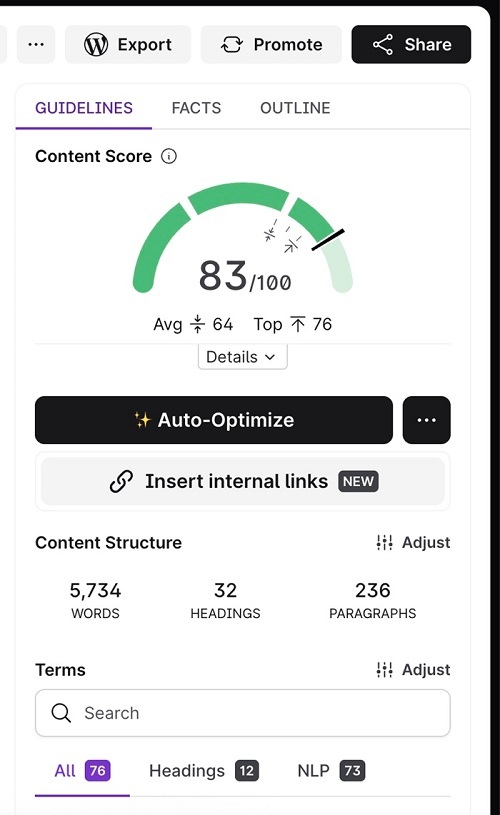
Digital marketers need uniquely tailored content strategies powered by the best content optimization tools with AI features that can generate and optimize content simultaneously with real-time metrics taking care of the structure, word count, NLP-ready keywords and even suggestions for images. Such powerful guidance will help brands to rank high, no matter whether it is in Google search results or LLM search engine models. Such tools can comprehensively help in generating personalized, and clear content. Below mentioned are a few ways through which AI can help businesses enhance their content strategy beyond keywords.
NLP-Ready Keyword Research with Analytics and Performance
Natural Language Processing (NLP) Keywords research is one of the core functions of a successful marketing strategy today in the AI era. For this, businesses need a more strategic and data-driven approach to keyword research, that helps them analyze engagement trends, user intent, real-time performance metrics, content gaps, and many more concerns.
While traditional keyword research tools rely on manual brainstorming, basic search volume check, and guesswork, AI-powered SEO tools combine analytics with performance insights to optimize content for advanced keywords and drive higher rankings.
Keyword research in a traditional tool
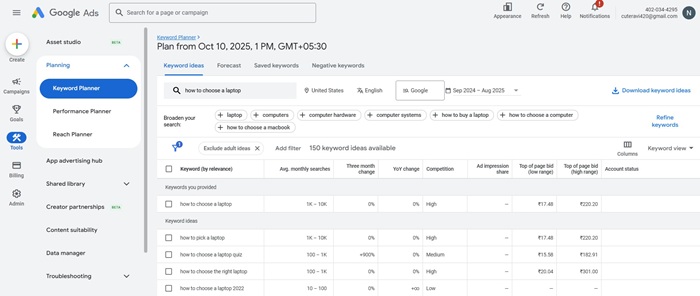
In traditional SEO tools, limited functionalities were there for identifying potentially beneficial keywords. They relied on static lists, gave monthly search volume only, had basic difficulty scores, offered minimal suggestions, etc., making the keyword research less efficient.
For example, when a prompt on “How to choose a laptop” is given on a traditional tool, it gives limited data with a list of around 50 relevant keywords, their monthly traffic volume, etc.
Keyword research in an AI-powered SEO tool
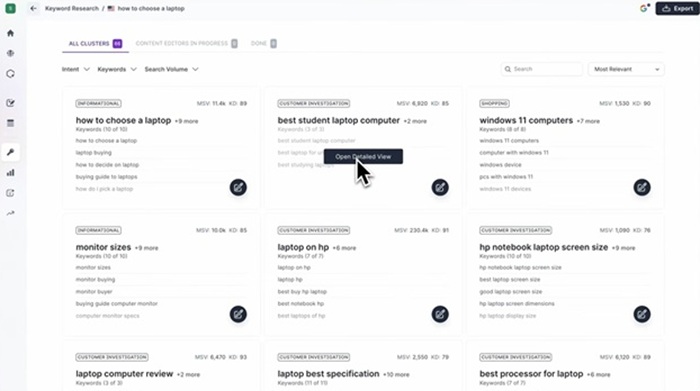
AI-powered SEO tools offer automated clustering, real-time search volume, trend forecasts, intent-based categorization, and various other advanced keyword research features to efficiently identify best performing keywords.
For example, when the same prompt of “How to choose a laptop” is given on an AI-powered SEO tool, it gives clustered results with intent, keyword difficulty, monthly volume, etc., meaning enriched results to leverage highly relevant keywords.
Content Writing with Analytics and Performance
As per the State of AI in Marketing 2025 report, businesses that use AI are likely to report 25% better content than those who don’t leverage it.
AI-powered SEO tools can analyze keyword intent, trending topics, readability scores, audience behavior, etc., before and after the content goes live. Through this, they can offer real time suggestions to be made to the tone, structure, length, keyword placement, etc., for maximum visibility.
For example, when a writer manually creates content without any AI help, there are chances of missing key subtopics or search intent which leads to limited reach.
On the other hand, AI-powered SEO tools can create topics, subtopics, heading, content schema, etc., based on search intent, traffic volume, with a few prompts. Apart from the creation, they can also optimize the content to fix gaps and get found on search engines, whether normal or AI.
On-page SEO with Analytics and Performance
Gone are the days when on-page optimization was done manually. In the era of AI-powered SEO tools, a large majority of on-page SEO functions are automated. These tools can run batch audits to find SEO gaps, suggest fixes for links, meta data, and headers, automate inclusion of keywords, analyze user experience signals, and do much more to improve the page even before it goes live.
In the traditional SEO approach without AI, marketers manually perform each and every on-page SEO activity using basic tools. For instance, a footwear business who wants to target “best sports shoes” will typically use Keyword Planner to identify keywords, leverage basic SEO tools such as Yoast to optimize meta data, and manually adjust heading and content changes.
AI-powered SEO tools, on the other hand, study semantic relationships in the content to provide data-driven, performance-based on-page optimization suggestions. AI tools can even suggest relevant keywords for which competitors are already ranking. For example, AI-powered SEO tools can even suggest keywords like best sports shoes for females, best male sports shoes, etc.
AI can monitor metrics, such as CTR, bounce rate, keyword volatility, dwell rate, etc., to suggest changes where performance goes down.
Ranking in the Zero-Click Era with Analytics and Performance
At present, spot eaters like AI overviews, features snippets, People Also Ask boxes, etc., are taking the top positions that allow users to directly gain answers to their queries without visiting any website. So, in such a scenario, just ranking in the top positions cannot guarantee expected traffic. Studies indicate that 60% searches end with users getting the information on the search page itself without a click.
When activities such as keyword research, content generation and optimization, on-page optimization, etc., are done through traditional SEO tools, businesses can rank in top positions but can lose to spot eaters, meaning zero clicks.
For example, if an ERP company is creating content on “ERP Software And Its Uses”. Traditional SEO tools will focus on ERP Software and optimize its metadata, keyword density, linking, etc., accordingly. There are chances that when a user searches for this keyword, the content may rank well, but a featured snippet from the competitor can lead to no reach and visibility.
With AI-powered SEO tools, ERP businesses can identify zero click queries along with their click intent, such as top ERP software for SME, ERP challenges, Benefits of ERP software, etc., ensuring higher conversion.
How to Master Content Creation with the Best AI-Powered SEO Tools?
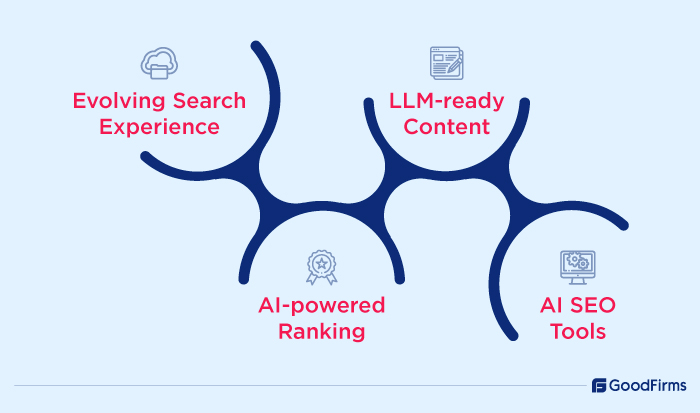
As the SEO landscape shifts from traditional to super-intelligent search engines with AI, every detail of digital marketing, from strategizing to execution, needs to be reengineered. Search engines are taking a different approach to understanding user intent and semantics. Businesses can definitely see benefits if they invest in the best AI SEO tools.
It is time to stop generating keyword-stuffed content in bulk. AI SEO tools should be leveraged for predictive analytics, content clarity, performance monitoring, and forecasting. Such tools will also help build authoritative content focused on improving user experience and getting featured in Google snippets. Moreover, AI-powered content audits identify crawl issues and schema gaps and fix speed issues.
Best AI-powered SEO tools come with unique features and functionalities that help digital marketers easily master content creation. Here are a few tips to master content creation with the best AI-powered SEO tools as follows;
- Use automated keyword clustering to plan entire content.
- Leverage AI trend prediction to identify emerging keywords which are not popular yet.
- Use AI editors to draft, complete, and publish content.
- Integrate analytics feedback loops to optimize content
- Besides keywords, also implement semantic keywords and NLP terms
- Use AI to create FAQ schema and automate meta optimization
- Constantly monitor SERP visibility metrics, such as impressions and clicks.
The Best AI-Powered SEO Tools To Master Content Creation
Surfer
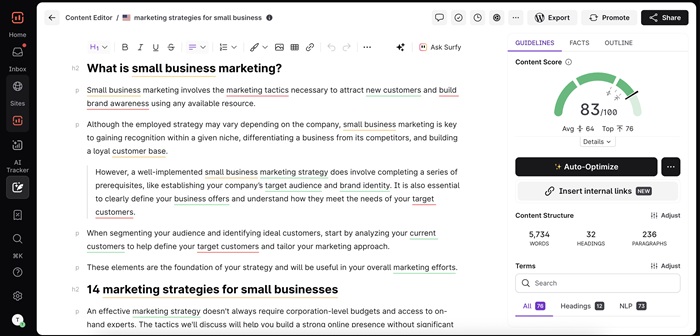
Trusted by over 150,000+ users, Surfer is one of the best AI-powered SEO tools to gain unparalleled visibility over generative as well as traditional search engines. The software allows marketers to track citations, optimize content for LLMs, and increase discoverability. The software acts as a reliable choice for AI-powered content optimization and AI search optimization.
Source: Surfer
Surfer’s suite of SEO tools:
- Content Editor: Real-time SEO writing guidance across 500+ ranking factors
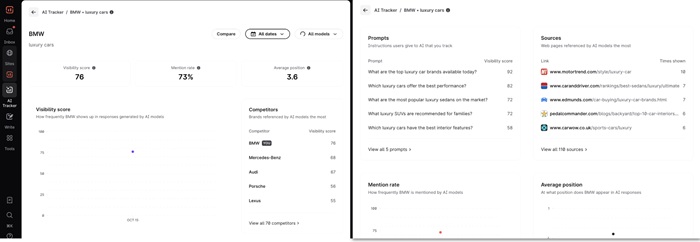
- AI Tracker: Track and grow your brand’s visibility across AI search and LLM citations
- Surfer AI & Surfy: Fast, SERP-driven content creation + on-demand writing assistance
- Content Audit: Improve existing pages with GSC & SERP-based insights
- Topical Maps: Plan strategic content clusters based on competitor analysis
- Sites Dashboard: Monitor keyword and traffic trends, and stay ahead of SEO priorities
- Integrations: Google Docs, WordPress, Jasper, Zapier, ChatGPT & more
Free tools:
- Chrome Extension
- AI Detector
- AI Humanizer
Surfer’s Content Editor is one of the top highlights of Surfer. It’s powered by AI to help your content stand out in both Google and AI search results. It goes beyond traditional optimization - providing real-time insights, verified facts, and topic coverage suggestions from the Coverage Booster to make your pages LLM-ready. With Auto-Optimize and Internal Linking built in, it ensures every article is accurate, comprehensive, and seamlessly connected across your site.
These tools are great to automatically audit, evaluate, and optimize web content. Users can automatically insert links, get weekly recommendations, and gain a clear picture of business SEO and AI Search Visibility.
Features:
- AI Search Brand Presence Overview
- AI content detector and humanizer
- Auto-optimize, Auto Internal Links, Coverage Booster
- LLM optimization guidance
- Entity optimization & fact clarity
- Topical mapping and coverage
- Weekly Reporting and notification for new optimization opportunities
- Publish Content Editor articles directly to site
- GSC Integration
Best for
Best for in-house marketing teams, enterprise companies, agencies and business owners who want to scale their organic visibility across Google and emerging AI search engines, without being SEO experts.
Pros
- Unified platform for SEO, AI Search Optimization and content creation
- Easy to use and offers handy AI powered features
- Gives you tools for full content creation workflow: Research, Audit, Optimize, Track
- Supports creation of content for multiple languages and countries
Cons
- Does not offer technical SEO
- Does not offer a free plan, but has a 7-day money back option
Scalability and collaboration
Team collaboration and robust customization options.
Integrations
Supports integration with WordPress, Google Docs, Zapier, Contentful, and many more.
Pricing
Three plans, i.e., Essential, Scale, and Enterprise, starting from $79/month, billed annually.
Semrush
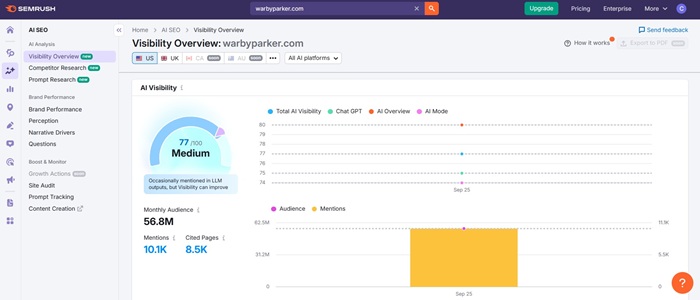
Another leading AI SEO tool is Semrush, a comprehensive platform to automate SEO and content functions. It is used by over 10 million marketing professionals to stay ahead of the competition. For seamless AI SEO, the software offers competitor research, AI visibility overview, prompt research, content optimization, and crawlability checks.
Source: Semrush
AI-powered business strategy recommendations
Semrush’s advanced AI capabilities help businesses get tailored recommendations to strengthen competitive position in the search results.
SEO brief and article generator
It allows users to create attractive briefs and articles using its in-built editor, AI image generator, SEO improvements, and readability features.
Features:
- AI search site audit
- Keyword cannibalization report
- Monthly/Weekly/Daily scheduling
- AI-generated summaries
- AI brand sentiment analysis
- Competitive positioning insights
- AI-driven marketing opportunities
- User queries and intent analysis
Best for
Best for marketing agencies, Fortune 500 companies, and inhouse marketing teams who are looking to leverage enhanced data insights.
Pros
- Comprehensive reports covering a wide range of key metrics
- AI-powered PR media toolkit offers enhanced visibility in AI search engines.
Cons
- Costly for SMBs and Startups
- In-efficient content creation and optimization capabilities
Scalability and collaboration
Scalable and modular platform to scale at ease.
Integrations
Supports integration with Google Analytics,Google Search Console, Looker Studio, and 30+ other external tools.
Pricing
- Free version available
- Premium pricing plans for AI SEO start from $99 per month.
Ahrefs
Ahrefs is a popular AI SEO tool to uncover content gaps, match search intent, optimize with AI insights, and plan high-impact content. Through this powerful software, marketing professionals, agencies, and enterprises can track traffic sources across AI and traditional search engines, analyze competitor strategies, discover brand mentions, and monitor brand sentiments.
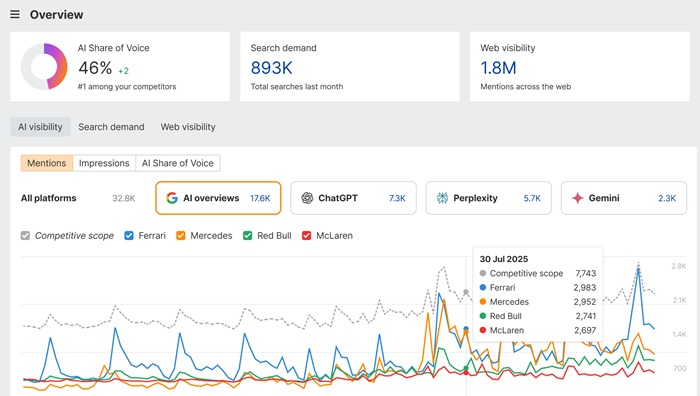
Source: Ahrefs
IndexNow integration
Users can quickly index their content for getting quick visibility and positions in the AI and normal searches.
AI-powered technical SEO
Ahrefs allows content localization for global markets, automated patches, AI detector, etc., to ensure optimal execution of SEO strategy without any hassle.
Features:
- AI suggestions
- Keyword clustering
- AI-powered search intent
- Rank tracking
- Competitor benchmarking
- Content gap analysis
- Custom prompts with a database of over 150+ million total prompts
Best for
Best for PPC specialists, SEO analysts, content marketers, and brand marketers who want to stay ranked on AI chatbots and Google.
Pros
- AI-powered workflow optimization to uncover content issues
- Quickly publish high-quality content with advanced keyword insights and streamlined workflows
- 10+ AI presets to brainstorm rare keyword ideas
Cons
- No free trial
- Expensive user addons
Scalability and collaboration
Multi-user, team feature for collaboration and expandable plans for higher needs.
Integrations
Support Looker Studio integration, Screamingfrog SEO Spider, Google Sheets, Databox, and various other tools.
Pricing
- Free webmaster tools
- Three pricing plans, i.e. Lite, Standard, and Advanced, starting from $108 per month, billed annually.
Conclusion:
The global SEO Software Market is expected to touch USD 154.6 billion by 2030. Digital marketing will not be the same as it was till 2024. Businesses of all sizes and types will have to re-engineer their marketing strategies to fit themselves in the LLM search engine models. Automated content creation with the help of generative AI will play a prominent role in digital marketing. From keyword research and content creation to on-page optimization, AI offers tremendous potential to analyze, predict, and improve in real time. Mastering content creation with AI will enable businesses to achieve long term SEO success.
In the future, if businesses wish to escalate their SEO tactics, they need to consistently update their knowledge on the evolving AI models and LLM-based search engines. It is always better to invest in the best AI SEO tool that will help to implement new AI-readable content.