Key takeaways
- The developers worth hiring are the ones with real review discipline — they know when to trust AI-generated output and when to slow down and write critical logic themselves, especially in security, payments, and data handling.
- Scenario-based questions, a paid trial task, and direct questions about how candidates handle authentication and API keys reveal far more than a resume or a portfolio of demos.
- Vibe coding tools are cheap, so businesses are really paying for a developer's review discipline — the judgment to test and harden AI-generated code before it reaches real users.
Scroll through any developer forum lately, and you'll find the same question surfacing again and again: are companies actually hiring for vibe coding skills, or is this still mostly media hype?
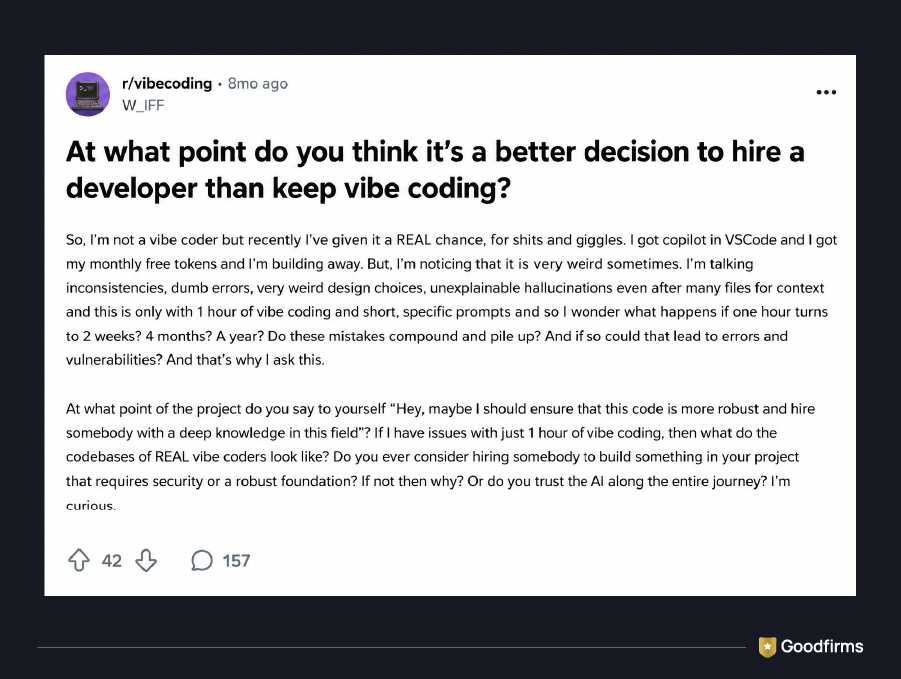
Source: Reddit
The data suggests it's the former. Cursor's annual recurring revenue passed $2 billion by February 2026 — double what it was just three months earlier. That's how fast teams are picking up AI coding tools right now. But the speed of review hasn't kept up with adoption. Most teams still aren't checking AI-generated code closely enough.
And this isn't a one-time jump. The vibe coding market was worth USD 5.85 billion in 2025. It's expected to hit USD 7.06 billion in 2026, then grow to USD 15.52 billion by 2031 — a 17.06% CAGR over that period. As adoption scales this fast, the gap between "using AI to code" and "using AI to code safely" is exactly where hiring the right vibe coding developer becomes essential.
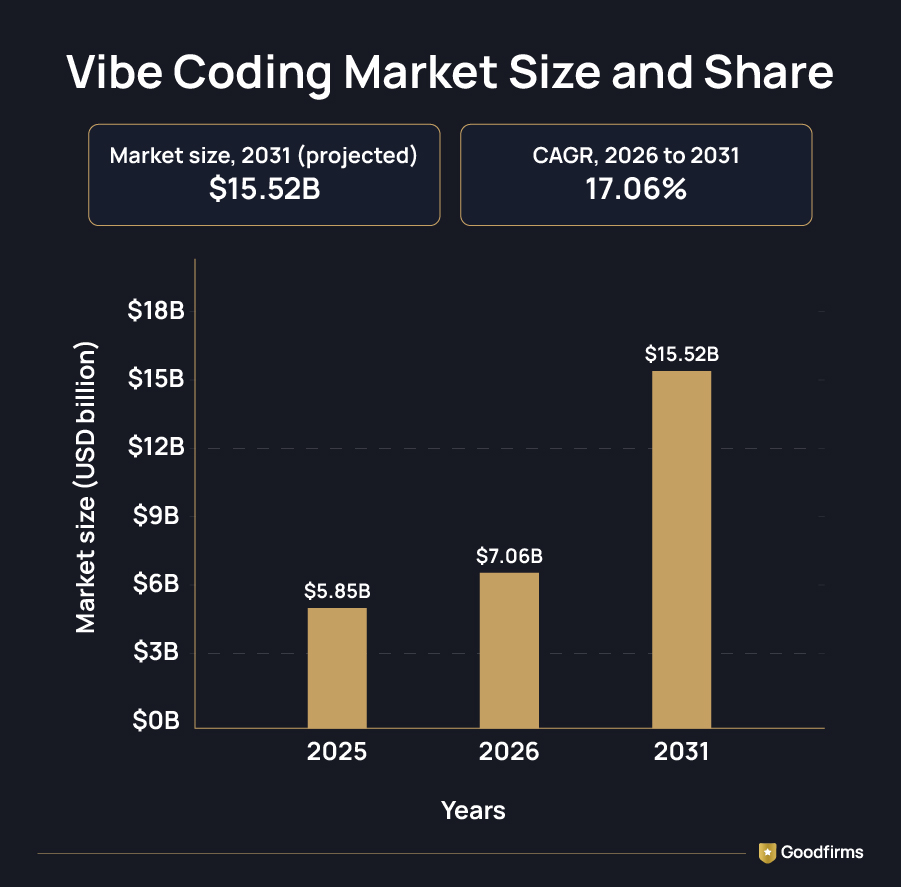
Source: Mordor Intelligence
The real question founders, product managers, and CTOs are asking is: "How do you actually hire vibe coding developers who are good at this?" This blog provides a step-by-step way to hire people who can turn fast AI-built prototypes into software you can actually trust with real users.
Skip the guesswork. Explore vetted vibe coding companies on Goodfirms — verified reviews, transparent hourly rates, and visible AI tool stacks, filterable by budget and team size
Why Hire Vibe Coding Developers in 2026?
Speed, lower cost, and faster iteration — that's what's driving founders and product teams to hire vibe coding developers right now. A few years ago, building an MVP meant weeks of planning, a full hiring process, and then months of actual development. That timeline has been reduced significantly. Here's why:
- Speed to market: Initially, a functional prototype took four to six weeks. With vibe coding, it can be built and tested in a matter of days. That frees up the budget for testing ideas and growing the product, instead of just building the basic structure.
- Lower initial cost: AI tools can write boilerplate code in seconds, so developers don't have to type it out by hand. That means early-stage builds cost much less than traditional custom development.
- Faster iteration with real users: Changing a feature is often as simple as rewriting a prompt, which means teams can test more ideas with real user feedback before locking in an architecture.
- Access to talent that thinks in systems, not just syntax: The best vibe coding developers spend less time on typing and more time on product thinking, which is exactly what early-stage companies need.
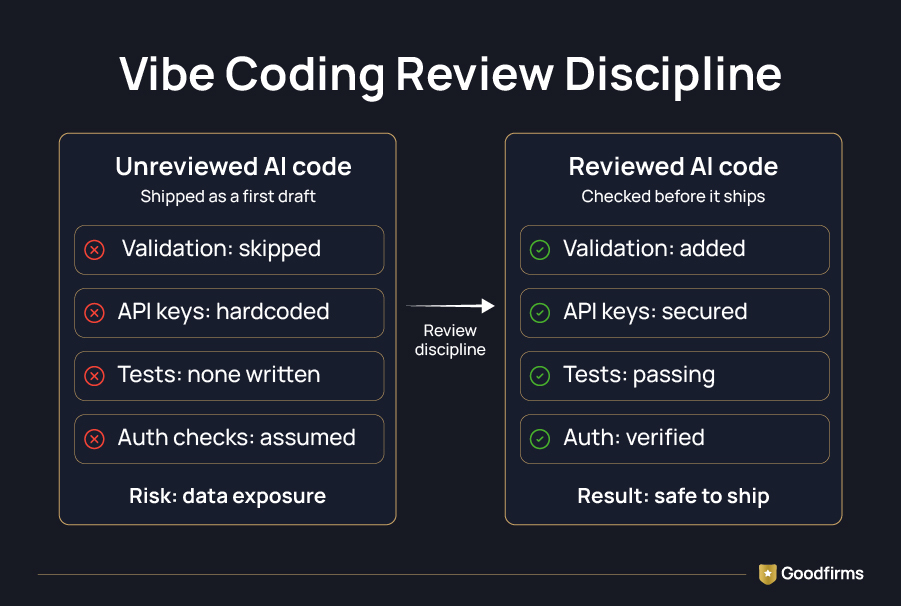
This does not mean that vibe coding has replaced solid engineering. It has only shifted the bottleneck from “how fast can someone type code" to "how well can someone direct, review, and harden AI-generated code," and review discipline is the skill you are actually hiring for.
Speed is not the only factor, though — knowing who's actually behind that speed matters just as much.
Vibe Coding Developers vs. Traditional Developers: What's the Difference?
A vibe coding developer may use AI tools just as a regular developer does. In practice, their day-to-day work differs.
- Traditional developers spend most of their time writing and debugging code directly, referencing documentation, and building up deep familiarity with a specific codebase line by line.
- Vibe coding developers spend more time clearly describing intent, reviewing AI-generated output critically, running tests, and course-correcting the AI when it goes off track — a workflow some in the industry now call "agentic engineering."
Category
Traditional developer
Vibe coding developer
Where time goes
Writing and debugging code line by line
Describing intent, reviewing AI output, and testing
Core skill
Deep codebase familiarity, manual implementation
Review discipline — catching AI mistakes before they ship
Working style
References documentation, builds incrementally
Directs AI tools, course-corrects when output drifts
Best suited for
Complex, custom logic; legacy systems
Fast iteration, prototypes, feature velocity
The two aren't mutually exclusive. In fact, the strongest vibe coding developers usually come from a traditional engineering background - for a deeper look at how the two approaches actually compare, see Goodfirms' vibe coding vs. traditional coding breakdown. Their prior experience enables them to spot a subtly incorrect SQL query or a missing authentication check in AI-generated code — something a complete beginner simply wouldn't catch.
Before you can evaluate a candidate's toolkit, it helps to know the tools non-technical founders reach for first.
Best Vibe Coding Tools for Non-Developers
Non-technical users do not necessarily have to hire a developer for every idea, as several tools are purpose-built. They can describe an app and get a working version back. If you understand these tools, you will be able to evaluate a vibe coding developer’s toolkit, since many professionals use the same platforms in more advanced ways.
Here are some commonly used tools.
-
Lovable — popular for design-forward web apps and landing pages; strong at turning a rough idea into a polished-looking front-end quickly.
- Bolt.new — browser-based, good for spinning up full-stack prototypes without any local setup.
- Replit Agent — handles planning, coding, and basic deployment in a single flow, making it approachable for people who've never touched a terminal.
- v0 by Vercel — focused specifically on generating individual UI components from a text or image prompt, great for non-developers who just need a screen built fast.
-
What is common for all these tools is that they're excellent for prototypes, internal tools, and proof-of-concept builds. When your app starts handling real user data, payments, or anything that requires compliance, you need a developer with real review discipline to check and reinforce what the tool produces.
With the main players on the table, the "best" one really comes down to what you're trying to ship.
Best Vibe Coding App for Non-Developers
If you want a single recommendation rather than a list, the "best" vibe coding app really depends on what you're building:
- For a simple landing page or marketing site: a design-focused builder that generates clean front-end code you can hand off later is usually the fastest path.
- For a working prototype with a database and user accounts, an agent-style tool that can plan, code, and deploy in one session saves the most time.
- For mobile apps meant for the App Store: look specifically for tools that generate native code rather than a web app wrapped in a shell — app stores are increasingly strict about rejecting the latter, and users can feel the performance difference.
-
Whatever app you choose, don't treat the output as finished — it's a starting point. Turning that promising demo into something solid enough for real customers is exactly where a good vibe coding developer earns their fee.
Once a professional engineer takes over, the toolkit and the stakes change.
Vibe Coding Tools Experienced Developers Actually Use
Professional engineers who've adopted vibe coding use a more advanced set of tools than non-developers. These tools integrate with existing codebases, version control, and team workflows rather than generating a standalone app from scratch.
- Cursor — an AI-native code editor built on top of familiar tooling, widely used for full-stack development and large refactors.
- Claude Code — a terminal-based agent well suited to complex, multi-file changes and codebase-wide reasoning, popular with engineers who want more control over the process.
- Windsurf — another AI-first IDE competing closely with Cursor, often chosen for its agentic workflows.
- GitHub Copilot — still widely used for in-line autocomplete and smaller, targeted suggestions rather than whole-feature generation.
-
While interviewing a vibe coding developer, ask which of these tools they reach for and why. A candidate who can explain the trade-offs — say, when they'd use an agent to plan an entire feature versus when they'd write critical logic by hand — is showing you real judgment, not just tool familiarity.
Goodfirms insight: The developers who get the most value from these tools aren't the ones who use them the most—they're the ones who know exactly which parts of a build to hand off and which to keep close.
Here's a process you can follow to hire someone who uses the tools responsibly.How to Hire Vibe Coding Developers: A Step-by-Step Process
Hiring the right person isn't about finding someone who can prompt well, but about finding someone with real review discipline. Here's how to get started.
1. Define what you're building
Before you post a job or reach out to an agency, define the scope honestly. A quick internal tool or landing page needs a very different skill set than a fintech app handling real payments. Get clear on your product, the sensitivity of your data, and your timeline. This alone will save you from hiring the wrong fit.
2. Decide between a freelancer, an agency, or a full-time hire
- Go with a freelancer for short, well-defined projects or prototypes — good for speed, and when you don't need someone for the long term.
- Go with an agency when you need a small team covering design, front-end, back-end, and QA together — especially for an MVP you plan to keep building on.
- Go with a full-time hire for an ongoing product that needs continuous development, security oversight, and someone who really knows your codebase.
3. Test judgment, not buzzwords
Skip "must know AI tools" in your job post. Give candidates a real scenario instead: "You'll use AI tools to build features fast, but you're expected to review the generated code for security issues, write tests, and explain the architecture clearly to a teammate." This will remove anyone who just accepts whatever the AI hands them.
4. Screen for a hybrid skill set
A good vibe coding developer has solid fundamentals in their stack. They know how to direct AI tools effectively and test and review the output rather than unquestioningly shipping it. During screening, ask them to walk you through a time they caught a bug or security issue in AI-generated code. Their answers tell you a lot.
5. Run a real, paid test task
Instead of relying solely on a portfolio, give candidates a small, well-scoped task. You can build a feature with a couple of edge cases baked in — and watch how they use their tools. Do they just accept the first AI suggestion, or do they iterate, test, and clean up the output? A two- to four-hour paid trial usually reveals more than a dozen interview questions.
6. Check how they handle security and data
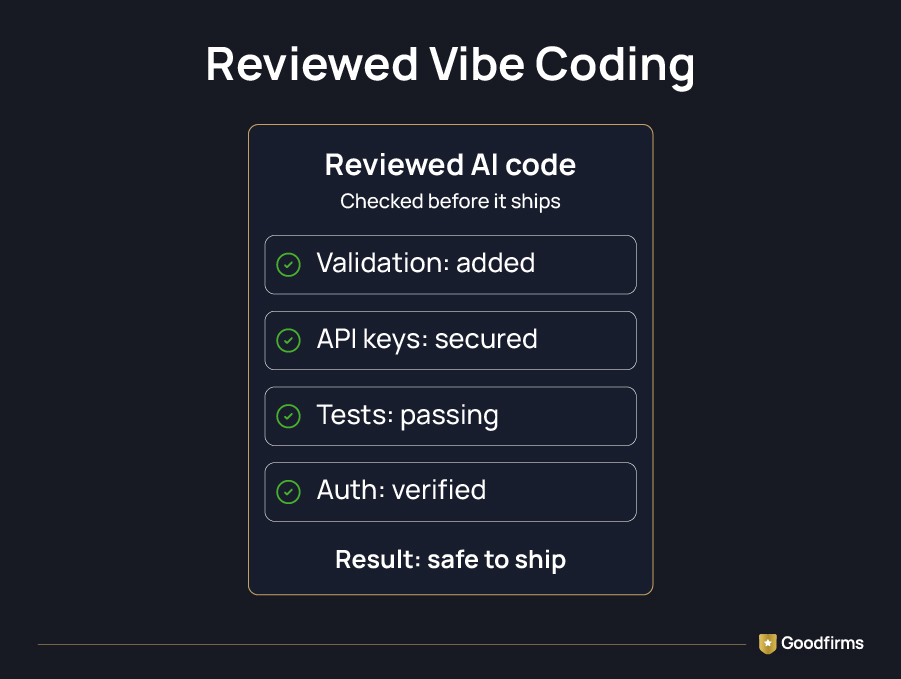
This is the area where vibe coding has burned teams the most publicly. Ask directly: how do you handle authentication, API keys, and database permissions when AI is writing that code? A developer with real review discipline has a clear checklist here, rather than a vague "the AI handles it,” and you can hire such developers.
7. Set expectations for documentation and handoff
AI-generated codebases can become surprisingly hard to navigate if their structure isn't intentionally designed. Ask how the developer documents architecture decisions and structures projects so the next person (or the next AI session) can pick up where they left off.
8. Use a vetted directory to compare options
Once you know what you're building and what skill set it needs, narrow the field using Goodfirms' vibe coding companies listing, filtered by client rating, portfolio depth, and specialization, as a full reference point before you start outreach.
A few things worth checking on each profile before you reach out:
- Review recency — are client reviews from the last 6–12 months, or mostly older? Vibe coding tooling changes fast; a 2024 review doesn't tell you much about a team's current practices.
- Portfolio substance — does the portfolio show shipped, production applications, or mostly demos and prototypes?
- Service scope — does the listing mention code review, security auditing, or QA as part of the engagement, or only "AI-assisted development"?
You can also check the shortlisted agencies against Goodfirms' Vibe Coding Service Guide. It explains typical engagement models, pricing ranges, and project timelines — a useful way to see if a quote you got is reasonable before you commit.
That process tells you a lot on its own. But it also helps to know exactly what to look for as you go.
Skills to Look for in Vibe Coding Developers
Beyond a resume, here's what actually separates a strong vibe coding developer from someone who just knows how to prompt.
- Strong fundamentals in at least one modern stack (React/Next.js, Node.js, Python, or similar), so they can catch AI mistakes rather than just trust them
- Practical, daily experience with tools like Cursor, Claude Code, Windsurf, or Replit Agent
- A habit of testing generated code immediately rather than batching up untested changes
- Comfort with Git — frequent commits and the discipline to revert quickly when an AI-generated change breaks something
- Working knowledge of common security pitfalls: exposed API keys, weak authentication, misconfigured databases, and insufficient input validation — for example, knowing to check that AI-generated login code never stores passwords in plain text, or that API keys never end up hardcoded in a file that gets committed to Git.
- Clear communication — since a lot of the actual "coding" now happens through written prompts, the ability to describe requirements precisely is a core technical skill, not a soft skill.
It also helps to know what a weak candidate doesn't do.
Red Flags to Avoid When Hiring Vibe Coding Developers
Just as important as what to look for is knowing what should make you pause.
- A candidate who can't explain, when asked, what the AI-generated code is actually doing, line by line, is a warning signal.
- They do not mention testing, code review, or version control in their workflow description.
- They are overconfident about shipping straight to production without a review step, especially for anything touching user data or payments.
- Their portfolio is entirely made up of demos and prototypes, with nothing that's been in contact with real users at scale.
- They are unwilling to do a short, paid trial task — confident, capable developers are usually happy to demonstrate their process.
Mario Zechner, an engineer behind the Pi coding harness that powers OpenClaw, cautioned in a May 2026 Wall Street Journal interview that companies leaning on unreviewed AI-generated code are accumulating technical debt. As he put it, "eventually it will catch up to us."
Source: The Wall Street Journal (May 2026)
It's the same lack of review discipline you'd spot in a single bad hire — just multiplied across an entire codebase.
Once you know who to look for, the next question is almost always budget
What Does It Cost to Hire Vibe Coding Developers?
Costs vary widely depending on scope, location, and engagement type. Because "vibe coding developer" is still a young, inconsistently defined role, pricing data is thinner and less standardized than for roles like "web developer" or "software engineer." For a broader breakdown of what vibe coding costs beyond just hiring a developer — including tool subscriptions, platform pricing, and project-level budgets — see Goodfirms' guide on how much vibe coding costs.
The numbers below are the closest thing to a rate card that currently exists — pulled from freelance platforms and early salary-tracking sites — so treat them as a useful starting point rather than a fixed benchmark. Expect to land on the higher end of standard developer pay, since fluency with AI tools still commands a premium.
Freelance and agency hourly rates
|
Region / Platform |
Hourly rate |
|---|---|
|
Asian developers |
$20+/hour |
|
Freelance marketplaces (general) |
$60–$100+/hour |
|
Eastern Europe & Latin America |
$75–$95/hour |
Full-time salary ranges
(For context, if you're building an internal team rather than contracting)
|
Experience level |
Annual salary |
|---|---|
|
Entry-level (1–2 years) |
$70,000–$100,000 |
| Mid-level | $100,000–$150,000 |
| Senior | $150,000–$250,000+ |
Additional costs to budget for
|
Cost type |
Estimate |
Notes |
|---|---|---|
|
Onboarding to your product/tools/workflow |
$1,500–$4,000/developer/year |
On top of base pay |
|
Post-build cleanup (AI-generated code → production-ready) |
+20–30% of total project cost |
Applies even after an MVP demo looks complete |
Vibe coding project support services cost
This is the cost layer most people don't think about until they're already stuck: what it costs to get a vibe-coded project reviewed, fixed, or made production-ready by an experienced developer or agency.
Code audits
A professional code audit, where developers review your codebase for security issues, structural problems, and scalability risks, generally runs:
|
Project size |
Typical cost |
|---|---|
|
Small (under 20k lines of code) |
$1,000–$5,000 |
|
Medium (20k–100k lines) |
$5,000–$15,000 |
|
Large / enterprise systems |
$15,000+ |
Pricing depends on codebase size, the number of integrations and dependencies, and whether the audit needs to cover compliance requirements such as healthcare or financial data handling, which can extend the hours needed.
Fix and refactor work
On freelance platforms, this is increasingly sold as a packaged service rather than open-ended hourly billing:
|
Package tier |
What's included |
|---|---|
|
Starter |
Full audit + written diagnosis |
|
Standard |
Audit + up to 3 priority fixes |
|
Advanced |
Audit + up to 7 fixes, including refactoring and security hardening |
Ongoing support
|
Cost type |
Estimate |
|---|---|
|
AI coding tool subscription + human oversight (per developer/month) |
$200–$600 |
This combines seat licenses and token usage for teams, mixing inline AI suggestions with agentic coding tools.
The pattern across all of these sources is the same: catching problems early, before a vibe-coded app has real users and accumulated months of untested changes, keeps the support cost closer to the audit end of the range. Waiting until something breaks in production pushes it toward the refactor or rebuild end, which costs more in both money and downtime.
Go through the vibe coding service guide on Goodfirms for a detailed and real understanding before you budget a single dollar. Across the 200+ agencies on Goodfirms, typical pricing breaks down as: $3–10K for a 1-week prototype (clickable, demo-ready), $10–50K for a 2–6 week MVP (limited beta-quality), $30–80K for a production MVP (ready for real users). Hourly rates range from $25–199/hr, depending on geography and seniority.
Vibe coding tools themselves are inexpensive, usually $10–$50 per seat per month. What you're really paying a developer for is review discipline — the judgment to use those tools safely, and the experience to know when not to use them at all. That skill doesn't appear on a rate card, but it shows up quickly when it's missing.
Put all of this together, and one idea keeps coming up, and that's "review discipline."
Final Thoughts
Vibe coding is here to stay in 2026. But it hasn't removed the need for good engineering judgment — if anything, that judgment matters more now, because mistakes show up faster and get noticed sooner.
When you hire vibe coding developers, you're not hiring someone who knows how to prompt an AI tool — you're hiring their review discipline. Without it, you get a working demo. With it, you get something you can actually put in front of paying customers.
Take the time to test candidates on real tasks, and ask them directly about how they handle security and code review. You can also compare vetted teams using Goodfirms' Vibe Coding companies listing and its service guide to see reviews and past work before you decide.
FAQs - How to Hire Vibe Coding Developers
What does a vibe coding developer actually do?
A vibe coding developer writes what the software needs to do in plain language, has AI tools generate the code, then reviews, tests, and cleans up the output so it's ready to ship. It's a mix of solid engineering judgment and being comfortable with AI-assisted tools.
Is vibe coding safe for production applications?
It can be — but only if a skilled developer reviews the AI-generated code, thoroughly tests it, and follows standard security practices for authentication, data handling, and API access. Most publicized security problems trace back to AI output that went live without anyone reviewing it.
Do I need a developer if I'm using a no-code or vibe coding app myself?
You likely don't need one for a basic prototype or internal tool. But when your app starts handling real user accounts, payments, or sensitive data, get an experienced developer to review and shore up the code.
What's the difference between vibe coding and no-code platforms?
No-code tools like Bubble or Glide limit you to pre-built components and templates. Vibe coding generates actual source code — you get the flexibility of custom software with much of the speed of a drag-and-drop builder.
How much does it cost to hire a vibe coding developer?
Costs depend on experience and engagement type. On freelance platforms, expect $20+/hour for developers based in Asia, $60–$100+/hour on marketplaces generally, and $75–$95/hour for talent in Eastern Europe or Latin America. Full-time hires follow standard software engineering pay bands: $70,000–$100,000/year for entry-level, $100,000–$150,000/year for mid-level, and $150,000–$250,000+/year for senior developers, since the core skill set hasn't changed, even though the tools have. Beyond the base rate, budget $1,500–$4,000 per developer annually for onboarding, plus an extra 20–30% of project cost for post-build cleanup before the app is truly production-ready.
Where can I find vetted Vibe coding developers or agencies?
Platforms that collect verified client reviews and portfolios, such as the Goodfirms Vibe Coding Companies listing, are a practical starting point for comparing agencies before reaching out directly.