Key takeaways
- Only 29% of developers trust AI-written code enough to ship it without review; that's the real story of vibe coding in 2026.
- Vibe coding builds in hours, not weeks, but that speed doesn't make it safe for production.
- Nearly half of all AI-generated code fails basic security checks, so skipping review isn't optional; it's the biggest risk.
- The vibe coding market has hit $4.7 billion and is growing 38% a year, too big for enterprises to ignore.
- Enterprises winning with vibe coding aren't picking AI over engineers; they're using both together, speed first, review before launch.
51% of professional developers now use AI tools every day, and 84% are already using or planning to use them in their workflows. Yet writing code is only one part of enterprise software development.
The real question isn't whether AI can write code; it's what happens when that code reaches an enterprise environment.
Here's how vibe coding compares with traditional enterprise development.
Vibe Coding vs Traditional Enterprise Software Development
|
Vibe Coding |
Traditional Enterprise Development |
|---|---|
|
Build in hours to days |
Build in weeks to months |
|
Every output needs human review |
Review is built into the process |
|
Higher security risk without oversight |
Lower risk, mature review process |
|
Best for prototypes and internal tools |
Best for production, customer-facing apps |
Speed was never the hard part here. Getting a working version of something has always been the easy win with vibe coding for enterprise software development.
The harder part, and the part most teams are still figuring out, is what happens after that first draft: who reviews it, what checks it needs to pass, and who's accountable if something breaks in production.
Planning an enterprise AI development strategy? Explore the top vibe coding companies for implementation expertise, or compare the latest vibe coding tools to accelerate secure, AI-assisted software development.
What Is Vibe Coding?
Vibe coding is a way of building software where you describe what you want in simple words, and AI turns that description into working code.
There's no manual scripting involved, and no need to write syntax line by line. You explain the idea, the AI handles the implementation, and the software comes together in a fraction of the usual time.
The term itself was coined by AI researcher Andrej Karpathy in early 2025, and it caught on fast because it captured something real: developers were no longer just writing code; they were directing it. That shift is exactly why enterprises are paying attention to it now.
Is Vibe Coding Ready for Enterprise Software Development in 2026?
Vibe coding isn't fully ready for core enterprise software development in 2026 because governance, security, and architectural oversight haven't caught up with adoption. Ninety-two percent of U.S. developers now use AI coding tools daily, but only 29% trust that AI-generated code is production-ready without review. That gap is exactly why enterprise vibe coding, for now, stays concentrated in prototyping, internal tools, and code that gets heavily audited before it ships.
Challenges of Vibe Coding for Enterprise Software
- Governance gaps: Many prompt-to-app tools push code straight toward deployment, skipping the staging gates, audit trails, and security checks that traditional enterprise development builds in by default.
- Low trust in output: AI-generated code can look correct while hiding failure modes that only surface under real-world load, a costly risk in complex, multi-layered systems.
- Maintenance overhead: Code generated quickly and without a consistent architecture is harder to scale, debug, and hand off without a senior developer stepping in.
Benefits of Vibe Coding for Enterprise Software Development
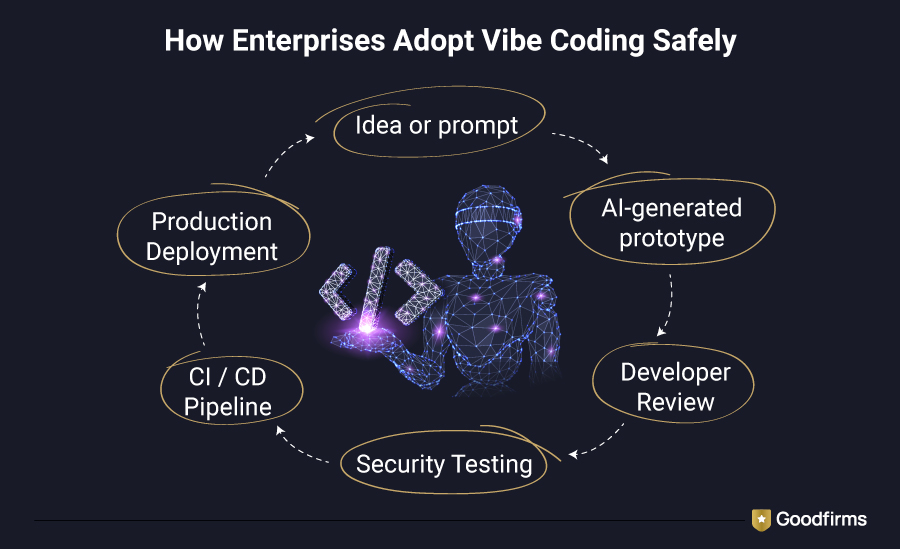
- Prototype, then harden: Teams build quickly using tools like Lovable or Bolt.new, then move the code into governed environments for security reviews before it goes anywhere near production. For many organizations, partnering with Lovable development companies is considered a best practice.
- Engineers as reviewers: Senior developers are shifting from writing every line themselves to writing specs and reviewing AI output, same rigor, just earlier in the process.
- Sandboxing by design: Organizations keep vibe coding limited to isolated scripts and MVPs, still wrapped in standard CI/CD pipelines, rather than anything customer-facing.
So the real answer isn't "yes" or "no"; it's that vibe coding is enterprise-ready at the edges of software development right now, but enterprise-risky at the core until governance closes the gap.
Best Vibe Coding Tools in 2026
Enterprise teams aren't standardizing on a single vibe coding platform. Most use AI-native development tools for rapid prototyping, then integrate the generated code into existing engineering workflows for testing, security reviews, and deployment.
|
Tool |
Best For |
Enterprise Fit |
|---|---|---|
|
AI pair programming |
High |
|
|
AI first IDE |
High |
|
|
Claude Code |
Large codebase generation |
High |
|
Full-stack prototypes |
Medium |
|
|
MVPs & internal apps |
Medium |
Choosing the right tool is only half the equation. The bigger challenge is deciding how these tools fit into enterprise engineering without compromising governance or security.
How can Enterprise Adopt Vibe Coding Responsibly?
Responsible adoption starts with knowing exactly where vibe coding earns its place, before governance even enters the conversation. Right now, it works best for:
- Prototypes and MVPs, where speed matters more than polish
- Internal tools and admin panels that never face a customer
- Data migration scripts and one-off automation, where mistakes are cheap to catch
- Low-stakes experimentation, like testing a feature idea before committing engineering time to it.
Goodfirms Insight: The Goodfirms Custom Software Development Cost Survey 2026 found that over 90% of software companies use AI across the SDLC, highlighting the growing shift toward AI-assisted development.
Once that boundary is clear, responsible adoption comes down to a few practices listed below:
Draw a hard line on where it's allowed
Vibe coding stays in prototypes, internal tools, and sandboxed environments. Anything customer-facing, compliance-sensitive, or tied to core infrastructure goes through standard development and review, no exceptions. Even a small exception here tends to expand quietly over time, so the boundary needs to be enforced, not just stated.
Treat AI output as a first draft, not a final one
Every piece of AI-generated code gets reviewed by a senior engineer before it moves anywhere near staging, the same scrutiny applied to code a human wrote. This isn't about distrust of the tool; it's about applying the same standard enterprises already hold every other line of code to.
Build in the graduate workflow
Let teams prototype fast in AI-native tools, then port working code into governed environments for security hardening, testing, and cleanup before deployment. This gives teams the speed benefit up front without carrying the risk all the way through to production.
Shift engineers into an architect role
The most effective teams aren't using AI to skip engineering; they're using it to free senior vibe coding developers to focus on specs, architecture, and review, the things AI still can't do well. Over time, this changes what "senior engineer" even means on a vibe-coding-enabled team.
Keep it inside existing CI/CD pipelines
Vibe-coded projects should pass through the same staging gates, audit trails, and security checks as everything else. Skipping that step is where most of the risk creeps in, since it's rarely the AI-generated code itself that causes damage; it's code that bypasses the checks meant to catch it.
Done this way, vibe coding stops being a shortcut around good engineering and becomes another tool inside it, one that speeds up the parts of development that were never the risky parts to begin with. Many enterprises also partner with DevOps companies to strengthen CI/CD pipelines, automate testing, and enforce deployment governance for AI-generated code.
Vibe Coding Trends and Outlook for 2026
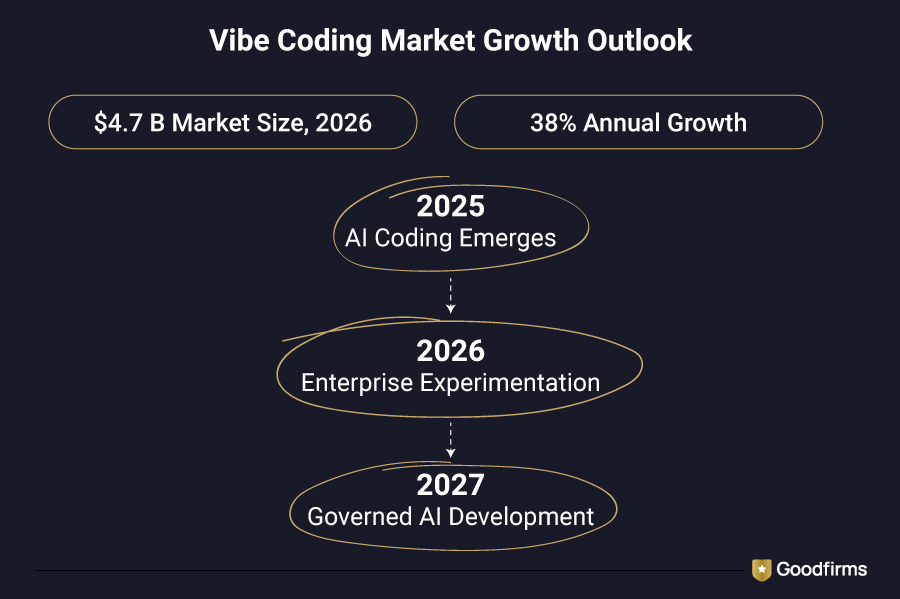
The vibe coding market has grown from a niche experiment to a $4.7 billion industry in 2026, expanding at 38% a year, with governance now deciding who benefits and who gets burned.
Market Growth
The vibe coding market hit $4.7 billion in 2026 and is projected to reach $12.3 billion by 2027, growing nearly twice as fast as the broader low-code/no-code space it emerged from. This growth is also reshaping the broader low-code ecosystem, with many enterprises evaluating low-code development companies alongside AI-native development platforms.
AI-Written Code
92% of U.S. developers now use AI coding tools daily, and 41% of all new code written globally is AI-generated, making it a default part of software development rather than a fringe practice. That scale alone is forcing enterprises to treat it as a permanent part of their workflow.
Non-Developer Builders
63% of users on prompt-to-app platforms like Lovable aren't professional developers. Product managers, founders, and designers are now shipping working software using nothing but plain language, blurring the line between who's technically "allowed" to build.
Security Gaps
Roughly 45% of AI-generated code fails basic security checks, pushing enterprises toward stricter review processes and a "build fast, verify harder" approach instead of treating AI output as production-ready by default. This gap is exactly why governance has become the defining issue of 2026, not the technology itself.
Rise of AI Agents
Coding tools are moving past simple suggestions into multi-AI agent setups that handle testing and deployment, shifting human engineers into more of an oversight and review role than a hands-on coding one. That shift is changing what "engineering skill" even means on modern teams.
Hybrid Development Model
Enterprises seeing the strongest results aren't choosing between AI and traditional development. They're combining both, using AI for early speed and human engineers for review before anything reaches production, and this hybrid approach is quickly becoming the industry standard.
FAQs - Vibe Coding for Enterprise Software Development
Is vibe coding safe for enterprise use?
Vibe coding is not safe without oversight for enterprises. Vibe coding can speed up development significantly, but roughly 45% of AI-generated code fails basic security checks, so it needs to go through the same vibe coding governance and review processes as any other code before it touches production systems.
Can vibe coding replace software developers?
No. Vibe coding shifts what developers spend time on rather than replacing them. Engineers move from writing every line themselves to reviewing AI output, writing specs, and owning architecture, work that still requires human judgment and technical depth.
What is the difference between vibe coding and traditional software development?
Vibe coding vs traditional software development comes down to input and control. Vibe coding uses plain-language prompts to generate code automatically, while traditional development involves engineers writing and reviewing every line manually, with structured testing built in from the start.
What are the risks of vibe coding for businesses?
The biggest vibe coding security risks include vulnerable code slipping into production, weak audit trails, and maintenance issues from inconsistent architecture. Gartner warns that without governance, defect rates could rise by 2,500% by 2028.
How much does vibe coding cost for enterprises?
Enterprise vibe coding cost licenses typically run $30 to $125 per user per month. GitHub Copilot Enterprise starts around $39/user, Cursor Enterprise around $90/user, and Claude Code around $125/seat, though the subscription price is only part of the real enterprise AI coding tools cost.
Which industries are adopting vibe coding fastest?
Tech, SaaS, and startups lead vibe coding adoption, largely because of Adoption Is Accelerating prototyping needs. Regulated industries like finance and healthcare are adopting it more cautiously, mostly for internal tools rather than customer-facing or compliance-sensitive systems.
Final Words
So, is vibe coding ready for enterprise software development in 2026? Not fully, but it's getting there.
Right now, it works well for prototypes, internal tools, and small automation tasks. For anything customer-facing or business-critical, it still needs strong code governance and human review.
The real value of enterprise AI coding comes from using it with the right safeguards, not just moving faster. Working with one of the top software development companies can help bridge that gap, giving enterprises access to teams that know how to combine AI speed with the governance and quality standards production systems require.
That balance is really what enterprise vibe coding success looks like in 2026.