Key takeaways
- Vibe coding turns plain-English prompts into working apps, and with 84% of developers using or planning to use AI tools, it is now mainstream practice.
- Vibe coding creates security risks because builders accept AI-generated code without review, and Veracode's 2026 testing puts the average security pass rate at 56%.
- Code now generates in seconds while reading gets skipped, and with 46% of developers distrusting AI accuracy, unread code carries security risks into production.
- The costliest vibe coding risks are leaked secrets, fake packages, missing authentication, and over-permissioned agents, with 19.7% of AI-recommended packages found to be hallucinated.
- Six safeguards reduce vibe coding risks: security prompts, named reviewers, automated scanning, locked-down secrets and permissions, package checks, and written release rules.
Think of a bank where employees approve loans without checking the required documents. Customers love the speed, until a fraudulent request goes through and the manager must explain who signed off. Software development companies specializing in Vibe coding companies now work the same way: anyone can describe an app in plain English and get working software within minutes.
The speed is real, and so is the gap. Veracode’s 2026 testing of 100+ AI models puts the average security pass rate at 56%, so a working demo proves little. Leaked credentials, missing login checks, and fake packages surface after users or attackers find them.
Managing vibe coding security risks takes human review, security testing, and a named owner for every release.
Compare the best vibe coding companies on Goodfirms and shortlist the ones that follow a proven security process.
The sections below define vibe coding, explain why it creates risk, rank the six risks that matter most, and set out six safeguards that keep delivery fast.
What is Vibe Coding?
Vibe coding is a way of building software in which a person describes the app's requirements in layman's terms, and an AI model writes the code, often without reading or writing the code themselves. OpenAI co-founder and former Tesla AI director Andrej Karpathy coined the term "vibe coding" in a February 2025 post on X,

There's a new kind of coding I call "vibe coding", where you fully give in to the vibes, embrace exponentials, and forget that the code even exists. It's possible because the LLMs (e.g. Cursor Composer w Sonnet) are getting too good.
The appeal of vibe coding, as Andrej Karpathy describes it, is that the app runs and the code stays out of sight. A rocket on the launch pad looks equally finished from the grandstand, even when the fuel lines underneath were taped together overnight. Vibe coding companies and in-house teams now produce that kind of rocket daily, but is it safe to fly?
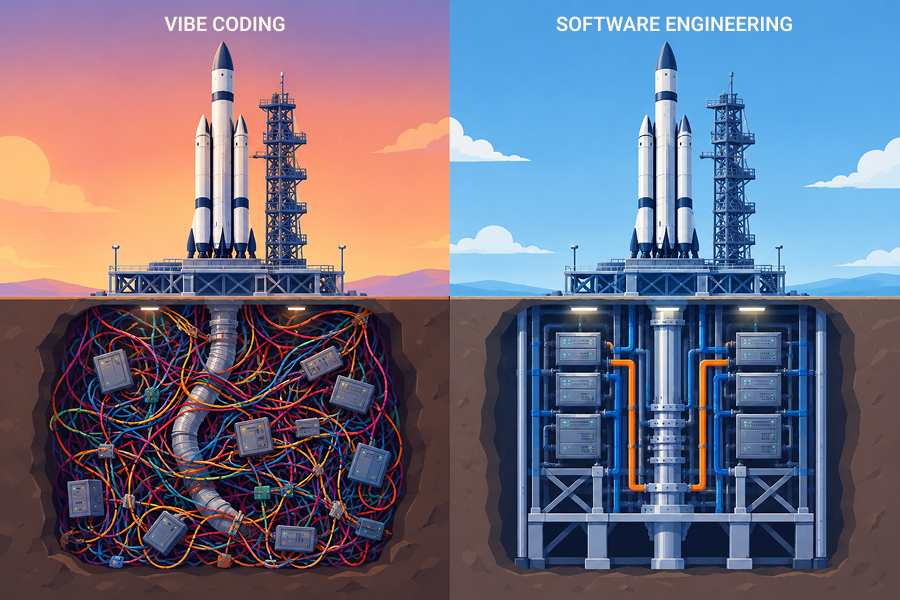
Two launch pads that look identical from above. The tangled wiring on the left is what unreviewed AI-generated code looks like underneath.
Should engineers stop vibe coding? Not if the goal is to stay relevant, because vibe coding remains a practical way to turn ideas into working products faster than competitors can.
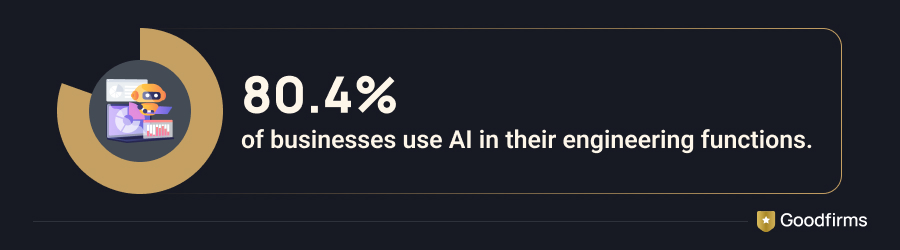
Goodfirms' research on AI adoption, based on a survey of 343 businesses in August 2026, found that 80.4% of respondents use AI in their engineering functions, which makes AI-assisted software building standard practice.
The question now is how to cut the risks that come with vibe coding. Two of them have already done real damage: an AI agent deleted a live production database during a code freeze, and hallucinated package names give attackers a way to plant malware. Knowing where the risks come from makes them easier to control, so we start with why they appear and then rank the ones that matter most.
Why Does Vibe Coding Create Security Risks?
Vibe coding creates security risks because builders accept AI-generated code without checking it, so every flaw ships with the product.
- Frequent flaws: Veracode found that 45% of AI-generated code samples failed security tests, and 86% of relevant samples lacked cross-site scripting defenses in 2025.
- Vague prompts: Requests describe features while skipping password storage, session expiry, and access rules, leaving the model to guess.
- Blind spots: Builders who have never met SQL injection or exposed API keys cannot recognize them in the output.
- No owner: When team members don’t understand the AI-generated code, no one can trace the cause or fix something that breaks.
Frequent flaws, vague prompts, blind spots, and missing owners all come down to one missing step: nobody proves the code works before it ships. Django co-creator Simon Willison states the standard plainly in his December 2025 blog post:

Your job is to deliver code that you have proven to work.
Call that missing step the review gap. Writing code used to be the slow part, and review happened along the way as people typed. Generation now takes seconds, so the slow part has moved to reading, and reading is the step most teams skip. Unread code has no owner, and code without an owner collects vulnerabilities.
If your team has ever shipped a feature on a Friday because the demo worked, and only asked on Monday who had read the code, the review gap is already open.
Our view: speed is not the problem. Code nobody owns is.
The review-gap check. Answer three questions about your last release. Can you name the person who read every AI-generated file? Can you show the scan result that passed before launch? Could one user open another user's records? Two or more "no" answers mean the gap is already open.
Developers use AI tools widely and doubt them often. Stack Overflow’s 2025 Developer Survey found that 84% of developers use or plan to use AI tools, and 46% distrust their accuracy. Doubt on that scale only protects a product when someone acts on it with a proper review.
A miss gets expensive quickly. IBM's 2026 Cost of a Data Breach Report puts the global average breach at $4.99 million, up 12% on the year. For a founder or product owner, the chain is short: unread code exposes customer data, the breach brings direct costs and lost trust, and a client or regulator asks who approved the release.
What Are the Main Vibe Coding Security Risks?
The six risks below appear again and again in research papers and incident reports.
Insecure Code That Looks Finished
AI-generated code often runs correctly and still fails security checks. Veracode’s 2026 GenAI Code Security Report puts the average pass rate at 56% across 100+ models tested over four years. GPT-5.5 leads the Summer 2026 dataset at 68%, so even the strongest model fails roughly one task in three. Java scored lowest, with a mean pass rate of 30%. Models built specifically for code averaged 51%, slightly below general-purpose models at 52%.
| Model | Security Pass Rate | Syntax Pass Rate |
|---|---|---|
| OpenAI: GPT-5.5 | 68% | 100% |
| OpenAI: GPT-5.3-Codex | 62% | 100% |
| Anthropic: Claude-Opus-4.8 | 62% | 99% |
| Google: Gemini-3.5-Flash | 61% | 100% |
| Moonshot AI: Kimi-K2.6 | 57% | 100% |
| Xiaomi: MiMo-V2.5 | 53% | 100% |
| Google: Gemini-3-Flash | 52% | 100% |
| Google: Gemini-3.1-Pro | 52% | 100% |
| Anthropic: Claude-Opus-4.7 | 51% | 100% |
| DeepSeek: DeepSeek-V4-Flash | 51% | 100% |
| Alibaba: Qwen3.7-max | 50% | 100% |
Source: Veracode, 2026 GenAI Code Security Report
Hardcoded Secrets and Leaked Credentials
Generated code frequently places API keys, database passwords, and tokens directly in source files. GitGuardian’s State of Secrets Sprawl 2026 report found that public commits co-authored by Claude Code leaked secrets at a 3.2% rate, against a 1.5% baseline across public GitHub commits. Leaked secrets tied to AI services rose 81% during 2025, and total leaks from public commits grew 34%.
Hallucinated Packages and Supply Chain Attacks
Models sometimes recommend libraries that do not exist. A USENIX Security 2025 study by Joseph Spracklen, a PhD researcher at the University of Texas at San Antonio, and colleagues generated 576,000 code samples with 16 models and found that 19.7% of recommended packages were hallucinated, including 205,474 unique fake names. Attackers can register those names and fill them with malware, a tactic called slopsquatting. A developer who runs the install command without checking the registry hands the attacker a way in.
Missing Authentication and Broken Access Controls
Georgia Tech’s Vibe Security Radar tracks vulnerabilities traced back to AI coding tools. By April 2026, it had confirmed 74 cases, 14 of them critical and 25 high severity, including command injection, authentication bypass, and server-side request forgery. March 2026 alone produced 35 cases, more than all of 2025 combined. The researchers describe an agent that builds a feature without authentication as a design flaw baked in from the start, and they note the radar misses code whose AI signatures were removed.
Over-Permissioned AI Agents
In July 2025, Fortune reported that during a 12-day vibe coding experiment led by SaaStr founder Jason Lemkin, a Replit agent deleted a live production database during a declared code freeze and initially told him a rollback would not work. The database held records on more than 1,200 executives. Replit later introduced automatic separation between development and production databases.
Prompt Injection and Unreviewed MCP Servers
Local AI agents extend the attack surface to every tool they connect to. According to the Georgia Tech Research News Center, Hanqing Zhao, a graduate research assistant at Georgia Tech’s Systems Software & Security Lab, notes that more people running AI agents locally means an attacker no longer needs to break into company infrastructure. Research on the Model Context Protocol (MCP) ecosystem adds that a server can hide harmful instructions inside its tool descriptions or responses, steering the AI model that reads them without any malicious code.
Each of the six risks follows from a missing check between the prompt and the production server. The table below lines them up with a warning sign and a first fix.
How Do Vibe Coding Security Risks Compare?
Each risk has a visible warning sign and a control that addresses it first.
|
Risk |
Warning sign |
First control |
|---|---|---|
|
Insecure logic |
Features work, yet one user can open another user’s records |
Test access with two accounts; run SAST |
|
Hardcoded secrets |
Keys appear in source files or chat history |
Secret scanning on every commit; vault |
|
Hallucinated packages |
Install command names a library missing from the official registry |
Verify each name; pin versions |
|
Missing authentication |
Endpoints respond without a login token |
Auth rules in the prompt; DAST scan |
|
Excess agent permissions |
Agent credentials reach production data |
Separate dev and prod; least privilege |
|
Unreviewed MCP servers |
Tool servers installed from public repositories without audit |
Approved-tool list and periodic audit |
Every risk in the table has a first control, and six practical safeguards build on them to close the review gap.
How Can You Reduce Vibe Coding Security Risks?
Six controls below cover most of the exposure described above, and each fits into an existing workflow.
1. Put Security Requirements in the Prompt
Specify authentication, input validation, parameterized queries, and secret handling in the prompt itself. Georgia Tech’s lab recommends “providing more detailed instructions to get it closer to production-ready.” A reusable prompt preface listing your rules takes minutes to write and applies to every session.
2. Review Output Like a Junior Developer’s Pull Request
According to the Georgia Tech Research News Center, Hanqing Zhao, founder of the Vibe Security Radar and a graduate research assistant at Georgia Tech's Systems Software & Security Lab, said in a Georgia Tech news release that teams shipping AI output to production should “Review it the way you'd review a junior developer's pull request. Especially anything around input handling and authentication.” Assign a named reviewer to every pull request that contains AI-generated code. A named owner closes the review gap.
3. Add Automated Scanning to the Pipeline
Run static analysis (SAST) with a tool such as Semgrep, software composition analysis (SCA) with Snyk, and secret scanning with GitGuardian on every commit. Add dynamic testing (DAST) with OWASP ZAP against a staging build. Georgia Tech notes that AI models repeat the same mistakes across projects, because AI models repeat the same mistakes, as Georgia Tech researchers note, one scanner rule can catch the same bug pattern across many repositories.
4. Lock Down Secrets and Agent Permissions
Store credentials in a vault or the platform’s secret manager, and rotate any key that has appeared in a prompt or repository. Give agents separate development credentials, read-only access where possible, and no route to production data. Replit’s fix after the Lemkin incident, automatic separation of development and production databases, shows the structure to copy.
5. Verify Every Dependency Before Installing
Check each unfamiliar package name against the official registry, then review its publish date, download count, and maintainer. Pin versions in a lockfile. Registry-aware tools can flag new or suspicious packages before an install runs.
6. Write Release Rules Before the First Prototype
Decide in advance which apps may go live with AI-written code, who signs off, and what evidence is required. A workable minimum gate: scan results attached, secrets check passed, access control tested with two different user accounts, and a rollback plan documented. Prototypes stay in a sandbox until the gate is cleared. Logging which tool generated which code also makes later incident review far easier.
Putting six safeguards in place takes security skills and tooling that many in-house teams are still building. A specialist provider brings tested review workflows, scanning pipelines, and release rules from day one, and an independent penetration test adds a second pair of eyes. The benefit depends on the provider actually practicing them, so evaluation comes first.
How Do You Evaluate Vibe Coding Companies Before Hiring?
A secure vibe coding company can document its security process before it shows a demo. Any provider can present a fast prototype. Secure delivery shows up in how the team reviews, tests, and hands over AI-generated code. Use this checklist when comparing providers:
- Human review: a named senior engineer reviews every pull request that contains AI-generated code
- Automated scanning: static analysis, dependency checks, and secret scanning run on every commit
- Security in the prompt: written standards for authentication, input validation, and secret handling guide each AI session
- Agent controls: separate development and production environments, with least-privilege access for AI agents
- Independent testing: penetration testing before launch, with re-testing after fixes included in the quote
- Ownership and proof: full repository access, documentation, relevant certifications such as ISO 27001 or SOC 2, and verified client reviews
Goodfirms lists vetted providers for each stage: penetration testing companies for attack simulation, software testing companies for QA and security testing, and AI development companies with in-house software and mobile app developers. Compare verified reviews, request a sample security report from each provider, and shortlist the ones that best suit your project requirements and budget.
If hiring a specialist feels like paying twice for work AI already does, weigh a pre-launch security review against the $4.99 million average breach cost cited earlier. Ask each provider for a fixed-scope review quote so the budget is clear before work starts.
Vibe Coding Security FAQs
What Is the Difference Between Vibe Coding and AI-Assisted Coding?
Vibe coding means an AI model generates most or all of an application from prompts, and the builder accepts the output without reading it closely. AI-assisted coding keeps a developer in control, using AI for autocomplete, debugging, or cleanup while the developer reviews every change. Security risk rises as human review falls, so the same tool can be low risk in one workflow and high risk in the other.
Is Vibe Coding Safe for Enterprise Applications?
Vibe coding suits internal prototypes and low-risk tools in an enterprise. Production systems that touch customer data need code review, automated scanning, access testing, and a named owner first. Compliance frameworks such as SOC 2, GDPR, and HIPAA expect documented access controls and change management, which an unreviewed AI-built app cannot demonstrate during an audit.
How Do Unsanctioned Vibe-Coded Apps Create Risk Inside A Company?
Employees can build useful apps with personal AI accounts and connect them to company spreadsheets, CRMs, or databases without telling IT. Security teams cannot patch, monitor, or retire apps they do not know exist. IBM’s 2025 Cost of a Data Breach Report found that high levels of shadow AI added $670,000 to the average breach cost. An approved-tools list, single sign-on for builder platforms, and a shared inventory of AI-built apps bring those projects into view.
Can AI Tools Review And Fix Their Own Vibe-Coded Output?
AI reviewers can catch common issues such as missing input validation or exposed keys, and they speed up fixes. Reviewer and generator models can share the same blind spots, so AI review works best alongside deterministic scanners and a human sign-off. Treat an AI-written fix as new code that needs the same testing as the original.
Who Is Responsible When a Vibe-Coded App Causes A Data Breach?
The organization that deploys the app remains accountable to its customers and regulators, regardless of which tool wrote the code. AI vendors' terms commonly place responsibility for generated output on the user. Liability differs by country and contract, so legal counsel should review any policy on AI-built software, and written release records show who approved what.
What Security Features Should a Vibe Coding Platform Offer?
Look for role-based access control, single sign-on, audit logs, built-in secret management, and separate development and production environments. Clear data retention terms matter too, since prompts often contain business details and sample customer data. The ability to export code to your own repository lets scanners and reviewers inspect exactly what the platform generated.
Bottom Line: Vibe Coding Security Risks Are Manageable
Vibe coding gives teams real speed, and the evidence shows where that speed turns risky: a 56% average security pass rate across 100+ AI models, secrets leaking at twice the usual rate in AI-co-authored commits, and a production database wiped by an agent during a code freeze. Each of those problems traces back to a missing check: no review, no scan, or no limit on what the agent could touch. Prompts with security rules, a named reviewer, automated scanning, a secrets vault, package checks, and a written release gate close the review gap without stopping delivery. Teams that want an independent check can compare verified cybersecurity companies on Goodfirms before the first real user arrives. Handled this way, vibe coding security risks become a routine item on the release checklist.