Key takeaways
- 83% of businesses now run AI across multiple functions or organization-wide — this means businesses are no longer testing the AI waters but embracing it in full.
- 92.2% of business leaders increased AI investment in 2026, with 59.3% reporting a significant jump in spend.
- 62.7% of leadership teams report measurable cost reduction from AI, even though cost ranks only fourth among the metrics leaders track most.
- Data quality is the top obstacle to AI adoption, cited by 26.8% of respondents — more than double the next-ranked concern, security and privacy (17.6%).
- 79% of business leaders say a human sign-off safeguard is the top requirement for trusting AI with high-stakes decisions, ahead of accuracy track record and explainability.
Most businesses have stopped asking "should we use AI" and started asking "is it working?"
83% of the organizations in this study now run AI across multiple functions or the entire business, and that shift has raised a tougher question than adoption itself: whether the investment is actually paying off?
Goodfirms surveyed 343 business leaders across 30 countries in 2026 to uncover AI Adoption Statistics 2026, covering everything from budgets and tools to the obstacles nobody talks about publicly.
The findings offer useful information whether you're refining your own AI strategy or evaluating AI consulting companies to help get you there.
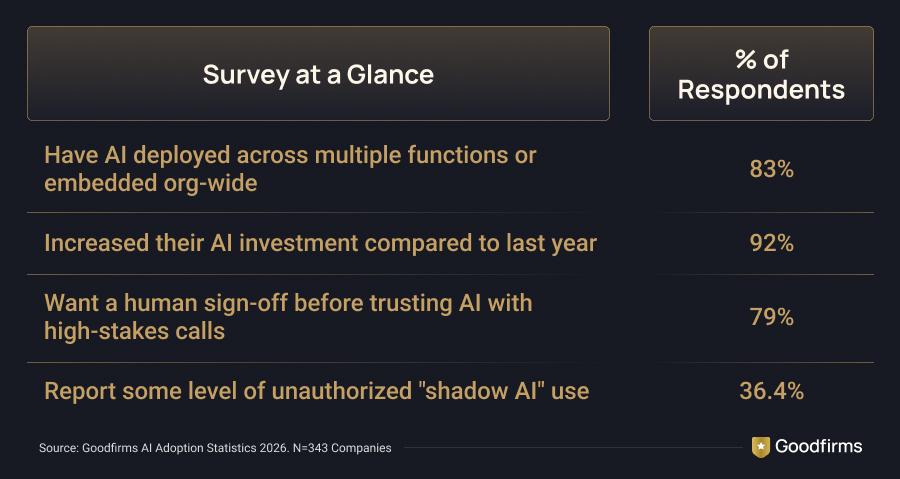
That's the quick snapshot. Next comes the in-depth information behind each piece of information, starting with how far adoption has actually gone.
Looking for a reliable AI partner? Check Goodfirms' list of leading Artificial Intelligence Companies before making your next move.
AI Adoption Statistics 2026: Adoption Rates and Business Use
Adoption is no longer a yes-or-no question — it's a matter of degree. The numbers below break down how deep that integration actually goes, and where each function stands today.
What Is the Current AI Adoption Rate?
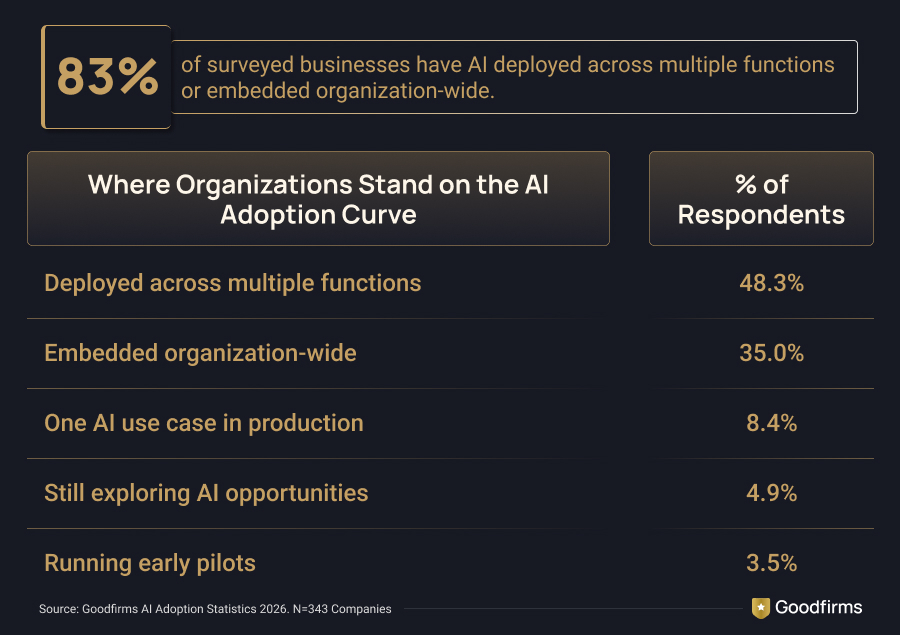
Among organizations represented in the Goodfirms survey, 48.3% report AI deployed across multiple functions, while another 35.0% say it is embedded organization-wide. This means a combined 83% of participant companies are operating with AI as standard infrastructure rather than a side project. Only 8.4% report just one, whereas 4.9% are still exploring AI opportunities, and 3.5% are running early pilots.
With the adoption numbers in view, the natural follow-up is: AI has actually spread into which parts of the business currently?
Which Business Functions Are Already Using AI?
Marketing and sales lead every other function by a wide margin, named by 88.8% of respondents, followed closely by engineering at 80.4% and content creation at 71.3%. The pattern breaks down cleanly along one line: functions that produce drafts, first passes, and creative starting points have adopted AI fastest, while functions where a mistake carries legal or financial weight are still catching up.
|
Business Function |
% Using AI Tools |
|---|---|
|
Marketing / Sales |
88.8% |
|
Engineering |
80.4% |
|
Content Creation |
71.3% |
|
Design / Animation |
59.4% |
|
Operations |
58.7% |
|
Testing |
52.4% |
|
Customer Support |
47.6% |
|
Leadership |
37.8% |
|
HR |
28.0% |
|
Finance |
24.5% |
|
Legal |
21.7% |
Marketing, engineering, and content lead adoption. What's actually pulling organizations toward AI in the first place?
What Motivates Organizations to Adopt AI?
Cost reduction and efficiency goals were the single biggest motivator, cited by 78.3% of respondents, ahead of leadership vision or strategic initiative (74.1%), a need to improve product or service quality (55.9%), and customer or market demand (46.2%). Very few organizations adopted AI for a single reason; for most of the organizations, the reason for adopting AI was the combination of more than 2 factors.
Combining more than two reasons for adopting AI still leaves one question open: who inside these organizations is actually leading that charge?
Who Drives AI Adoption Within Organizations?
When asked who actually drives AI adoption within organizations, 48.3% say employees and leadership pushed AI adoption together, and almost as many 46.2% call it a top-down, leadership-led push — that's 94.5% combined. Only 2.8% say it started from employees on their own, and another 2.8% have no clear direction behind it at all. In short: this isn't happening by accident. Someone at the top is usually driving it.
Which AI Tools Are Companies Using in 2026?
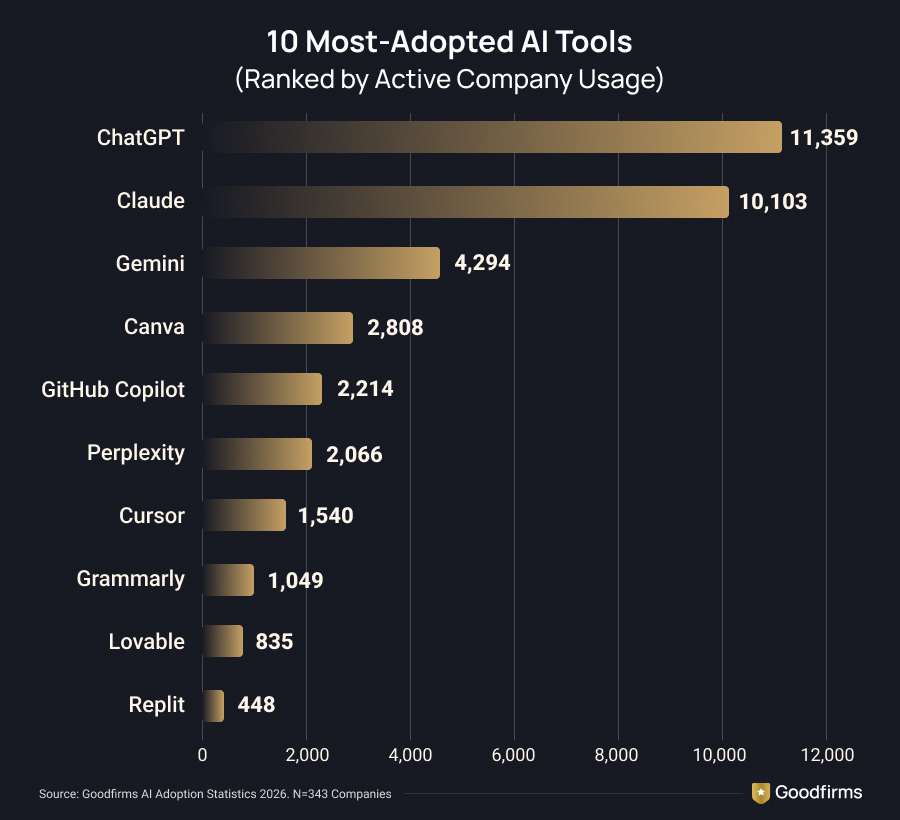
According to Goodfirms’ AI tool adoption tracking system, among the 14,022 active companies using AI tools, ChatGPT is the most widely used, with 11,359 companies using it. Claude follows closely at 10,103 companies, putting the two LLMs nearly neck-and-neck at the top of the market. Whereas Gemini trails in third place with 4,294 companies. Here are the 10 most adopted AI tools ranked by active company usage.
With ChatGPT leading adoption by a wide margin, demand has grown alongside it for OpenAI Developers who build custom integrations rather than relying on the tool as-is. But behind every one of those tool rankings sits a leadership team trying to answer a harder question: is AI investment actually paying off?
AI Investment, ROI and Business Outcomes
Widespread adoption usually comes with a bigger price tag attached. Here's what businesses are actually spending on AI, and what they're getting back for it.
How Much Are AI Budgets Rising in 2026?
In the Goodfirms survey, 92.2% of business leaders reported increasing AI investment in 2026. Of these, 59.3% said they have increased significantly, and 32.9% have increased slightly. The rest 6.4% of them said it remained the same, and 1.4% said this is their first year investing in AI.
So, what is the annual budget that organizations are allocating to AI automation tools, platforms, and infrastructure?
Annual AI budget allocation varies widely across respondents. Below is a breakdown of how much businesses are currently spending on AI each year.
Annual AI Budget Allocation by Respondents
|
Annual AI Budget |
% of Respondents |
|---|---|
|
Below $1,000 |
6.3% |
|
$1,000 – $5,000 |
23.8% |
|
$5,000 – $10,000 |
14.0% |
|
$10,000 – $50,000 |
18.9% |
|
$50,000 – $100,000 |
13.3% |
|
$100,000 – $200,000 |
3.5% |
|
More than $500,000 |
2.8% |
|
No dedicated AI budget |
11.9% |
And now, where exactly is this budget being spent?
Where Is the AI Budget Going?
Licensing third-party AI tools absorbs the largest share of that spend, mentioned by 77.3% of respondents, well ahead of AI infrastructure and cloud compute (46.8%), building custom models in-house (33.3%), and training or upskilling employees (29.1%). Most companies are buying access to existing models rather than building their own. For a 40-person company, building a custom model isn't an ambition; it's a distraction from the actual business. Investing in licensing third-party tools becomes the wise option here.
Hence, licensing third-party tools is where most of that budget goes. The next question is for which tools this budget is being spent on.
Is AI Investment Paying Off?
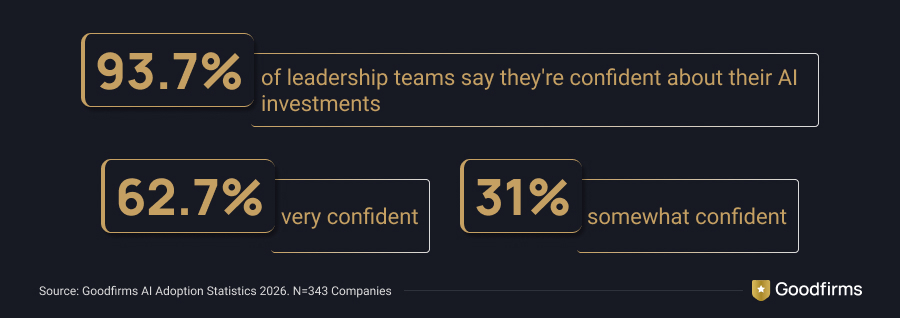
Confidence runs high. 62.7% of leadership teams that answered this question describe themselves as very confident that current AI investments deliver value for money, with clear returns visible. Another 31% are somewhat confident, citing early positive signs. Summing up to 93.7% of business leaders are confident about their AI investments. Just 6.3% remain neutral, saying it's too early to judge. What is worth highlighting is that none of the respondents said they were questioning the investment.
Confidence in AI ROI has to be backed by something concrete. Here are the measurable business outcomes AI delivered for surveyed organizations
What Measurable Business Outcomes Has AI Delivered?
When asked about real, measurable business outcomes that AI has delivered, these business leaders have identified a few notable categories: faster turnaround, more output per person, and cleaner decisions.
Turnaround Time Drops Sharply
Matthew Suffoletto of PageSpeed Matters cut SOP documentation time by 67%, from 90 minutes down to 30. Cyrus Kennedy of The Ad Firm reduced monthly client reporting time from 5–6 hours per account to about 90 minutes. Tudor Brad of BetterQA turned a 3-hour bug-documentation process into one that takes under 5 minutes.
Berkay Aydin, Head of AI at Jotform, has seen the same pattern play out, and this is what he said about it.

AI tools have significantly improved our speed. We were already doing this before AI through methods like prototypes and user testing. The difference is that with AI in our daily work, these cycles have dropped from weeks to days, and sometimes even hours.
More Output, Same Headcount
Ziad Talha of North Texas Growth says his team now handles 70% more volume without adding headcount, and Amy Bos of Mediumchat Group scaled the business without growing back-office staff. Aakash Singh of Mantravi reports a 35% increase in engineering velocity alongside a 20%-plus drop in delivery costs. Gains like this are increasingly common among teams working with Vibe Coding Companies or adopting similar AI-assisted development practices in-house.
Revenue Per Person Climbs
At Bitsmiths Studio, Muhammad Ali Abbas says the team is now about half its former size and producing roughly the same revenue, nearly doubling revenue per head. Four people left over the last ten months and weren't replaced, because the remaining team could already carry the work.
Delivery Costs and Timelines Fall Together
Mahnoush of AI First Partners reports project delivery timelines reduced by 35% and operational costs down by 26–50% over the same period, using automated workflows to scale client engagements without expanding headcount.
Cleaner Data Behind Every Decision
Not every outcome is about speed achieved or money saved. Michael of Southtown Web Design ran an AI-assisted audit of his own ad account and found four conversion-tracking failures the platform had reported as healthy. This means every optimization decision made before that AI-assisted audit was built on bad numbers.
That confidence is grounded in what leaders actually track. So, according to these business leaders, which metrics matter the most when evaluating AI success?
AI Success Metrics and Real-World Cost Impact
Success looks different depending on who you ask, but the metrics leaders track — and the cost savings those metrics point to — tell a consistent story. Here's what the data shows on both fronts.
Which Metric Matters Most When Evaluating AI Success?
Productivity gains are the metric leaders watch most closely when judging whether AI is working, chosen by 50.3% as the metric that matters most, well ahead of revenue growth (19.6%), customer satisfaction (14.0%), and cost reduction (11.9%). Just 3.5% say they don't formally evaluate AI outcomes at all, and 0.7% weigh risk reduction above everything else.
Cost reduction may rank fourth on that list, but that doesn't make it less important. The real question is whether AI adoption has actually moved the needle on cost for business leaders worldwide.
Has AI Adoption Resulted in Measurable Cost Reduction?
Cost reduction ranks fourth as a success metric, but when asked, "Has AI adoption resulted in measurable cost reduction for your organization?” 67.2% of respondents reported a measurable cost reduction associated with AI. 21% say it’s still too early to measure, 7.7% report no measurable reductions so far, and 41.2% say AI has actually increased their costs.
Cost savings are easier to sustain when there's a clear plan behind them, which raises the question of how many organizations actually have one.
AI Strategy, Governance, and Adoption Challenges
Impressive outcomes can mask a messier reality underneath. Here's a look at how much oversight actually exists behind the AI adoption numbers covered so far.
Do Organizations Have a Formal AI Strategy in Place?
Among surveyed business leaders, 76.3% say their organizations have an AI strategy, either fully documented (33.6%) or informal and still in progress (42.7%). Only 20.3% are still making AI decisions case by case with no strategy at all, and just 3.5% have no plans to build yet.
That governance gap is where “shadow AI” enters the picture. Shadow AI refers to employees using AI tools at work without their leadership's formal approval or knowledge — things like an employee pasting company data into a public chatbot or using an unsanctioned AI app to get a task done faster. It typically shows up when official tool-approval processes move more slowly than people's day-to-day need to get work done.
Seeing how many organizations are already dealing with unauthorized AI use makes that approval gap easier to picture.
Tetiana Hnatiuk, CEO of Skylum, Ukraine, traces the problem back to how tool adoption actually happens on teams:

Tool testing is typically done from the bottom up, as team members discover and share hacks for their own processes. If I could go back, I would create a central framework from the beginning that would allow me to capture these discoveries at a higher level. Doing this would let me learn from the team’s work while preventing the use of multiple software tools.
What Do Shadow AI Statistics Reveal About Unauthorized AI Use?
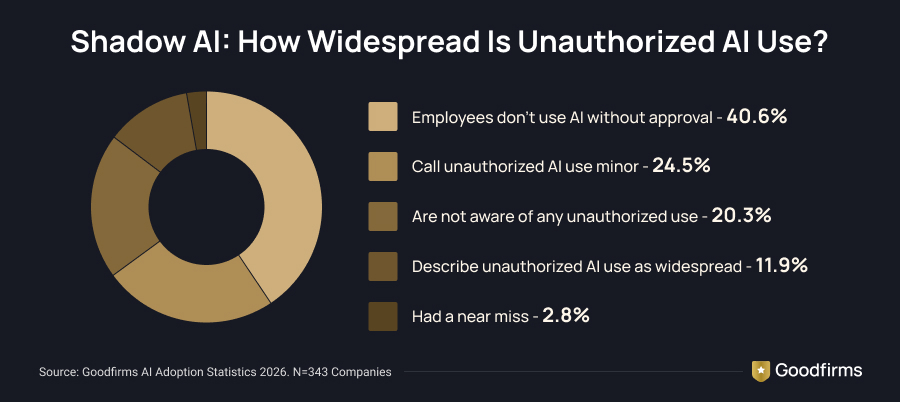
In this survey, 36.4% of organizations report at least some unauthorized AI use — 24.5% call it minor, and 11.9% describe it as widespread. A further 20.3% say they are not aware of any, which is itself a telling answer since not knowing is not the same as knowing it isn't happening.
That much unsanctioned use doesn't happen in isolation; it usually brings up whether these organizations have any ethical guardrails in place.
Do Organizations Have Ethical Guidelines for AI Use?
Shadow AI is not happening in a vacuum, and a formal ethics policy explains a good part of the variation. Among organizations represented in the survey, 32.9% have a formal ethical AI policy, and another 32.9% have informal guidelines. This means a combined 65.7% have some form of guardrail already in place. A further 16.8% have guidelines in development, 13.3% have none at all, and 4.2% follow their clients' guidelines instead of setting their own.
Having systematic policies in place is a strong start, but plenty of organizations are still running into real obstacles along the way. Here's what's actually slowing AI adoption down.
What Are the Biggest AI Adoption Challenges in 2026?
Data quality is the single largest obstacle, named by 26.8% of respondents who answered this question, more than double the next most common answer, security and privacy concerns (17.6%). Budget constraints (14.8%), a shortage of skilled AI talent (9.2%), difficulty proving ROI (8.5%), and employee resistance (5.6%) round out the top six.
|
Top Roadblocks Slowing Down AI Adoption |
% of Respondents |
|---|---|
|
Data quality |
26.8% |
|
Security / privacy concerns |
17.6% |
|
Budget constraints |
14.8% |
|
Lack of skilled talent |
9.2% |
|
Difficulty proving ROI |
8.5% |
|
Employee resistance |
5.6% |
Companies aren't struggling to access AI models anymore. They're struggling to feed those models clean, structured, trustworthy information, and to prove afterward that the investment was worth it. Todd Tyler, founder of AI with Renew, put it bluntly: AI output is plausible by default, and it's only verifiably correct once someone checks it. Adopting AI was the easy part, he said; the harder part has been building the review gates and the discipline of honesty so speed doesn't outrun trust.
That's the uncomfortable part most vendor pitches skip. Buying a better model doesn't fix bad inputs; it just makes bad decisions faster.
That gap between adopting AI and actually trusting its output points to something bigger: where the AI industry itself is still falling short.
What Is the AI Industry Still Getting Wrong?
The AI industry's narrative doesn't always match what's happening on the ground. Here's where leaders think the gap between the hype and reality is widest.
|
Gaps Between AI Hype and Reality |
% of Respondents |
|---|---|
|
Oversells AI's ability to replace skilled judgment |
30.3% |
|
Overstates how “ready” most organizations actually are |
19.0% |
|
Treats AI adoption as a technology problem, not a leadership problem |
16.9% |
|
Assumes ROI is faster and clearer than it really is |
14.8% |
|
Downplays the risks, errors, and incidents happening internally |
6.3% |
|
Ignores the cultural and change-management side of adoption |
4.9% |
|
Underestimates employee resistance and trust issues |
2.1% |
|
Ignores how uneven adoption is across company size and industry |
1.4% |
Amit Agrawal, Head of AI & Technology at Cyber Infrastructure in India, frames the fix as a sequencing problem more than a technology one:

First, identify a few high-value use cases tied to measurable outcomes—revenue, delivery speed, quality, or customer experience—and establish baselines before investing. I would build data governance, security, accountability, and human oversight into the foundation rather than adding them later. Then I’d run small, time-bound pilots, scale only what proves ROI, and retire what does not.
Advice like that is one thing to hear in theory; it's another to see how leaders would apply it if given a real second chance.
How Would Businesses Restart Their AI Journey?
When business leaders who participated in this survey were asked how they would like to rebuild their AI journey with no legacy tools, no sunk costs, and no internal politics, the following aspects were brought up.
Governance and Data Come Before Any Tool
Partho Mondal of Wisitech InfoSolutions said he'd start with a clear AI roadmap tied to measurable outcomes, set quality-control and data-security standards from day one, and only then train the team on role-specific workflows. Amit Kumar Singh of EXL described the same instinct in reverse order of most rollouts: clean data, trusted metadata, and clear ownership before a single AI tool gets introduced.
One Integrated System Beats Scattered Tools
Sergey Golubev of Crynet Marketing Solutions said he'd skip piecemeal adoption entirely and build a fully integrated, AI-first operating model from day one, with agents for research, sales, content, and reporting under one roof. Chris Raulf of Boulder SEO Marketing described the alternative he lived through: chasing individual AI writing software, and AI image generators that never talked to each other, calling it "noisy" until his team stopped treating AI as a pile of separate products and built one system instead.
That kind of integrated, agent-based setup is exactly what AI Agent Development Companies specialize in building, rather than integrating stand alone tools.
Training Gets Funded Earlier, Not After The Fact
Karyna Yeremeieva of ANODA said she'd build documentation as a foundation and pick a lean, AI-native stack from the start rather than layering tools on top of each other later. Oleg Kalyta, founder of ProductCrafters, put it more directly: no old tool held them back — what slows most teams down is treating AI as a feature to add, instead of changing how they actually work.
Earlier Adoption Matters
Mark Nguyen, founder of SlideFactory, said the one change he'd make is speed. If he could rewind, he'd push to roll out the company's internal tools faster instead of phasing them in gradually, and get new team members onboarded onto that AI-native workflow much sooner, rather than letting adoption build up piecemeal over time.
Not Everyone Wants a Do-Over
Dave Taillefer of ICONA Inc. said he wouldn't change anything. His team adopted early, tested safely, and learned a great deal for a manageable cost, and hands-on experience is what got them to where they are now.
Across these answers, a pattern holds regardless of what changed. Every leader who described "starting over" was really describing a strategic fix, not a different technology.
AI Trust, Risk and Workforce Statistics
Governance sets the rules. This section covers what happens once real people and real decisions are involved — trust, incidents, and how ready leaders are to let AI take on more.
How Do Business Leaders Describe Employee Trust in AI?
Skepticism, not blind faith, defines how most employees work with AI day to day. Among organizations surveyed, 47.6% say employees treat AI output as a starting point and always verify it before acting. And another 35% say employees trust AI for low-stakes tasks but double-check anything important. Only 4.9% report employees following AI output without much question.
That approach of double-checking clearly pays off in one way or another, so it's worth seeing how often things actually go wrong.
How Often Are Organizations Experiencing AI-Related Incidents?
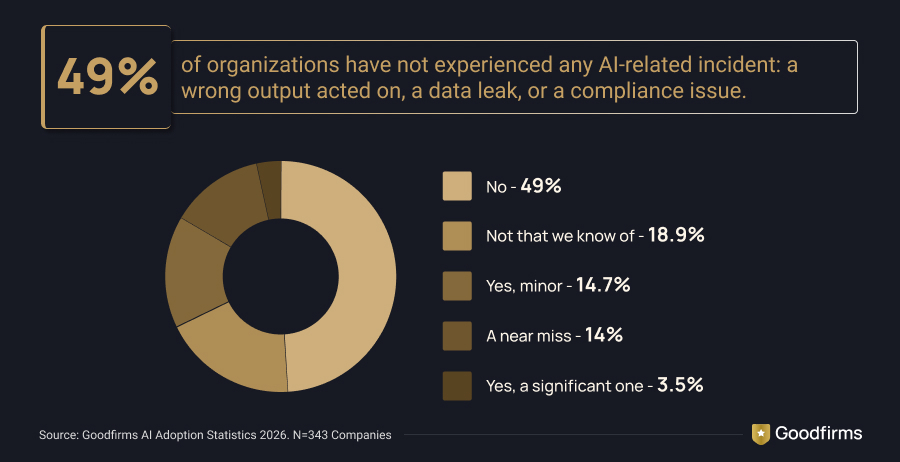
Nearly half of the organizations represented in this survey—49%—reported no known AI-related incidents. no wrong output acted on, no data leak, no compliance issue. Where something did happen, 14.7% call it minor, and 3.5% call it significant, while 14% report a near miss that didn't turn into an actual incident.
With most organizations coming through incident-free, the bigger question is what it would take for leaders to trust AI with the decisions that matter most.
What Would Make Business Leaders Trust AI With High-Stakes Decisions?
The single most common requirement for trusting AI with high-stakes decisions, such as hiring, pricing, legal, or financial decisions, is a human sign-off safeguard, chosen by 79% of business leaders. A proven track record of accuracy follows at 51.7%, and then 42.7% say they would be able to trust AI if it comes with better explainability, 36.4% need clear accountability, and 35% consider stronger data security important. Whereas only 8.4% of business leaders said they don't believe AI will ever be trusted to make decisions at this level, regardless of how the technology improves.
|
Condition for Trusting AI With High-Stakes Calls |
% of Respondents |
|---|---|
|
Human sign-off safeguard |
79.0% |
|
Proven accuracy track record |
51.7% |
|
Better explainability |
42.7% |
|
Clear accountability |
36.4% |
|
Stronger data security |
35.0% |
|
AI will never be trusted for high stakes |
8.4% |
On this subject, Rawad Baroud, CEO of ZeroGPT, put it plainly:

Building clear processes around where AI adds genuine value and where human judgment still needs to lead should be prioritized. The goal should be to build AI into workflows deliberately, with clear expectations for accuracy, accountability, and business value.
That view puts human judgement at the center, which raises the broader question of how AI has changed the workforce overall.
What Do AI in the Workplace Statistics Reveal?
Workforce reaction to AI is overwhelmingly positive, with more than three-quarters of leaders describing the impact as mostly positive and only a small minority reporting friction. Mixed reactions (11.9%) are far more common than any negative outcome, and job-loss fears barely register — just 6.3% report reduced hiring needs, and increased anxiety sits at 0.7%, tied with new hiring needs created by AI. For most organizations, AI appears to be reshaping work without the disruption people often expect.
|
AI's Impact on the Workforce |
% of Respondents |
|---|---|
|
Describe the workforce impact as mostly positive |
77.6% |
|
Report mixed reactions from their workforce |
11.9% |
|
Say AI has directly reduced hiring needs |
6.3% |
|
See no noticeable workforce impact yet |
2.8% |
|
Report increased anxiety |
0.7% |
|
Report new hiring needs |
0.7% |
That imbalance says something encouraging: workforce anxiety is one of the most common assumptions people bring to AI adoption, and this sample pushes back on it. Fewer than one in a hundred respondents report rising anxiety among staff, while more than three in four describe a workforce that has adjusted well and come out ahead. Deven Patel, Founder of Role.com, puts it this way:

More automation is not automatically better. I would establish clear success metrics earlier, test AI against real user outcomes, and keep people involved where context and judgment matter. The goal would be to use AI to remove friction without making the experience less human
A positive workforce shift like this usually has training behind it. Here's how much organizations are actually investing in AI upskilling.
Are Businesses Investing in AI Upskilling?
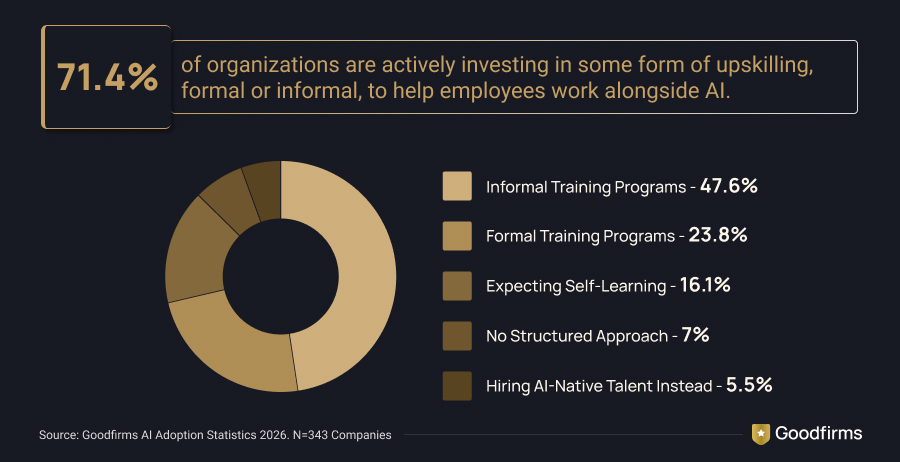
Among organizations represented in the survey, informal on-the-job learning is the most common approach to AI upskilling. 47.6% of respondents rely on informal learning as employees pick up AI tools while doing their regular work, while 23.8% run formal training programs. In total, 71.4% of organizations are actively investing in some form of AI upskilling, whether formal or informal. Whereas 16.1% are simply expecting staff to figure it out on their own, 7.0% report no structured approach at all, and 5.6% are sidestepping the training question entirely by hiring AI-native talent instead.
That upskilling effort points to where organizations expect to need those skills most, which points to where AI adoption will move in the next two years.
AI Adoption Statistics 2026: Future Trends and Priorities
Everything so far has been about the present — how AI is used, funded, governed, and trusted today. What's left is less about the current state and more about direction: which parts of the business stand to change the most.
Where Will AI Have the Greatest Impact Over the Next Two Years?
Product innovation is the area where the largest share of respondents expect AI to have its biggest impact over the next two years, named by 59.4%, closely followed by revenue growth at 58.7%. Internal operations follow at 55.9%, cost reduction at 49.7%, customer experience at 48.3%, and competitive survival at 33.6%. Businesses expecting AI to move across several of these areas at once are more likely to already have a documented AI strategy than to decide on a case-by-case basis.
|
Where AI Investment Is Headed |
% of Respondents |
|---|---|
|
Product innovation |
59.4% |
|
Revenue growth |
58.7% |
|
Internal operations |
55.9% |
|
Cost reduction |
49.7% |
|
Customer experience |
48.3% |
|
Competitive survival |
33.6% |
Product innovation, revenue growth, and internal operations top the list of where organizations expect AI to move next, and that kind of expansion rarely happens without the right partner behind it. Choosing that partner is where a lot of the strategic risk in this whole process actually sits. Here's what's worth checking before signing anything.
How Should Businesses Choose the Right AI Partner?
Picking an AI partner is where most of the strategic risk in this whole process sits, because the wrong partner locks a business into tooling, data practices, and technical debt that are expensive to unwind. Based on what respondents named as their biggest pain points — data quality, security, and unclear ROI — a short evaluation checklist helps narrow the field before signing anything.
- Ask for evidence of results with companies of your size. A vendor that mainly serves enterprise clients may over-engineer a solution for a 20-person team, and vice versa.
- Get specific about data handling before signing. Security and privacy were the second most common challenges in this survey — ask exactly where your data is stored and whether it is used to train the vendor's models.
- Not every AI partner does the same thing. Generative AI Companies build and provide the underlying models and tools, while AIOps Companies apply AI specifically to monitoring, managing, and automating IT operations.
- Request a pilot tied to a measurable outcome — productivity gains, cost reduction, or a specific turnaround-time improvement — not a generic demo.
- Confirm the error-handling process. Given how many respondents named accountability as a condition for trust, any vendor worth hiring should explain their escalation process without hesitation.
- Check verified reviews, not just case studies. Goodfirms has listed the top AI development companies, allowing you to compare vendors based on verified client feedback rather than marketing copy.
That checklist covers how to choose a partner, but a few broader questions about AI adoption are worth closing out before wrapping up.
FAQs About AI Adoption in 2026
Some of the most common questions about AI adoption aren't the kind a survey captures, so here's a direct look at those.
What does "AI adoption" actually mean for a business?
AI adoption is less about whether a company uses a chatbot occasionally and more about whether AI is built into regular workflows, marketing, engineering, content, and reporting, rather than treated as a one-off experiment. In this survey, that distinction is what separates the 83% running AI across multiple functions from the smaller group still piloting it.
Is it too late for a business that hasn't started using AI yet?
No, but the gap is real. With adoption this widespread across functions and budgets rising for the vast majority of organizations, businesses starting now are further behind than they would have been a year ago, though not so far that catching up is unrealistic. Starting with a clear workflow and governance plan, rather than jumping straight to tools, tends to close that gap faster.
What's The Difference Between an AI Strategy and AI Ethical Guidelines?
An AI strategy covers the business side, including which tools to use, what budget to allocate, and which functions to prioritize. Ethical guidelines are narrower; they set boundaries on how AI can be used internally, covering things like what data employees can input into AI software and when human review is required. Organizations can have one without the other, though most in this survey have moved on at least to the strategy side.
Should small businesses approach AI adoption differently from large enterprises?
Yes, mainly around tooling and pace. Larger firms have the budget to build custom models or run formal training programs, while smaller teams generally get further faster by licensing existing tools and relying on informal, on-the-job learning. The core discipline, clean data and human sign-off on high-stakes decisions, matters at any size.
What should a business do if it discovers employees using unauthorized AI tools?
The instinct to shut it down immediately usually backfires, since employees typically turn to unsanctioned tools because the approved process is too slow for their actual workload. A faster response is to find out which tools employees are already relying on, evaluate them properly, and either approve what's safe or offer a sanctioned alternative that's just as quick to use.
AI Adoption Statistics 2026: Key Conclusions
The numbers in this report point to a market that has moved beyond testing stages. Most organizations represented in this survey are no longer asking whether to use AI; they are asking how to manage it responsibly while proving its value. Confidence in ROI is high, budgets are climbing, and measurable outcomes, faster turnaround, leaner teams, and cleaner decisions back that confidence up.
But the data also shows where the real work still sits. Governance hasn't kept pace with adoption for a meaningful share of organizations, shadow AI is common enough to be a standing concern rather than an edge case, and trust in AI for high-stakes decisions still hinges on human sign-off, not the technology alone. Data quality, not access to tools, remains the biggest obstacle standing between where companies are and where they want to be.
None of this suggests AI adoption is slowing down. If anything, the next two years point toward deeper integration across product, revenue, and operations. For organizations still weighing who to bring on for that next stage, Goodfirms' curated list of the top AI development companies is a useful starting point for comparing vendors based on verified client reviews rather than sales pitches alone.
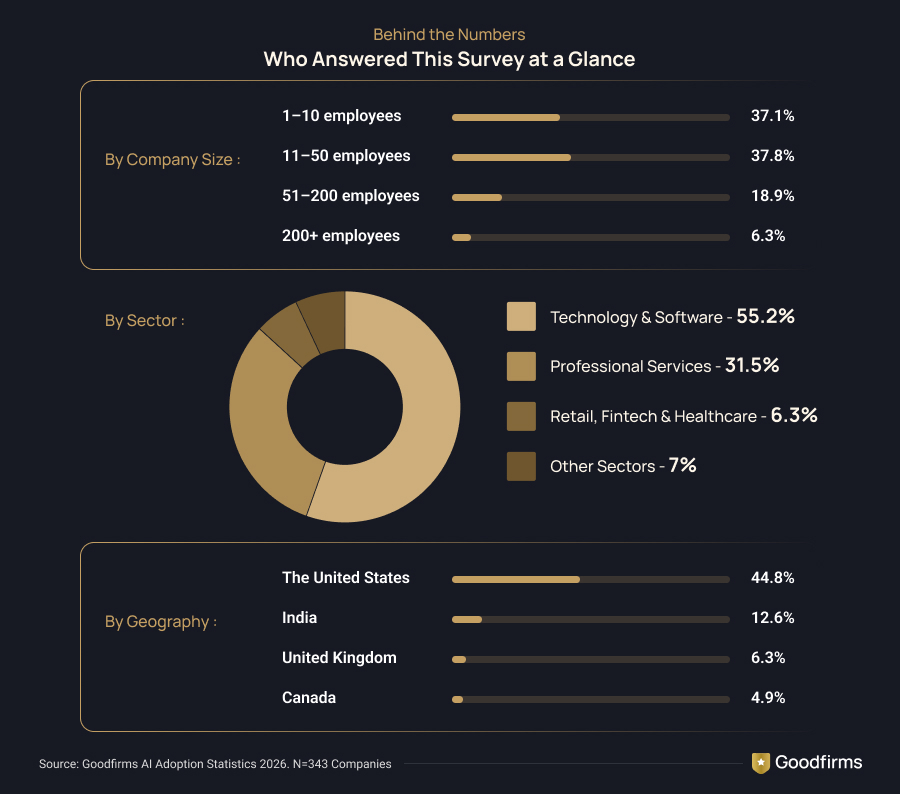
Methodology: This report is based on Goodfirms' AI Adoption Survey 2026, completed by 343 business leaders across 30 countries in 2026. All figures reflect self-reported data from founders, CEOs, and department heads. Percentages are rounded to one decimal place; multi-select questions total more than 100%. Quotes were collected via written survey responses and follow-up email correspondence with respondents, coordinated with Goodfirms' research partners.
| Sr. No. | Research Partners |
| 1. | 2immersive4u Inc |
| 2. | 3 Sided Cube |
| 3. | 365 Digital Consulting |
| 4. | ABAMobile |
| 5. | Above Apex |
| 6. | Action1 |
| 7. | AddWeb Solution |
| 8. | Agentora Technologies Private Limited |
| 9. | AI First Partners |
| 10. | AI Miracle |
| 11. | AI Smart Ventures |
| 12. | AI with Renew |
| 13. | Ambsan Digital |
| 14. | ANODA |
| 15. | UPS |
| 16. | Apollo Studio |
| 17. | ArcTouch |
| 18. | BEON.tech |
| 19. | Best California Movers |
| 20. | BetterQA |
| 21. | Bitsmiths Studio |
| 22. | Boulder SEO Marketing |
| 23. | Brizy |
| 24. | BugRaptors |
| 25. | BUTCHER |
| 26. | Canaveral |
| 27. | Classet |
| 28. | Classroom365 |
| 29. | CloudNSite |
| 30. | CoinLedger |
| 31. | CompareAccounts |
| 32. | Crynet |
| 33. | Cyber Infrastructure Inc. |
| 34. | Dalton Mills |
| 35. | Del Val Investment Group |
| 36. | Digimark |
| 37. | Digital Aptech |
| 38. | Dopamine Studio |
| 39. | EXL |
| 40. | First Factory |
| 41. | Flying V Group Digital Marketing |
| 42. | Fuselab Creative |
| 43. | Geniusee |
| 44. | Globi Web Solutions |
| 45. | GMAT Ninja |
| 46. | Go Murder Mystery |
| 47. | Grip Creative |
| 48. | Grooveyard |
| 49. | GS Consulting, LLC |
| 50. | GSP Solutions |
| 51. | Hambone AI |
| 52. | HireWebPro Solutions |
| 53. | Hosticon |
| 54. | HostZealot |
| 55. | HR Bridge |
| 56. | Hum JAM |
| 57. | ICONA Inc. |
| 58. | IMMAGEST |
| 59. | Integrated365 |
| 60. | Internest Agency |
| 61. | intSignal |
| 62. | It Monks |
| 63. | Jotform |
| 64. | Jumix |
| 65. | JVM Design |
| 66. | Kalpita Technologies |
| 67. | Ketch |
| 68. | KEY Difference Media |
| 69. | Kompella Technologies |
| 70. | Kosinski Photography |
| 71. | KPI Media |
| 72. | Lantern Media Private Limited |
| 73. | Laramate GmbH |
| 74. | LeetForce |
| 75. | lipi ai |
| 76. | Major Tom |
| 77. | Mantravi |
| 78. | Market Brew |
| 79. | MarketSign |
| 80. | Mediumchat Group |
| 81. | Momentum |
| 82. | Mooglelabs |
| 83. | MySuper.Site |
| 84. | New Wave Devs |
| 85. | Nexios Technologies LLP |
| 86. | northtexasgrowth.com |
| 87. | Numinix Web Development |
| 88. | NYRO Dynamics |
| 89. | Omnius Partners |
| 90. | Opti AI |
| 91. | PageSpeed Matters |
| 92. | PanX Project |
| 93. | PFLB |
| 94. | PhotoGov |
| 95. | Phuket Event Company |
| 96. | PICF Inc. |
| 97. | Pikadil |
| 98. | Primotech |
| 99. | ProductCrafters |
| 100. | PromptMarketing |
| 101. | Quema |
| 102. | Quinn Marketing |
| 103. | Reinforce Lab Limited |
| 104. | Relia Software |
| 105. | Role |
| 106. | Score Academy |
| 107. | SCUBE Marketing |
| 108. | SEOfly |
| 109. | Silver Maple Strategies |
| 110. | Skylum |
| 111. | SlideFactory |
| 112. | Smart Web Agency |
| 113. | Solo Media Group |
| 114. | South-End Tech Limited |
| 115. | Southtown Web Design |
| 116. | Sovereign Events |
| 117. | Ssquares Tech |
| 118. | Stubbs |
| 119. | SUF Digital |
| 120. | Suff Digital |
| 121. | Support My Website |
| 122. | SysGears |
| 123. | Teamflect |
| 124. | TestFort |
| 125. | The Ad Firm |
| 126. | The JRB Team |
| 127. | Trainow |
| 128. | Truck1 |
| 129. | Unidata |
| 130. | Upplai |
| 131. | USA Marketing Pros |
| 132. | Viston AI |
| 133. | Wdesigna |
| 134. | Whale Group |
| 135. | WhisperAI |
| 136. | Wild Creek Web Studio |
| 137. | Wisitech |
| 138. | Woww |
| 139. | Your National Park Guide |
| 140. | ZeroGPT |