Key takeaways
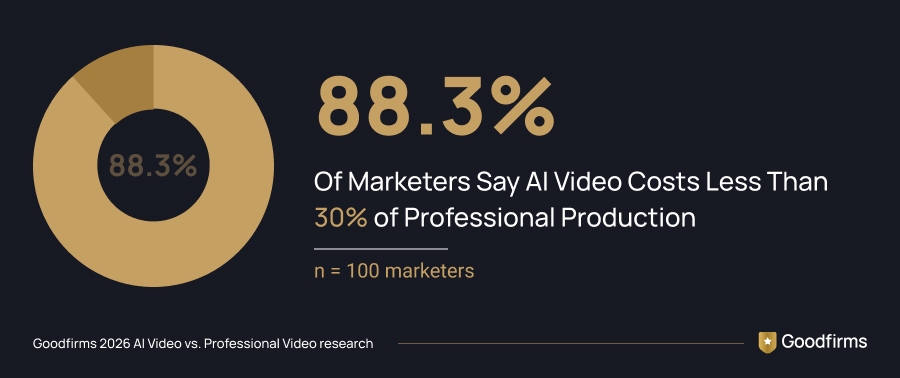
- 88.3% of marketers say AI video production costs less than 30% of professional production.
- 47.1% report AI video production costs at less than 10% of professional production.
- AI video is being used to create content faster and at scale, while professional production remains relevant for high-impact, brand-focused content.
AI is changing how businesses create video, making production faster and potentially far less expensive than traditional professional production. But how much does AI video production actually cost in 2026?
Goodfirms surveyed 100+ marketers, agency owners, creative directors, and content leaders to compare AI and professional video production costs, usage, and performance. The findings show just how significant the cost difference can be—and where businesses are using AI video today.
How Much Does AI Video Production Cost in 2026?
AI video production costs in 2026 range from less than $100 per month for self-service software to several thousand dollars for a professionally managed project. The final cost depends on whether a business uses a DIY platform, hires a freelancer, or works with an agency that provides strategy, scripting, creative direction, editing, and quality assurance.
| Production approach | Typical published cost | What it generally covers |
|---|---|---|
| DIY AI video software | $0–$300 per month | Platform access, templates, avatars, and generation credits |
| Multi-tool DIY workflow | $170–$685 per month | Generator, editing, stock assets, captions, and related tools |
| Freelancer or small studio | $500–$5,000 per project | Production support for one-off social, demo or campaign videos |
| Agency-led AI production | From approximately $5,000 per video | Strategy, scripting, AI generation, human direction, editing, and QA |
| Traditional professional production | Approximately $15,000–$50,000+ per video | Crew, talent, equipment, locations, and post-production |
Published platform pricing supports the lower end of the market. For example, Synthesia’s paid plans currently start at $29 per month, while HeyGen offers individual plans from $29 per month and a business plan at $149 per month. However, these subscriptions cover software access—not the complete cost of developing the concept, writing the script, producing assets, reviewing outputs, and creating a polished final video.
Costs also vary by video format. One AI-production company publishes the following estimates:
| Video type | AI-assisted production | Traditional production |
|---|---|---|
| Short-form content, 15–60 seconds | $300–$1,200 | $1,500–$5,000 |
| Explainer video, 60–90 seconds | $2,500–$8,000 | $8,000–$25,000 |
| Product demonstration | $1,500–$5,000 | $5,000–$15,000 |
| 30-second brand commercial | $8,000–$30,000 | $25,000–$100,000+ |
| Batch of 10 social videos | $2,000–$8,000 | $10,000–$30,000 |
These are published provider estimates rather than universal market averages, but they illustrate how costs change by format and production model.
Goodfirms’ own findings reinforce the size of this cost difference: 88.3% of surveyed marketers reported that AI video cost less than 30% of professional production, while 47.1% put it below 10%. The comparison should still account for internal labor, revisions, subscriptions, quality control, and campaign performance—not only the cost of generating footage.
Research note: Quantitative findings are based on respondents who answered each specific question, so sample sizes vary by finding. Contributor-reported campaign examples should not be interpreted as aggregated industry benchmarks.
If you are currently evaluating which video production companies fit your workflow, the research findings below offer a data-backed starting point for understanding where each approach creates the most value.
88.3% of Marketers Say AI Video Costs Less Than 30% of Professional Production
Video production cost is where AI's advantage is clearest.
88.3% of respondents reported that AI video production costs less than 30% of professional production. Nearly half, 47.1%, reported AI production costs below 10% of professional production, while another 41.2% placed the cost between 10% and 30%.
AI Video Production Cost vs. Professional Video
|
AI production cost compared with professional production |
Marketers |
|---|---|
|
Less than 10% |
47.1% |
|
10–30% |
41.2% |
|
30–50% |
11.8% |
|
More than 50% |
0% |
The finding suggests that AI's biggest advantage lies in production economics, particularly for high-volume, low-complexity video.
20% of Professional Video Campaigns Hit 5%+ CTR, Compared With 0% of AI Video Campaigns
20% of professional video campaigns reached a CTR of 5% or higher, compared with 0% of AI video campaigns in the research.
At the same time, broader 2026 market evidence shows that AI-generated creative can also deliver strong performance when well executed. Recent 2026 research, based on more than 500 million ad impressions, found that AI-generated ads had an average CTR of 0.76%, compared with 0.65% for human-made ads, although the two performed comparably after tighter statistical controls. The study also found that AI ads that did not appear visibly synthetic generated the strongest engagement.
The takeaway is that AI does not inherently underperform. Creative quality, authenticity, and execution can influence performance regardless of how the video is produced.
AI Video vs. Professional Video CTR
|
CTR range |
AI Video |
Professional Video |
|---|---|---|
|
Under 0.5% |
18.8% |
13.3% |
|
0.5–1% |
18.8% |
13.3% |
|
1–2% |
37.5% |
26.7% |
|
2–5% |
25.0% |
26.7% |
|
5%+ |
0% |
20.0% |
The results suggest that professional production may offer an advantage when a campaign depends on highly polished, credibility-driven creative, particularly for more demanding conversion goals.
AI-generated video, meanwhile, can be effective when the priority is speed, creative variation, experimentation, or publishing at scale.
That distinction becomes even clearer in B2B campaigns.
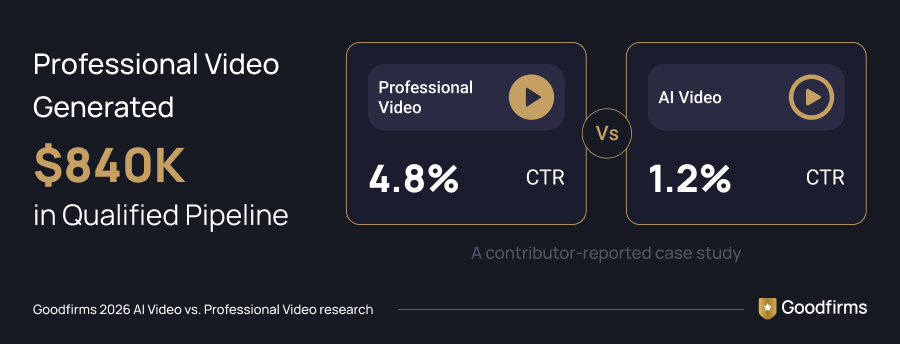
Professional Video Drove $840K in Qualified B2B Pipeline
A contributor-reported B2B campaign shared by Riken Shah, Founder & CEO of OSP, highlights how professional video can support high-value sales. The professionally produced two-minute customer case study achieved a 4.8% CTR, compared with 1.2% for its AI-generated versions, and contributed $840,000 in qualified sales pipeline within 60 days.
Professional vs. AI Video in a B2B Case Study
|
Metric |
AI-generated video |
Professional video |
|---|---|---|
|
CTR |
1.2% |
4.8% |
|
Qualified pipeline |
— |
$840,000 |
|
Time period |
— |
60 days |
“AI can flawlessly optimize data and structure scripts, but it cannot manufacture the high-stakes brand authority required to close six-figure B2B deals.”
— Riken Shah, Founder & CEO, OSP
This example should not be interpreted as an industry-wide benchmark. It is a contributor-reported campaign result.
It does, however, illustrate why professional video can matter in B2B marketing when credibility and trust are closely tied to the purchase decision.
A professionally produced customer case study can bring real people, experiences, and brand context into the story—elements that can be particularly important when buyers face a long sales cycle, multiple stakeholders, or significant financial risk.
A second contributor-reported example points in a similar direction. In a premium hardware campaign, AI-generated video achieved a 0.8% CTR and a $340 CAC, while professionally produced content reached a 2.1% CTR and a $165 CAC.
"A genuine customer fumbling through their own praises registers as proof you can trust your product. A computer-generated face singing the praises of your product registers as an advertisement."
— Cyrus Kennedy, CEO, The Ad Firm
A Lower Video Production Cost Doesn't Always Mean a Cheaper Campaign
Video production cost and total campaign cost are two different measures — and the research shows they don't always move together. A video that costs 90% less to produce isn't necessarily the cheaper campaign if it needs more revisions, more media spend, or generates weaker engagement.
Reported Customer Acquisition Cost
|
CAC Range |
AI Video |
Professional Video |
|---|---|---|
|
Under $25 |
20.0% |
0% |
|
$25–75 |
40.0% |
26.7% |
|
$75–200 |
33.3% |
33.3% |
|
$200–500 |
6.7% |
33.3% |
|
$500+ |
0% |
6.7% |
Reported customer acquisition cost varied considerably between the two formats. AI video campaigns clustered at the low end: 20% came in under $25 CAC, and 60% stayed under $75. Professional video shifted toward the higher end — a third landed between $200–$500, and 6.7% topped $500.
That is why marketers should evaluate AI video on total campaign economics, rather than software or production cost alone. Businesses working on high-value campaigns may still find AI video generator companies worthwhile when stronger engagement, credibility, or conversion performance justifies the higher upfront cost.
The takeaway: video production cost predicts what you'll spend to make the video. It doesn't predict what you'll spend to make the video work.
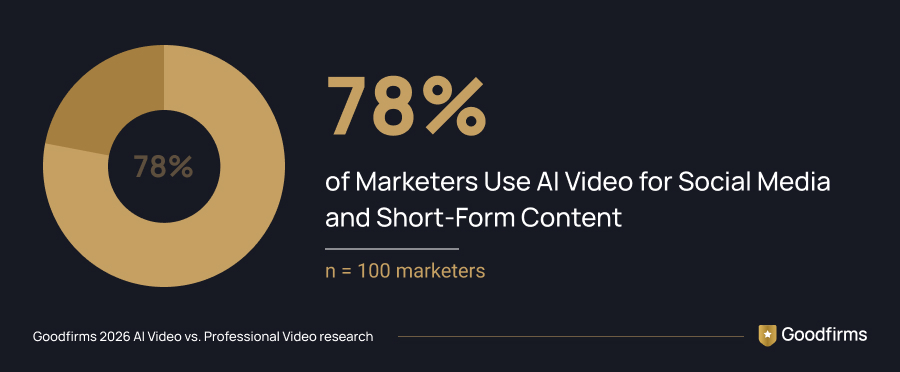
78% of Marketers Use AI Video for Social Media and Short-Form Content
78% of marketers in the Goodfirms research use AI video for social media and short-form content, making it the leading use case. AI Video Ads followed at 44%, while explainer or product videos accounted for 39%.
Where Marketers Are Using AI Video
|
Use case |
Marketers |
|---|---|
|
Social media / short-form clips |
78% |
|
Ads |
44% |
|
Explainer or product videos |
39% |
|
Concept testing |
33% |
|
Repurposing blog/written content |
33% |
|
Internal/training content |
17% |
 The reason is straightforward: social content demands volume.
A brand may need multiple videos each week — sometimes each day — across several platforms. Producing every variation through a traditional production process can be expensive and slow.
AI allows teams to:
- Turn one idea into multiple creative variations.
- Test different hooks.
- Repurpose existing content.
- Respond to trends quickly.
- Produce videos without a full production crew.
- Experiment before committing to larger production budgets.
Advertising is another major use case.
Rather than replacing every professionally produced advertisement, marketers are increasingly using AI to test concepts before investing in final production.
That creates a hybrid workflow:
AI → concept → test → optimize → professional production
This can reduce the risk of spending heavily on an idea that audiences ultimately ignore.
AI Video Scores 3.7/5, While 27.8% Cite Flickering and Temporal Inconsistency as the Biggest Limitation
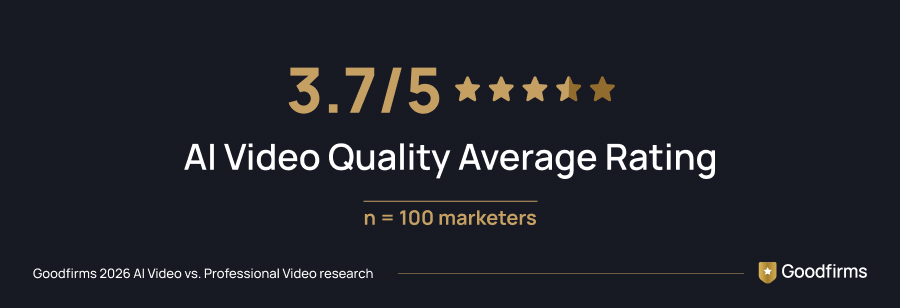
AI-generated video received an average quality rating of 3.7 out of 5 from respondents, suggesting that marketers see it as increasingly usable but not yet equivalent to professional production across every use case.
The broader market shows a similar tension. Wistia's 2026 State of Video research, based on 900+ professionals and more than 13 million videos, found that 62% of teams are already using AI in their video workflows or plan to start soon, with more than one-third already using it. Most teams are using AI to support planning, scripting, ideation, and post-production rather than replace human production entirely.
How Marketers Rate AI Video Quality
|
Rating |
Share of marketers |
|---|---|
|
5/5 — On par or better |
17% |
|
4/5 |
44% |
|
3/5 |
28% |
|
2/5 |
11% |
|
1/5 — Far worse |
0% |
44% of marketers rated AI video 4 out of 5, while 17% considered it on par with or better than professional production for certain use cases.
The more revealing finding, however, is what marketers identify as the biggest quality limitations.
What Is the Biggest Problem With AI-Generated Video?
27.8% identified temporal consistency and flickering as the biggest limitation. For teams evaluating AI avatar generators specifically, these limitations help define which use cases are viable and which require human-directed production.
Other commonly reported issues included:
- Faulty physics or object permanence — 16.7%
- Limited editing control — 16.7%
- Short clip length ceilings — 11.1%
- Poor prompt accuracy or creative control — 11.1%
- Text rendering issues — 11.1%
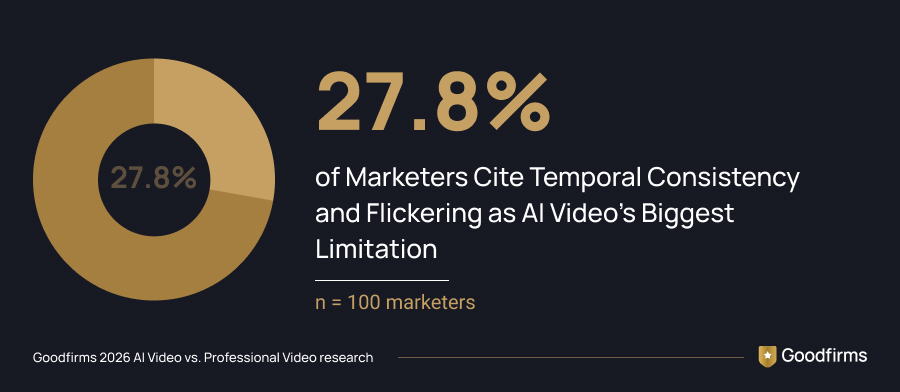
These limitations explain why many marketing teams treat AI as a production accelerator rather than a complete replacement for human-directed production.
That concern is also showing up at the platform level. YouTube recently clarified that its monetization rules target repetitive, mass-produced “inauthentic” content, while AI-assisted videos can still qualify when creators add meaningful originality and creative input. The update reinforces the research finding that using AI is not the issue; how it is used matters.
"The limitation is trust, not quality. When audiences need to trust the person delivering the message, not just receive information from them, AI avatars don't land the same way."
— Kuber Sharma, Senior Director of Product Marketing, UiPath
A minor visual inconsistency may be acceptable in a short social post.The same error can become much more damaging in a product launch, executive video, customer testimonial, or premium advertising campaign.
"About 30% of AI outputs just aren't usable because of small glitches or awkward motion. That kills credibility fast."
— Ivan Vislavskiy, CEO & Co-founder, Comrade Digital Marketing Agency
AI Video Performs Best at Scale, While Professional Video Gains Value When Trust Matters
The research suggests that the AI-versus-professional debate is too broad. The better question is what the video needs to accomplish.
AI video performs best when the priority is:
- Speed
- Production scale
- Creative testing
- Social media publishing
- Content repurposing
- Training and onboarding
- Explainer content
- Rapid ad variations
- Early-stage concept development
Professional video performs best when the priority is:
- Trust
- Emotional storytelling
- Customer testimonials
- Premium branding
- Executive communication
- Product launches
- High-value B2B campaign
- Enterprise sales
- High-consideration purchases
"AI video makes sense when speed matters. Professional video makes sense when trust matters."
— Charles Liu, Marketing Director, Cubic Promote
The distinction is especially important because different industries have different requirements.
AI and Professional Video Take Different Roles Across Industries
AI video adoption varies depending on the audience, buying journey, and marketing objective.
|
Industry |
AI video performs best for |
Professional video leads for |
|---|---|---|
|
SaaS & B2B technology |
Product updates, demos, onboarding, education |
Case studies, executive messaging, enterprise sales |
|
E-commerce & retail |
Product ads, social content, A/B testing, seasonal campaigns |
Brand storytelling, premium launches |
|
Marketing agencies |
High-volume content, concept testing, client iterations |
Commercial campaigns, brand films, hero creatives |
|
Healthcare & education |
Training, explainers, internal communication |
Patient stories, institutional branding, trust-based messaging |
|
Professional services |
FAQs, educational videos, and thought leadership |
Testimonials, corporate branding, leadership communication |
The broader pattern is consistent:
AI often works best when the viewer primarily needs information, while professional video can be more valuable when trust and authenticity are central to the decision.
34% Decline in Consultation Bookings Highlights the Trust Challenge in Healthcare Video
Healthcare provides one of the clearest examples of how production choices can affect the performance of patient-facing video.
According to a contributor-reported example in the research, a patient-facing AI avatar campaign for a plastic surgery clinic was associated with a 34% decline in consultation bookings over six weeks.
The clinic subsequently used a professional shoot featuring real patient testimonials and a surgeon on camera, after which bookings reportedly returned to baseline within four weeks.
This is a contributor-reported campaign example, not a general healthcare benchmark.
"AI video fails at the trust threshold, and in healthcare, that threshold is the only thing that actually converts a prospect into a booked patient."
- Chris Kirksey, Founder & CEO, Direction.com
The example illustrates why AI and professional video may serve different roles in healthcare.
AI video can make sense for healthcare training, compliance, onboarding, and internal communication, where the primary objective is information delivery.
But patient-facing content has a different requirement.
The viewer may be evaluating:
- Whether the provider appears credible.
- Whether the people featured seem authentic.
- Whether the brand feels trustworthy.
- Whether the provider understands their concerns.
This concern extends beyond healthcare. Animoto's 2026 State of Video research found that 83% of consumers said they could identify AI-generated video, while 36% said AI-generated video lowers their trust in the brand behind it.
That helps explain why the distinction between AI-assisted and fully AI-generated video matters. AI can accelerate production without necessarily removing the human presence that audiences associate with authenticity.
For trust-sensitive content, production choices can become part of the conversion experience.
Professional Video Outperformed 14 AI Hook Variations in a Contributor-Reported E-commerce Test
Physical products create another challenge for AI-generated video: the viewer often needs to see the real product interacting with the real world.
The research includes a contributor-reported 30-day test comparing 14 AI-generated hook variations with a $750 professional shoot using the same audiences and budget. According to the contributor, the professional video outperformed every AI variation on conversion rate.
The finding is particularly relevant for products where visual and physical characteristics influence purchase decisions.
Consumers may want to see:
- The texture of a product.
- How it moves.
- How it fits.
- How it performs.
- How does it look in real lighting?
- How a real person interacts with it.
AI can create compelling representations of products, but representation is not always proof.
For premium physical products, that distinction can influence how consumers perceive quality and value.
"AI cannot accurately replicate the exact way a knife cuts through a stack of pancakes or how olive oil glazes a delicate sardine. It lacks the precise physical realism needed for high-end product close-ups."
- Stefan Chiriacescu, Founder & CEO, eCommerce Today
Professional Video Campaigns Reported 46% Higher Watch Time and 2.3× More Organic Shares
The research found several contributor-reported examples where professional video produced stronger conversion outcomes.
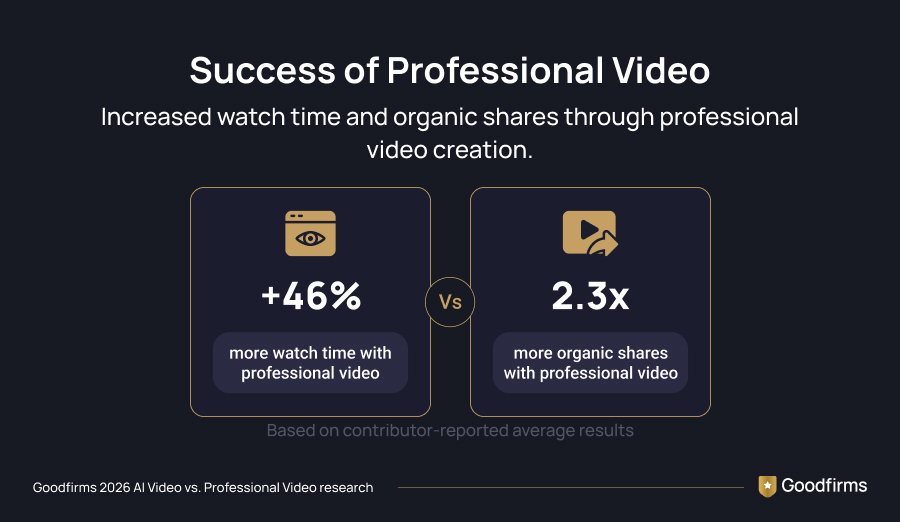
Contributors reported:
- 2.4× more trial sign-ups
- 3× more demo requests
- Conversion improvement from 5.8% to 8.1%
- 46% higher watch time
- 2.3× more organic shares
These are contributor-reported campaign outcomes rather than aggregated industry benchmarks.
Taken together, these examples suggest that professional video can become more valuable when trust, credibility, and perceived quality have a direct bearing on the buying decision.
That can be particularly relevant in different scenarios:
- A short social post may succeed because it is timely and entertaining.
- An enterprise case study may need to establish credibility across multiple stakeholders.
- A premium product video may need to reinforce perceived value.
- A healthcare video may need to make a potential patient comfortable enough to take the next step.
These are fundamentally different communication problems, which helps explain why the best video format can vary by campaign objective.
AI Wins on Speed and Scale, While Professional Video Can Be More Valuable for Trust and Storytelling
The research points toward a hybrid model rather than a winner-takes-all approach. Each format has strengths that make it better suited to different marketing activities.
|
Marketing activity |
AI Video |
Professional Video |
|---|---|---|
|
Social media & short-form |
Strong fit |
Useful for hero content |
|
Ad variations & A/B testing |
Strong fit |
Useful for final creative |
|
Blog & webinar repurposing |
Strong fit |
— |
|
Internal training & onboarding |
Strong fit |
Useful for high-impact training |
|
Product launches |
Useful for testing |
Strong fit |
|
Customer testimonials |
Limited |
Strong fit |
|
Brand campaigns |
Limited |
Strong fit |
|
Executive thought leadership |
Useful for drafts/repurposing |
Strong fit |
|
High-value B2B case studies |
Limited |
Strong fit |
AI is particularly well suited to repetitive, high-volume production, rapid experimentation, and content repurposing. Professional production can be more valuable when authenticity, emotional storytelling, authority, or brand credibility are central to the campaign.
For content marketing teams this means the decision does not have to be AI or professional production. The stronger approach may be using AI for scale and iteration while reserving professional production for content where trust and brand impact matter most.
55.6% of Marketers Use Synthesia, While 38.9% Use Sora, Veo, Creatify, and Pictory AI
The research also examined which AI video generator software platforms marketers are using.
Synthesia was the most widely used platform at 55.6%, followed by Sora, Google Veo, Creatify, and Pictory AI at 38.9% each. HeyGen followed at 33.3%.
|
AI video tool |
Share of marketers |
|---|---|
|
Synthesia |
55.6% |
|
Sora |
38.9% |
|
Google Veo |
38.9% |
|
Creatify |
38.9% |
|
Pictory AI |
38.9% |
|
HeyGen |
33.3% |
|
RunwayML |
27.8% |
|
Kling AI |
22.2% |
|
Seedance 2.0 |
22.2% |
|
Vizard |
11.1% |
|
Higgsfield |
11.1% |
The adoption pattern suggests that marketing teams are not necessarily looking for one platform that does everything.
Instead, they are building multi-tool workflows.
- Avatar platforms can handle presentations and training.
- Text-to-video AI platforms can create cinematic visuals and B-roll.
- Creative optimization tools can help produce ad variations.
- Repurposing platforms can turn existing long-form assets into short-form content.
- That specialization is becoming an important part of AI video workflows.
For marketing teams, the emerging model is less about finding one AI video tool that does everything and more about combining specialized tools across the production workflow.
AI + Professional Video: The Hybrid Workflow Emerging From the Research
The most effective workflow may not be AI vs. professional. It may be: AI + professional
A marketing team can use AI during the early and repetitive stages of production while reserving professional resources for the moments that have the greatest impact on business outcomes.
A typical workflow might look like this:
1. Generate concepts with AI
Use AI to explore hooks, scripts, visual concepts, storyboards, and creative directions.
2. Test ideas quickly
Create multiple AI-generated variations and evaluate which concepts attract attention.
3. Identify the strongest creative
Use performance data to determine which messages, hooks, and positioning resonate.
4. Repurpose existing content
Turn blogs, webinars, podcasts, and long-form content into social clips and educational videos.
5. Invest in professional production where trust matters
Use professional production for:
- Customer testimonials
- Executive messaging
- Product launches
- Premium campaigns
- High-value B2B case studies
- Brand films
- Trust-sensitive content
6. Use AI for post-production and distribution
AI can continue to support editing, repurposing, personalization, and creative iteration after the professional shoot.

AI wins anywhere the goal is comprehension and completion at scale. Human production wins where the point is emotion and brand intimacy. The mistake is treating it as all-or-nothing.
This hybrid workflow allows teams to reduce production costs without treating AI as a universal replacement for human creativity and production expertise. For businesses looking to work with digital marketing agencies that understand both sides of this workflow, finding partners who can advise on where each format applies is increasingly important.
Most AI Video Software Plans Cost $15–$100 per Month
AI video production cost and AI video software pricing are two different questions.
Production cost refers to the total cost of creating the video. Software pricing refers to what a company pays for access to an AI video platform. AI video generator pricing typically falls into five tiers, from free plans to custom enterprise contracts.
Most AI video platforms use subscription-based pricing, although features, generation limits, and enterprise capabilities vary considerably.
|
Plan |
Typical monthly cost |
Typical features |
|---|---|---|
|
Free |
$0 |
Limited credits, watermarked exports, basic templates |
|
Starter |
$15–30 |
HD exports, limited AI generation, basic editing |
|
Professional |
$30–100 |
AI avatars, longer videos, premium templates, and collaboration |
|
Business |
$100–500 |
Team workspaces, brand kits, higher generation limits, API access |
|
Enterprise |
Custom |
Custom avatars, SSO, security, governance, dedicated support |
The research found that most entry-level and professional AI video plans fall within the $15–$100 monthly range, while business and enterprise plans can cost considerably more
However, businesses should not evaluate AI video tools on subscription price alone.
Pricing can depend on:
- AI avatar capabilities
- Generation limits
- Video length
- Editing functionality
- Collaboration features
- Brand management
- API access
- Automation
- Customization
- Security and governance
For a company producing thousands of videos, an inexpensive platform with restrictive generation limits may ultimately be more expensive than a higher-priced platform built for scale. Teams building in-house workflows often pair AI tools with video-making software to manage production volume more efficiently.
When Should a Business Choose AI Video Over Professional Production?
The right choice depends on the video's objective, production demands, and the role it needs to play in the buyer's decision.
Choose AI when you need:
- Dozens of creative variations.
- Frequent social content.
- Rapid concept testing.
- Internal training.
- Product education.
- Content repurposing.
- Short-form video at scale.
- Quick experimentation.
In these situations, the cost of traditional production can outweigh the value of cinematic quality.
AI allows teams to produce more content and learn faster.
Choose Professional Video when you need:
- Healthcare marketing
- Enterprise B2B campaigns
- Customer testimonials
- Premium products
- Product launches
- Executive communication
- Brand campaigns
- High-value sales content
The research consistently points toward the same fact: Professional production can be more valuable when trust, credibility, authenticity, or perceived quality directly influence the viewer's decision.
The choice is therefore not simply between AI and professional production. It is about matching the production approach to the marketing objective.
100+ Marketers Point to a Hybrid Future, Not a Full AI Replacement
The research suggests that AI video is already a practical alternative for high-volume, lower-stakes content, including social clips, training, education, and concept testing.
But professional video can be more effective in trust-sensitive contexts such as healthcare, high-value B2B campaigns, premium products, customer testimonials, and executive communication.
The better question is therefore not:
Will AI replace professional video?
It is:
Which parts of the video workflow should be automated, and which parts require human production?
A practical hybrid workflow can widen the production funnel:
More ideas → more variations → faster testing → better creative selection → professional execution where it matters most
AI can help teams test more ideas before committing significant production resources. Professional production can then be concentrated on campaigns where quality, authenticity, trust, and brand impact have the greatest commercial importance.
This approach allows businesses to expand creative output without treating AI as a universal replacement for human direction and professional production.
"AI video is a smart intern, not a director."
- Benjamin Seer, Founder & Director, Blitz Growth
The Bottom Line: 88.3% Cite AI's Cost Advantage, While Professional Video Shows Strength in High-Value Use Cases
The research does not identify a single winner. Instead, it shows that AI and professional video create value in different ways.
AI video is strongest for:
- Production economics
- Speed
- Scale
- Creative iteration
- Social content
- Concept testing
- Repurposing
- Training and education
Professional video is particularly valuable for:
- Trust
- Authenticity
- Emotional storytelling
- Premium positioning
- Customer testimonials
- High-value B2B campaigns
- Executive communication
- Brand storytelling
The strongest evidence comes from the contrast between the two. 88.3% of marketers reported AI production costs below 30% of professional production. But 20% of professional video campaigns achieved 5%+ CTR compared with 0% of AI video campaigns in the research sample.
And in one contributor-reported B2B case, professional video generated a 4.8% CTR and $840,000 in qualified pipeline within 60 days, compared with 1.2% CTR from AI-generated versions.
But these findings do not mean businesses should choose professional video by default—or AI simply because it costs less.
The better approach is to match the production method to the business objective.
Use AI where speed, scale, experimentation, and cost efficiency create an advantage. Use professional production where trust, credibility, authenticity, and storytelling can materially influence the outcome.
The future of video marketing is therefore likely to be hybrid: AI expands production capacity and accelerates creative testing, while human direction and professional production remain valuable where video needs to do more than communicate.

The AI tools saved me money; the professional production made me money, and there is a huge difference between the two
"AI is great at producing content, but not yet at producing proof."
— Loc Dang, Digital Marketing Specialist, Cricket One
Methodology
This research was conducted between June and July 2026 and draws on contributions from 100+ marketers, agency owners, creative directors, and content leaders across the United States, Canada, Australia, the United Kingdom, Bulgaria, and other markets.
Participants shared information about AI video tool usage, production costs, campaign performance, and qualitative experiences through direct outreach and a structured research form.
Because respondents did not answer every research question, sample sizes vary by finding. Where applicable, tables identify the number of respondents used to calculate individual percentages.
Individual campaign results are presented as contributor-reported examples and should not be interpreted as aggregated industry benchmarks.
External sources referenced in the research include Wyzowl's Video Marketing Statistics 2026, HubSpot's State of Marketing Report 2026, and GoodFirms research published through GlobalNewswire, Wisita, animoto,taboola,vidico.
FAQs
1. Do AI video tools perform as well as professionally produced videos?
Not consistently. AI video performs strongly for social content, internal training, concept testing, and high-volume production. Professional video performs better in trust-sensitive campaigns such as customer testimonials, healthcare, premium products, and high-value B2B content. In this research, professional video was the only format to reach the 5%+ CTR range, with 20% of professional campaigns reaching that level compared with 0% of AI video campaigns.
2. Which AI video tools are most widely used by marketers in 2026?
Synthesia was the most widely used platform in the research at 55.6%, followed by Sora, Google Veo, Creatify, and Pictory AI at 38.9% each.
3. How much cheaper is AI video production than professional production?
AI video production is substantially cheaper according to the research. 88.3% of respondents reported AI production costs below 30% of professional production, while 47.1% reported costs below 10%. However, production cost should not be confused with total campaign cost. Revisions, quality control, media spend, and conversion performance can affect the final economics.
4. Can AI video replace professional video production?
Not entirely. AI is already useful for high-volume, lower-stakes content, while professional production remains more effective for campaigns where trust, credibility, emotional storytelling, or premium positioning influence the buying decision.
5. When should a business choose professional video production?
Professional video is most appropriate when viewers need to trust what they see before taking action. The strongest use cases identified in this research include healthcare, enterprise B2B, physical products, customer testimonials, executive messaging, product launches, and premium brand campaigns.
6. Is AI video more cost-effective than professional video?
It depends on the objective.
AI is generally more cost-effective for high-volume production, social content, rapid experimentation, and training. Professional video can be more cost-effective when stronger engagement, trust, and conversion performance justify the higher upfront production investment. The research therefore suggests evaluating campaign economics rather than production cost alone.