Key takeaways
- What FDE is — Forward-deployed engineers (FDEs) embed inside a client's environment and own outcomes, not just deliverables.
- Adoption is already mainstream — Around 70% of surveyed companies run a formal or informal FDE function, with another 15% actively building toward one.
- Hiring, not technology, is the top bottleneck — 85.7% of companies with a FDE function name finding the right talent mix as their hardest challenge, far ahead of pricing (60.7%) or defining outcomes (53.6%).
- AI is expanding the role, not replacing it — 57.1% of companies say AI now lets a single engineer deliver more, while only 10.7% say FDEs mainly review AI-generated code instead of writing it.
- Final Outcomes drive success metrics — 78.6% of companies measure FDE success by pre-agreed business outcomes rather than internal delivery milestones like hours logged.
- The industry is split on where this goes next — companies are evenly divided, 39.4% to 39.4%, on whether FDE becomes a standard function everywhere or stays a premium model for complex engagements only.
Forward-deployed engineers embed inside the client's environment. They own outcomes, not deliverables — success means the project actually works in production, not that code got shipped and handed off.
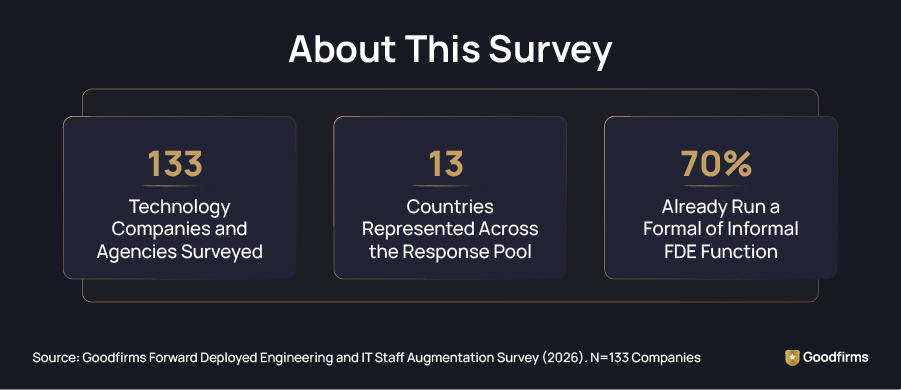
Goodfirms surveyed 133 AI and software companies to see how this model — forward-deployed engineering (FDE) — is being used in 2026. Nearly 70% already have a formal or informal FDE function, while 15.2% are building one.
The research looks at adoption, team structure, hiring, salaries, pricing, AI's impact, key challenges, and where FDE works best. It also compares FDE with traditional IT staff augmentation.
What Is Forward Deployed Engineering?
Traditional IT staff augmentation companies place a developer inside a client team to fill a capacity gap. The client directs the work, manages the priorities, and owns the outcome. There is one term that differentiates FDE from IT staff augmentation: “Accountability.”
An FDE is embedded to own the problem, not just fill a seat. That shift in accountability shows up across how engagements run, are priced, and are measured — as the comparison table below shows at a glance.
Let’s start with real numbers - how many companies have actually acted on a forward-deployed engineering approach — not just talked about it, but actually implemented it practically.
Forward Deployed Engineering Adoption in 2026
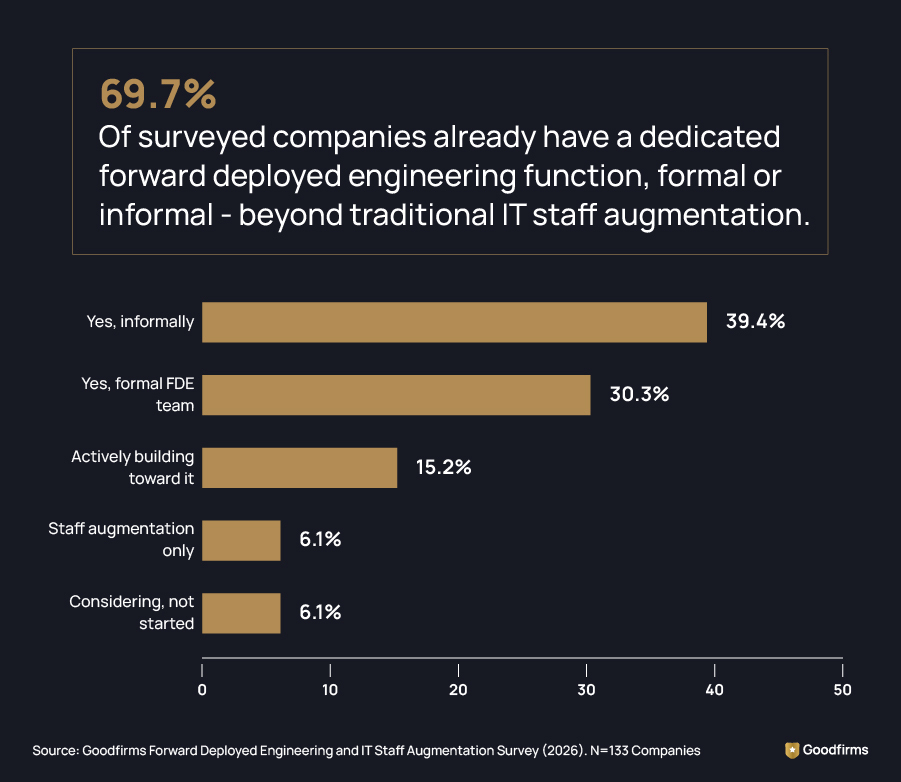
Adoption is already the majority position, not the exception. Of the 133 companies surveyed, 39.4% run an FDE function informally on specific engagements, and 30.3% have a formal, named FDE team — a combined 69.7% already operating some version of the model. Another 15.2% are actively building toward it, which pushes the share of companies engaged with FDE in some form to 84.8%.
That adoption curve raises an obvious next question: what actually pushes a company to build the function in the first place?
Why Companies Are Adopting Forward Deployed Engineering?
Client pressure, not internal strategy, is what pushes most companies into building an FDE function. Among companies that have built or are building one, 78.6% pointed to enterprise clients needing deeper technical support than solutions engineering could provide, and 71.4% cited high-value clients demanding an embedded technical owner directly.
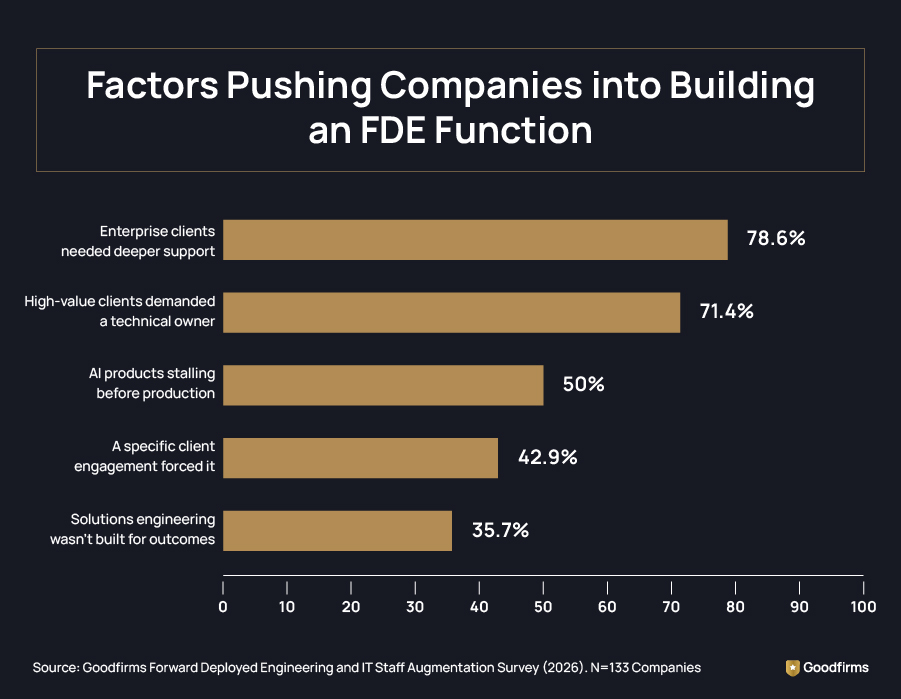
The AI trigger is worth sitting with. Half of the companies building an FDE function said AI products were reaching clients but stalling before production — a signal that the bottleneck in 2026 is rarely the model itself. It is getting AI-driven software live and adopted inside a client's actual operating environment, which is precisely the gap an embedded, accountable engineer is built to close. Once companies adopt FDE, the next question is how they structure the function internally.
This deployment gap is also reflected in Goodfirms’ AI SaaS trends research, where getting AI initiatives from experimentation into practical business use remains a key concern.
How Companies Structure Their FDE Teams
Most companies have not carved out a separate department for FDE work. Among companies with an FDE function, 42.9% keep it inside the existing solutions engineering function, and 32.1% distribute FDEs across business units or verticals rather than centralizing them.
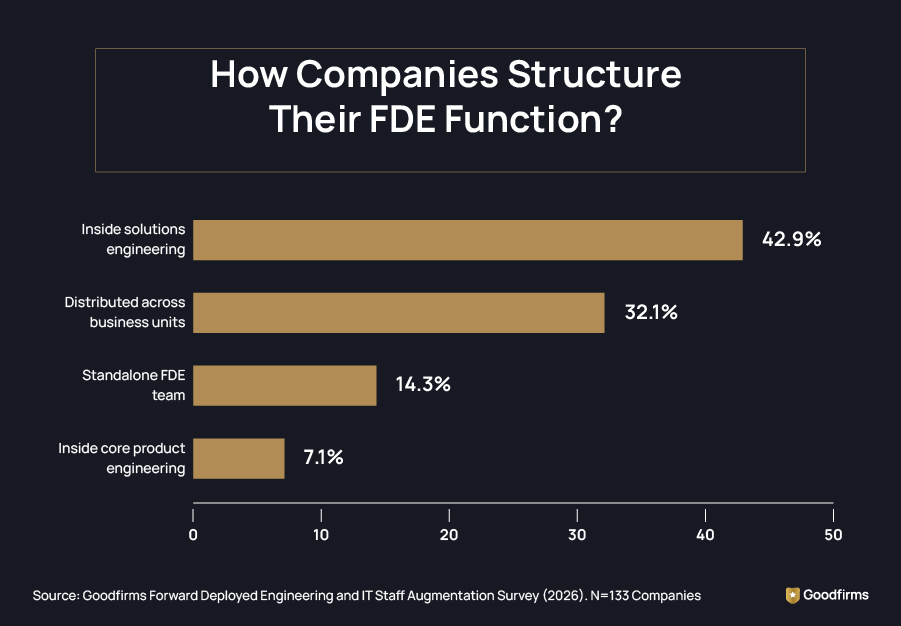
Only 14.3% have separated FDE into a standalone team with its own reporting line, distinct from solutions engineering and customer success. That low figure lines up with what respondents describe elsewhere in the survey: FDE is, for most companies, an operating model layered onto existing engineering talent rather than a headcount category with its own budget line.
How those teams are structured is only part of the picture. Companies also differ in how and where they deploy FDEs with clients.
How FDEs Get Deployed and For How Long?
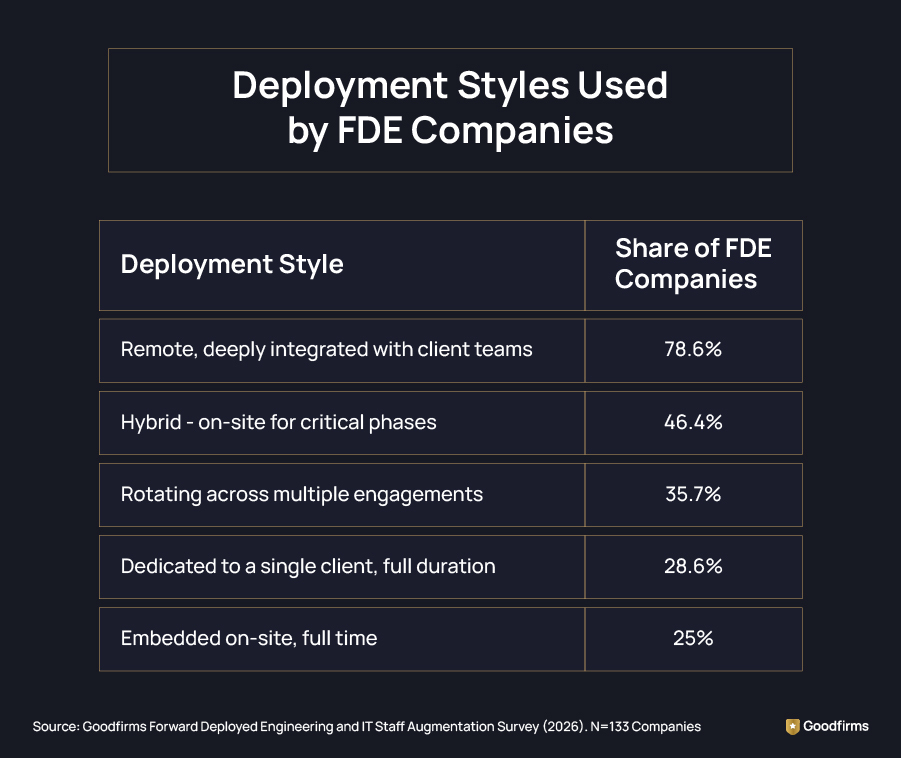
Remote-but-integrated is the dominant deployment style, not on-site presence. Among companies with an FDE function, 78.6% deploy their engineers remotely while keeping them deeply integrated with client teams, and just 25.0% put engineers on-site at the client location full-time.
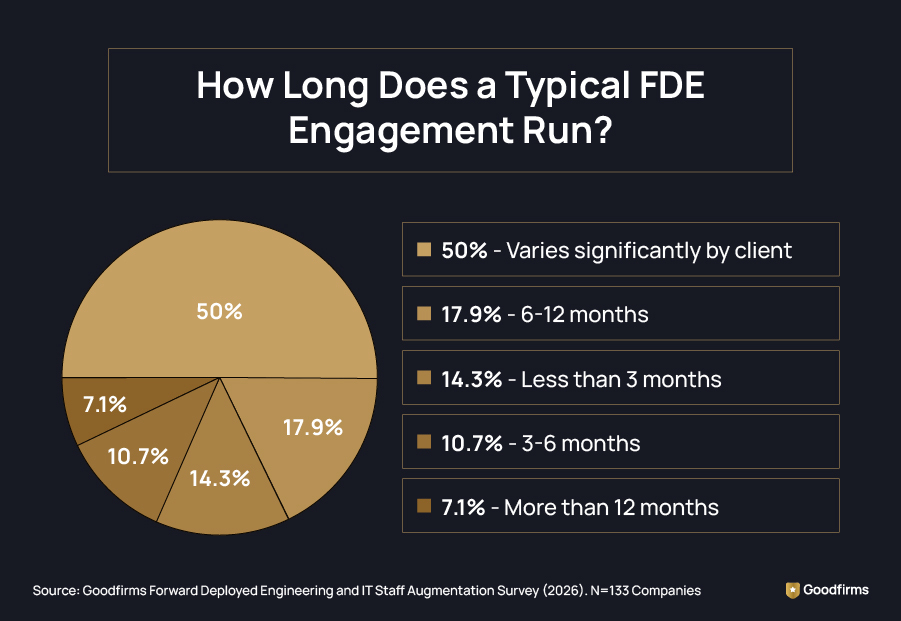
Engagement length resists a single answer. Half of respondents (50%) said duration simply varies by client, which tracks with a model built around outcomes rather than fixed statements of work. Where a typical length was reported, 17.9% run 6–12 months, 14.3% run under three months, and 7.1% extend past a year, suggesting the longest engagements are reserved for the most complex, highest-stakes accounts.
Where FDEs work is one part of the model. Just as important is the mix of skills companies expect them to bring.
What Skills Do Forward Deployed Engineers Need?
Almost every company with an FDE function — 89.3% — expects strong software engineering skills paired with client-facing experience. But technical skill alone isn't enough. Product sense comes in close behind at 85.7%, and AI fluency, the ability to guide and check AI-generated work, follows at 82.1%.
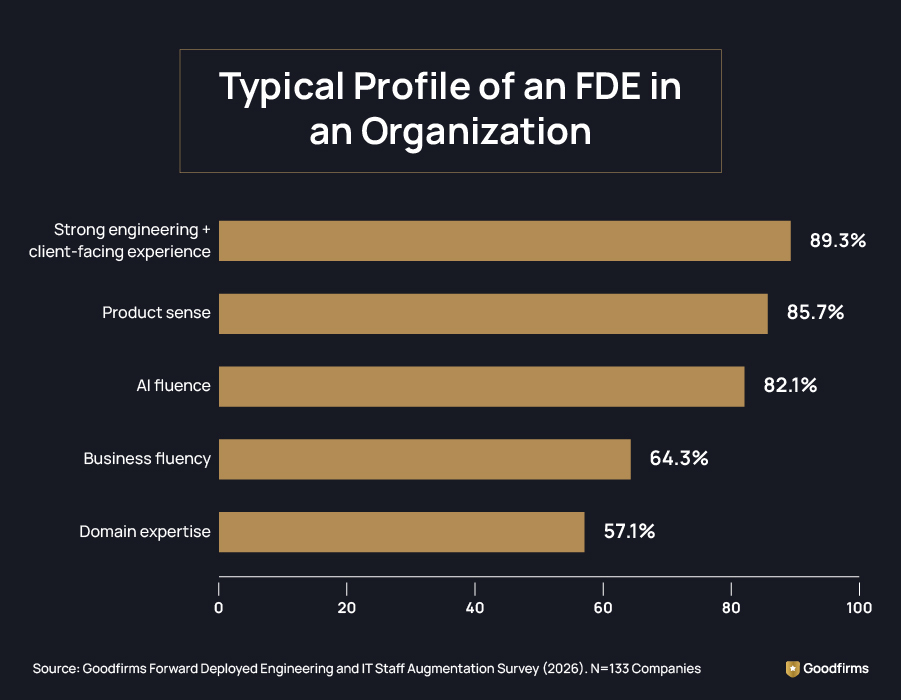
Business fluency — comfort in commercial and strategic conversations — appears in 64.3% of profiles, which is the clearest evidence that the FDE role sits deliberately between engineering and account management. Robert Giezen, Strategic Advisor & Founder of Global BrainForce, Philippines, has run into this firsthand while hiring for the role:

It isn't finding the tech talent that is hardest — it's finding engineers who can hold a commercial conversation and push back on a client when they ask for something that isn't feasible.
That's one shift in what the role demands. That mix of technical, product, and business skills also makes the role unusually difficult to hire for.
Is Finding the Right Forward-Deployed Engineer Tough?
When asked whether finding the right forward-deployed engineer is tough or not, 63.6% of all respondents describe the talent supply problem as difficult but manageable, while a further 21.2% call it extremely difficult to find, leaving only 15.2% who say it is no harder than hiring strong engineers generally.
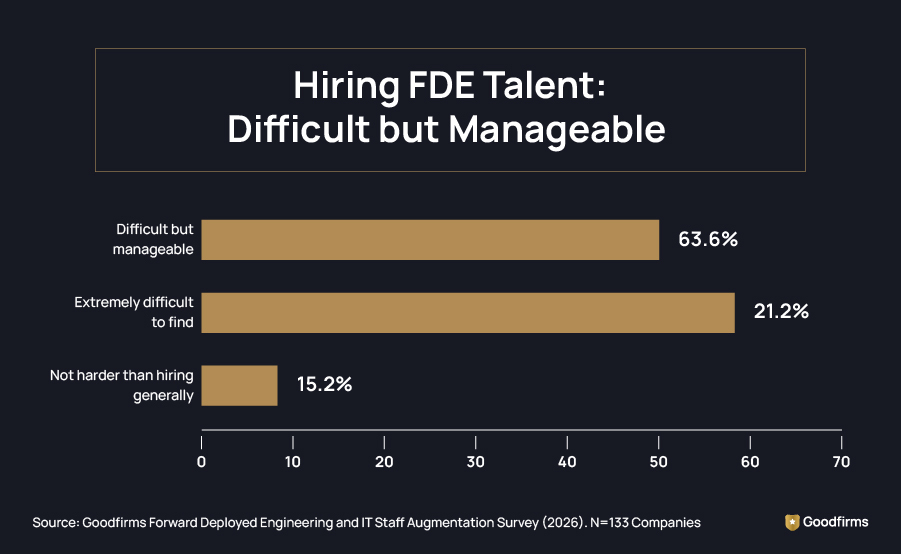
The scarcity is not about coding ability. It is about the rare combination the profile demands: engineers who are technically strong, comfortable in front of a client, and willing to own an outcome without a safety net. Ms. Hien Phan, VP (Growth & Impact) at Kyanon Digital in Vietnam, sees the same shortage playing out at scale:

The bottleneck to scaling this model is not a shortage of people who can write code; the bottleneck is the extreme scarcity of engineers who possess both technical mastery and business fluency.
That scarcity also has a direct impact on what companies have to pay to hire forward-deployed engineers.
Forward Deployed Engineer Salaries in 2026
How Much Does a Full-Time Forward Deployed Engineer Cost? Salary by Country
| Forward Deployed Engineers' Annual Salaries (in USD) | |||
|
Country |
Junior |
Mid-Level |
Senior |
|
United States |
$170,000 |
$250,000 |
$330,000 |
|
Canada |
$128,000 |
$143,000 |
$194,000 |
|
United Kingdom |
$120,000 |
$216,000 |
$270,000 |
|
Germany |
$110,000 |
$120,000 |
$135,000 |
|
Australia |
$58,000 |
$65,000 |
$70,000 |
|
India |
$10,000 |
$15,000 |
$20,000 |
This information about salaries can help you select the region from which to hire forward-deployed engineers. For example, hiring an FDE in India can prove to be more cost-effective than FDE in the U.S. without compromising on quality.
Location is only one part of the cost equation; Goodfirms’ software development cost research also looks at how team structure, project complexity, and pricing models affect development budgets.
Knowing the cost is one thing, knowing whether the FDE is a different model, or just staff augmentation with better branding?
Some software leaders treat FDE as staff augmentation with a fancier title, nothing more. Others see it as a real structural shift — one where the engineer, not the client, carries responsibility for whether a system works and keeps working after it goes live.
Volodymyr Kaminovskyy, CEO & Co-founder of Lionwood Software, Ukraine, has seen the FDE model change that equation for his own clients:

The Forward Deployed Engineering (FDE) model places an emphasis on operational accountability rather than just headcount. Our FDE model is enabling our clients to improve project budget efficiency by up to 25%, as well as establish a 95% predictable delivery timeline.
An FDE arrangement shifts outcome responsibilities to the engineers handling the project instead of the client who owns the project. In the context of software development, the engineer doesn't just develop software; they're accountable for whether that software reaches production, gets adopted, and delivers the business result the client signed up for.
The word “Accountability” showed up in some form across nearly every response in the survey. It's the closest thing to a single named concept this dataset produces, and it's worth holding onto as you read the rest of this article.
The Accountability Gap: The space between delivering resources and owning results. It's the gap every company in this survey is trying to close in one way or another, and it's the real difference between staff augmentation and forward-deployed engineering.
How Companies Measure FDE Success
Business outcomes agreed at the start of the engagement — revenue, efficiency, or cost reduction — are the leading success metric, cited by 78.6% of companies with an FDE function. Time to production for AI or software implementation follows at 67.9%, ahead of both product adoption metrics and client satisfaction, which tie at 60.7% each. OKRs defined jointly with the client round out the list at 42.9%, showing that most companies pair a broad outcome with a more specific, mutually agreed target.
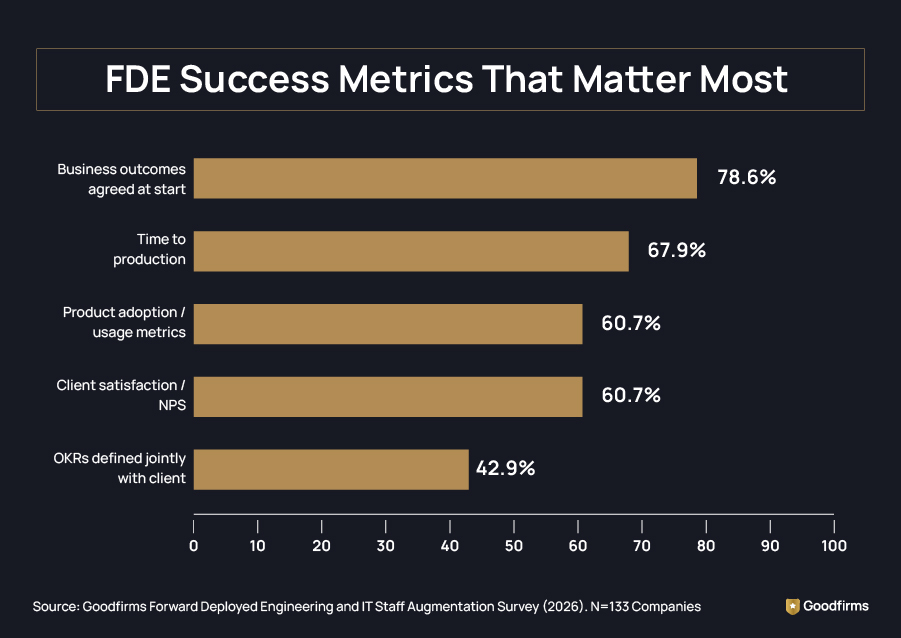
The consistency across these figures matters more than any single number. Every leading metric in this list measures something the client experiences directly — production, adoption, satisfaction — rather than internal delivery milestones like story points or hours logged, which is the clearest structural difference between how FDEs and staff augmentation engagements are typically scored.
Challenges of Forward Deployed Engineering
Among companies with an FDE function, 85.7% named hiring engineers with the right mix of technical depth and business fluency as one of their hardest challenges — more than 25 points ahead of the next most common answer.
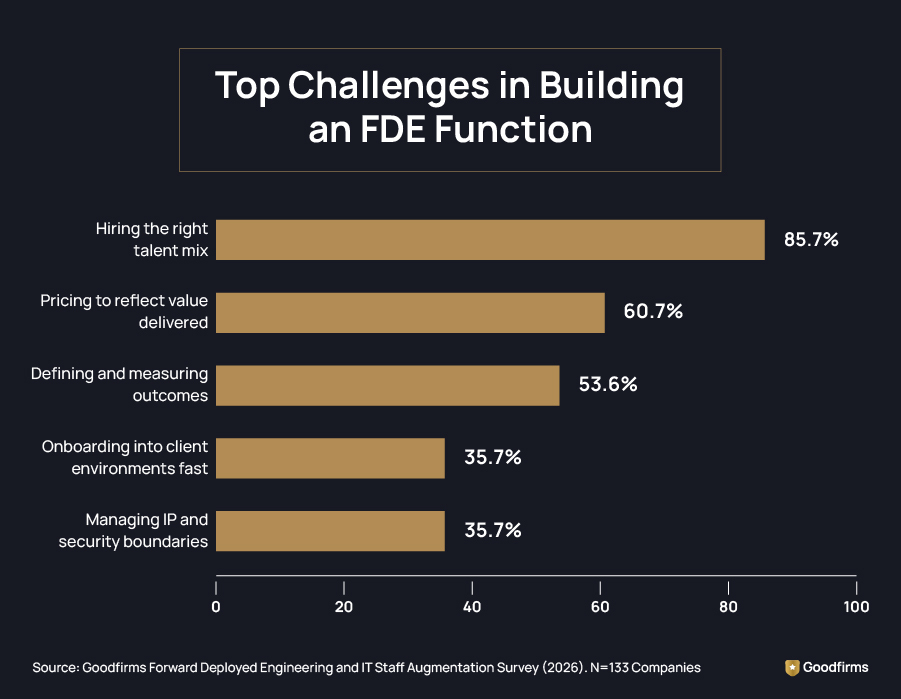
Pricing engagements to reflect value delivered ranks second at 60.7%, and defining clear, measurable outcomes per engagement follows closely at 53.6%. Together, these three challenges describe a model still searching for a shared operating standard — companies broadly agree on what FDE should deliver, but not yet on how to hire for it, price it, or measure it consistently. Artimenia Sergio, CEO of Geomotiv in Portugal, sums up what's still missing:

To scale the FDE model effectively, the companies need to hire engineers with the right mix of technical depth and business fluency.
Hiring is the biggest constraint today, but AI is also changing what companies expect from the engineers they do hire.
How AI Is Shaping FDE
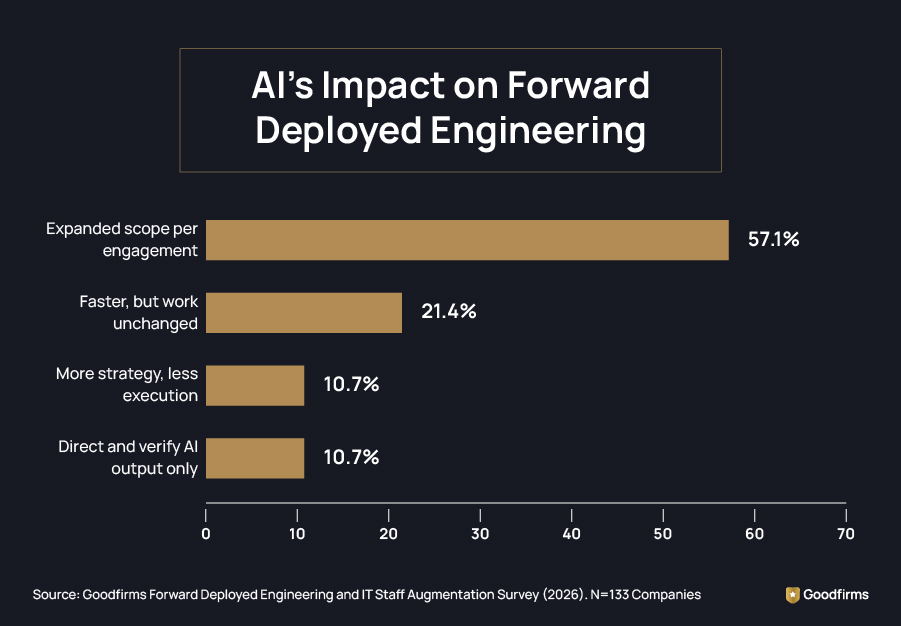
AI has expanded the role of forward-deployed engineers. 57.1% of companies with an FDE function say AI now lets a single engineer deliver more, making it the most common change reported. Another 21.4% say AI has simply made the work faster, without changing what the job actually involves. A further 10.7% say their FDEs now spend more time on strategy and diagnosis and less on hands-on execution. Whereas, 10.7% of companies also say their FDEs mainly direct and review AI-generated code rather than write it themselves. In other words, AI is enhancing the job of FDE for now, and not taking it over.
Below are 3 ways AI is rewriting the FDE job.
1. AI is changing the way companies hire for FDE roles
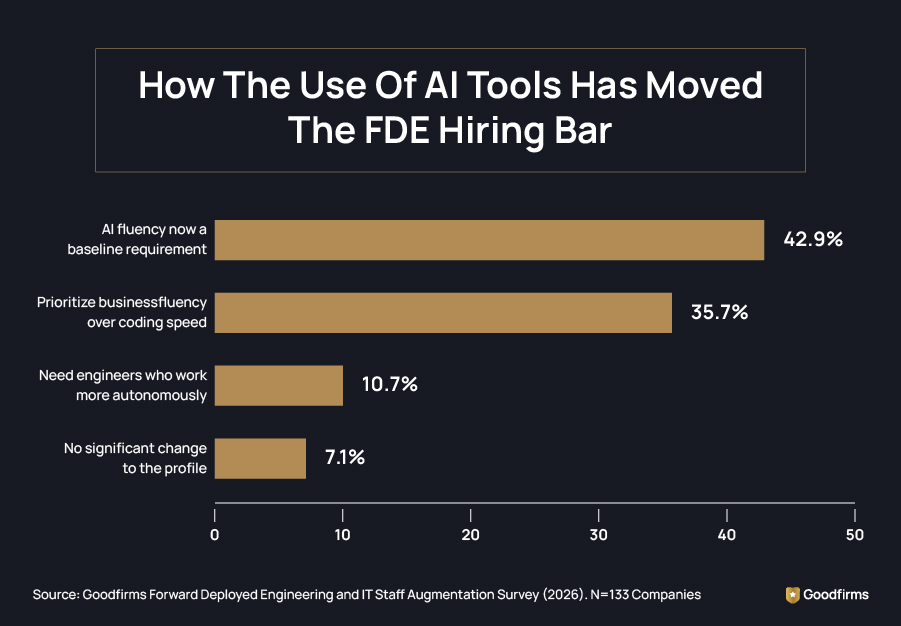
When asked about how the use of AI tools has moved the FDE hiring bar, 42.9% of companies with an FDE function said the ability to work fluently alongside AI tools is now a baseline requirement. A further 35.7% said they now prioritize business fluency and judgment over raw coding speed, since AI has closed much of the speed gap between engineers. Only 10.7% look for engineers who can operate more autonomously, and just 7.1% say the profile hasn't changed at all.
2. One Engineer, More Clients
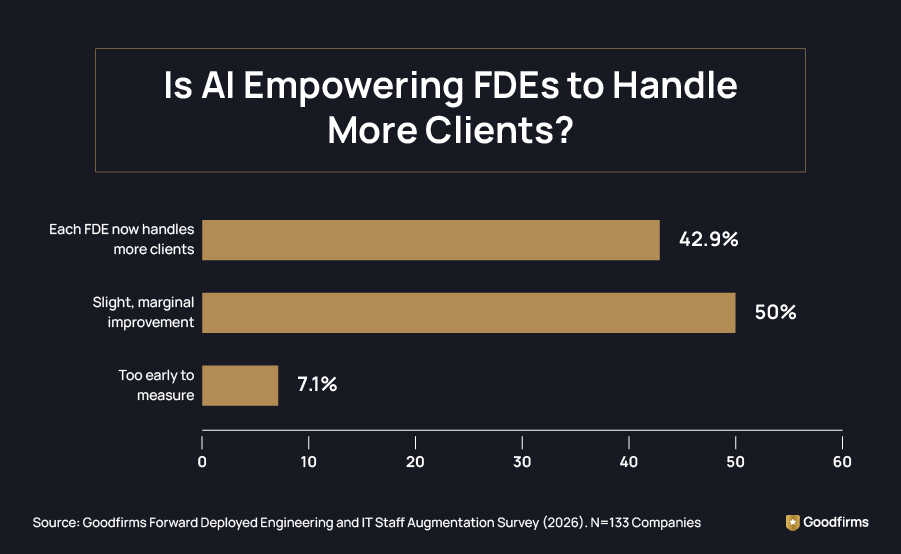
AI empowers FDEs to handle more clients than ever before. 50% of companies say there is a slight improvement in capacity per FDE, whereas 42.9% say each of their FDEs can now handle more client engagements at once because of AI. Taken together, more than nine in ten companies with an FDE function report at least some gain in how many clients one engineer can serve — a shift that changes the underlying economics of the model, since the same headcount can now cover more accounts without a proportional rise in cost.
3. Qualities of an FDE that AI Has Made Most Valuable
Ask companies which single capability AI has made most valuable in an FDE, and the answer isn't speed. 60.7% point to business context deep enough to direct AI's output and take ownership of the result — nearly four times the share who cited raw speed of code production, at just 14.3%. The ability to build AI-native systems from scratch and the ability to review and improve AI-generated code tie for third, each cited by 10.7%.
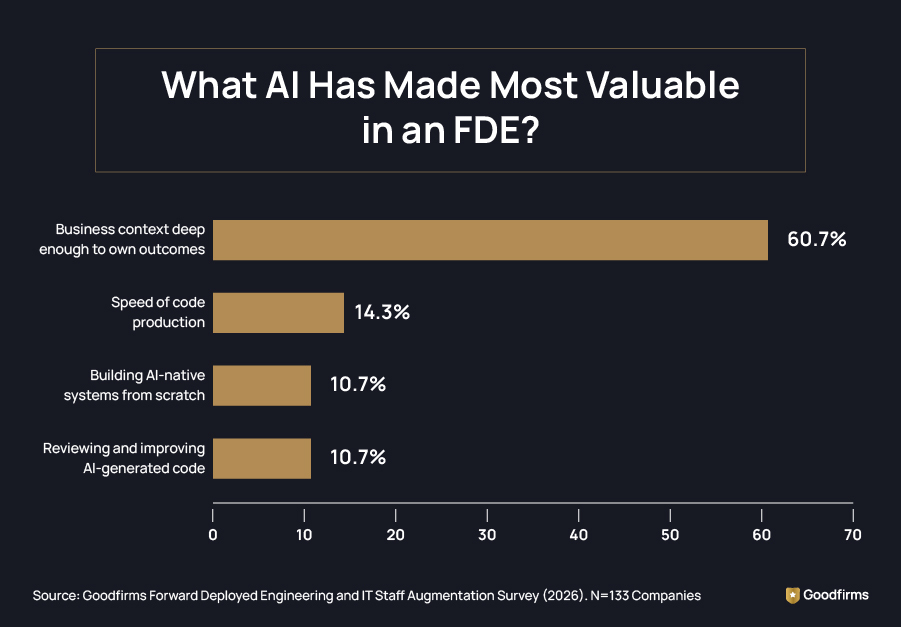
Precisely, AI hasn't lowered the bar for what an FDE needs to know — it has raised it in a different direction. Engineers are expected to move faster, cover more clients, and stay fluent in AI tooling, but the trait companies value most is still judgment: knowing enough about the client's business to point AI at the right problem and stand behind the outcome. Praveen Jha, Director of Sales and Business Development at Ortem Technologies LLC, United States, put it in terms of how his own team now hires and coaches for the role:

Finally, we now treat AI as a leverage multiplier for FDEs, hiring and coaching them to orchestrate AI tools effectively rather than just write code themselves.
Those changes make the distinction between FDE and traditional staff augmentation even more important.
Forward Deployed Engineering vs IT Staff Augmentation: Comparison at a Glance
| Features | FDE | Staff Augmentation |
| Accountability | High | Low |
| Client Ownership | Shared | Client-led |
| AI Deployment | Strong | Moderate |
| Pricing | Outcome-Based | Hourly |
| Enterprise Adoption | Growing | Mature |
While the table above outlines the structural differences, accountability is where the FDE model still faces its biggest test:

The industry needs a clear definition of 'ownership of outcomes' — where FDE responsibility begins and ends, separate from product, customer success, and engineering. Without it, the model stays ambiguous.
The difference also shows up in how FDE engagements are priced, with companies moving beyond traditional hourly billing.
Which Pricing Model Do Companies with FDE Function Usually Follow?
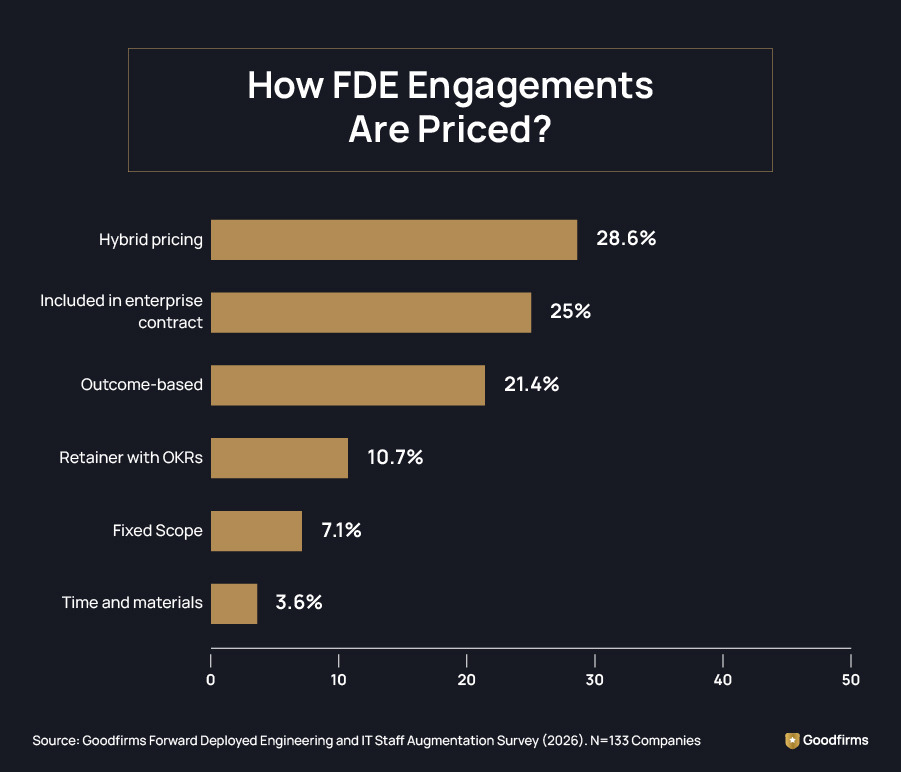
No single pricing model dominates. Among companies with an FDE function, 28.6% use a hybrid pricing structure, 25.0% fold the cost into enterprise contract pricing rather than billing separately, and 21.4% price purely on outcomes. A retainer tied to jointly agreed OKRs accounts for 10.7%, fixed-scope pricing for 7.1%, and traditional time-and-materials billing trails at just 3.6% — the least common approach among companies running an FDE function.
With adoption growing but hiring and pricing still unsettled, the next question is where companies expect FDE to go from here.
Future of Forward Deployed Engineering: 2027–2028
Opinion on how forward-deployed engineering evolves by 2027–2028 splits into an exact tie. 39.4% of all respondents expect it to become a standard function inside every serious AI and software company, and an identical 39.4% expect it to remain a premium model reserved for the most complex enterprise engagements. Also, 12.1% of companies believe that an FDE's job would be more strategic and less technical, whereas 6.1% say that FDE is likely to merge with staff augmentation in the coming years.
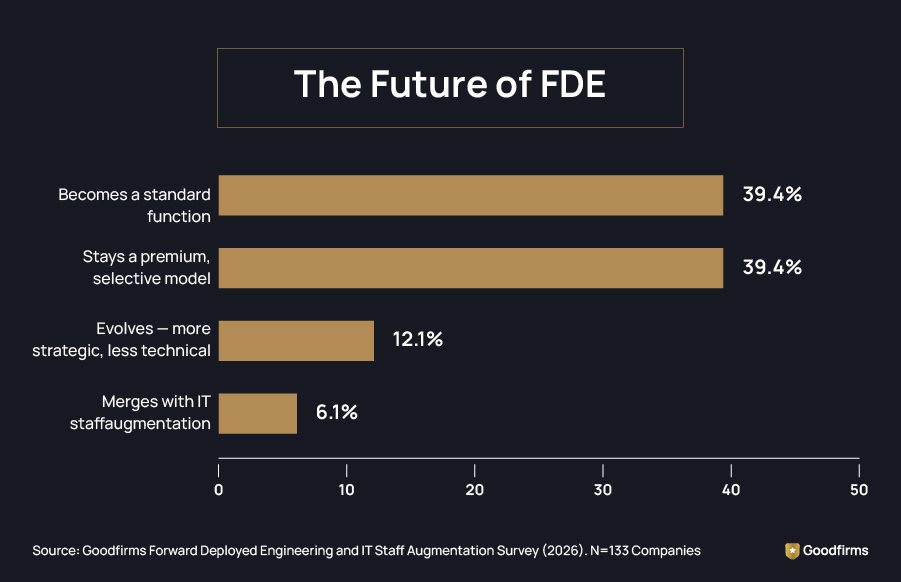
That split is the most honest finding in the entire survey. Forward-deployed engineering has not settled into a single trajectory yet, and the companies closest to running it are evenly divided on whether it becomes universal infrastructure or stays a scarce, high-margin specialty.
Precisely, one thing is clear: nobody's figured this out completely yet. The companies furthest along have some experience that can help you get it right the first time.
What FDE Builders Wish They'd Known Before Executing FDE Function?
In this survey, respondents were asked what they wished they'd known before building their FDE function in the first place—and the regrets cluster around structure and communication, not hiring.
It's an Operating Model, Not a Job Title
The most repeated regret in the data is treating FDE as a rebrand rather than a redesign. Ortem Technologies' Praveen Jha put it plainly: "FDE is a full operating model, not just a new title for contractors, and it demands a very specific profile. structured onboarding, explicit outcome definition, and tight alignment with our core platform are critical to prevent FDEs from becoming high-end staff aug instead of strategic partners." PhotoGov's Vitaly Yago described the same early mistake from a different angle: "The biggest mistake early on is treating FDEs like 'super solutions engineers' instead of outcome owners embedded in a delivery system." His conclusion was that companies underestimate how much structure the function actually needs before it works.
For Geomotiv's Artimenia Sergio, Founder/CEO with engineering oversight, the lesson was even more compact: "Domain expertise is the key." Buzzvel's Arthur Leal arrived at a similar conclusion, but with more of the mechanics spelled out:
We learned that the hardest part is not the technical delivery itself, but creating the right balance between engineering depth, client context, and outcome ownership. FDE only works when expectations, decision-making, access, and success metrics are clear from the beginning.
Communication Skills Matter as Much as Code
Multiple respondents said the hard part of running an FDE function turned out to be human, not technical. Designli's Emerson Reyna was direct about it: "Building a successful FDE function is much more about communication, expectation management, and ownership than technical execution. The technical challenges are usually solvable; the real challenge is creating a structure where clients feel supported."
Parthasarathi Raghavan, CTO of Rootquotient in Canada, reduced the entire lesson to one sentence: the real skill to learn was "how to effectively integrate with the client team and drive outcomes for them." At the same time, Zibtek's Cache Merrill reached the same conclusion from the other side of the engagement:

One thing I wish we had known from the start is that successful FDE engagements depend as much on integration and communication as they do on technical talent.
Start Sooner Than You Think
A smaller but pointed regret was about timing rather than structure. Several respondents said they waited too long to formalize their FDE function, treating it as a response to a specific client crisis rather than something worth building ahead of demand. By the time they moved, they were catching up rather than leading. Taazaa's Head of AI and Principal Architect, Syed Shabih Hasan, frames the cost of that delay as treating FDE as optional infrastructure when, in reality, it was the obstacle standing between a nice demo and something clients could actually use.

Should have started sooner. It is very interesting to see that everyone wants AI, but deployments beyond PoCs are almost an impossible hill to climb before FDEs.
Outcomes Over Tasks, Judgment Over Pure Skill
Technical skill got FDEs in the door, but respondents said it was mere judgment. Knowing when to push back, when to escalate, and when to own a decision are some aspects that determine whether the engagement succeeds or not.
Xiteb's Dr. Dhanesh R. Jayathilaka summarized the cultural shift required: "Technical expertise alone is not enough... clients value trusted advisors who can translate business objectives into technical solutions more than pure technical specialists." Similarly, Systalent's Billy Knott framed the same idea as an operating principle: "FDE works when engineers are accountable for outcomes, not just tasks." Idealogic's Alexander S. distilled the same shift into a single, balanced principle:

Technical skills are essential, but the ability to understand business context, communicate with stakeholders, and take ownership of outcomes is equally important
Knowing what went wrong is useful. What's more interesting is what these same FDE companies would do differently without legal structures and internal constraints.
If Given A Chance, How Would FDE Builders Redesign Client Delivery (No Legacy Structures And Internal Constraints)?
Asked how they'd rebuild client implementation and deployment from scratch, with no legacy structures or internal constraints holding them back, respondents converged on a few clear principles rather than radically different visions.
One Team, No Handoffs
The most common design was a single cross-functional pod owning the client relationship end-to-end, instead of separate teams passing work along a chain. Ortem Technologies' Praveen Jha described building "a fully AI-native, FDE-first delivery organization where every client engagement is treated as a product, not a project," anchored by one forward-deployed engineer supported by a shared platform team. Also, Emerson Reyna, product owner at Designli, voiced out something similar:

I would build a cross-functional implementation team around each client from day one, combining product, engineering, QA, design, and project management under a single ownership structure. The focus would be on business outcomes rather than departmental handoffs.
A Straight Line From Prototype to Production
Many teams treat a working prototype and a production system as two separate builds — the demo gets thrown together to prove the idea, then rebuilt from scratch once a client signs on. A straight line from prototype to production means skipping that rework entirely: building on the real production stack from day one, so what the client first sees is already the thing that ships. THEY.dev's Dawid, based in the UK, wanted to remove the gap between what a client approves and what actually ships:

If we rebuilt implementation and deployment from a blank sheet, the organizing principle would be a single, unbroken path from a working prototype to production.
Accountability Built Into the Product, Not Bolted On
Many companies treat accountability as something layered on top of a product after the fact — an extra support contract, an escalation process, a person you call when something breaks. Building ownership directly into how the product is designed and delivered is required, so that a single technical owner is accountable for outcomes from the start rather than being added in as a patch later. In Germany, Truck1.eu's Oksana Fando proposed keeping most onboarding self-serve and AI-assisted, reserving embedded engineers only for complex enterprise deployments — but with one non-negotiable rule:

Every complex deployment would have a single technical owner responsible for outcomes end-to-end.
An AI-First, Outcome-Driven Delivery Engine
A few respondents took the redesign a step further than restructuring teams — they wanted to stop operating like a services company altogether. Instead of scoping each engagement from zero and rebuilding the same groundwork for every client, they described replacing that model with a reusable, AI-powered engine that gets faster and more consistent with every deployment. Shashank Jain, the founder & CEO of Bytequest Softwares Pvt Ltd, described exactly this shift:

I would build it as an AI-first, outcome-driven delivery engine rather than a traditional services organization. Implementation would be highly standardized, with reusable frameworks, AI-powered development workflows, automated testing, infrastructure-as-code, and predefined deployment playbooks
Those redesigns describe what companies want FDE to become. The next question is simpler: what has it already delivered that the old model couldn't?
Comparison: What FDE Delivers That Staff Augmentation Never Could?
The numbers show how far forward-deployed engineering has spread. When asked what FDE delivered that staff augmentation couldn't, respondents from different companies shared their valuable insights.
Ownership Replaces Task Execution
The clearest win is a shift from doing work to owning results. Under staff augmentation, clients simply received resources. Under FDE, they get a team that stands behind the outcome. Robert Giezen, the Strategic Advisor & Founder of Global Brainforce in the Philippines, said that - “FDE has shifted us from filling capacity to owning results. This is what our clients in complex, fast-moving environments actually need.” Fx31 Labs' Dr. Nilesh Modi captured the same shift in a single, clean contrast:

Traditional staff augmentation provides talent. FDE provides outcomes. Instead of managing individual developers, clients receive a dedicated engineering function with built-in leadership, delivery accountability, and scalability.
Faster Delivery, Higher Adoption
A second, closely related win is speed — not just building faster, but getting the finished product actually used inside the client's environment. PhotoGov's Vitaly Yago has seen that speed advantage play out directly with his own clients:

In our experience, FDEs have delivered faster production deployment of AI and software systems, tighter alignment between technical execution and business goals, and significantly higher adoption rates inside client environments
Stronger, More Complete Solutions
A third win is depth. Companies describe FDE as combining several disciplines that used to sit in separate roles, so clients get a more rounded solution rather than a narrowly scoped one. Xiteb LLC's Dr. Dhanesh R. Jayathilaka describes that added depth as a direct outcome of the model itself:

The FDE model has enabled us to move beyond simply providing technical resources to taking ownership of business outcomes. Unlike traditional IT staff augmentation, our FDE approach combines technical expertise, business understanding, solution architecture, stakeholder engagement, and delivery accountability.
Clients Come Back
The last win is the most commercial one: retention. When clients see an engineer own the outcome rather than just the task list, they stay — and they bring more work. Systalent USA's Billy Knott sums up why that retention effect holds:

When engineers own outcomes and relationships, clients come back. That is the difference between augmentation and forward-deployed engineering.
That case for FDE is strong. So why does a portion of the market still sit on the sidelines?
Why Some Companies Are Still Reluctant Towards Adopting the FDE Model?
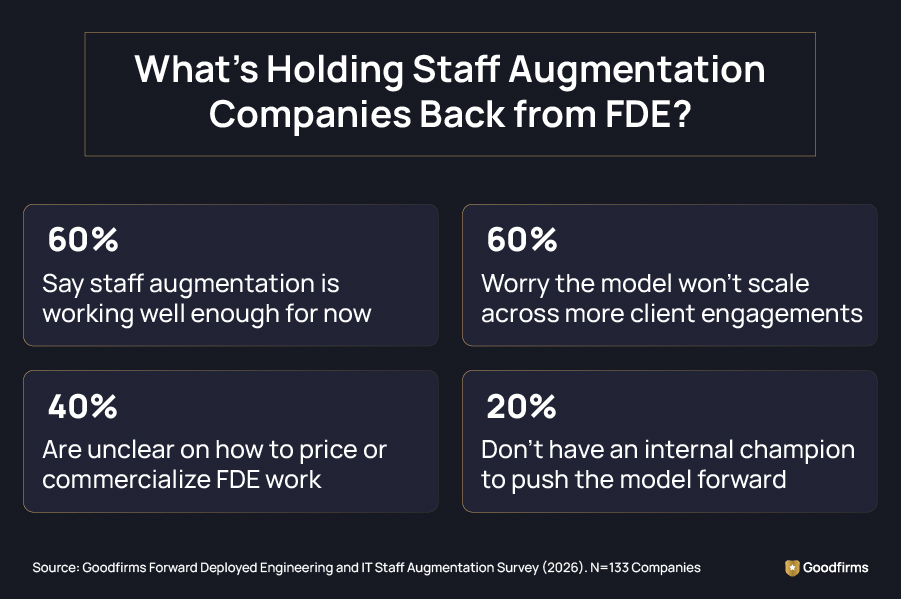
A small group of respondents — 15% of all the companies that responded to this survey — have not built an FDE function, and their reasons are commercial rather than technical. When asked their primary reason for not adopting FDE yet, 60% tell that their existing IT staff augmentation setup is working well enough for now, and an equal 60% cited scalability concerns. Moreover, 40% of them are unclear on how to price or commercialize FDE work, and 20% don't have an internal champion to push the model forward
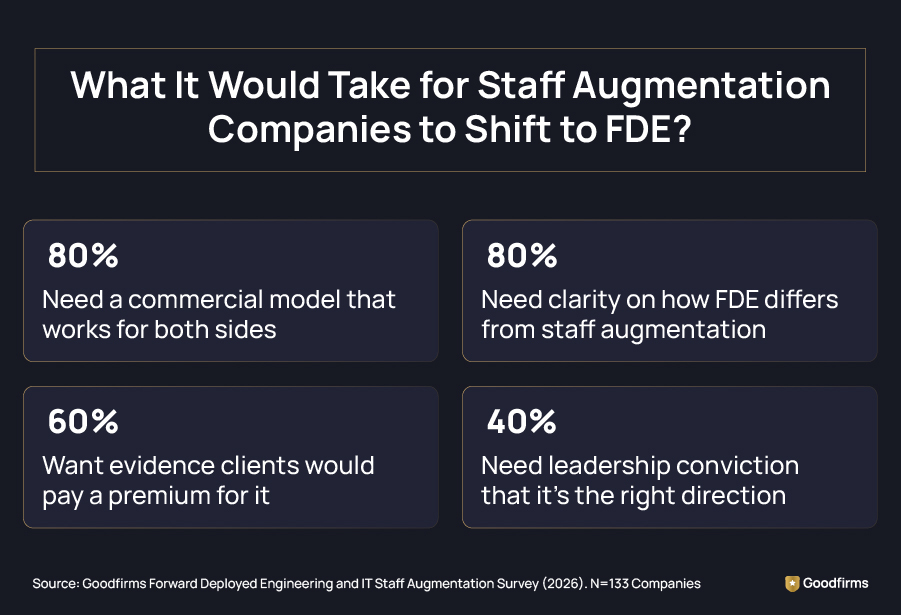
When asked what they'd actually need to build an FDE function, the answers point away from talent or technology entirely. 80% need a commercial model that works for both sides, and an equal 80% need clarity on how FDE differs from staff augmentation in outcomes and accountability. A further 60% want proof that enterprise clients would pay a premium for it before committing, and 40% need a leader's conviction that adopting the FDE model is the right thing to do in the current times.
Precisely, these companies are still reluctant towards adopting the FDE approach, not because they are struggling to find the right engineers or technology, but because they're struggling to define the model clearly enough to price it and pitch it in front of their clients.
All of this — the wins, the holdouts, the unresolved questions relating to FDE— adds up to a practical problem for anyone hiring a vendor right now - how to evaluate a company offering FDE function.
How to Evaluate a Company Offering FDE Function?
If you're comparing FDE vendors or implementation service providers, the data above turns into a short checklist worth asking directly — because ‘we do FDE’ means something different at every company.
Vendor Evaluation Checklist
- Ask whether the FDE function is formal or informal, and how many dedicated FDEs the vendor currently has.
- Confirm how success will be measured — business outcomes, time to production, or adoption metrics — before the engagement starts.
- Clarify IP ownership in writing; the market is split evenly between client-owned and negotiated terms.
- Check whether pricing is outcome-based, retainer-based, or bundled into the contract, and what happens if scope shifts mid-engagement.
- Ask directly how AI tooling changes what their FDEs deliver versus what a traditional staff augmentation contractor would deliver.
That checklist covers what to ask a vendor directly. A few broader questions given below are worth answering here too.
FAQs: Forward Deployed Engineering
What is a forward deployed engineer?
A forward deployed engineer (FDE) is a software engineer who works embedded inside a client's environment rather than remotely behind a product team. Unlike a typical engineering role focused on building features, an FDE owns the outcome of implementation — making sure the software actually works, gets adopted, and delivers results inside the client's real operating environment, not just that it ships.
Is forward-deployed engineering only viable for large companies?
Mostly, yes, based on this data. Every company running a formal FDE team came from an organization with 51 or more engineers, and the model was rarest among companies with 1–10 engineers. That doesn't rule out FDE for smaller teams, but it does suggest the formal, dedicated version of the model needs enough engineering headcount to spare before it makes sense to separate out.
Does adopting FDE mean replacing your existing engineering or IT staff augmentation team?
No. Most companies in this survey run FDE and staff augmentation side by side rather than replacing one with the other, routing clients to whichever model fits the engagement. FDE is best understood as an additional layer of accountability for complex, high-stakes clients, not a wholesale swap-out of your delivery model.
How is FDE different from solutions engineering or customer success?
The distinction is ownership, not job title. Solutions engineering and customer success typically support a sale or manage a relationship; an FDE carries direct, ongoing responsibility for whether the implementation actually works in production and delivers the business result. Several respondents specifically warned against treating FDEs as "super solutions engineers" — the mistake several companies said they made early on.
Should a company start with an informal FDE model or build a formal team right away?
The data suggests that starting informally is the more common and lower-risk path. 39.4% of companies run FDE informally on specific engagements before ever formalizing it, and several respondents said the real lesson was building the right structure — clear ownership, outcome definitions, onboarding — before scaling headcount, not the other way around.
What's the biggest risk of adopting FDE without the right structure in place?
Based on the challenges and lessons learned sections of this survey, the biggest risk isn't hiring the wrong engineers — it's under-defining the role. Companies that treated FDE as a rebranded staff augmentation title, without structured onboarding, clear outcome ownership, and defined boundaries with product and customer success, reported the function drifting back into high-end staff augmentation instead of becoming a strategic differentiator.
Does forward-deployed engineering cost more than traditional IT staff augmentation?
It's not a direct apples-to-apples comparison, since pricing models differ. Rather than a flat hourly rate, most FDE engagements use hybrid pricing, outcome-based pricing, or costs folded into the broader enterprise contract — reflecting the fact that clients are paying for accountability and outcomes, not just hours of engineering time.
Methodology: This report is based on a Goodfirms survey of 133 AI and software companies conducted in June–July 2026. Respondents represent a cross-section of company sizes (1–10 engineers through 200+ engineer organizations) and company stages (pre-seed/seed through public/late-stage enterprises), spanning software/SaaS, enterprise technology, AI-native product companies, IT staffing and managed services providers, and engineering consultancies. All percentage figures reflect responses from the subset of companies that reported having a dedicated or informally operating forward deployed engineering (FDE) function, unless otherwise noted; base sizes vary by question. Salary figures cited for full-time forward deployed engineers are sourced separately from levels.fyi and Glassdoor and reflect self-reported and aggregated market data rather than direct survey responses. We sincerely thank our research partners for their valuable time, suggestions, and inputs.
| Sr. No. | Research Partners |
| 1. | Blue Crystal Solutions |
| 2. | Brainium Information Technologies Pvt LTD |
| 3. | Bravado Solutions |
| 4. | Buzzvel |
| 5. | Bytequest Softwares Pvt Ltd |
| 6. | Capital Numbers Infotech Limited |
| 7. | Cloud Hawk Tech |
| 8. | Designli |
| 9. | Edhac Healthcore Private Limited |
| 10. | Fx31 Labs |
| 11. | Geomotiv |
| 12. | Global BrainForce |
| 13. | Idealogic |
| 14. | Kitrum |
| 15. | Kyanon Digital |
| 16. | Linkbuilder |
| 17. | Ortem Technologies LLC |
| 18. | PhotoGov |
| 19. | Prakash Software Solutions Pvt. Ltd |
| 20. | Rootquotient Technologies Inc. |
| 21. | RowebCo LLC |
| 22. | SmartLinks |
| 23. | So Efforts Solution Pvt Ltd |
| 24. | Systalent USA |
| 25. | Taazaa |
| 26. | Technostacks LLC |
| 27. | THEY.dev |
| 28. | Vivasoft Ltd. |
| 29. | Truck1.eu |
| 30. | Wesence Technologies Pvt Ltd |
| 31. | Xiteb LLC |
| 32. | Zibtek |