Key takeaways
• Only 14% of respondents who answered the AI pricing question said they lowered prices. Another 34% kept prices steady and improved margins, while 32% kept prices steady and included more work.
• 66% of respondents reported that their website redesign projects cost less than $10,000. Scope creep and changing requirements were the most cited reasons projects went over budget.
• Outdated design was the most cited reason for a website redesign (81%). Low conversion rates (57%), poor mobile experience (49%), and poor SEO performance (48%) followed.
• Better user experience was the most common goal (64%). More inquiries or leads (54%) and higher conversion rates (53%) came next.
• One to two months was the most commonly reported redesign timeline (40%). Design approvals were the most cited cause of delays, followed by content creation and migration.
• Research and discovery were the most reported uses of AI in website redesign (82%). Copywriting (63%), front-end coding (59%), and SEO (53%) followed.
“Design is not just what it looks like and feels like. Design is how it works.” - Steve Jobs
The more I looked at the findings of this research, the more this quote made sense in the context of website redesign.
An outdated design was the most common reason respondents gave for redesigning a website, cited by 81% of them. That is hardly surprising. An old-looking website can make a business appear out of touch, even when its products and services are still relevant.
But the reasons behind a redesign went beyond appearance.
Low conversion rates, poor mobile experience, and poor SEO performance featured prominently.
That means businesses wanted websites that could do a better job of attracting visitors, keeping them engaged, and turning them into customers.
The findings also brought up some practical questions. How much should a redesign cost? What tends to push projects over budget? How long does a launch really take? And now that AI is part of the process, are agencies completing projects faster or simply taking on more work?
We asked professionals involved in website design and development about these issues. Their responses offer a closer look at what happens before, during, and after a redesign.
MethodologyThis report is based on 99 valid survey responses collected in October 2026. The survey gathered input from professionals involved in website design and development, including people working on website redesign projects for clients. Respondents represented multiple regions: North America (34.3%), Asia (29.3%), Europe (21.2%), Africa (6.1%), Oceania (5.1%), the Middle East (3.0%), and Latin America (1.0%). The findings reflect the experiences and estimates shared by these respondents. They should not be read as a statistically representative measure of every website redesign agency or project worldwide. Percentages are reported as supplied in the survey analysis; totals may vary slightly because of rounding or question-level response counts. |
Why Companies Redesign Their Websites
An outdated design topped the list of reasons clients approach agencies for a website redesign.
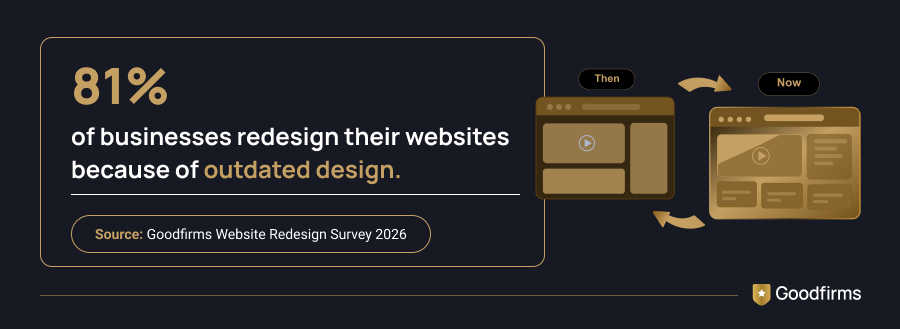
Low conversion rates came next at 57%, followed by poor mobile experience at 49%, poor SEO performance at 48%, and rebranding at 47%.
Businesses planning a redesign can also explore top web design companies to find agencies with experience in creating user-friendly websites that support business goals.
Here is how respondents ranked the most common reasons for starting a redesign.
|
Reason for website redesign |
Share of respondents |
|---|---|
|
Outdated design |
81% |
|
Low conversion rates |
57% |
|
Poor mobile experience |
49% |
|
Poor SEO performance |
48% |
|
Rebranding |
47% |
|
Slow site speed |
34% |
|
New features |
31% |
|
Platform or CMS change |
26% |
|
Accessibility or compliance |
12% |
|
Security concerns |
11% |
The results tell us something about the way businesses approach redesigns. A dated interface is visible to everyone. A weak conversion path is harder to spot. So is a navigation structure that frustrates users or a page that attracts search traffic but fails to generate inquiries.
The expected outcomes reinforce this point.
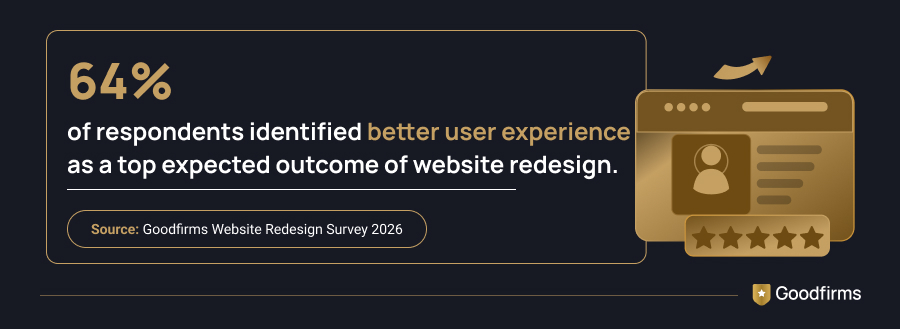
A better user experience was the most frequently selected expected outcome. More leads and higher conversion rates followed closely.
|
Expected outcome after a website redesign |
Response percentage |
|---|---|
|
Better user experience |
64% |
|
More website inquiries/leads |
54% |
|
Higher conversion rates |
53% |
|
Increased organic traffic |
48% |
|
Faster website performance |
48% |
|
Improved website engagement |
45% |
|
Better search rankings |
43% |
|
Better mobile experience |
43% |
|
Improved brand perception |
35% |
|
Higher sales/revenue |
27% |
|
Reduced website maintenance effort |
21% |
|
Easier content management |
19% |
A website can look modern and still fail to generate business if you improve the visual experience without fixing confusing navigation, weak calls to action, or content that doesn't answer visitors' questions.
William Marchand captured this well:

Respondents also highlighted the risk of treating a redesign as a visual project rather than a business and customer-experience project. The responses pointed to existing analytics, conversion paths, customer behavior, sales feedback, and high-performing content as inputs that should inform the work before anything changes.
I think this is one of the most important considerations for anyone planning a redesign. The new look should come after the team understands what needs to improve.
Which pages bring in traffic? Where do visitors drop off? What questions do customers repeatedly ask? Which parts of the current website are already working well?
These questions may not be as exciting as choosing a new layout, but they can make the difference between a redesign that looks impressive and one that delivers measurable results.
| Goodfirms keynotes: Appearance can get a redesign approved, but business goals should guide the work. Before deciding what the new website should look like, agree on what it needs to do better. |
Website Redesign cost: What Businesses Need to Consider
Cost is one of the first things businesses want to understand before starting a website redesign. Yet a single average price rarely tells the whole story.
Comparing web development companies can help businesses understand the services included in a proposal, assess technical expertise, and find a development partner that fits their project requirements.
We asked respondents about their ideal redesign budgets, the factors that influence costs, and the issues that can push projects beyond their original estimates to understand what can affect the final project cost.
Most website redesign budgets fall below $10,000
Around 66% of respondents said their website redesign projects cost less than $10,000.
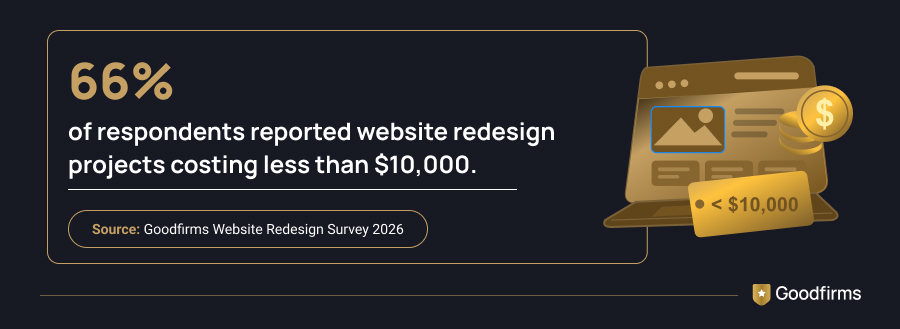
This gives businesses a useful starting point, particularly smaller companies planning to refresh an existing website.
This is not a universal price benchmark. The number of pages and templates to be created was a key factor respondents identified when discussing project costs.
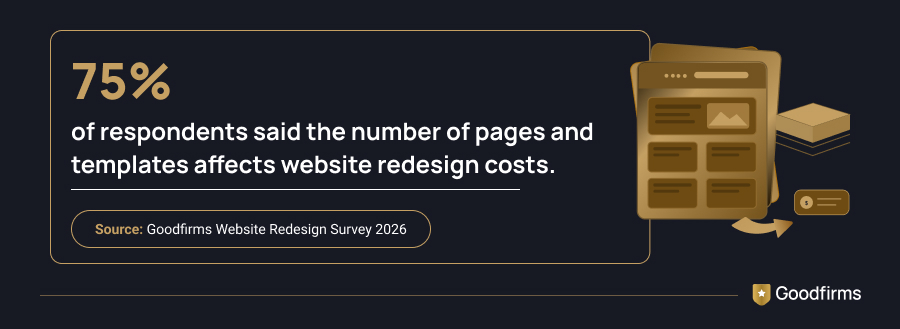
Other considerations included third-party integrations, ecommerce functionality, SEO migration, custom or headless development, platform changes, content migration, and accessibility requirements.
|
Cost factor |
Respondents selecting it |
|---|---|
|
Number of pages or templates |
75% |
|
Custom design instead of a template |
64% |
|
Third-party integrations |
58% |
|
Ecommerce functionality |
46% |
|
SEO migration work |
40% |
|
Custom or headless development |
38% |
|
CMS or platform change |
37% |
|
Content migration |
29% |
Consider two businesses planning a redesign. One needs a new homepage, a few service pages, and a contact form. The other needs hundreds of product pages, payment integrations, customer account functionality, and a carefully managed migration of existing URLs. Both may describe their requirement as a website redesign, but the work involved is nowhere near the same.
This is why businesses should look beyond the headline quote. The more useful question is what the proposed budget actually covers.
Businesses redesigning online stores may also need specialist support with platform migration, payment integrations, and store functionality, making it worth comparing eCommerce development companies.
The hidden cost of overlooking SEO
SEO deserves particular attention during a redesign. It is easy to focus on the new structure and visual improvements while overlooking the search visibility the existing website has already earned.
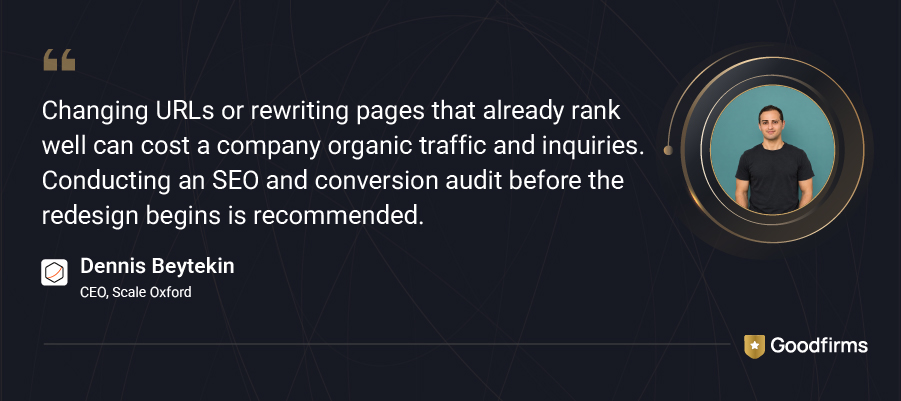
That distinction is worth remembering. A redesign may involve moving content, changing URLs, restructuring navigation, or switching platforms. These changes can affect how search engines discover and understand a website.
Google's guidance for site moves recommends planning URL changes, mapping old URLs to their new destinations, implementing redirects, testing the new site, submitting an updated sitemap where appropriate, and monitoring traffic and indexing after launch. Temporary ranking fluctuations can occur while Google processes the changes.
Businesses that need support with this process can consult SEO companies experienced in technical SEO, website audits, and migration planning.
For businesses, that means SEO should be part of the project plan and budget from the beginning. Identify the pages that attract traffic and generate leads. Decide which content needs to move, improve, merge, or retire. Then make sure redirects and tracking are ready before launch.
A redesign should create a better future for a website without carelessly discarding the value it has already built.
Why website redesign projects go over budget
The original estimate is only one part of the cost story. What happens after the project begins matters just as much.
Among respondents, 31% said fewer than 10% of their redesign projects went over budget. Another 36% said that 10% to 25% of their projects exceeded the budget. Meanwhile, 5% reported that more than half of their redesign projects went over budget.
These responses suggest that budget overruns are not inevitable, but they are a real possibility.
The most frequently selected reasons were scope creep and changes in requirements. Slow client feedback was another reported issue.
It is easy to see how these problems build up. A client approves the initial scope, then asks for additional pages or functionality. The team agrees to a few changes. More requests follow. Individually, each change may seem manageable. Together, they can add development hours, affect other tasks, and push the project beyond its original budget.
Craig Steinberg identified the issue directly when asked about common redesign mistakes:

Bobby Steinbach also pointed to client feedback time as something companies often fail to account for.
This is something to remember because project planning usually focuses on the work the agency needs to complete. But a redesign also depends on the client's ability to provide content, review designs, answer questions, and approve decisions on time.
When those inputs arrive late, the project can stall. The team may need to reschedule work, revisit earlier decisions, or spend additional hours making changes.
My view is that a realistic budget needs more than a list of development tasks. It needs a clear scope, a process for handling new requirements, and agreed timelines for feedback and approvals.
Before work begins, both sides should know how many pages and templates are included, which integrations are required, how many review rounds are planned, and what happens when the scope changes.
Which pricing model works best for a redesign?
Fixed pricing was the most commonly reported model, selected by 39% of respondents. Hybrid pricing was the next most common approach.
Each model has its place, but the choice should reflect the nature of the project.
With fixed pricing, the agency and client agree on a defined scope and price before the work begins. This can make budgeting easier, provided both sides understand what is included. Additional requirements or scope changes may need a separate estimate.
Hybrid pricing can combine a fixed price for the initial development with hourly billing for later maintenance or additional features. This can be useful when the core requirements are clear but ongoing needs may evolve.
The important point is not that one model is always better than the others. It is that the pricing arrangement should match the level of certainty in the project.
If a business expects frequent changes but chooses a fixed-price arrangement without defining how those changes will be handled, friction is likely. If the scope is well understood, fixed pricing can offer useful predictability.
Before signing a proposal, ask the agency to explain the assumptions behind the quote, the exclusions, and the process for approving additional work. That conversation can prevent misunderstandings later.
Website Redesign Timeline: How Long Does a Project Really Take?
Most businesses want their redesigned website launched as soon as possible. But how long should a redesign actually take?
The answer depends on various factors like the scope, the number of features, the integrations involved, and how quickly decisions are made. Still, the responses give us a useful starting point.
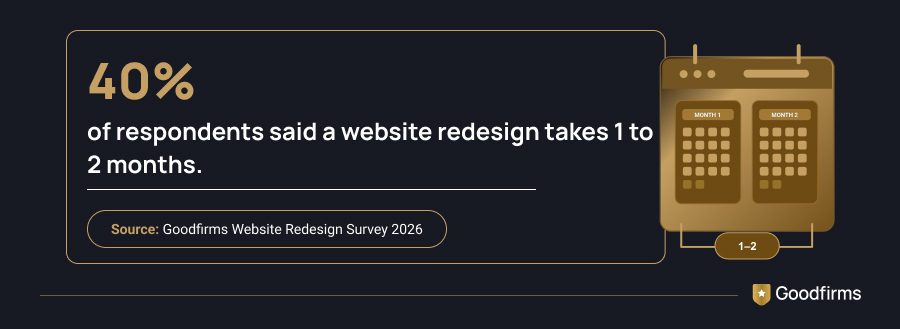
According to the responses, 95% of respondents reported launch timelines of less than five months. The remaining 5% said it takes more than 5 months to launch a redesigned website.
|
Average website redesign timeline |
Response percentage |
|---|---|
|
Under 1 month |
21% |
|
1 to 2 months |
40% |
|
3 to 4 months |
35% |
|
5 to 9 months |
5% |
Another part of the timeline deserves attention: delays.
Around 60% of respondents said fewer than 10% of their website redesign projects were delayed. That suggests many agencies manage to keep most of their projects on schedule. But the responses also reveal where delays tend to happen.
Design approvals were the most frequently identified cause of delays. Content creation and migration came next.
This is an interesting finding because neither issue is necessarily a development problem. An agency can complete its work on time and still miss the launch date if the client hasn't approved the design or supplied the required content.
Think about a redesign where the homepage design is ready, but the decision-makers haven't agreed on the final version. The development team may be unable to proceed with dependent tasks. If the delay continues, other work may need to be rescheduled as well.
Content can create a similar bottleneck. Businesses sometimes treat copywriting, image selection, and content migration as tasks to handle once the design is ready. In reality, these activities often need to run alongside design and development.
Client sign-off and changes to requirements can also affect the schedule.
For businesses planning a redesign, the learning is to treat approvals and content as part of the project, not as last-minute responsibilities. Assign owners, set deadlines, and decide who has the final say when stakeholders disagree.
Agencies have a role here, too. During the initial discussions, they should clarify what they need from the client and when they need it. This is especially important for fixed-price projects, where delays or additional rounds of work can affect the original plan.
A launch date is more realistic when everyone involved understands their responsibilities.
The Growing Role of AI in Website Redesign
AI has become part of everyday work for many design and development teams. But where is it making the biggest difference?
We asked respondents which stages of website redesign they use AI for.
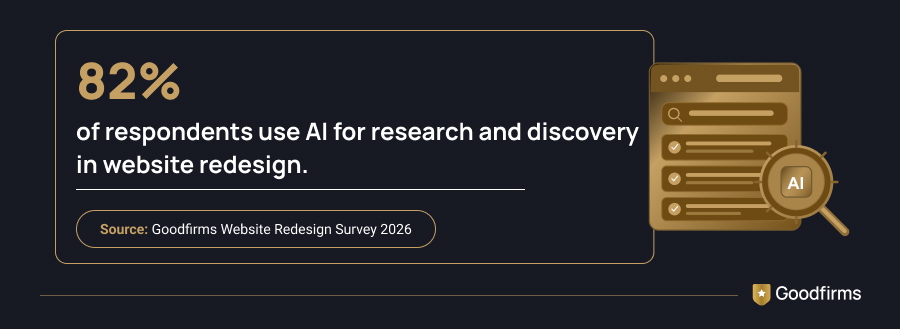
Research and discovery came out on top, followed by copywriting, front-end code, and SEO.
|
AI use case in website redesign |
Response percentage |
|---|---|
|
Research and discovery |
82% |
|
Copywriting |
63% |
|
Front-end code |
59% |
|
SEO |
53% |
|
Wireframing |
46% |
|
UI design |
47% |
|
Image generation |
41% |
|
QA and testing |
41% |
The pattern is worth noting. AI isn't being used only to generate code or produce design assets. Respondents reported using it across several stages of the process, including the work that happens before a website is built.
D’angelo Bailey described the difference AI has made to research and discovery:

That example captures a practical benefit. Research can help agencies arrive at client discussions with a better understanding of the business, its audience, and the problems the website needs to solve.
Jigna Thaker described another change. Many non-technical clients now come with surprisingly detailed design concepts, user flows, and even complete wireframes generated using AI tools. Earlier, discovery calls were focused on understanding requirements and translating them into initial wireframes. Today, AI often handles that first step, so roles have shifted from creating the initial framework to validating, refining, and implementing it in a way that aligns with real business goals, user experience, scalability, and technical feasibility. The conversation has moved from "What should we build?" to "How do we build this the right way?"
The same principle applies to AI-generated images and automated testing. The output may save time, but someone still needs to evaluate whether it meets the project's requirements.
External research points in a similar direction. WP Engine's 2026 AI Agency Trends Report found that 72% of surveyed agency professionals had adjusted their design and development practices because of AI. The report also found that 45% gave human users and AI systems equal priority when designing websites.
These findings provide useful context, although they come from a separate survey and should not be treated as a direct comparison with the Goodfirms responses.
The question now is where agencies find AI useful, and where human review still matters. It is how they decide where AI can help, where human judgment is essential, and how they ensure the finished website meets the required standard.
Does AI Make Website Redesigns Faster and Cheaper?
Respondents reported completing redesigns faster with AI, but few said they lowered their prices.
|
Estimated change in redesign time |
Share of respondents |
|---|---|
|
More than 40% faster |
30% |
|
26% to 40% faster |
28% |
|
11% to 25% faster |
24% |
The most common pricing responses were to keep fees steady and either improve margins or include more work.
|
Reported effect of AI on pricing |
Share of respondents |
|---|---|
|
Same price, better margins |
34% |
|
Same price, more scope |
32% |
|
No change in pricing yet |
16% |
|
Lowered prices |
14% |
What AI Changes Beyond Speed and Price
AI can speed up research, copywriting, and front-end coding. How much earlier a site can launch still depends on when stakeholders make decisions, approve designs, and sign off on the finished site. Some respondents also described higher expectations for revisions, which can use up some of the time saved.
The more interesting shift is what agencies can do with that time. A team that drafts copy or builds an initial layout faster may have room to explore more design options, validate assumptions from discovery, or run more thorough quality checks. For businesses comparing quotes, ask which milestones could move earlier, what additional work the same fee covers, and which deliverables the team will review manually.
The Cost That Can Show Up After Launch
Beate Öttl described reviewing a website a client had built entirely with AI in two weeks. The site performed well, but the team struggled to make routine changes independently. Even small updates meant going back to the AI tool.

Öttl’s example raises a practical question for handover. Before signing off, have your team make a routine update, confirm who will handle technical fixes, and ask what ongoing support will cost.
Website Redesign Planning Checklist
- Define what needs to improve. Record current performance and agree on how you’ll measure success after launch, such as qualified leads, conversion rates, or organic traffic.
- Audit the existing site. Identify the pages that drive traffic and leads. If URLs will change, map redirects before launch and monitor traffic and indexing afterward.
- Agree on scope before approving the quote. Specify the pages, templates, integrations, and review rounds included. Decide how additional work will be approved and priced.
- Give content and approvals their own deadlines. Assign owners for copy, migration, and design feedback, and name the person responsible for final sign-off.
- Test the handover. Have your team make a routine content update before launch and confirm who will handle changes that require technical support.