Key takeaways
- Tool subscriptions start at just $20 to $30/month, but that's only the entry point. Hosting, databases, and API costs stack on top once you move past a prototype.
- Hiring a developer for a vibe coding project ranges from $60 to $100+/hour freelance to $70,000 to $250,000+/year full-time, plus $1,500 to $4,000/year in onboarding costs most people forget to budget for.
- Getting a vibe-coded project audited and made production-ready costs $1,000 to $15,000+ depending on codebase size, still far less than the $40,000 to $400,000+ traditional custom development usually runs.
- Traditional software projects aren't more predictable either: 53% end up costing 189% of the original estimate, and 31% get canceled outright.
Vibe coding looks cheap on the pricing page. Twenty dollars a month, describe what you want, watch an app come together. But almost everyone who has actually built something this way ends up spending more than that number, and often in places they didn't expect.
This guide breaks the real cost of vibe coding into three layers: what the AI tools themselves cost, what it costs to hire a developer if you need one, and what it costs to get a vibe-coded project supported or made production-ready. Whether you're weighing the cost of vibe coding against hiring an agency outright, or just trying to budget your monthly tool spend, here's what the numbers actually show.
Explore Goodfirms' curated list of top vibe coding companies to compare services, client ratings, pricing & past projects before making your decision.
What vibe coding tools actually cost
Most vibe coding platforms combine a flat subscription with usage-based credits, and the credits are where the bill grows. A comparison of major tools found subscriptions ranging from $20 to $30 per month for entry-level plans.
Here's roughly where the major tools sit:
|
Tool |
Starting price/month |
|
AppForceStudio |
$20 |
|
Devin (Previously Windsurf) |
$20 |
|
Cursor |
$20 |
|
Bolt |
$25 |
|
v0 |
$30 |
|
Replit Agent |
$20 |
|
Lovable |
$25 |
|
Claude |
$20 |
These are the starting prices of the tools. They come with limited credits. Once used, you have to either purchase more tokens or upgrade your pan.
Why the subscription price is never the full picture
The credit or token system is the part that catches people off guard. Code is token-dense, meaning a single line of code can consume more tokens than a full sentence of plain English. So debugging and regenerating code burns through credits faster than casual chatting with an AI would.
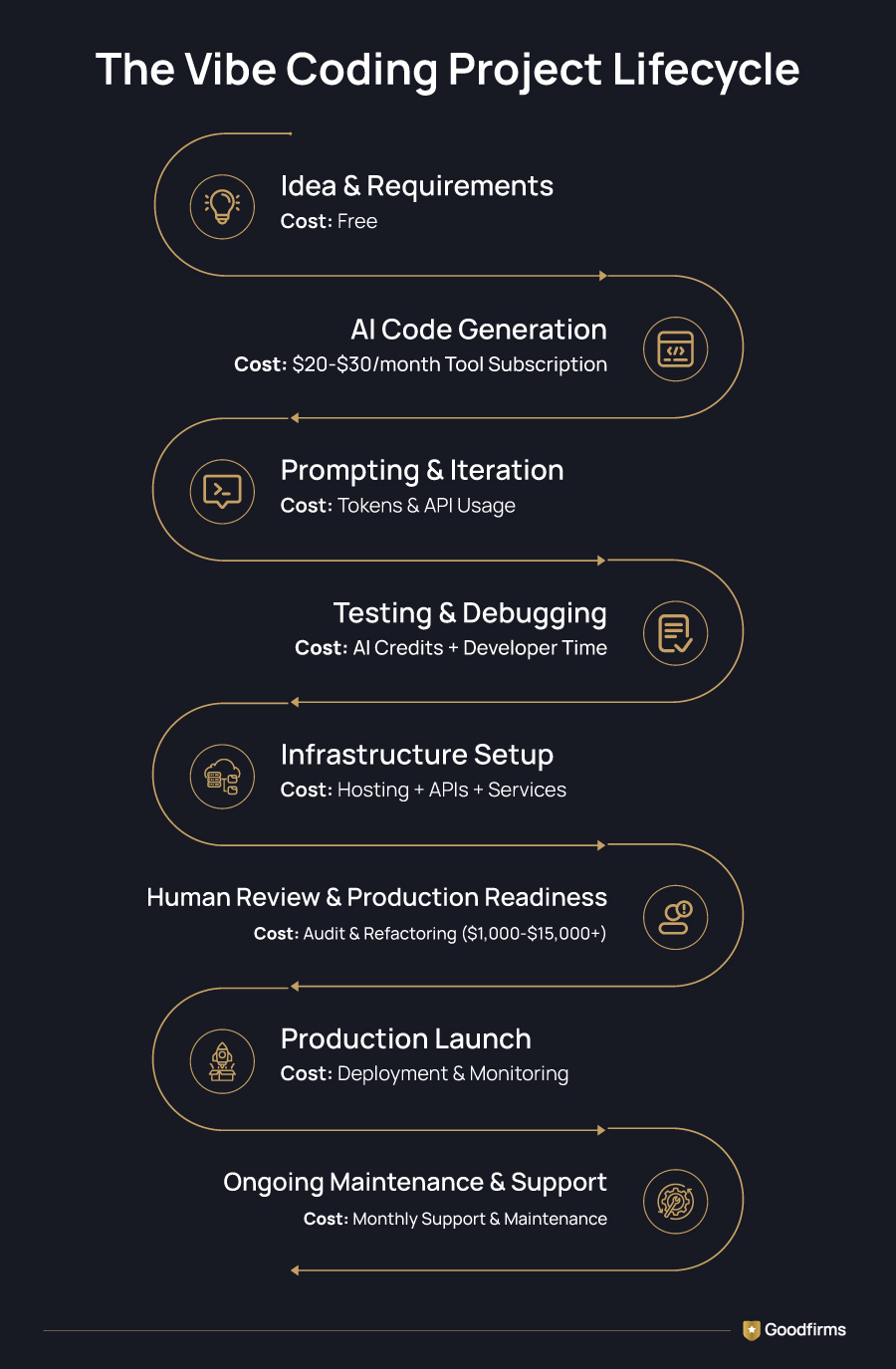
On top of platform credits, the full cost of a vibe-coded app includes hosting and backend fees, third-party API and integration costs (payments, maps, and similar services), and eventually engineering time to finish or stabilize the app once it goes past prototype stage.
There's also a technical reason agentic coding tools burn through budgets faster than expected. A single user instruction to a coding agent triggers multiple API calls behind the scenes, a planning call, one or more execution calls, and a synthesis call, meaning the effective step count can run 5 to 8 times higher than what shows up as messages in the chat window.
Cost to hire a developer for a vibe coding project
So, what does it cost to hire a developer for a vibe coding project? If you'd rather not manage the tools and iteration yourself, hiring someone changes the cost structure entirely. Rates vary a lot by engagement model and region.
Freelance and agency hourly rates:
Expect a $20+ hourly rate from Asian developers. $60 to $100+/hour on freelance marketplaces with Eastern Europe and Latin America-based developers running $75 to $95/hour.
Full-time salary ranges, for context, if you are building an internal team rather than contracting:
Entry-level (1-2 years): $70,000 to $100,000/year
Mid-level: $100,000 to $150,000/year
Senior: $150,000 to $250,000+/year
Source: Vibecodecareers
Beyond the hourly or salary rate, there are two costs worth budgeting for separately. First, onboarding a vibe coding developer to your specific product, tools, and workflow runs $1,500 to $4,000 per developer annually on top of their pay.
Second, AI-generated code that's ready for an MVP demo often needs post-build cleanup before it's truly production-ready, which the same source estimates adds 20 to 30% to total project cost.
For comparison, traditional custom development from an agency, for an app of similar complexity to a small SaaS product, has been informally estimated at $100,000 or more by at least one experienced builder who has priced both routes.
Source: dannorris.me
That figure is his own ballpark from industry conversations rather than a published rate card, so treat it as directional, not a quote you can take to a vendor.
If you want to see how these two approaches stack up beyond just price, from speed to code ownership to long-term maintenance, Goodfirms' blog on vibe coding vs traditional coding comparison breaks it down.
Vibe coding project support services cost
This is the cost layer most people don't think about until they're already stuck: what it costs to get a vibe-coded project reviewed, fixed, or made production-ready by an experienced developer or agency.
Code audits
A professional code audit, where developers review your codebase for security issues, structural problems, and scalability risks, generally runs:
Small projects (under 20k lines of code): $1,000 to $5,000
Medium projects (20k to 100k lines): $5,000 to $15,000
Large or enterprise systems: $15k or more
Pricing depends on codebase size, how many integrations and dependencies are involved, and whether the audit needs to cover compliance requirements like healthcare or financial data handling, which extends the hours needed.
Fix and refactor work
On freelance platforms, this is increasingly sold as a packaged service rather than open-ended hourly billing. One example structures the engagement in tiers: a starter package covering a full audit and written diagnosis, a standard package adding up to three priority fixes, and an advanced package adding up to seven fixes including refactoring and security hardening, all fixed-price and scoped after the initial audit.
Ongoing support
If you are keeping a development tool subscription active alongside human oversight, teams, mixing inline AI suggestions with agentic coding tools, report a total cost of $200 to $600 per developer per month once seat and token spend are combined.
The pattern across all of these sources is the same: catching problems early, before a vibe-coded app has real users and accumulated months of untested changes, keeps the support cost closer to the audit end of the range. Waiting until something breaks in production pushes it toward the refactor or rebuild end, which costs more in both money and downtime.
Go through the vibe coding service guide on Goodfirms for a detailed and real understanding before you budget a single dollar.
How to keep vibe coding costs under control
A few practical habits make a real difference in the final bill:
- Match the model to the task. Not every step needs your most expensive model tier. Simple tasks handled by a mid-tier model can deliver comparable results at a fraction of the cost of top-tier models for routine work.
- Compact your context regularly. Tools like Claude Code include a compact command that summarizes project state instead of carrying full conversation history forward, which keeps token costs from compounding as a session grows.
- Use cheaper tools for planning. Save platform credits for actual code generation, and use subscription or free-tier chat tools for framework questions and planning work instead.
- Know when to bring in a human. The moment a prototype needs to handle real users, real payments, or real data, the cost of a professional audit is usually smaller than the cost of the problems an unreviewed AI-generated codebase can create.
- Consider lower-cost model providers for routine work. Some builders report running a full agentic coding workflow, including coding plans, API usage, and MCP servers, for under $10/month by using lower-cost model providers instead of premium ones for everyday tasks.
- Use a daily credit budget instead of unlimited pay-as-you-go. A fixed daily allowance that resets each day encourages more deliberate prompting, since vague instructions that burn through credits become a visible, immediate cost rather than a surprise at the end of the month.
FAQs - Vibe Coding Cost
Is vibe coding cheaper than hiring a developer?
For an early prototype, usually yes. A tool subscription runs $20 to $50/month against thousands of dollars for a freelance build. But the gap narrows once a project needs to go live. Post-build cleanup alone can add 20 to 30% to total project cost, and a professional code audit for even a small project runs $1,000 to $5,000.
What's the cheapest way to vibe code?
Builders who have optimized aggressively report running a full workflow, coding plans, API usage, and MCP servers included, for under $10/month by choosing lower-cost model providers over premium ones for routine tasks.
Do I need a developer if I'm vibe coding?
Not necessarily for a prototype or internal tool. But once real users, payments, or customer data are involved, a professional review becomes worth the cost. A code audit's scope and price depend on the codebase size and whether compliance requirements apply.
How much does it cost to fix a vibe-coded app after it's built?
This is increasingly sold as fixed-price packages rather than open hourly billing, starting with an audit and written diagnosis, then scaling up to include a set number of priority fixes or a full refactor with security hardening. If you're keeping ongoing human oversight alongside AI tools, expect a combined seat-plus-token cost of $200 to $600 per developer per month.
How much does coding cost the traditional way, compared to vibe coding?
Traditional custom software development runs far higher than vibe coding tool costs. Estimates put custom mobile app development at $40,000 to $400,000+, with 6 to 12 month timelines. Traditional projects also carry real overrun risk: research found that 53% of custom software projects end up costing 189% of the original estimate, and organizations cancel 31% of build projects outright. That unpredictability is a big part of why vibe coding and no-code tools have gained ground for early-stage builds.
Is vibe coding cheaper than no-code platforms?
It depends on what you're building. Vibe coding tools cost $20 to $30/month, but production apps often need hosting ($20 to $30/month) and a managed database ($25 to $30/month) on top, since most vibe coding platforms don't include these.
What You're Actually Paying For
Vibe coding rarely costs what the pricing page says. Between platform credits, hosting, hiring help, and eventually getting a project reviewed or made production-ready, the real number is almost always higher than the $20/month headline. Knowing which layer you are actually paying for, tool cost, developer cost, or support cost, makes it much easier to budget for the project you are actually building rather than the one the marketing page describes.
If you are at the point where your vibe-coded project needs a professional audit or a development team to take it the rest of the way, Goodfirms' directory of vetted software development agencies is a good place to compare options and read verified client reviews before you commit budget.