Key takeaways
- A small checkout change reportedly added $300 million in sales, showing how removing one point of friction can directly affect revenue.
- Forrester Research suggests that improving interface design can increase conversions by up to 200%, while better customer experiences can increase them by up to 400%.
- Poor experiences can quickly affect customer behavior, with 88% of users unlikely to return after a bad website experience and 32% saying they would leave a brand they love after one negative experience.
- The ROI of UX goes beyond revenue. Better experiences can also reduce support costs, development rework, errors, and customer drop-offs while improving retention and productivity.
- The most useful way to measure UX ROI is to connect changes in user behavior with business outcomes such as revenue, retention, cost savings, or productivity.
A button changed the way customers checked out and reportedly added $300 million in sales. That may sound like a marketing success story. But it was actually a UX decision.
The lesson is simple: UX does not always need a dramatic redesign to affect the bottom line. Sometimes, removing one small point of friction is enough to change what users do next.
But knowing that UX matters and proving its financial value are two different things. How much does a better experience really contribute to revenue? Where do the savings come from? And how can businesses measure the return?
This guide breaks down the ROI of UX, from conversions and retention to cost savings, measurement, and long-term business value.
Looking to turn UX investment into measurable results? Explore top UI/UX design agencies listed by Goodfirms to find the right expertise for your next project.
What is the ROI of UX?
Imagine a customer landing on your website, finding exactly what they need, and completing the purchase without a second thought. That smooth experience keeps people longer and does far more than just make the customer happy; it can directly affect your bottom line.
That is where the ROI of UX comes in. It looks at the business value created by better user experiences, from higher conversions and retention to fewer support costs and less friction throughout the customer journey, making it a perfect choice for customers while increasing the range of return on investment for companies from $5 to $100.
Where Does UX Create Business Value?
A customer abandons checkout because the form is too complicated. Another leaves an app because they cannot figure out how to use it. These may seem like minor design issues, but they can quickly lead to lost revenue and customers.
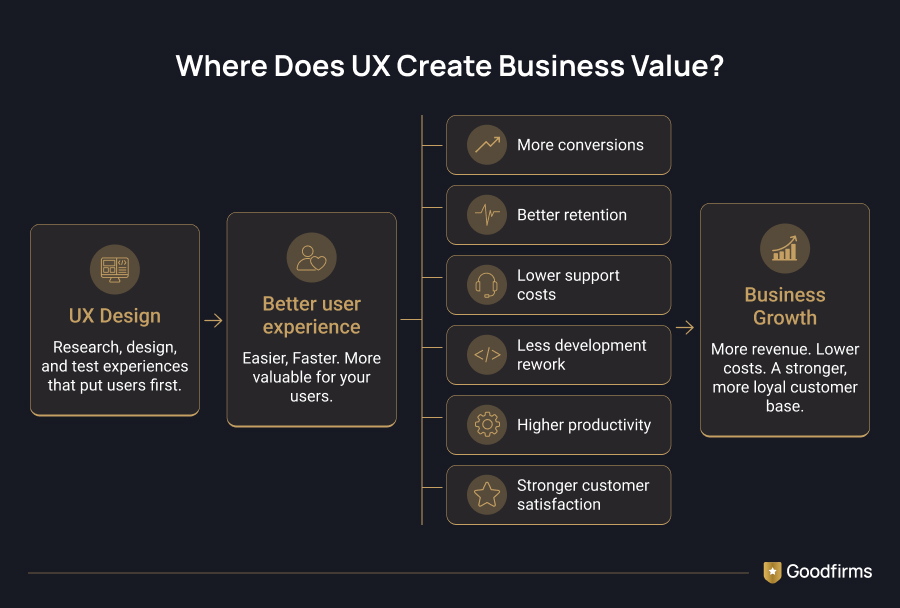
That is where the business value of UX becomes clear. Better UX removes friction from the customer journey, making it easier for people to buy, return, and get value from the product, and can influence several outcomes that directly affect business growth.
More Conversions and Revenue
Sometimes, a small UX change can have a big commercial impact. One well-known example is an e-commerce retailer that replaced its “Register” button with “Continue,” allowing customers to check out without creating an account. The change reportedly generated $300 million in additional sales. It clearly signifies that when customers encounter fewer obstacles, they are more likely to complete the journey. For businesses, a simpler process can lead to a better conversion rate.
Research cited by Forrester also suggests that improving interface design can increase conversions by up to 200%, while improving the customer experience can increase them by up to 400%.
Better Retention and Satisfaction
UX plays an important role in customer behavior and affects what happens after the first conversion. 88% of users are unlikely to revisit a website after one bad interaction or experience. Moreover, according to PwC data, 32% of customers would stop doing business with a brand they love after a single negative experience.
A smoother onboarding process, simpler navigation, and fewer usability issues can therefore support customer retention, loyalty, and satisfaction, making UX a prime factor that can influence way more than immediate sales.
Lower Costs and Better Efficiency
UX can create value by preventing problems before they become expensive for businesses. Top usability testing companies can help identify confusing workflows early, reducing rework, support requests, and development costs. Otherwise, if users can’t understand an interface, they turn to customer support.
Investing in UX is not only about generating more revenue. It can also reduce avoidable support costs, rework, and development waste. UX design’s business impact is far-reaching, driving higher conversions, stronger retention, lower costs, and a better customer experience, all of which contribute to measurable business growth.
Which UX Metrics Actually Prove Business Impact?
A higher usability score sounds good to every business owner. So does a faster task-completion time. But what happens when the business asks, “Did any of this actually improve revenue?”
That is where choosing the right UX metrics matters. The strongest metrics connect what users do with what the business cares about. Nielsen Norman Group recommends measuring UX changes against business outcomes and has analyzed 44 real-world case studies showing how UX metrics can demonstrate business value.
Here are the metrics worth watching that truly prove business value:
|
UX metric |
What does it tell you |
Business impact |
|---|---|---|
|
Task success rate |
Can users complete an important task? |
Fewer failed journeys and support requests |
|
Time on task |
How quickly can users complete it? |
Greater efficiency and lower effort |
|
Error rate |
Where are users getting stuck? |
Less rework, support cost, and abandonment |
|
Conversion rate |
Are more users completing a desired action? |
More leads or revenue |
|
Retention/churn |
Are users coming back? |
Stronger customer lifetime value |
|
CSAT/NPS |
How do users perceive the experience? |
Better satisfaction and loyalty |
One of the most essential parts is connecting the metrics. Even a 20% improvement in task success is sometimes considered useful, but it becomes much more meaningful when it also leads to fewer support tickets or higher conversions. Likewise, a lower time on task is not automatically better as it depends on the task.
So, rather than tracking every number available, choose 2-4 UX metrics that map directly to your business goals. The goal isn't to prove that UX changed a score. It is to show what that change meant for the business.
How to Measure UX ROI: A Practical Framework
A smoother experience is valuable, but proving its ROI (Return on Investment) requires more than showing that users liked the redesign. You need to connect the UX improvement to a business result and show what changed. A practical framework given below can help you do that.
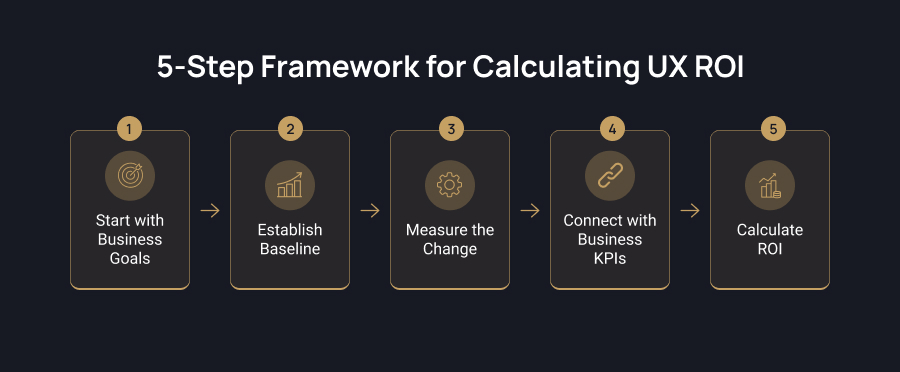
1. Start With a Business Goal
Begin with the outcome you want UX to influence for your brand. It could be a higher conversion rate, better customer retention, fewer support requests, or greater employee productivity.
This gives your UX metrics a clear purpose, rather than measuring numbers simply because they are easy to collect. Also, it’s comparatively easy to achieve a goal that is clearly specified rather than an ambiguous one.
2. Establish a Baseline
Measure the existing experience before making changes. Depending on the project, this might include task success rate, completion time, error rate, conversion rate, churn rate, or number of support tickets.
Nielsen Norman Group recommends benchmarking before and after a design change, and its latest research analyzed 44 real-world UX case studies to examine how these metrics can demonstrate business value. As an estimated baseline, help businesses identify the impact that the UX design change had on the business.
3. Implement and Measure the Change
Once the new experience is live, measure the same indicators again. For example, if checkout completion increases from 62% to 70%, you have evidence that the experience improved. But don't stop there. The next step is understanding what that improvement means financially.
4. Connect UX Metrics to Business KPIs
Translate the UX result into a metric the wider business already understands. A reduction in support tickets can lead to cost savings by reducing the need for additional developers. Higher task completion can translate into productivity gains, while better conversion can translate into additional revenue.
Nielsen Norman Group describes this as converting a UX metric into a business KPI, the key step that turns UX evidence into an ROI case.
5. Calculate the Return
Once the business benefit and UX investment are known, use:
UX ROI = (Business benefit − UX investment) ÷ UX investment × 100
For example, a $10,000 redesign that generates $50,000 in measurable business value produces a 400% ROI.
Treat the result as an evidence-based estimate, not a guaranteed financial forecast. UX ROI calculations can involve assumptions, so being transparent about how the numbers were derived makes the business case more credible.
What Does a Strong UX ROI Strategy Look Like?
A strong UX ROI strategy is simple at heart. Ensure you put design effort where customers really struggle, test your fixes before you build them, and report the results in money terms. The math matters, but where you aim your effort determines how big the return is. Here are five tactics that do most of the work.
Fix the Biggest Problem First
Find the step where customers quit, then start there. Checkout is a good example. Baymard Institute puts the average cart abandonment rate at 70.22% and estimates that better checkout design could lift conversion by 35.26% for the average large e-commerce site. Sign-up and onboarding flows leak in much the same way.
Test Before You Build
Show a rough prototype to a few real users. You will spot confusing steps in days instead of months. In Goodfirms' 2025 survey of 411 businesses, 91.2% rated pre-launch UX testing as extremely important. Fixing a problem on a prototype costs a few hours. Fixing it after launch costs engineering time and customers.
Track Results in Money Terms
Task success and satisfaction scores show the experience got better. Conversion rate, churn, and support costs show the business did too. Look at them together. More teams are doing this now. Maze's 2026 research found that the share tracking KPIs or OKRs to measure research impact grew from 43% in 2025 to 56% in 2026.
Make It Accessible
It is cheaper to build accessibility in than to patch it later. The European Accessibility Act, which sets accessibility rules for many consumer products and services, has applied since 28 June 2025. Planning for it early also means more people can use what you build.
Review Every Quarter
Compare the numbers against where you started and put the gain in dollars. Drop what is not working and move that budget to what is. This keeps your UX investment tied to business growth.
Why the ROI of UX Is Difficult to Prove
A better UX may increase conversions, but can you prove the redesign caused the increase? That is where measuring the ROI of UX gets tricky.
UX rarely works in isolation. Pricing, marketing campaigns, product changes, and market conditions can influence the same business metrics. Some benefits, such as improved customer satisfaction or loyalty, also take longer to translate into revenue.
There is another challenge: UX metrics and business KPIs don't always speak the same language. A higher task-success rate is useful, but leadership may want to know what it means for revenue, retention, or costs.
The answer is not perfect attribution but consistent measurement, clear baselines, and a credible link between UX improvements and business outcomes.
How does UX ROI Change Over Time?
The ROI of UX is not always immediate. Its value can grow as users adopt the improved experience and the business starts to see the broader effects.
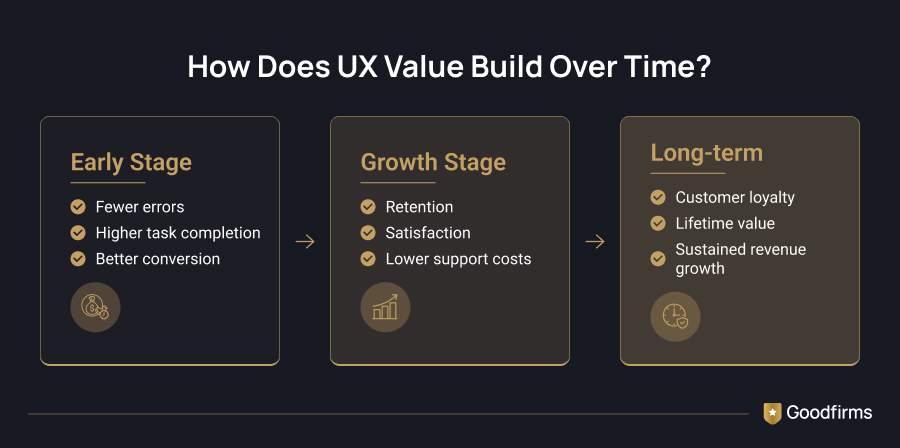
- Early stage: The first gains usually appear in user behavior. You may see fewer errors, higher task completion rates, better conversion rates, or fewer drop-offs.
- Growth stage: As more users experience the improved journey, the impact can extend to customer retention, satisfaction, and support costs. Fewer usability problems can also reduce the need for ongoing fixes and assistance.
- Long-term: The biggest returns can come from stronger customer loyalty, higher customer lifetime value, improved productivity, and sustained revenue growth. These benefits are harder to attribute to one UX change, but they can compound over time.
This is why UX ROI should be measured at multiple points rather than judged immediately after launch. A redesign that delivers a modest initial gain may create significantly greater business value of UX as its effects accumulate.
How to Present UX ROI to Stakeholders?
Lead with the numbers leaders already track, such as revenue, churn, and support costs, and show how UX moved them. NN/g's State of UX 2026 notes that leaders are pushing for clearer proof that design affects the bottom line.
- Start With the Cost of Doing Nothing: Show what the weak experience costs today. In Qualtrics' Q3 2025 survey of 20,000+ consumers, 47% of bad experiences led people to cut spending, putting nearly $3 trillion of 2026 sales at risk.
- Compare Today With the Goal: Say your checkout converts at 3.0% and a $40,000 redesign could lift it to 3.5%. On 100,000 monthly visits, a $60 average order, and a 25% margin, that is about $90,000 in extra profit a year, a 125% return. (These figures are illustrative.)
- Test Small, Then Ask: Run an A/B test on one flow, then request the full budget with real results in hand.
The Future of UX ROI: From Design Metric to Business Intelligence
The future of UX ROI is moving beyond isolated design metrics toward a broader view of business intelligence. Instead of reporting task success, usability scores, or conversion rates separately, UX teams can connect these signals to revenue, retention, customer lifetime value, and operational costs.
This makes UX data more useful for business decisions, not just design reviews. As companies collect more behavioral and customer data, they can also identify patterns earlier for example, where friction is causing users to abandon a journey or where a product improvement is increasing retention.
The result is a more continuous approach to measuring the business value of UX. UX investment will increasingly be evaluated alongside other growth initiatives, using measurable evidence rather than assumptions.
For businesses, that shift matters: UX stops being viewed as a one-time design expense and becomes an ongoing source of insight into what customers need, where they struggle, and what changes can create measurable business growth.
How to Choose a UX Partner Who Delivers ROI?
The right UX partner should do more than improve how a product looks or feels. If you plan to hire UI/UX designers, look for a team that understands the business problem behind the design and connects its recommendations to measurable outcomes. Before choosing a partner, look for:
- Business-first thinking: Does the team understand your goals, customers, and conversion challenges before proposing design solutions?
- Evidence-based process: Look for partners that use user research, usability testing, analytics, and behavioral data rather than relying on assumptions.
- Relevant experience: Review case studies for measurable results such as higher conversions, better retention, reduced drop-offs, or lower support costs not just attractive interfaces.
- Clear measurement framework: Ask how they will define and track UX success before the project begins. A good partner should identify the metrics that matter to your business.
- Post-launch support: UX improvements often need iteration. Choose a partner willing to test, learn, and refine the experience after launch.
The best UX partner isn't the one with the most impressive portfolio. It's the one that can show how better experiences translated into better business results.
FAQs - ROI of UX
Is UX design worth the investment?
Yes, but the return depends on what the UX investment is intended to improve. Better UX can contribute to higher conversions, stronger retention, fewer support requests, reduced development rework, and improved operational efficiency. Instead of relying on a universal ROI benchmark, businesses should compare the cost of UX work with the specific revenue gains or cost savings it generates.
What is a good ROI for a UX redesign?
There is no universal benchmark for a good UX redesign ROI because projects differ in scope, objectives, and business model. A redesign focused on increasing conversions may measure additional revenue, while an enterprise product may measure reduced support costs or faster task completion. The most useful benchmark is the return against the original business goal and UX investment.
How much does UX design cost compared with its potential ROI?
UX design can cost anywhere from $6,000 to $200,000+, depending on project complexity, scope, and expertise. The potential ROI can be significant: Forrester research has cited a return of $100 for every $1 invested in UX. However, actual returns vary by project and may come through higher conversions, better retention, lower support costs, and reduced development rework.
How can I justify a UX budget to business stakeholders?
A UX budget is easier to justify when the conversation moves from design deliverables to business outcomes. Instead of presenting the number of screens or design hours, connect the investment to measurable goals such as increasing conversions, reducing churn, lowering support costs, or avoiding expensive rework. Baseline data and post-launch results can make the business case more credible.
What is the 1-10-100 rule in UX design?
The 1-10-100 rule is a commonly cited UX principle suggesting that usability problems become increasingly expensive to fix as they move from the design stage to development and then to post-launch. It is often used to explain the financial value of identifying usability issues early. However, it should be treated as a rule of thumb rather than a universal cost formula.
Final Words
Good UX rarely announces its value with a big number. It shows up quietly in fewer abandoned journeys, more completed purchases, happier customers, and fewer problems for teams to fix.
That is why the ROI of UX should be treated as an ongoing business metric rather than a one-time calculation. The right UX investment connects customer needs with measurable business outcomes.
If you’re ready to turn better experiences into business growth, exploring top web design companies can help you find teams that bring design, usability, and business goals together.