Key takeaways
- Unregulated operators accounted for an estimated 72% of EU online gambling GGR in 2025, making compliance a critical priority for licensed platforms.
- Rising regulatory scrutiny means iGaming operators must move beyond basic licensing and build compliance into everyday platform operations.
- Eight core compliance capabilities, including KYC, AML monitoring, sanctions screening, responsible gambling tools, geolocation, data security, regulatory reporting, and API integration.
- Automating player verification, transaction monitoring, and suspicious activity reporting helps operators identify risks earlier and reduce manual compliance efforts.
- Selecting the right iGaming compliance technology requires evaluating regulatory coverage, API compatibility, data security, scalability, and vendor support.
- Continuous monitoring, adaptable controls, and transparent audit trails help iGaming businesses stay prepared for evolving regulations and protect player trust.
A gambling platform can be technically perfect and still run into trouble if its compliance controls fail. A missed identity check, an unflagged transaction, or access from a restricted market can put an operator's license and reputation at risk. This makes iGaming compliance a critical part of platform planning, particularly for businesses operating across multiple jurisdictions.
The challenge is significant: a 2025 estimate by European Gaming Compliance International found that unregulated operators accounted for 72% of online gambling gross gaming revenue across the EU. The figure highlights the scale of the regulatory challenge and the need for stronger oversight.
This guide examines the compliance capabilities, integrations, and technology decisions operators need to consider. It also explores the iGaming & Casino Platform Recipe (Fiat + Crypto) for a closer look at the platform foundations behind modern gaming operations.
Understanding iGaming Compliance in 2026
iGaming compliance involves meeting the legal and regulatory requirements for operating online casinos, sportsbooks, and other gambling platforms. In 2026, these requirements extend beyond licensing to cover player verification, anti-money laundering (AML), responsible gambling, payment monitoring, and data protection.
The need for stronger safeguards is evident from the industry's growth. According to the UK Gambling Commission, Great Britain's remote gambling sector generated £8.3 billion in gross gambling yield between April 2025 and March 2026, a 6.9% year-on-year increase.
For platform operators, meeting these requirements means having the right compliance tools built into their technology stack. When comparing the best iGaming platforms, operators should look beyond gaming features and evaluate built-in support for KYC verification, transaction monitoring, sanctions screening, and regulatory reporting. The specific requirements vary by jurisdiction, making it important to choose solutions that support the markets where an operator holds a license.
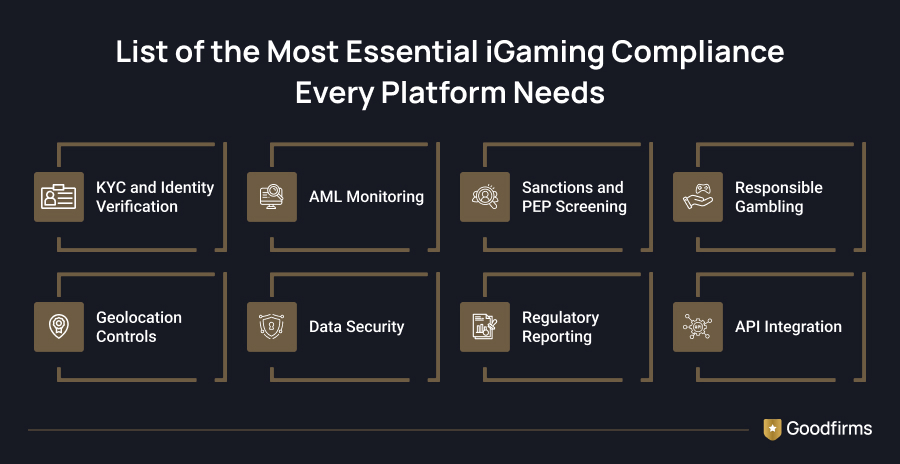
8 iGaming Compliance Capabilities to Evaluate Every iGaming Platform Needs
Meeting iGaming compliance requirements takes more than a license and a set of internal policies. Platform operators need systems that can verify players, flag suspicious transactions, restrict access where required, and maintain records for regulatory checks. The following eight capabilities cover the key areas that should be considered when building or upgrading an iGaming platform.
KYC and Player Identity Verification
KYC (Know Your Customer) is the first step in establishing whether a player is eligible to use a gaming platform. An iGaming platform should support identity and age verification during registration, using reliable documents or electronic verification services. Depending on the player's risk profile and jurisdiction, checks may also include proof of address, source of funds, and enhanced due diligence (EDD).
The UK Gambling Commission requires casino operators to identify customers and verify their identities using reliable, independent sources. For platform operators, integrating iGaming identity verification tools helps automate these checks, reduce manual reviews, and prevent underage or fraudulent accounts from accessing gaming services.
Operators evaluating verification tools can also explore the best KYC software to compare solutions for identity verification, document checks, and customer onboarding.
AML Monitoring and Financial Crime Prevention
AML controls help operators identify transactions that may involve money laundering or other financial crimes. These checks should continue after onboarding, particularly when players deposit, withdraw, or move funds between payment methods.
An effective iGaming AML setup should include:
- Real-time transaction monitoring to flag unusual deposits and withdrawals.
- Risk scoring based on transaction patterns and player activity.
- Alerts for suspicious activity, including multiple small transactions or mismatched payment details.
- Case management and records to support investigations and suspicious activity reporting.
This is an area receiving increased regulatory attention. In July 2026, the UK Gambling Commission rated remote casino, betting, and bingo activities as high risk for money laundering. It also raised the risk rating for gambling software from low to medium.
The FATF's September 2026 report, drawing on contributions from more than 80 jurisdictions, also highlighted risks such as multiple accounts, unusual payment patterns, and transactions designed to avoid detection.
To evaluate available monitoring and risk assessment tools, operators can explore top AML software and compare solutions that support transaction monitoring, risk scoring, and suspicious activity detection.
Sanctions and PEP Screening
Identity verification alone does not establish whether a player or business is associated with financial crime risks. Platforms also need screening processes to identify individuals on sanctions lists and politically exposed persons (PEPs).
An iGaming compliance software solution should support checks against relevant domestic and international sanctions lists, PEP databases, and other risk sources. Screening should take place during onboarding and, where required, continue throughout the customer relationship as lists and risk profiles change.
If a potential match appears, the system should flag it for review rather than automatically treating every match as confirmed. This helps compliance teams investigate the result and take action according to applicable regulations.
Responsible Gambling and Player Protection
Responsible gambling is not just a player-facing feature. It is an important part of iGaming regulatory compliance, and platforms need tools that help operators identify risky behavior and intervene when necessary.
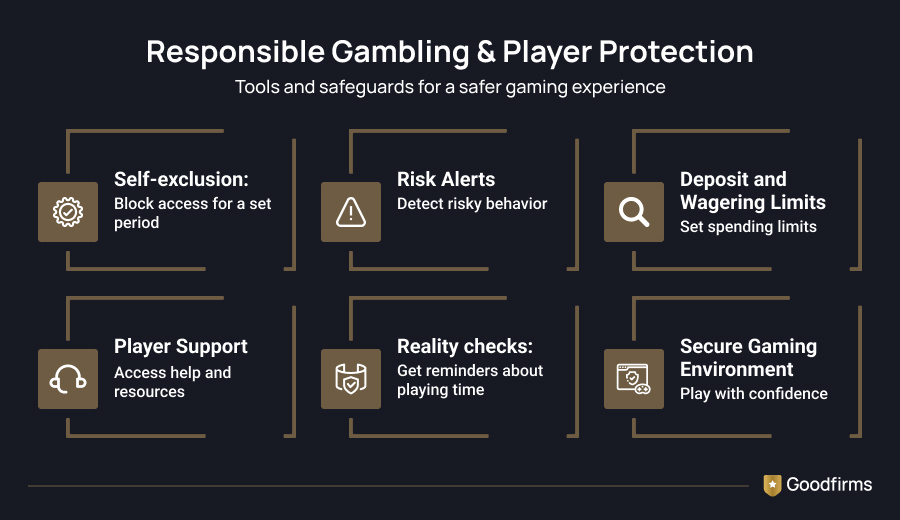
Key features should include:
- Self-exclusion: Allow players to block themselves from accessing gaming services for a selected period.
- Deposit and wagering limits: Let players set limits on how much they can deposit or wager.
- Reality checks: Display reminders about playing time and spending.
- Risk alerts: Flag behavioral changes, such as frequent deposits, increased wagering, or repeated withdrawal cancellations.
For example, the Malta Gaming Authority requires licensed operators to provide player protection tools, including self-exclusion and deposit or wagering limits. These controls should be accessible within the platform rather than managed through separate manual processes.
Geolocation and Market-Based Access Controls
Gambling laws differ across countries and even between regions within the same country. A platform that accepts players from multiple markets must be able to identify their location and apply the relevant access restrictions.
Geolocation tools can verify a player's location using IP addresses, GPS signals, and device information. Platforms can also use VPN and proxy detection to identify attempts to bypass location restrictions. Based on the result, the system should allow, restrict, or block access according to the operator's licensing conditions.
This is particularly important for operators offering online casino software and sportsbook software across multiple jurisdictions, where a single access policy may not meet every market's requirements.
Data Security and Privacy Management
iGaming platforms collect sensitive player information, including identity documents, addresses, payment details, and transaction histories. Poor data handling can expose this information to fraud, breaches, and regulatory penalties.
A reliable platform should include:
- Encryption for player information during storage and transmission.
- Role-based access controls to restrict who can view sensitive records.
- Secure storage of identity documents and verification results.
- Data retention and deletion policies that follow applicable privacy laws.
- Audit logs to track access to and changes in important records.
These safeguards should be part of the platform's core infrastructure. Operators must also ensure that third-party KYC, payment, and compliance providers follow appropriate data protection practices.
Operators looking to strengthen their platform security can also explore top cybersecurity companies for expertise in application security, vulnerability assessments, and data protection.
Regulatory Reporting and Audit Readiness
Compliance teams need to demonstrate that required checks were performed and that suspicious activities or player protection concerns were handled appropriately. This makes recordkeeping and reporting essential parts of an iGaming compliance platform.
Useful capabilities include automated regulatory reports, timestamped records of player verification, transaction histories, investigation logs, and records of responsible gambling interactions. Dashboards can also help compliance teams track pending reviews, flagged transactions, and unresolved alerts.
Instead of collecting information from multiple systems whenever a regulator requests it, operators should have a centralized record of relevant compliance activities. Reporting requirements will vary by licensing jurisdiction, so platforms should support configurable reporting and documentation workflows.
API Integration and Compliance Automation
Most operators rely on external providers for identity verification, payment processing, fraud detection, and AML screening. A platform should connect these services through secure APIs so that information can move between systems without repeated manual entry.
For example, when a new player registers, the platform can send their details to a KYC provider, receive the verification result, and update the player's account status. Similarly, payment activity can trigger AML checks, while suspicious transactions can generate alerts for the compliance team.
Since payment processing is closely connected to transaction monitoring and fraud prevention, operators can also explore top payment gateway development companies when evaluating secure payment integrations for their platforms.
When evaluating iGaming compliance solutions, operators should look for flexible APIs, reliable data exchange, clear error handling, and integration with existing platform systems. Good automation tools for iGaming compliance can reduce repetitive work and help teams respond to potential risks faster. However, automated decisions should still allow human review wherever the applicable rules or risk involved require it.
How to Build Compliance Into Your iGaming Platform Stack
Building compliance into iGaming platform development requires more than adding individual verification tools. Operators need connected systems that support regulatory requirements throughout the player journey. Here are five practical steps:
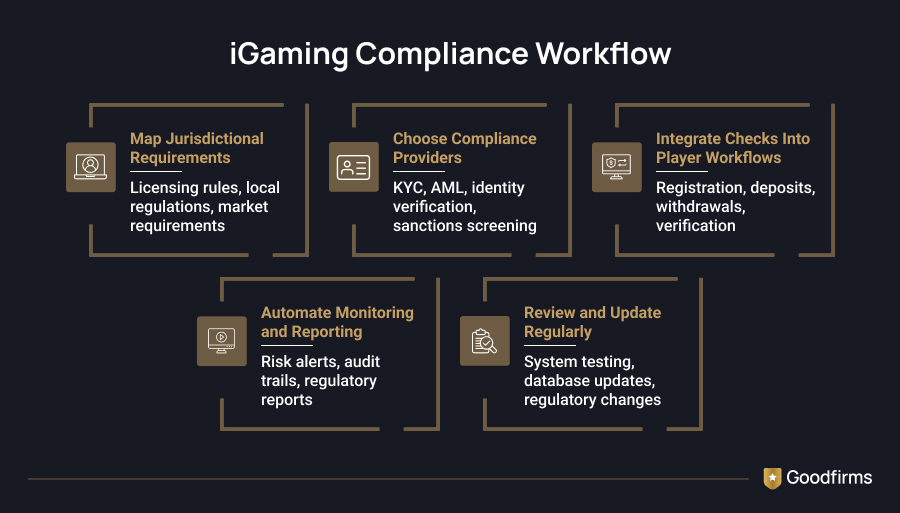
- Map jurisdictional requirements: Identify the licensing conditions and iGaming compliance requirements for each target market before selecting your technology.
- Choose the right compliance providers: Evaluate KYC, AML, identity verification, and sanctions screening tools based on their accuracy, coverage, and reliability.
- Integrate checks into player workflows: Add verification during registration, transaction monitoring during deposits and withdrawals, and responsible gambling controls within player accounts.
- Automate monitoring and reporting: Use iGaming compliance software to flag suspicious activities, generate alerts, maintain audit trails, and simplify regulatory reporting.
- Review and update regularly: Test integrations, monitor false positives, update screening databases, and adjust compliance workflows when regulations change.
A well-integrated iGaming compliance platform helps operators manage these responsibilities without relying on disconnected systems or excessive manual checks.
Common iGaming Compliance Challenges Platform Operators Face
Even with the right tools in place, maintaining iGaming compliance can be difficult. Operators often face challenges when managing multiple markets, integrating third-party solutions, and keeping up with changing regulatory requirements.
Managing Different Jurisdictional Requirements
Each market has its own licensing conditions, KYC procedures, AML obligations, and responsible gambling regulations. Operators running across multiple regions may need different compliance workflows for each jurisdiction, making standardization difficult.
Balancing Player Experience With Verification
Strict KYC and identity verification checks can slow down registration and frustrate players. Operators need reliable verification tools that meet regulatory requirements without creating unnecessary delays during onboarding and withdrawals.
Handling False Positives in AML Monitoring
Transaction monitoring systems can flag legitimate payments as suspicious, increasing the workload for compliance teams. Without proper risk scoring and screening rules, investigating these alerts can consume time and delay genuine transactions.
Integrating Third-Party Compliance Solutions
Connecting KYC providers, AML screening tools, payment gateways, and other services can create technical challenges. Poor API integration may lead to inconsistent records, duplicated checks, or gaps in compliance monitoring.
Keeping Up With Changing Regulations
Regulatory requirements, sanctions lists, and reporting obligations can change over time. Operators need to regularly update their iGaming compliance software, internal policies, and platform workflows to avoid falling behind new requirements.
How to Choose the Right iGaming Compliance Technology
Choosing the right iGaming compliance technology requires more than comparing software features. Operators should consider how well a solution supports their licensing requirements, existing platform infrastructure, and future expansion plans. Here are five factors to evaluate:
- Regulatory Coverage: Check whether the solution supports the jurisdictions where you operate. It should accommodate local KYC, AML, reporting, and responsible gambling requirements.
- Integration Capabilities: Look for flexible APIs that connect with existing payment gateways, identity verification providers, CRM systems, and online casino software without disrupting operations.
- Automation and Monitoring: Choose iGaming compliance software that supports automated identity checks, transaction monitoring, sanctions screening, and suspicious activity alerts.
- Data Security and Audit Trails: Evaluate encryption, access controls, data retention policies, and audit logs. These features help protect sensitive player information and support regulatory audits.
- Scalability and Vendor Support: Choose a provider that can handle growing transaction volumes, multiple markets, and changing compliance requirements. Reliable technical support and regular software updates are equally important.
The right iGaming compliance solutions should fit into your existing technology stack while giving your compliance team the tools to manage regulatory responsibilities efficiently.
The Future of iGaming Compliance: What to Expect Beyond 2026
iGaming compliance is likely to become more data-driven, automated, and closely connected to everyday platform operations. As regulators strengthen their oversight, operators will need systems that can identify risks continuously rather than rely only on periodic checks and manual reviews. A few developments are worth watching:
Greater Use of AI in Compliance Monitoring
AI-powered tools will play a bigger role in identifying suspicious transactions, unusual betting patterns, and potential player risks. However, operators will still need human oversight to review alerts and explain decisions, particularly in AML investigations and responsible gambling interventions.
More Continuous Regulatory Monitoring
Regulators are moving towards data-led supervision, where compliance can be assessed through ongoing access to platform information. This may increase the need for real-time reporting, accurate audit trails, and systems that can share data with regulatory authorities.
Stronger AML and Financial Crime Controls
The Financial Action Task Force (FATF), drawing on contributions from more than 80 jurisdictions, published new risk indicators for gaming and gambling in September 2026. These highlight concerns such as multiple accounts, unusual payment patterns, and transactions designed to avoid detection. This points to a greater need for effective iGaming AML tools and transaction monitoring.
More Consistent Cross-Border Requirements
Regulatory changes will continue to affect operators working across multiple markets. For example, the EU's new Anti-Money Laundering Regulation is scheduled to apply from July 10, 2027. Operators will need flexible iGaming compliance solutions that can adapt to local licensing rules as well as broader regulatory standards.
For platform operators, the priority beyond 2026 should be to build compliance into the platform from the start. Scalable technology, reliable data, and adaptable workflows will help businesses respond to regulatory changes without repeatedly rebuilding their systems.
FAQs: iGaming Compliance
1. Who is responsible for iGaming compliance: the operator or the platform provider?
The licensed operator remains responsible for meeting iGaming compliance requirements, even when it uses third-party platform providers. Vendors can offer KYC, AML, monitoring, and reporting tools, but operators must ensure these services meet the regulations in every market where they hold a license.
2. Can one iGaming compliance solution support multiple jurisdictions?
Yes, some iGaming compliance solutions support multiple jurisdictions, but their regulatory coverage varies. Before selecting a provider, check whether it supports the licensing rules, identity verification methods, sanctions databases, and reporting requirements of your target markets.
3. When should KYC verification take place on an iGaming platform?
Verification timing depends on the market and license. In Great Britain, remote licenses covered by Gambling Commission condition 17.1.1 must verify a customer’s identity before allowing them to gamble. If the operator could reasonably have requested information earlier, it cannot make that information a condition of withdrawal. Other legal obligations may still require checks at that point.
4. What should an iGaming compliance checklist include?
An iGaming compliance checklist should cover licensing conditions, age and identity verification, AML monitoring, sanctions screening, responsible gambling controls, data protection, and regulatory reporting. Operators should also include regular system testing, staff training, and third-party vendor reviews to verify that these controls are effective.
5. How do you choose the right iGaming compliance software provider?
Evaluate iGaming compliance software providers based on their regulatory coverage, integration capabilities, data security, system reliability, and support services. Request a product demonstration and test how the software handles practical scenarios, such as failed identity checks, suspicious transactions, and regulatory reporting.
6. Does outsourcing iGaming compliance services reduce an operator's legal responsibility?
No. Outsourcing iGaming compliance services, such as KYC verification or AML monitoring, does not remove the operator's regulatory responsibilities. Operators must conduct due diligence on third-party vendors, define responsibilities in contracts, and regularly review the quality of outsourced services.
Final Words
A strong iGaming platform needs to do more than process bets and manage player accounts. It must also help operators verify users, detect suspicious activity, protect player data, and respond to regulatory changes across different markets.
These capabilities should be considered when selecting or upgrading a platform, not added as an afterthought. The right technology partner can make compliance easier to manage as the business expands.
If you are evaluating your options, explore the best iGaming platform providers to compare platforms and identify a solution that fits your operational and compliance needs.