Key takeaways
- AI-powered hiring tools are reducing recruitment time by up to 50%, pushing businesses toward faster IT staff augmentation models.
- Companies are prioritizing specialized AI, cloud, and cybersecurity talent over generalist hiring to meet rapid product delivery demands.
- Staff augmentation is becoming the preferred model for SaaS businesses that want faster scaling without losing product control.
- AI-assisted talent matching is improving onboarding quality, reducing hiring mismatches, and helping distributed teams collaborate better.
AI is putting pressure on hiring teams because businesses now expect AI-level speed everywhere, including recruitment.
Every product team is racing to launch AI features faster, but hiring the people needed to build them has become much harder. Demand for AI engineers, cloud specialists, and data experts has surged so quickly that many companies simply cannot hire fast enough through traditional recruitment cycles.
That pressure is pushing more businesses toward IT staff augmentation services.
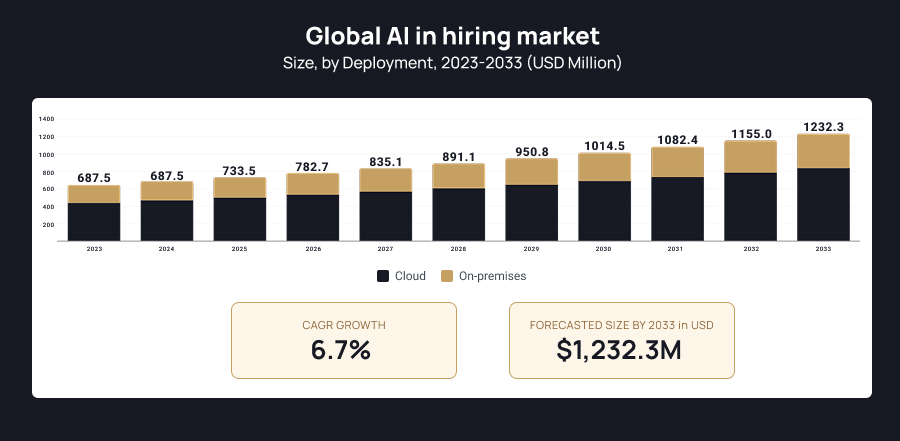
The shift is already visible in hiring data. The global AI in recruitment market is projected to grow from $1.23 billion by 2033. Around 65% of recruiters already use AI-powered hiring tools, while automated screening systems are reducing time-to-hire by as much as 50%.
But the real change goes beyond faster hiring. The entire tech hiring landscape is changing. Businesses are no longer building massive in-house engineering teams for every requirement. Instead, they are keeping lean core teams and scaling through specialized external talent whenever execution pressure rises.
That is exactly why AI-driven staff augmentation is gaining momentum in 2026.
The difference between a smooth product launch and a delayed roadmap often comes down to who you hire, and how fast you can onboard them. Explore top-rated IT staff augmentation companies on Goodfirms before your next hiring bottleneck slows delivery.
Why AI Is Reshaping IT Staff Augmentation
AI has accelerated software delivery expectations so aggressively that hiring delays now create operational bottlenecks almost immediately. Product teams are expected to ship faster, integrate AI features more quickly, and modernize infrastructure without slowing customer growth.
The problem is, internal hiring still moves slowly. And by the time traditional hiring closes, the project would have shipped in a completely different direction.
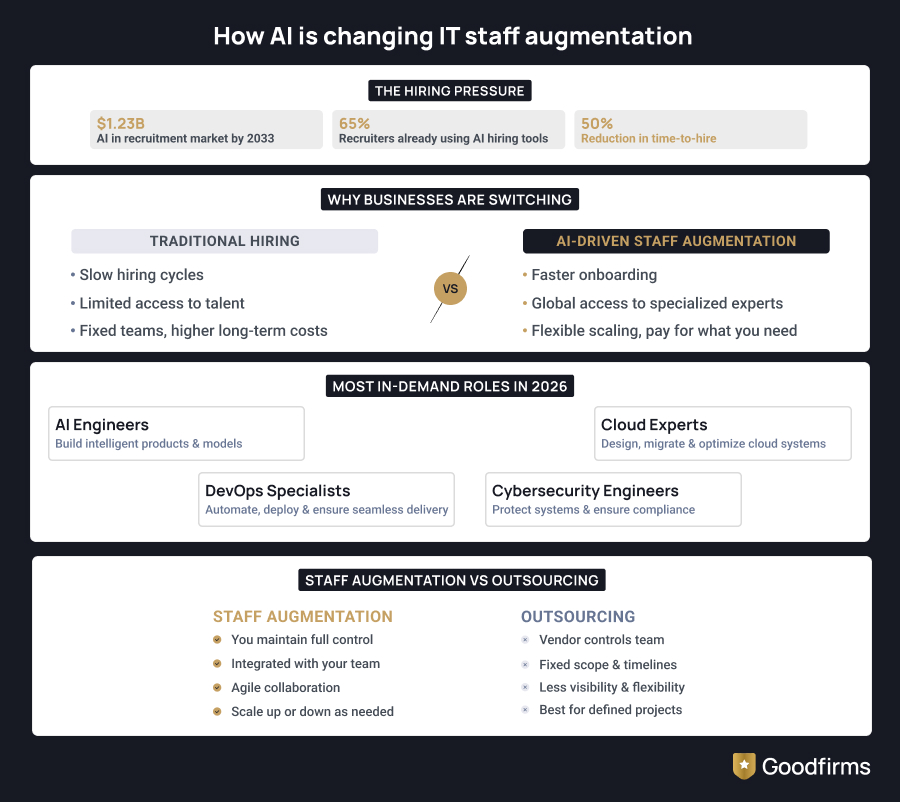
Many businesses now view AI talent augmentation as a faster way to access specialized engineers without slowing product delivery.
Hiring Speed
For years, businesses mostly used staff augmentation to reduce development pressure or lower hiring costs.
But in 2026, speed is becoming the bigger driver. AI-powered sourcing tools are helping augmentation providers move faster by automating large parts of technical screening and candidate matching. Recruiters can filter stack compatibility, project experience, and coding proficiency much earlier in the process.
The result is a hiring cycle that looks very different from traditional recruiting.
Some companies are onboarding external developers in under two weeks for roles that previously stayed open for months.
And honestly, that speed is becoming difficult for internal hiring teams to compete with.
Average Time to Hire Software Engineers by Region in 2026
Hiring timelines vary significantly across regions, especially for specialized engineering roles. Businesses trying to hire AI engineers, DevOps specialists, and cloud architects locally are often facing longer recruitment cycles due to talent shortages and rising competition.
That is one reason global staff augmentation models are growing faster in 2026.
| Region | Average Hiring Time |
|---|---|
| USA | 40-60 days |
| Western Europe | 35–50 days |
| LATAM | 20–35 days |
| APAC | 15–30 days |
Companies looking to hire remote developers are increasingly expanding beyond local hiring markets because distributed hiring models often reduce sourcing delays while improving access to specialized expertise.
High Demand for Specialists
One major shift happening quietly across the industry is the decline of generalist hiring.
Training developers internally for highly specialized projects takes time. So companies want an experienced expert for the role.
Companies are using augmentation partners to access niche expertise exactly when execution pressure spikes.
Hiring Timelines Increase Sharply for Senior Engineering Roles
The hiring gap becomes even more visible when businesses start recruiting senior-level technical specialists.
Junior developers are still relatively easier to source, but experienced AI engineers, cloud architects, cybersecurity experts, and senior backend developers remain heavily competitive across global markets.
| Seniority Level | Average Hiring Time |
|---|---|
| Junior Developers | 2–4 weeks |
| Mid-Level Engineers | 4–8 weeks |
| Senior Engineers | 8–12 weeks |
| AI/ML Specialists | 10–16+ weeks |
This growing delay is one reason businesses increasingly rely on IT staff augmentation services during high-pressure product cycles. Instead of waiting months for permanent hiring, companies can onboard experienced specialists much faster through augmentation partners.
AI is Improving Talent Matching
One reason hiring remote developers in 2026 became difficult was volume.
It is time-consuming to manually scan a large number of resumes. AI-assisted matching is fast and gives excellent results when it comes to matching the skills to the open role. Finding the right candidate means better alignment with the internal teams.
Earlier, small mismatches mattered more than people think. AI-assisted vetting helps surface those differences. All this leads to smoother onboarding and fewer expensive hiring mistakes.
Top IT Staff Augmentation Companies in 2026
Businesses searching for IT staff augmentation services are becoming far more selective about the partners they work with.
A few years ago, scaling external development teams mostly meant adding more developers. In 2026, the expectation is very different. Companies want engineers who can contribute almost immediately, collaborate across remote workflows, and work comfortably.
That is why businesses are paying closer attention to technical vetting, communication maturity, cloud expertise, and delivery consistency before choosing augmentation partners.
Here are some quick highlights:
|
Company |
Best For |
Key Strength Highlighted |
|---|---|---|
|
SDLC Corp |
AI and enterprise platforms |
Flexible engineering scale |
|
Saigon Technology |
Offshore SaaS collaboration |
Agile workflow integration |
|
Tallium Inc. |
Product-focused SaaS teams |
UX + engineering alignment |
|
STS Software |
Distributed development environments |
Sprint integration flexibility |
|
Kevych Solutions |
Startups and MVP launches |
Rapid execution adaptability |
Let's discuss IT staff augmentation companies that businesses are considering actively in 2026 in detail:
1. SDLC Corp
Best for businesses building AI, blockchain, and enterprise-grade software products that require flexible engineering scale. Their augmentation model is particularly relevant for organizations managing rapid product expansion across multiple modern stacks like AI integrations, cloud applications, fintech platforms, and custom software delivery. Their experience across AI-focused development projects makes them particularly relevant as more businesses integrate automation and intelligent workflows into existing platforms.
2. Saigon Technology
Saigon Technology is commonly evaluated by companies looking for offshore development support with stable long-term collaboration structures. Businesses managing ongoing SaaS development cycles often prefer augmentation partners that can adapt to agile workflows without creating communication overhead across distributed teams. The company is especially visible among startups and mid-sized product teams scaling gradually instead of hiring aggressively upfront.
3. Tallium Inc.
Tallium Inc. attracts businesses that care heavily about product execution alongside engineering delivery. That distinction matters because many augmentation providers focus purely on technical capacity while product-focused SaaS teams increasingly want developers who also understand usability, customer experience, and platform scalability. That combination becomes valuable once engineering speed starts affecting customer retention directly.
4. STS Software
STS Software is frequently considered by businesses expanding remote engineering operations without losing internal delivery control. Many companies adopting distributed development models prefer augmentation partners that can integrate into existing sprint structures rather than operating independently from them. That flexibility is becoming increasingly important as hybrid engineering environments become standard across SaaS businesses.
5. Kevych Solutions
Kevych Solutions is gaining visibility among startups and early-stage SaaS companies that need faster execution without building large permanent engineering departments immediately. Smaller product teams often prefer augmentation partners capable of adapting quickly during MVP launches, rapid iteration cycles, and early growth stages. That adaptability matters because startup hiring delays usually affect product momentum much faster than enterprise organizations.
Staff Augmentation vs Outsourcing in 2026
The difference between staff augmentation vs outsourcing is becoming much easier to spot in practice.
One model protects product control. The other transfers operational responsibility.
Businesses building long-term SaaS products increasingly lean toward augmentation because they want engineers embedded directly into their internal workflows. Sprint planning, product decisions, architecture discussions, and release priorities remain internal.
That matters more now because AI-driven product development moves quickly. And so decisions and roadmaps move faster. Internal visibility matters more than it did a few years ago.
Outsourcing still works well for clearly defined projects with fixed deliverables.
But many SaaS teams no longer operate inside predictable project structures.
They operate inside continuous product evolution.
That is exactly why augmentation is growing faster across AI-focused companies. They want specialists integrated directly into ongoing product development while the roadmap evolves in real time.
That operational difference in staff augmentation vs outsourcing is becoming more important than hourly pricing comparisons.
What Risks Do Businesses Overlook in IT Staff Augmentation?
The biggest problems in augmentation come from operational assumptions.
A surprising number of businesses believe external developers will automatically integrate into internal workflows without structured onboarding, documentation, or delivery alignment.
That almost never works well.
One engineering manager described their first augmentation experience this way:
“We hired excellent developers, but nobody explained how decisions were made internally. Every sprint became slower because people were waiting for approvals they did not understand.”
That problem appears constantly across growing product teams.
The strongest augmentation partnerships succeed because onboarding systems are treated seriously:
- documentation access is prepared early
- sprint ownership is clear
- communication expectations are defined immediately
- delivery accountability stays visible
Security creates another overlooked risk.
External developers often require access to repositories, infrastructure environments, customer systems, and internal tooling. Businesses rushing onboarding frequently underestimate how exposed those systems become without structured access controls.
The companies succeeding with augmentation long-term are usually the ones treating external contributors as integrated engineering participants instead of temporary add-ons.
How Should Businesses Evaluate IT Staff Augmentation Companies?
Most vendor comparisons fail because businesses focus too heavily on hourly pricing.
A cheaper developer who slows delivery cycles, misses sprint expectations, or struggles inside distributed workflows will cost you more.
Businesses evaluating IT staff augmentation companies should pay close attention to:
- technical vetting depth
- onboarding structure
- replacement policies
- timezone collaboration
- communication maturity
- delivery continuity
One useful question many buyers forget to ask:
“How does your team evaluate developers beyond coding assessments?”
Strong augmentation partners usually have a clear answer immediately.
Weak providers often fall back on generic screening language.
It is also worth reviewing verified client experiences instead of relying entirely on sales conversations. Businesses comparing providers can use Goodfirms staff augmentation service reviews and company comparisons to evaluate delivery experience, industries served, technical expertise, and collaboration quality before shortlisting vendors.
Adopting this step alone can help you eliminate a surprising amount of hiring risk.
FAQs
What are IT staff augmentation services?
IT staff augmentation services help businesses temporarily expand engineering capacity using external developers, DevOps specialists, cloud engineers, cybersecurity experts, and other technical professionals. Companies typically use augmentation when they need faster access to specialized expertise without increasing permanent headcount immediately.
How is staff augmentation different from outsourcing?
Staff augmentation integrates external developers directly into an internal team structure, while outsourcing transfers project ownership to an external vendor. Businesses using augmentation usually maintain stronger visibility into product decisions, sprint planning, and engineering workflows.
Why are businesses using AI in staff augmentation?
AI is helping augmentation providers improve candidate matching, automate technical screening, reduce hiring timelines, and identify developers with stronger stack compatibility. Many businesses use AI-assisted augmentation to reduce hiring friction during high-pressure delivery periods.
Can businesses hire remote developers through staff augmentation?
Yes. Most modern IT staff augmentation companies support remote engineering teams across regions like India, Eastern Europe, Latin America, and Southeast Asia. Businesses looking to hire remote developers in 2026 are increasingly using staff augmentation to access global technical talent faster than traditional local hiring allows.
What industries use tech team augmentation services the most?
SaaS, fintech, healthcare, ecommerce, AI, and cybersecurity companies are among the largest users of tech team augmentation services because they frequently need specialized expertise during fast-moving product and infrastructure projects.
Where is IT Staff Augmentation Heading Next
The future of IT staff augmentation services is moving toward smaller permanent teams and more fluid specialist networks.
That model is already becoming visible across AI-focused SaaS businesses.
Companies are hiring fewer generalists and relying more heavily on specialized contributors brought in during:
- infrastructure transitions
- AI integration projects
- security expansion phases
- high-pressure release cycles
This subtle shift is important for businesses, and they have started to optimize engineering structure around adaptability instead of headcount size. And that changes how hiring works entirely.