Key takeaways
- Do your own needs assessment — compliance obligations, growth plans, current pain points — before evaluating a single vendor.
- Ask for guaranteed response times in writing, not verbal assurances; an unwritten SLA isn't a real commitment.
- Compare proposals on scope first, price second — the cheapest quote is almost always the narrowest one.
- Treat vague onboarding plans, missing compliance conversations, and unclear contract exit terms as genuine red flags, not minor details.
- Talk to a real reference client in a similar industry, and consider a scoped trial engagement before committing long-term.
Not long ago, one of the top engineering service companies in Western Canada came to us after its long-standing IT provider — a relationship that had lasted 25 years — retired. What followed wasn't a clean handoff. It was a frustrating stretch of replacement providers who overpromised and underdelivered: band-aid fixes in place of strategic thinking, follow-through that never materialized, and an IT environment that kept sliding further out of date. The cost wasn't just technical. Across three office locations, employees were spending their time fighting the technology instead of doing their actual work, and leadership could feel it dragging on the whole organization. None of that dysfunction was visible when those providers were pitching. It only became clear once the firm was already living with the consequences.
That story ended well — within three months of the right partnership, the firm's entire IT environment was modernized, and the day-to-day friction was gone. But the more instructive part is the stretch of false starts that came first, because it's common enough to deserve its own conversation, separate from the usual advice about “making sure your MSP has good reviews.” Choosing a managed service provider is one of the more consequential vendor decisions a small or mid-sized business makes, and it's also one of the least understood. Most buyers evaluate MSPs the way they'd evaluate any other MSP software purchase — compare a few websites, request a couple of quotes, and pick the one that feels most professional. That approach works reasonably well for buying a printer. It works poorly for outsourcing the infrastructure your entire business runs on.
This guide walks through how to actually evaluate an MSP: what to ask, what the answers should sound like, and which signals reliably separate a genuine long-term partner from a vendor who will look identical to one until the first real problem arrives.

Why This Decision Carries More Weight Than It Looks
An MSP relationship touches nearly everything a modern business depends on: email, file access, client data, compliance posture, and the systems that keep day-to-day operations running. When that relationship works, it's invisible — which is exactly why so many businesses under-invest in choosing it carefully. The consequences of a poor fit rarely show up on day one. They show up eighteen months in, as slow response times, unexplained charges, or a security gap that surfaces during a client's due diligence request rather than during a routine audit.
The businesses that get this decision right tend to treat it less like a purchase and more like a partnership search — because that's functionally what it is. The businesses that get it wrong tend to make the decision quickly, based on price and first impressions, and then live with the outcome for years because switching providers feels disruptive enough to keep postponing.
That reluctance to switch is worth naming directly, because it's part of what makes this decision higher-stakes than a typical vendor choice. Migrating away from an entrenched IT provider means transferring institutional knowledge, re-documenting systems, and living through a transition period with some inevitable friction — which is exactly why so many businesses stay with an underperforming provider longer than they should. The switching cost is real. It's also almost always smaller than the cumulative cost of staying somewhere that isn't working, once lost productivity, security exposure, and the opportunity cost of a distracted leadership team are actually counted. Getting the choice right the first time isn't just about avoiding a bad outcome — it's about avoiding the multi-year inertia that a bad outcome tends to create.
In-House IT, Outsourced IT, or Both?
Before comparing specific MSPs, it's worth settling a more fundamental question: Does outsourcing make sense for your business at all, or would an internal hire serve you better? There's no universally correct answer, but there are useful signals. A single, well-rounded internal IT hire can work well for a business with a fairly static, simple environment and no significant compliance burden — provided you can tolerate that person's vacations, sick days, and eventual departure without any coverage gap. Partnering with the Best IT Outsourcing Companies tends to make more sense once your environment includes any real complexity: multiple locations, industry-specific compliance obligations, a need for round-the-clock monitoring, or specialized security expertise that a single generalist hire is unlikely to have across the board.
Many growing businesses eventually land on a hybrid model — an internal point of contact who understands the day-to-day business context, backed by an MSP that supplies the depth, redundancy, and specialized coverage a single employee can't provide alone. If you're unsure which category your business falls into, that uncertainty is itself useful information: it usually means you're at the size where the decision genuinely could go either way, and it's worth running the numbers on both paths before committing to either one.
Understanding How MSPs Actually Price Their Services
Part of what makes MSP proposals hard to compare is that pricing models genuinely differ, not just the numbers attached to them. Per-user pricing charges a flat monthly rate per employee, which is simple to budget for but can become expensive for organizations with many low-intensity users. Per-device pricing charges based on the number of workstations, servers, and endpoints under management, which suits organizations with more devices than staff. Tiered flat-rate models — bundling a defined scope of services into a small number of packages, often labeled something like Bronze, Silver, and Gold — tend to offer the most predictability, provided the tiers are clearly documented rather than vaguely described.
Whatever model a provider uses, the important question isn't which one is objectively best — it's whether the model matches how your business actually operates, and whether you can accurately predict next year's IT budget based on how they've explained it. A pricing model you can't confidently forecast against is a problem regardless of which model it is.
Start With Your Own Needs Before You Look at Any Vendor
The most common mistake in this process happens before a single vendor conversation: skipping a real assessment of what your business actually needs. Two companies with the same headcount can have completely different requirements depending on their industry, their compliance obligations, their growth trajectory, and the state of their existing systems.
Before evaluating shortlisted IT services companies, get honest answers to a few internal questions. What compliance or regulatory obligations does your industry carry, and how well does your current setup actually meet them? Where do your current pain points live — slow support, unclear invoicing, security anxiety, a system that can't keep up with growth? What does your business look like in three years, and does your technology decision today still make sense at that size? A vendor conversation without this groundwork tends to be shaped entirely by whatever the vendor chooses to emphasize, rather than by what your business actually requires.
The Questions That Actually Reveal Whether an MSP Is Any Good
Generic questions get generic answers. The questions below are designed to surface real information — the kind that's harder to fake in a sales conversation.
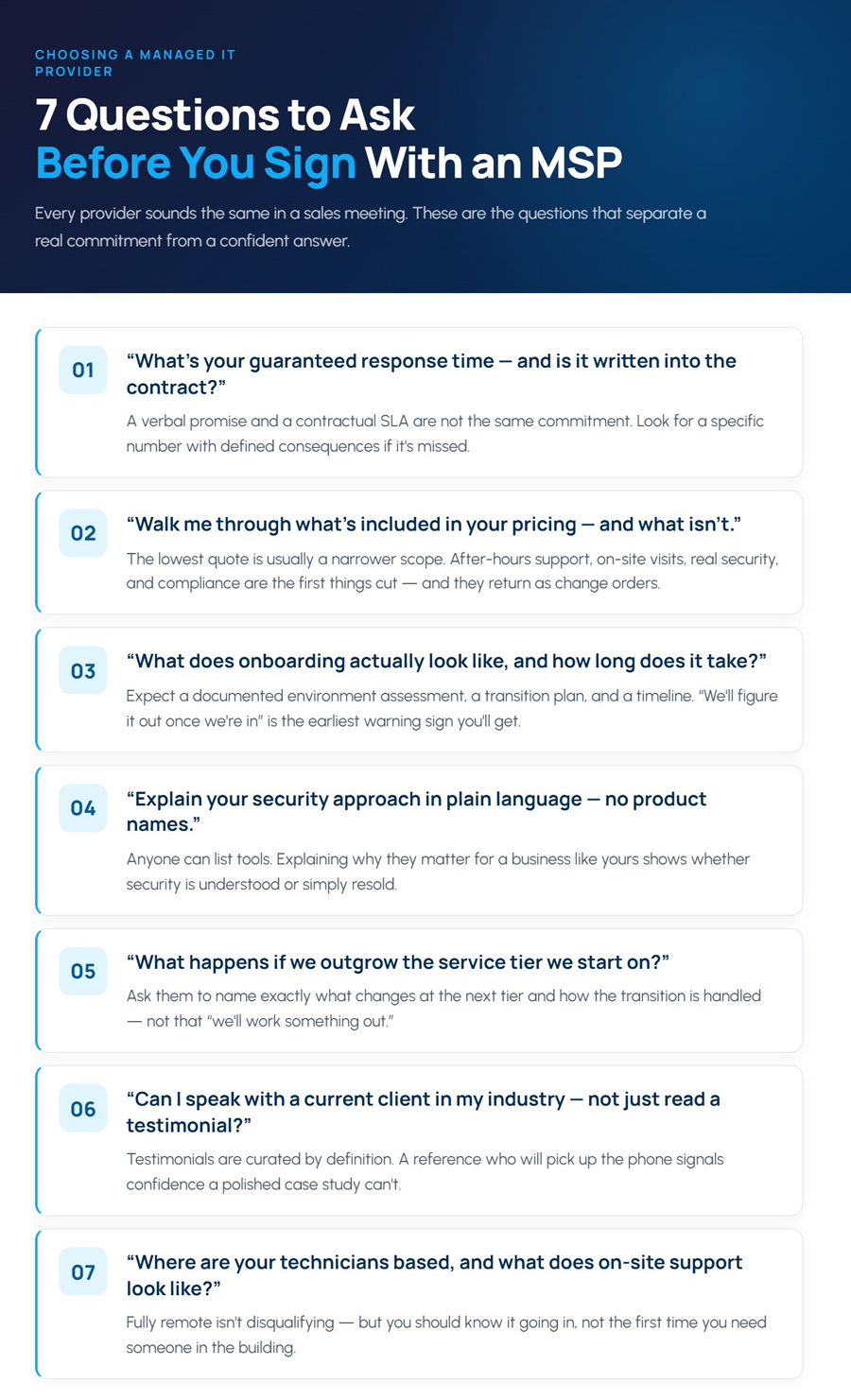
“What's your guaranteed response time, and is it actually written into the contract?” Every MSP will tell you they respond quickly. Far fewer will put a specific, enforceable number in writing, with defined consequences if they miss it. A verbal promise and a contractual SLA are not the same commitment, and the gap between them is where a lot of disappointment lives.
“Walk me through exactly what's included in your pricing — and just as importantly, what isn't.” The lowest quote in a competitive process is almost never the lowest total cost. It's usually a narrower scope. After-hours support, on-site visits, security services beyond basic antivirus, and compliance management are the most commonly excluded items in a low-ball proposal, and they tend to reappear as change orders exactly when you need them most.
“What does onboarding actually look like, and how long does it take?” A serious MSP has a structured onboarding process: a documented environment assessment, a migration or transition plan, and a defined timeline. A vague answer here — or a plan that starts with “we'll figure it out once we're in” — is one of the more reliable early warning signs available before you've signed anything.
“Can you explain your security approach in plain language, without reading off a list of product names?” Any provider can list the security tools they use. Fewer can explain, in language a non-technical business owner understands, why those tools matter for a business like yours specifically. That distinction usually reflects whether security is something the provider actually understands or something they resell.
“What happens if we outgrow the service tier we start on?” A good provider has a clear, predictable path for scaling service as a client grows — not a vague assurance that “we'll work something out.” Ask them to describe, specifically, what changes at the next tier and how that transition is handled.
“Can I speak with a current client in a similar industry, not just read a testimonial?” Written testimonials are curated by definition. A provider willing to connect you with an actual reference — someone who will pick up the phone and tell you the truth about response times and service quality — is signaling a level of confidence that a polished case study can't replicate.
“Where are your technicians actually based, and what does on-site support look like?” Some providers operate entirely remotely, with no capacity to physically respond when a hardware issue genuinely requires it. That's not automatically disqualifying — but you should know it going in, rather than discovering it the first time you need someone in the building.
Red Flags Worth Taking Seriously
- Vague or unwritten service level agreements. If a response-time promise isn't in the contract, it isn't a commitment — it's marketing.
- A price that's meaningfully lower than every other quote you've received, with no clear explanation of what's different about the scope.
- No real onboarding process, or an onboarding conversation that skips your existing environment entirely.No mention of your industry's compliance requirements during the sales process. If they don't raise it before you're a client, they won't manage it after.
- Long-term contracts paired with exit terms that are difficult to find or vague when asked about directly.
Reading a Proposal Like a Buyer, Not Like a Hopeful Client
Once you have proposals in hand, resist the pull to compare them purely on the bottom-line number. Line up scope against scope first: what's genuinely included, what's explicitly excluded, and what assumptions each provider is making about your environment. A proposal that's 20% more expensive but includes after-hours support, a defined security stack, and compliance management isn't the more expensive option — it's frequently the cheaper one once you account for what the lower quote leaves out.
It's also worth asking every finalist the same specific, pointed questions rather than letting each conversation wander wherever the salesperson steers it. Consistency in your own questions is what makes the answers genuinely comparable.
Making the Final Call
Once you've narrowed the field, a short trial period or a scoped starter engagement — handling one system, one office, or one specific project — can reveal more about a provider's actual working style than another month of sales conversations. Involve the people on your team who will actually interact with this provider day to day; their read on responsiveness and communication style is data a business owner alone won't always see.
The right MSP relationship should start to feel less like a vendor contract and more like an extension of your own team — a full-stack managed IT services provider that understands your business well enough to make decisions the way you would. That's a meaningfully different outcome than simply finding a company that answers the phone quickly.
The Bottom Line
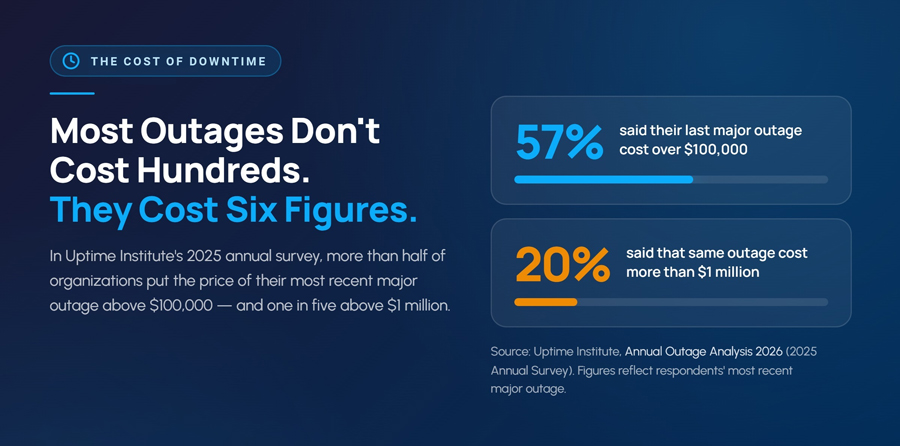 Source: Uptime Institute, Annual Outage Analysis 2026 (2025 Annual Survey)
Choosing an MSP is a decision that deserves the same rigor a business would apply to any major vendor relationship — arguably more, given how much of the business ends up depending on it. Ask specific questions. Get commitments in writing. Talk to real references. And treat a proposal's exclusions as carefully as its inclusions. If you're currently comparing providers and want a second opinion on a proposal you've received, our professional IT services team is glad to walk through it with you — no obligation attached.