Key takeaways
- Customer reviews provide valuable insight into a managed IT services provider's reliability and service quality.
- Technical expertise should extend beyond help desk support to cloud infrastructure, cybersecurity, compliance, and strategic IT planning.
- Industry-specific experience is especially important for businesses operating in regulated sectors.
- Transparent pricing, clearly defined SLAs, and proactive communication are strong indicators of a dependable MSP.
- Comparing providers across multiple evaluation criteria helps reduce risk and improves the chances of building a successful long-term partnership.
Businesses today depend on technology for almost everything, from daily communication and customer service to cybersecurity and cloud operations. Yet building an in-house IT team with expertise across every technology isn't always practical. That's why organizations of all sizes are increasingly relying on managed IT services to keep their systems secure, efficient, and up to date.
The challenge isn't deciding whether to outsource IT. It's choosing the right managed IT services provider. Almost every provider promises 24/7 monitoring, fast support, proactive maintenance, and enterprise-grade security. On paper, they can look remarkably similar. The real difference often comes down to what their clients say about them, how consistently they deliver results, and whether they have experience solving challenges similar to yours.
This guide walks you through a practical, review-based framework to evaluate managed IT services providers. Instead of relying on marketing claims, you'll learn how to assess customer feedback, technical capabilities, pricing, security practices, and industry expertise so you can confidently choose a long-term technology partner.
Searching for the right managed IT partner doesn't have to be overwhelming. Goodfirms helps you compare managed IT services providers based on verified client reviews, service focus, company size, industries served, hourly rates, and portfolios. Explore your options and shortlist providers that align with your business goals.
What are Managed IT Services?
Managed IT services involve outsourcing IT operations to a third-party provider that proactively manages, monitors, and supports an organization's technology environment. Instead of waiting for problems to occur, a managed IT services provider continuously monitors systems, applies security updates, resolves issues remotely, and helps businesses plan future technology investments.
Depending on your business needs, managed IT services and support may include:
- network monitoring
- help desk assistance
- cloud management
- endpoint security
- backup and disaster recovery
- server maintenance
- cybersecurity monitoring.
Many providers also offer strategic consulting, helping organizations align technology investments with long-term business goals.
This approach allows businesses to reduce downtime, improve security, and access specialized expertise without hiring a large in-house IT department.
Managed IT Services by the Numbers
The growing reliance on managed IT services isn't just a trend. Here are a few numbers that put it into perspective:
- The global managed services market is projected to reach $705.22 billion by 2031, growing at a CAGR of 8.9%. This reflects the increasing demand for outsourced IT expertise across businesses of all sizes.
- The average global cost of a data breach reached $4.44 million, making cybersecurity one of the biggest reasons organizations invest in managed IT services.
- Organizations take an average of 241 days to identify and contain a data breach, highlighting the importance of continuous monitoring and rapid incident response.
- AI-assisted attacks are becoming more common, with 16% of data breaches involving attackers who used AI-powered techniques such as phishing and deepfake impersonation.
What Does a Managed IT Services Provider Do?
A managed IT services provider takes responsibility for maintaining and optimizing your IT infrastructure. Rather than reacting only when something breaks, the provider works proactively to prevent disruptions and improve system performance.
Many providers also help businesses adopt emerging technologies, improve cybersecurity resilience, and prepare for digital transformation initiatives.
Why Businesses Choose Managed IT Services in 2026
Businesses manage hybrid workplaces, cloud applications, AI-powered tools, connected devices, and increasingly sophisticated cyber threats. Maintaining all of this internally requires significant investment in talent, infrastructure, and ongoing training.
Managed IT services give businesses access to experienced specialists without the overhead of building large internal teams. Instead of hiring separate professionals for networking, cybersecurity, cloud infrastructure, and compliance, organizations can access these capabilities through a single service provider.
Companies also appreciate the predictable monthly costs associated with managed IT services pricing. Rather than dealing with unexpected repair expenses or emergency consulting fees, businesses can budget more accurately while receiving continuous monitoring and support.
For small organizations with limited IT resources, managed IT services for small businesses provide enterprise-level expertise that would otherwise be difficult to afford. Larger enterprises often use co-managed IT services to supplement internal teams with specialized skills or additional capacity during major technology initiatives.
Co-Managed vs Fully Managed IT Services
Before comparing managed IT services providers, it's important to understand which service model best fits your organization. Businesses without dedicated IT staff often choose fully managed IT services, while organizations with internal IT teams may benefit from a co-managed approach that supplements existing capabilities.
|
Fully Managed IT Services |
Co-Managed IT Services |
|
Provider manages the entire IT environment |
Internal IT team and MSP share responsibilities |
|
Best suited for small and mid-sized businesses without a dedicated IT staff |
Ideal for larger organizations with existing IT departments |
|
Single point of accountability |
Flexible division of responsibilities |
|
Minimal internal IT resources required |
Internal team retains control while gaining additional expertise |
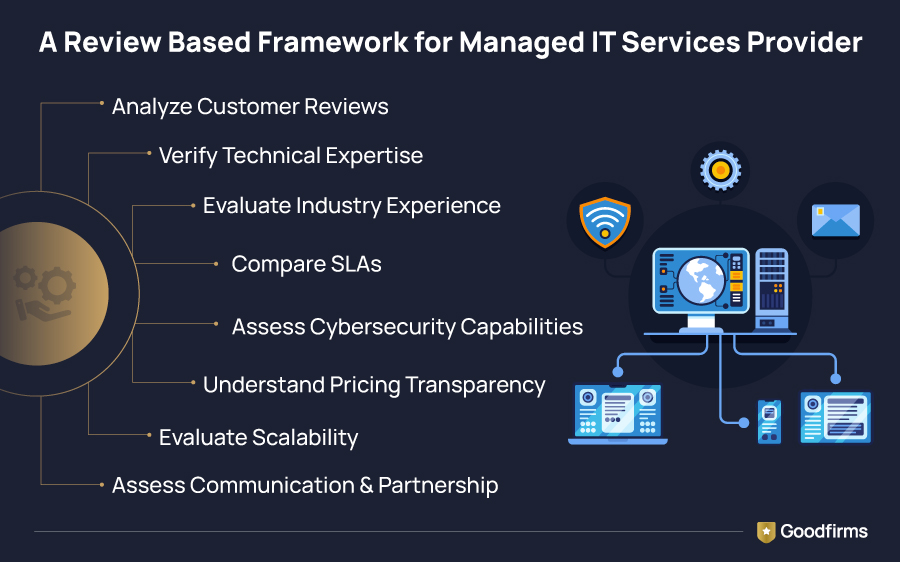
A Review-Based Framework for Evaluating Managed IT Services Providers
Comparing reviews, operational processes, technical expertise, and communication practices often provides a much clearer picture of how a provider performs in real-world situations.
Here's what you should evaluate before making a decision.
1. Go Beyond Overall Ratings
Five-star ratings can be helpful, but they are not enough on their own. Instead of focusing only on the average score, read individual reviews carefully to understand clients' actual experiences.
Pay attention to recurring themes such as responsiveness, communication quality, technical expertise, and problem resolution. If multiple customers consistently praise the provider's ability to resolve issues quickly or criticize delayed responses, those patterns deserve attention.
Recent reviews are particularly valuable because they reflect the provider's current capabilities rather than work completed several years ago.
Also consider whether reviews come from businesses similar to yours in terms of size, industry, or technical requirements. A provider that excels with startups may not necessarily be the right fit for a large healthcare organization or manufacturing company.
2. Evaluate Technical Expertise
Every managed IT services provider offers different technical capabilities. Some focus primarily on desktop support, while others manage enterprise cloud environments, cybersecurity operations, compliance, and digital transformation projects.
Ask potential providers about their expertise in areas such as: cloud infrastructure, migration services, and partnerships commonly offered by leading cloud consulting companies.
Certifications, technology partnerships, and documented case studies can help validate these capabilities. A provider should also demonstrate how they stay current with evolving technologies instead of relying on outdated processes.
3. Look for Industry Experience
Industry expertise often makes a measurable difference in project outcomes. Every sector has unique operational challenges, compliance requirements, and technology priorities.
For example, managed IT services for healthcare providers should include experience with HIPAA compliance, electronic health record systems, and data protection requirements. Managed IT services for law firms require secure document management, confidential client communications, and strong access controls.
If you are a growing company with limited IT resources, managed IT services for small business should prioritize scalability, cost efficiency, and proactive support that allows your internal team to focus on business growth instead of technical issues.
Ask prospective providers for client references or case studies within your industry. Practical experience often reduces implementation risks and shortens onboarding time.
4. Compare Service Level Agreements (SLAs)
A service-level agreement (SLA) defines what you can expect from your managed IT services provider. It sets clear expectations for response times, issue resolution, system availability, and support coverage. Without a well-defined SLA, it becomes difficult to hold your provider accountable when problems arise.
As you compare providers, review whether their SLAs clearly specify:
- Response times for critical, high, medium, and low-priority issues
- Resolution targets for different types of incidents
- Guaranteed uptime commitments
- Availability of 24/7 monitoring and emergency support
- Escalation procedures for unresolved issues
- Performance reporting and regular service reviews
The best providers don't hide these commitments in fine print. Instead, they explain how their support processes work and how they'll keep your business running with minimal disruption.
5. Assess Their Cybersecurity Capabilities
Cybersecurity has become one of the biggest reasons businesses invest in managed IT services. Modern MSPs are expected to do much more than install antivirus software. They should take a proactive approach to protecting their infrastructure against evolving threats.
If your organization operates in regulated industries, ask whether the provider has experience supporting standards such as HIPAA, PCI DSS, SOC 2, GDPR, or ISO 27001.
A provider should also explain how they respond when a security incident occurs. Fast detection, clear communication, and an established incident response plan can significantly reduce business impact.
6. Understand Managed IT Services Pricing
One of the most common questions businesses ask is, "How much do managed IT services cost?"
Managed IT services pricing ranges from $100 to $250 per user per month or $50 to $150 per device per month, depending on the services included, business size, infrastructure complexity, compliance requirements, and support availability.
While cost is important, it shouldn't be the only deciding factor. A lower monthly fee may exclude critical services like cybersecurity monitoring, cloud management, backup testing, or strategic consulting.
When comparing proposals, ask providers to clearly explain:
- What's included in the monthly fee
- Any onboarding or setup charges
- Emergency support costs
- After-hours service fees
- Licensing expenses
- Cloud infrastructure management costs
- Contract length and cancellation terms
Transparent pricing demonstrates professionalism and helps you avoid unexpected expenses later.
7. Evaluate Scalability
Your IT requirements today may look very different in two years. A provider should be able to support your business as it grows without requiring you to switch partners.
Discuss how they would handle situations such as:
- Opening additional offices
- Supporting remote and hybrid employees
- Migrating to new cloud platforms
- Integrating acquisitions
- Expanding cybersecurity operations
- Supporting business growth internationally
An experienced managed IT services provider should present a roadmap rather than simply selling today's support package.
8. Assess Communication and Strategic Partnership
The best providers become trusted advisors who help businesses make smarter technology decisions, a role often associated with experienced IT consulting companies.
During your evaluation, ask questions like:
- Will we have a dedicated account manager?
- How often do you conduct business reviews?
- Do you provide monthly performance reports?
- How are technology recommendations prioritized?
- How do you communicate during outages?
Strong communication builds trust and ensures that technology investments continue to support business objectives rather than react to problems after they occur.
Red Flags to Watch Before Hiring a Provider
Even providers with polished websites and attractive pricing can present risks. Keep an eye out for warning signs during your evaluation process.
Avoid providers that:
❌ Can't explain their service-level agreements.
❌ Offer vague or inconsistent pricing.
❌ Have very few recent customer reviews.
❌ Lack experience in your industry.
❌ Don't provide cybersecurity expertise.
❌ Require lengthy contracts with heavy termination penalties.
❌ Struggle to explain their support process.
❌ Avoid providing customer references.
A reputable provider welcomes questions and is transparent about both their strengths and limitations.
Build a Long-Term Partnership with the Right Managed IT Provider
Choosing a managed IT services provider isn't simply about finding the lowest price or the longest list of services. It's about selecting a partner that understands your business, communicates proactively, protects your technology, and consistently delivers measurable value.
Verified customer reviews can reveal insights that marketing materials often overlook. When combined with an evaluation of technical expertise, security capabilities, industry experience, pricing transparency, and service commitments, they provide a much clearer picture of which provider is the right fit.
Taking a structured, review-based approach helps reduce risk and increases the likelihood of building a long-term partnership that supports your business as technology continues to evolve.
FAQs - Managed IT Services Provider
What is a managed IT services provider?
A managed IT services provider is a third-party company that takes on ongoing responsibility for a business's IT infrastructure, monitoring, security, and support under a subscription-style contract, rather than billing for individual repairs as they arise.
What is included in managed IT services?
Most plans include network and system monitoring, help desk support, patch management, data backup, and baseline cybersecurity, such as endpoint protection and email filtering. Higher-tier plans often add strategic IT planning, compliance support, and co-managed options for businesses with existing IT staff.
How much do managed IT services cost?
Pricing runs $100 to $250 per user per month for standard coverage in the U.S., with full-service cybersecurity-heavy plans reaching higher. The exact number depends on user count, device count, compliance requirements, and support hours.
What is co-managed IT services?
Co-managed IT services describe an arrangement where a provider supports an existing internal IT team rather than replacing it, handling specific functions like after-hours monitoring, security operations, or cloud administration while the internal team keeps day-to-day control.
What is a managed IT security services provider?
A managed IT security services provider, sometimes called an MSSP, focuses specifically on cybersecurity functions, threat monitoring, incident response, and vulnerability management, rather than general IT support. Some managed IT services providers offer this as one part of a broader service, while others specialize in security alone.
What industries rely most on managed IT services?
Healthcare, legal, financial services, and manufacturing rely most heavily on managed IT services, largely because downtime, data breaches, or compliance failures carry disproportionately high costs in these sectors.
How do managed IT services handle cybersecurity?
A serious provider layers defenses: endpoint detection and response, patch management, email filtering, multi-factor authentication, and a documented incident response plan, backed by ongoing monitoring rather than a one-time setup.
How do I choose the right managed IT services provider?
Start by reviewing verified customer feedback, technical certifications, industry experience, cybersecurity capabilities, service-level agreements, and pricing transparency. It is also important to evaluate communication practices, scalability, reporting, and the provider's ability to support your long-term business strategy. Comparing multiple providers on platforms like Goodfirms makes this process much easier.