Key takeaways
- Verification is what separates real evidence from marketing — a review only matters if the reviewer's identity, project, and lack of financial stake can actually be confirmed.
- Reviews, testimonials, and case studies aren't interchangeable — only a verified review is submitted independently and checked by a third party before publishing.
- Gut-feel vendor selection has a real cost — 81% of B2B buyers report dissatisfaction with the provider they ultimately chose.
- Regulation has raised the stakes on fake reviews — the FTC's 2024 rule makes fabricated reviews a legal liability, not just a trust issue.
- Reading a review well matters as much as reading a verified one — specificity, recency, reviewer role, and response to criticism reveal more than the star rating alone.
Every IT agency's website says the same three things: expert team, on-time delivery, client-first approach. None of that separates a software development company that actually delivers quality services on time from one that stalls six weeks into your project. What separates them are verified reviews from real clients who have already paid and experienced delivery, confirming whether claims and promises were met.
In short, verified reviews answer one question prominently: what do the people who already paid this company say happened after the contract was signed?
Explore Top IT Services Companies on Goodfirms. Verified reviews. Real projects. No guesswork.
As per a recent report by IOSR Journal of Business and Management, 62% of consumers trust verified reviews more because they are written by actual buyers.
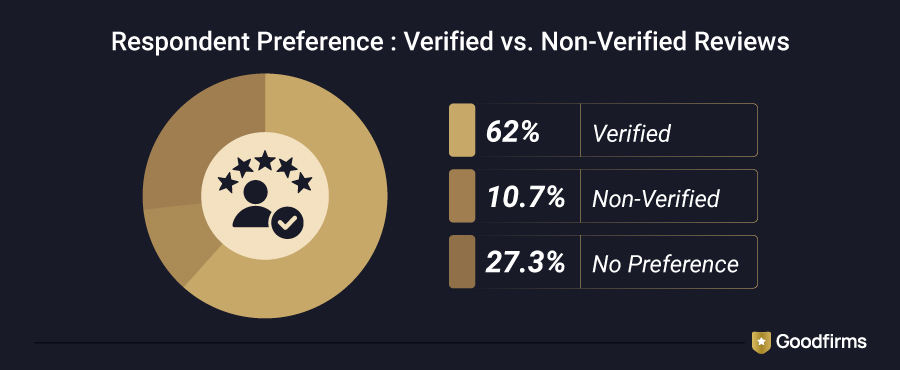
That trust only holds if the review itself is real, which raises the obvious question of what actually separates a checked review from one nobody bothered to check.
What Makes a Review "Verified" vs. "Non-Verified"
A star rating alone tells you almost nothing. What actually matters is whether the person behind it can be confirmed to exist, confirmed to have engaged the agency, and confirmed to have no financial stake in how the review reads. That confirmation step is the entire difference between a verified review and an unverified one — and most businesses looking for an IT partner skip this difference entirely.
An unverified review can be posted by anyone: a real client in a rush, a friend doing a favor, an employee posting under a fake name, or a competitor trying to inflate a rival's negative feedback. Nothing checks whether the reviewer actually hired the agency, and nothing stops the same person from posting multiple times under different identities.
A verified review works differently. It's tied to a confirmed identity, checked against a real project or business relationship, and screened for conflicts of interest before it ever goes live. Goodfirms is a useful reference point for what that screening looks like in practice. Before any review is published, the platform runs it through a few specific checks:
- Identity verification. The reviewer's business email address and social or professional profile (typically LinkedIn) are cross-checked against the company they claim to have worked with.
- Direct outreach for higher-stakes reviews. For higher-value engagements, the Goodfirms team may contact the reviewer directly to confirm the project actually happened.
- Conflict-of-interest screening. Reviews are checked for any financial or employment tie between the reviewer and the company being reviewed.
- Rejection of unverifiable submissions. Any review that can't be backed by credible, accurate reviewer information is rejected outright, not published with a disclaimer.
Anonymity doesn't lower that bar. Goodfirms lets reviewers withhold their name from the published review, but the same identity and project-verification steps still happen behind the scenes first; anonymity affects what other visitors see, not what the platform itself confirms.
That process sits behind a platform-wide number worth noting: Goodfirms currently hosts more than 1.2 million verified reviews across roughly 80,000 listed firms, spanning more than 60 service categories and 130 countries, all run through the same identity check before publication.
Before going further, it is imperative to know what actually counts as a review, because not everything does. A case study and a testimonial can look convincing too, but they're not the same thing as a review. Let’s have a look at how verified reviews are different from testimonials and case studies.
Verified Reviews, Testimonials, and Case Studies Aren't the Same Thing
Buyers often treat these three as interchangeable proof points. They aren't. To select the right IT agency among several options available, it becomes imperative to understand the difference between the three of them.
A case study is written and published entirely by the agency, showcasing its best possible outcome with no independent verification of the client's actual satisfaction.
A testimonial is a quote the agency selected and typically approved before publishing - useful for tone, not for due diligence.
A verified review is submitted independently by a real client, tied to a confirmed identity or project, and checked by a third party before it goes live.
Only a verified review gives you something that an agency can't fully control the narrative around. That's not a knock on case studies or testimonials — they're fine supporting material. It's a reminder that they answer a different question than the one that actually answers the question: what happened for the last five clients who hired this software development company or mobile app development company?
None of this matters if buyers keep skipping the step of checking verified reviews about the IT partner they choose. Let’s have a look at what happens when an IT agency is chosen on gut feel and not based on verified reviews.
The Cost of Choosing an IT Agency on Gut Feel
Here's the uncomfortable number for anyone who's ever picked a vendor based on a great sales deck:
81% of B2B buyers report dissatisfaction with the provider they ultimately chose, according to Forrester's State of Business Buying, 2024 report.
Buyers today have more content than ever — case studies, whitepapers, polished pitch decks, glowing testimonials curated by the agency itself. And still, most of them end up unhappy with what they picked. Volume of information was never the problem. Verification of information was.
This is where an unverified testimonial and a verified review part ways completely. A testimonial is selected by the company being reviewed. A verified review is submitted independently, tied to a real project, and checked before publication. One is marketing copy with a name attached. The other is evidence.
For example, a software development company can show you a beautifully built demo app and three testimonials praising "great communication" — none of which tells you whether the same team hit deadlines on a project involving legacy system integration, a distributed engineering group, or a compliance-heavy industry like healthcare or finance. A verified review from a client who ran a comparable project answers a question no polished sales deck ever will: did this specific agency, with this specific team, actually deliver under conditions like mine?
That question only gets harder to answer when the agency's own sales team is doing the talking, which is exactly why buyers should trust peer reviews over vendor pitches in 2026.
Why Buyers Trust Peer Reviews Over Vendor Pitches?
Buyer behavior has moved decisively in one direction. According to a recent Gartner survey, 61% of B2B buyers now prefer a rep-free buying experience, choosing to research vendors independently rather than relying on what a sales team tells them. The same survey found something more alarming: 69% of B2B buyers report inconsistencies between the information on a vendor's own website and what its sales reps say directly — a gap that quietly teaches buyers not to take vendor-supplied information at face value.
Robert Blaisdell, VP Analyst in Gartner's Sales Practice, put the risk of that gap plainly:

Many B2B buyers feel overwhelmed and frustrated by the outreach they receive from sellers and the seller’s organization. Bad prospecting actively damages relationships with potential customers. CSOs must rethink their outreach strategy to improve engagement and deliver the experience customers demand.
There's also a regulatory backdrop that makes verified platforms more valuable, not less. The U.S. Federal Trade Commission's final rule on fake and misleading reviews took effect on October 21, 2024, prohibiting businesses from buying, selling, or publishing fabricated reviews and testimonials, with civil penalties reaching $51,744 per violation.
The FTC's former Chair and Commissioner, Lina M. Khan, put the stakes bluntly when the rule was announced:

Fake reviews not only waste people’s time and money, but also pollute the marketplace and divert business away from honest competitors. By strengthening the FTC’s toolkit to fight deceptive advertising, the final rule will protect Americans from getting cheated, put businesses that unlawfully game the system on notice, and promote markets that are fair, honest, and competitive.
Regulation raises the cost of cheating, but it doesn't make cheating disappear — agencies still find ways around manipulating the review process. Let’s find out how to spot them.
Common Red Flags in IT Company Reviews
Verification raises the cost of manipulation. It doesn't eliminate it. Agencies still find workarounds: asking a happy client to leave a review the same week as a renewal negotiation, front-loading a listing with reviews from a project's honeymoon phase before the harder implementation work begins, or quietly rotating which account manager asks for feedback so the same pattern of complaints doesn't repeat under one name.
None of that shows up as an obvious red flag on a single review. It shows up in the aggregate. If every review on an agency's profile reads like it was written in the same week, in a similar tone, praising the same two features, that's worth more scrutiny than a mixed set of reviews spread across three years with the occasional three-star complaint mixed in. Real client relationships are uneven. A profile that looks suspiciously uniform usually is.
This is also where a verification process earns its keep, even when it isn't perfect. Basic requirements that reviewers hold a confirmed profile and attest they have no financial stake in the vendor don't stop every attempt at manipulating the system, but it does mean a competitor can't simply post a glowing five-star review under a fake name, and it means an agency can't submit reviews from its own staff without disclosure. Goodfirms' identity and project-verification checks catch a different category of manipulation — submissions that can't be tied back to a confirmed reviewer or a real engagement are rejected before they ever go live. Either way, the filtering happens before you ever see the profile, which is exactly the point.
The practical takeaway: Verification narrows the pool of reviews you need to be skeptical of. It doesn't hand you a pool with zero skepticism required.
Verification tells you a review is real. It doesn't tell you whether that review actually helps you decide anything; that takes a closer read of the five signals worth weighing in a review.
Reading a Review Like a Skeptic: Five Signals Worth Weighing
Not all verified reviews carry equal weight. Before shortlisting an IT agency, read past the star rating for these signals:
- Specificity of scope. A review that names the actual deliverable, like "migrated a 40-table legacy database to PostgreSQL in 11 weeks," carries more evidence than "great team, highly recommend."
- Recency. An agency's team, tooling, and leadership can change entirely in two years. A glowing review from 2021 tells you little about who you'd actually be hiring today.
- Reviewer role and project size. A CTO reviewing a $200,000 platform build is a different data point than a marketing coordinator reviewing a $3,000 landing page.
- Response to criticism. How an agency responds to a three-star review - defensive, dismissive, or accountable - often predicts how it will handle your project's inevitable rough patch.
- Pattern across multiple reviews. If Similar complaints, like missed timelines, poor communication, and scope creep, show up across five independent reviews, it points to an alarming pattern.
Reading individual reviews this closely is useful, but it's only one piece of a larger process. Here's how that plays out when you're actually vetting an agency.
How to Select the Best IT Agency Through Verified Reviews?
Before signing a contract, work through this sequence rather than trusting an IT agency’s homepage's testimonial carousel:
- Check reviews about top IT agencies on Goodfirms
- Filter for reviews based on services offered, relevance, and rating
- Read the agency's response (if any) to its lowest-rated review, not just its highest.
- Check reviewer job titles against the kind of stakeholder you'll actually be dealing with day to day.
- Cross-reference claimed team size and certifications in reviews against what the agency states on its own listing.
- Weight recency — prioritize reviews from the past 12 to 18 months over older ones.
None of these steps takes more than a few minutes individually, but run together, they turn a review section from something you skim into something closer to a background check — which is exactly the level of scrutiny an agency handling your infrastructure, your data, or your product roadmap deserves.
Goodfirms can help you specifically to make this sequence faster - every listed company goes through a review-and-verification process before client feedback is published, so the comparison you're running is between vetted agencies rather than whoever bought the best ad placement. If your search is narrowed to outsourced delivery, you can go through the list of the top IT outsourcing companies and apply the same verification standard across providers working with distributed and offshore teams, too. So whether it is about selecting top IT services companies in the USA or Top IT Services Companies in India, you can filter by hourly rate, team size, and specialty alongside verified client reviews and ratings.
Before wrapping up, a few practical questions are worth addressing directly — the kind that come up once you're actually vetting an IT services agency.
FAQs: Choosing an IT Agency Through Verified Reviews
Here are the answers to what buyers are likely to ask while choosing the right IT services agency through verified reviews on Goodfirms.
How long does it take for a review to get verified on Goodfirms?
Goodfirms typically completes standard identity checks within a few business days of submission. Reviews tied to higher-value engagements — the kind Goodfirms flags for direct reviewer outreach — can take longer, since the platform waits to confirm the project by phone or email before publishing. This timeline covers identity and project confirmation specifically, not general content moderation. Agencies cannot pay to speed up this process; verification runs on the same schedule regardless of the agency's listing tier.
Is it free for a client to submit a verified review on Goodfirms?
Yes. A client submitting a review on Goodfirms pays nothing; the process only requires a business email address and, optionally, a LinkedIn profile to support identity verification. Goodfirms also offers a phone-call option where a reviewer talks through their experience with a Goodfirms representative instead of filling out a form. Neither method involves a fee, subscription, or paywall for the person leaving the review, regardless of the project's size or industry.
Does checking verified reviews matter for a small project, or is this mainly useful for large enterprise deals?
Verified reviews matter at any budget level. A $5,000 website build and a $500,000 platform migration both carry real risk if the assigned team lacks the promised experience, and a smaller business often has less financial cushion to absorb a bad hire. Goodfirms lists agencies across this entire range, from single-developer shops to enterprise-focused firms, and reviews on each profile can be filtered by project size to match a buyer's own budget rather than skewing toward large contracts only.
What should a buyer do if a promising IT agency has no reviews on Goodfirms yet?
An absent review history isn't automatically disqualifying — a newer agency, or one recently added to Goodfirms, may simply not have accumulated reviews yet. In that case, ask the agency directly for two or three client references and contact them independently, outside any channel the agency controls. Cross-check the agency's claimed team size, certifications, and past clients against its Goodfirms profile and LinkedIn presence before treating a thin review history as either a red flag or a clean pass.
Does Goodfirms cover categories beyond software development, like digital marketing or design agencies?
Yes. Goodfirms verifies reviews across more than 60 service categories, including software development, IT outsourcing, digital marketing, web design, mobile app development, and cybersecurity, spanning firms in over 130 countries. The same identity-and-project verification standard applies across every category, so a buyer researching a branding agency goes through the same confirmation process as one researching an ERP implementation partner — the review isn't held to a lighter bar just because the service is non-technical.
Can an IT agency respond publicly if it disagrees with a review on its Goodfirms profile?
Yes. Goodfirms lets a reviewed company post a public response beneath any client review, visible directly on its profile alongside the original rating. This is different from having a review removed — the response can add context or correct a factual error, but the underlying review stays visible unless Goodfirms' own dispute process finds evidence that the review is fake or fraudulent. A buyer reading a critical review should check whether, and how, the agency responded before ruling the agency out.
Conclusion: Choose With Evidence, Not Optimism
Picking an IT services agency, whether it's a web development firm or an app development company, is a bet on a team you haven't worked with yet. Verified reviews don't eliminate that risk, but they replace guesswork with something closer to evidence, a record from people who already took the bet and can tell you, in detail, how it played out. Skipping that step because a sales pitch looked polished is how most incompatible vendor decisions actually happen. Read past the star rating, weigh the pattern across several independent reviewers, and let a systematic approach towards verification, and not a sales pitch, make the final decision.