Key takeaways
Most organizations should allocate 8–12% of their IT budget to cybersecurity, while highly regulated industries such as healthcare and financial services should target 10–15%.
Average cybersecurity investment rose from 0.48% to 0.69% of revenue between 2022 and 2025.
Healthcare, finance, manufacturing, and retail all face different threats and need tailored security strategies.
Budgeting is not just about tools; it also involves people, training, and outsourced services, which are equally critical investments.
Global cybersecurity spending is expected to hit $240 billion in 2026. That's a 12.5% increase from last year, and it still won't be enough for most businesses — because the average ransomware incident now costs $5.08 million, and 43% of all cyberattacks target small businesses who rarely budget like they're a target.
.jpg)
But then, the problem isn't spending too little. It's spending in the wrong place. Most businesses either overbuy tools they don't fully use or underinvest in the areas that actually stop breaches — training, incident response, and identity management.
This guide gives you a practical framework for building a cybersecurity budget that matches your actual risk, your industry, and your resources.
Looking for a vetted cybersecurity partner? Compare top cybersecurity companies on Goodfirms with verified reviews, pricing ranges, and client feedback to find the right fit for your budget and industry.
Average Cybersecurity Budget by Industry
Your industry determines which threats are most likely to impact your business and where your cybersecurity budget should be focused first.
Before you decide how much to spend, it helps to know what others in your industry are spending. Numbers don't lie, and in cybersecurity, they tell a very important story.
Cybersecurity budgets are commonly measured in two ways: as a percentage of IT spending and as a percentage of company revenue. Industry benchmarks suggest most organizations should allocate 8–12% of their IT budgets to cybersecurity, while regulated sectors such as healthcare and financial services often require 10–15% to meet compliance and risk-management requirements.
While every organization's risk profile is different, industry spending patterns reveal where security investment is increasing fastest. These benchmarks can help you understand whether your current budget is aligned with peers facing similar threats and compliance requirements.
Estimated Cybersecurity Spending by Industry ($100M Annual Revenue)
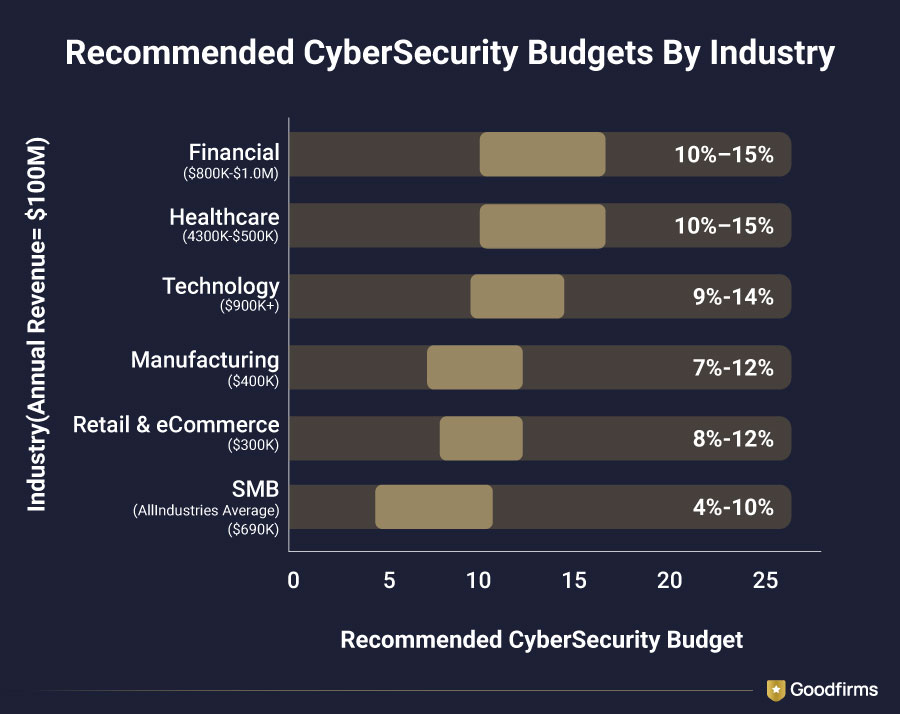
Note: These figures are based on cybersecurity spending as a percentage of annual revenue and should not be directly compared with IT-budget allocation benchmarks shown later in this guide.
Calculation:
$100M × 0.69% = $690,000 annual cybersecurity budget. This represents the average cross-industry cybersecurity spending benchmark reported by StationX.
Here's a quick breakdown of average cybersecurity budget by sector:
- Healthcare: faces increasing ransomware attacks and stringent patient data protection requirements. Organizations should allocate approximately 13.3% of their IT budget to cybersecurity, with a recommended range of 10%–15% based on regulatory demands, data sensitivity, and overall risk exposure.
- Financial Services: It is among the highest spenders on cybersecurity due to strict regulatory requirements and the constant threat of fraud and cybercrime. Organizations should allocate approximately 21% of their IT budget to cybersecurity, with a recommended range of 10%–15% depending on compliance obligations, transaction volumes, and risk exposure.
- Manufacturing: It is expected to see the strongest cybersecurity budget growth in 2026, driven by digital transformation and rising operational technology (OT) security risks. Organizations should allocate approximately 11% of their IT budget to cybersecurity, with a recommended range of 7%–12% depending on operational complexity, automation levels, and cyber risk exposure.
- Technology: the companies face constant threats targeting intellectual property, cloud environments, and software supply chains. Organizations should allocate approximately 21% of their IT budget to cybersecurity, with a recommended range of 9%–14% based on product complexity, infrastructure scale, and data protection requirements.
- Retail & E-commerce: the organizations must protect customer payment data and online transaction systems. Organizations should allocate approximately 6% of their IT budget to cybersecurity, with a recommended range of 8%–12% depending on transaction volume, customer data sensitivity, and digital footprint.
- Small businesses typically dedicate a larger percentage of their IT budgets to cybersecurity because fixed security costs are spread across smaller technology budgets. Organizations with fewer than 100 employees should generally allocate 16% of their IT budgets to cybersecurity, depending on risk exposure and compliance requirements, with a recommended range of 4%–10%.
Source: IANS
Why Cybersecurity Spending Changed in 2026
In 2026, cybersecurity spending entered a decisive phase marked by record investment levels, accelerated budget growth, and tighter alignment with business risk. Organizations are spending more, but differently, such as prioritizing automation, managed services, and identity-centric defenses over isolated point solutions.
What's behind this shift? A few things:
Ransomware continues to be a major threat. According to the 2025 Verizon DBIR, ransomware appeared in 88% of breaches involving SMBs — a staggering number that shows no signs of slowing. AI-powered phishing, deepfake impersonation, and automated vulnerability discovery are increasing the speed and sophistication of cyberattacks, forcing organizations to invest in stronger AI-powered encryption software for detection and response capabilities.
Goodfirms Insight: "Organizations that align cybersecurity budgets with business risk rather than technology purchases tend to achieve stronger security outcomes and better ROI from their investments."
Global Cybersecurity Spending by Region
Cybersecurity spending varies widely across regions. North America remains the largest market, accounting for nearly 45% of global cybersecurity investments. This is largely driven by strong government funding in the United States and significant spending by large enterprises. Europe represents around 25% of the market, with regulations such as GDPR, NIS2, and DORA encouraging organizations to strengthen their security programs. At the same time, Asia-Pacific is seeing the fastest growth, with cybersecurity investments rising rapidly across countries like Japan, Australia, and India.
.jpg)
Source: Fortune Business Insights
Cybersecurity Spending by Category
Security software continues to attract the largest share of cybersecurity spending, $106 billion in revenue, driven by growing demand for cloud-based tools that help organizations detect threats, automate responses, and manage compliance more efficiently. Security services remain a major investment at $86.1 billion, as businesses increasingly turn to managed security providers and consultants to fill cybersecurity skill gaps. Network security also continues to grow steadily, with $23.3 billion, as organizations invest in stronger infrastructure protection to defend against evolving cyber threats.
.jpg)
Cybersecurity Budget Trends in 2026
Cybersecurity is now a strategic business priority, with nearly 50% of organizations allocating between $1 million and $10 million annually. This trend reflects a shift beyond basic security measures toward advanced capabilities such as threat detection, exposure management, incident response, and governance.
.jpg)
How to Approach Your Cybersecurity Budget: A Step-by-Step Framework by Goodfirms
Planning a budget sounds complicated, but it doesn't have to be. Here's a straightforward way to think about it.
.jpg)
Step 1: Know your risk
Every industry faces different threats. A hospital worries about patient record theft. A bank worries about fraud and account takeovers. A manufacturer worries about OT attacks that can shut down production lines. Before you spend a single dollar, sit down and ask: What are the three biggest threats to my business? Your budget should be built around those answers.
Step 2: Benchmark your current spending
Organizations spend an average of 0.69% of annual revenue on cybersecurity, up from 0.48% in 2022. Use this benchmark alongside industry-specific IT budget recommendations when evaluating your security investments. Use this as a starting point. If you are spending significantly less than your industry peers, you are likely underprotected. If you are spending more, make sure you know exactly what you are getting for it.
Step 3: Allocate across the right categories
The typical cybersecurity budget splits roughly 40% to software and platforms, 30% to internal personnel, 15% to hardware and appliances, and 15% to outsourced services. This is a useful baseline, but your specific split will depend on whether you have an in-house security team, how mature your existing tools are, and whether you are relying on a managed security service provider (MSSP).
Step 4: Don't forget training
Human error is still the number one cause of data breaches. Your employees are either your greatest security asset or your biggest vulnerability — and that depends entirely on whether they have been trained. Budget for regular security awareness training. It's one of the highest-ROI investments you can make.
Step 5: Plan for incident response
Even with the best tools in place, breaches can happen. Having a documented incident response plan — and the budget to execute it — can be the difference between a manageable disruption and a company-ending crisis. Include this in your planning.
What Should You Actually Spend Your Budget On?
This is where many businesses get it wrong. There are the best cybersecurity software that are available for free vs. paid, but it's essential to invest in the right tools as per the specific requirements for industries. Here's a practical breakdown of where your cybersecurity money should go in 2026.
-
Cloud Security
Organizations spend an average of 10% of their annual revenue on cloud services, compared with roughly 0.69% allocated to cybersecurity. This gap highlights the importance of ensuring cloud investments are matched with appropriate security controls. If your business runs on cloud infrastructure — and most do — protecting your cloud environment isn't optional. Budget for Cloud Access Security Brokers (CASBs), cloud workload protection, and cloud management tools.
-
Endpoint Protection
Every device that connects to your network is a potential entry point. Endpoint detection and response (EDR) tools and encryption software are now standard for businesses of any size. If you are still relying on basic antivirus software, it's time to upgrade.
If you want to evaluate endpoint management and patching before committing budget, you can start a free trial of ManageEngine Endpoint Central and test it across your own devices.
-
Identity & Access Management (IAM)
One of the most overlooked areas of cybersecurity spending. Controlling who has access to what — and making sure that access is appropriate — is a foundational security practice. Multi-factor authentication (MFA) alone blocks the majority of credential-based attacks like identity management software.
-
Penetration Testing & Vulnerability Assessments
You can't fix what you don't know is broken. Regular penetration testing — where ethical hackers try to break into your systems before the real ones do — is an incredibly valuable investment. Looking for qualified firms to help? Browse verified cybersecurity providers with client reviews, pricing, and service expertise, making it much easier to find a partner that fits your budget and industry.
-
Managed Security Services (MSSP)
Not every business can afford a full in-house security team, and that's completely fine. Managed Service Provider (MSP) software offers round-the-clock monitoring, threat detection, and incident response at a fraction of the cost of building an internal team. For SMBs especially, this model makes a lot of financial sense.
Many organizations evaluating security investments eventually face a common question: build an internal team or outsource to a managed security provider?
|
Factor |
In-House Team |
MSSP |
|
Initial Cost |
High |
Low |
|
Hiring Requirements |
Significant |
Minimal |
|
24/7 Monitoring |
Expensive |
Included |
|
Specialized Expertise |
Depends on hires |
Built-in |
|
Scalability |
Slower |
Faster |
|
Best For |
Large enterprises |
SMBs & Mid-market |
Cybersecurity Priorities by Industry
Different industries have different threat landscapes, and your budget needs to reflect that.
- The Healthcare Sector: The top priorities should be protecting electronic health records (EHR), ensuring HIPAA compliance, and securing connected medical devices. 53% of medical devices carry critical vulnerabilities, and 99% of hospitals have devices with known exploits — this is an area that demands serious investment.
- The Financial Sector: At first, you need to focus on fraud detection, transaction monitoring, and protecting customer data. Regulatory compliance (SOX, PCI-DSS, GLBA) isn't optional, and failing to meet it can result in fines that far exceed the cost of compliance.
- The Manufacturing Sector: Manufacturing faces the challenge of securing both operational technology (OT) and industrial IoT, adding a second spending category on top of traditional IT security. With production lines now connected to digital networks, an attack can stop physical operations entirely.
- The Retail or eCommerce Sector: Payment security and fraud prevention are your biggest concerns. PCI-DSS compliance is mandatory, and protecting customer payment data should be a non-negotiable line item in your budget.
- The Technology Sector: As a tech company, your clients trust you with their data. A breach doesn't just hurt your business — it hurts everyone who relies on you. Zero Trust architecture and robust API security are worth the investment.
If you are looking for vetted cybersecurity partners with verified reviews for any of these industries, the Goodfirms top cybersecurity companies list is a strong starting point for comparing vetted providers across industries. Every company listed is evaluated on expertise, client satisfaction, market presence, and verified reviews — so you are not just taking someone's word for it.
Cybersecurity Budget Mistakes to Avoid in 2026
Even well-intentioned businesses make these errors. Knowing what they are helps you avoid them.
.jpg)
- Mistake 1: Treating cybersecurity as a one-time purchase. Security is not a product you buy and forget. Threats evolve constantly, and your defenses need to evolve with them. Budget for ongoing subscriptions, updates, and assessments — not just a single annual purchase.
- Mistake 2: Over-investing in tools, under-investing in people. Only 11% of security executives feel adequately staffed. Tools don't run themselves. If you have a sophisticated security platform but no one trained to use it properly, you have essentially wasted that money.
- Mistake 3: Relying on cyber insurance instead of security controls. Insurance carriers are tightening requirements and exclusions — policies won't cover losses from known unpatched vulnerabilities or insufficient security posture. Insurance is a safety net, not a strategy.
- Mistake 4: Not involving leadership. Cybersecurity budgets get approved faster when they are framed as risk management decisions, not IT costs. Present your budget in terms of what it protects against — not just what it costs.
- Mistake 5: Ignoring compliance deadlines. Critical 2026 compliance milestones include CMMC 2.0 Phase 1 for defense contractors, CIRCA incident reporting taking full effect in May 2026, and HIPAA Security Rule updates elevating network segmentation to mandatory status. Missing these deadlines can result in penalties that make the cost of compliance look very small in comparison.
How to Measure Your Cybersecurity Budget ROI
Spending money is easy. Knowing whether it's working is harder. Here are a few metrics worth tracking:
- Mean Time to Detect (MTTD): How long does it take your team to identify a breach? The faster you detect, the less damage is done.
- Mean Time to Respond (MTTR): Once a threat is detected, how quickly do you contain it? This measures the effectiveness of your incident response processes.
- Security spending as a percentage of revenue vs. peers: Are you in line with your industry? Too far below the benchmark suggests underinvestment; too far above might signal inefficiency.
- Cost per incident: Track what each security incident costs you in remediation, downtime, and reputation damage. Use this to make the case for preventive investments.
FAQs-Cybersecurity Budget in 2026:
What’s the First Thing to Cut When the Cybersecurity Budget is Tight?
Avoid cutting employee training, backups, or endpoint protection. These are foundational controls that prevent many common attacks. Instead, review overlapping tools, unused licenses, or low-priority projects before reducing core security protections.
How to Choose the Right Cybersecurity Partner
The right cybersecurity partner should understand your industry, business risks, and compliance needs. Look for proven experience, transparent pricing, strong client reviews, and services that align with your security goals and budget.
How much should a small business spend on cybersecurity?
Most small businesses should dedicate enough budget to cover essential protections such as endpoint security, employee training, backups, and monitoring. The exact amount depends on business size, risk exposure, and regulatory requirements.
What percentage of an IT budget should go to cybersecurity?
A common benchmark is 8–12% of the total IT budget. Organizations in highly regulated industries or those handling sensitive customer data may need to allocate closer to 15%.
Is cybersecurity outsourcing cheaper than hiring in-house?
For many SMBs, outsourcing is often more cost-effective. Managed security providers offer access to specialized expertise and 24/7 monitoring without the expense of building and maintaining a full internal team.
What industries spend the most on cybersecurity?
Healthcare, financial services, technology, and manufacturing typically invest the most in cybersecurity. These industries manage sensitive data, face strict regulations, or operate critical systems that require stronger protection.
What cybersecurity tools should SMBs prioritize first?
SMBs should start with endpoint protection, multi-factor authentication, cloud security, regular backups, and employee security training. These foundational measures help reduce the most common cyber risks effectively.
Conclusion:
Planning a cybersecurity budget in 2026 is not about spending the most. It requires attention to the specific business requirements based on your industry and your actual risk profile. Start with where you are, benchmark against your industry, allocate thoughtfully across people, tools, and services, and review your budget at least quarterly as your environment changes. Once you get this in place, you will stop treating security as an IT expense and ensure it's a part of your business decision, and it's the most valuable security investment you can make.