The eCommerce industry is fiercely competitive.
To stand out amongst a pool of online stores can seem incredibly tough these days.
The same story holds for online stores like Shopify. A whopping 95% of Shopify stores fail despite hiring top Shopify developers.
If your Shopify store is struggling, don't worry - many store owners face the same challenge. But there’s a solution to it.
This Shopify Store Optimization Checklist will fix that.
Here’s what you’ll get:
By following these Shopify best practices, you can easily increase traffic to your store.
Let’s quickly start by explaining what Shopify optimization is in a nutshell.
What is Shopify Store Optimization?
Shopify is one of the best eCommerce platforms available in the market. This undisputable eCommerce platform powers around 5.6 million active stores globally.
But, unfortunately, merely launching a Shopify store is just not enough to build a successful eCommerce business . You need to ensure that your Shopify store drives visitors, engages & delights them, and ultimately converts them into lifelong customers.
This is where Shopify store optimization comes into the picture.
Shopify store optimization involves paying attention to every aspect of your store that impacts the bottom line, including its design, functionality, product offers, payment modes, shipping & delivery, and more. Even a minutest improvement in the performance of your Shopify store can drive substantial benefits to your online business.
So, how to optimize your Shopify store in the right way?
Yes, there are some Shopify store optimization tips and tricks for optimizing your webstore in the right manner. But, before we go through them, let’s have a look at the fundamentals of Shopify store optimization.
Fundamentals of Shopify Store Optimization
Shopify store optimization is not all about just making the website look pretty or improving its speed. There are several basic elements of a Shopify store to be taken care of to ensure that no customer steps out of it without making a purchase. A comprehensive Shopify website optimization usually includes the following efforts:
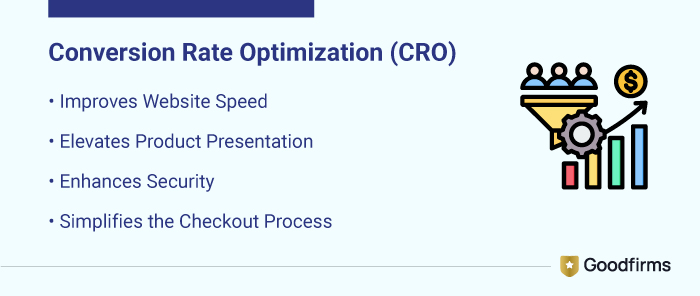
Conversion Rate Optimization (CRO)
There may be many visitors browsing your online store every day. But how many of them actually purchase your products or subscribe to your services? Shopify store conversion rate optimization is all about increasing purchases on your store. It involves enhancing the user experience, enriching the website with features, and making your products and services appealing enough to attract buyers to your store, and placing CTAs (Call to Action Buttons) prominently.
CRO efforts include web design and development services, analyzing user behavior, following the latest eCommerce trends, testing before launching the store, creating ideas about how to improve the store functionality, and executing those ideas to boost the overall conversion rate.
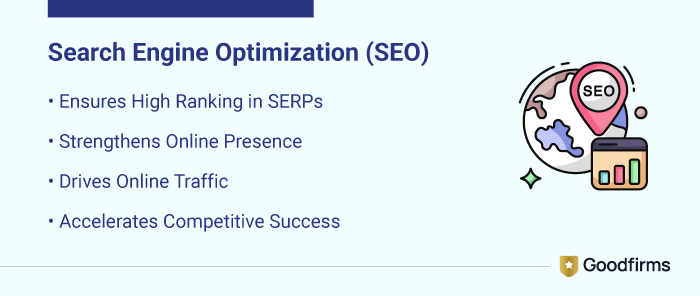
Search Engine Optimization (SEO)
Even though your Shopify store is extremely user-friendly and attractive, and you are offering the best products and services, if it is not ranking at the top of the search engine result pages, you might lose out on many sales opportunities. This is where search engine optimization for Shopify store comes into the picture.
Applying Shopify store SEO optimization techniques involves a proper blend of keyword research, high-quality content creation, link building, using images and videos effectively, assigning a clean URL structure, and many more techniques that help your Shopify store gain online visibility and drive visitors who can be converted into customers.
Mobile Optimization
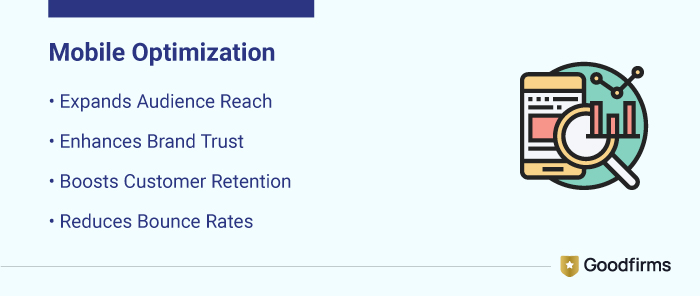
1.2 billion people are browsing websites from their mobile devices. Does your Shopify store look and function well on multiple mobile devices? If not, then you really need to make sure that your Shopify website uses a responsive design to adapt dynamically to multiple screen sizes and operating systems. The buttons and links on your website should be easy to tap on a mobile screen, and the content should be readable on small screen sizes.
Ensuring that your Shopify store is optimized for mobile devices is important to provide excellent user experiences, helping you expand the reach of your target audiences, gain their trust, and finally lead to improved sales.
Social Media Optimization (SMO)
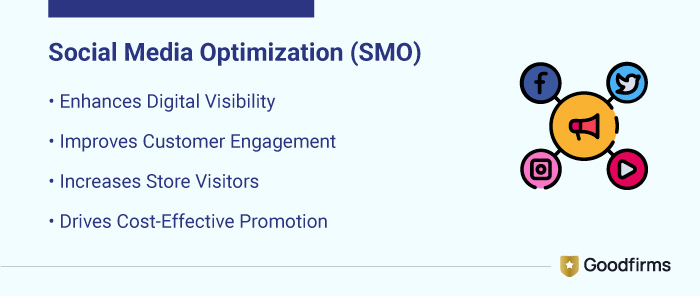
Creating engaging content like videos, images, and user-generated content and posting them on social media can help in driving traffic to your Shopify store. Also, posting and updating consistently using relevant keywords, strategic hashtags, and clear calls-to-action, running targeted ad campaigns on different social media platforms can lead to improved sales and revenue generation.
Social media optimization is a very useful tool that is being used by Shopify store optimization companies to establish a strong brand identity for eCommerce companies. Whether it is about attracting new customers or retaining the existing ones, social media optimization has become an essential part of digital marketing for eCommerce businesses these days.
So, these were the key elements of Shopify store optimization that can even make even your stagnantly selling online store into a happening and fast-selling marketplace.
(Source: Nudgify)
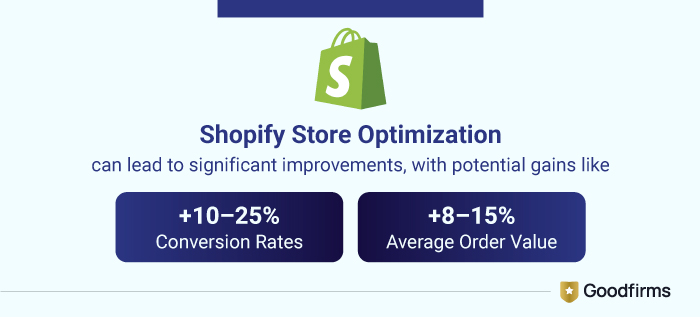
Yes, this is true. Shopify store optimization, if done correctly, can enhance customer experiences and search engine visibility, ultimately leading to consistent growth in revenue generation. Shopify store app optimization is crucial to eCommerce success. But why? Let’s have a look at the importance of Shopify store optimization.
Importance of Shopify Store Optimization
You would all agree that in this digital age, there are many eCommerce stores providing the same products and services that you do. Customers stay in a store for a longer period of time and buy from there only if they are enjoying their entire shopping experience - from stepping in to checkout. To keep your customers coming back to your online store and making purchases, you need to ensure that your store delights and pleases them. Below are some benefits that answer your question: why is optimizing a Shopify store important?
Why is Optimizing a Shopify Store Important?
To answer this question, let’s have a look at the core benefits of optimizing a Shopify store.
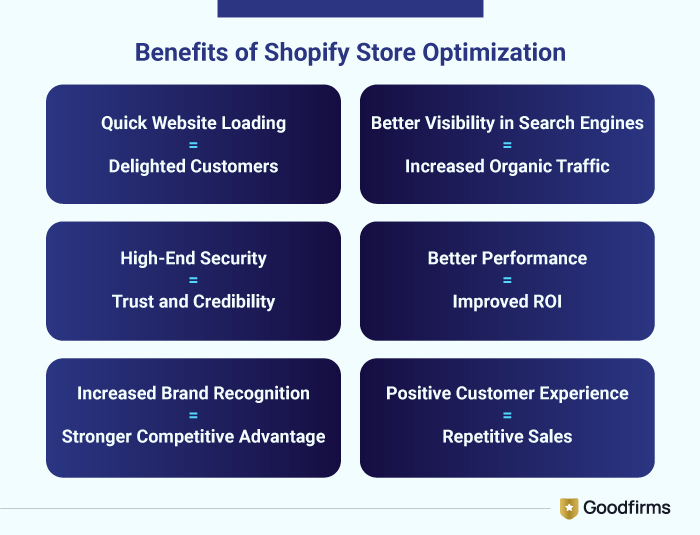
Let’s have a look at these benefits of Shopify store optimization in detail.
Quick Website Loading = Delighted Customers: Being an eCommerce business owner, you would definitely agree to the fact that a one-second delay in loading your website can make your customers move to your competitors’ store. Shopify store speed optimization ensures that your online store loads quickly and keeps your customers delighted.
Better Visibility in Search Engines = Increased Organic Traffic: Shopify store optimization is not only for users. It also helps a Shopify store to gain high rankings in SERPs. Search engines such as Google rank websites that include content with relevant keywords, have a structured navigation, and other attributes that make it extremely search engine-friendly.
High-End Security = Trust and Credibility: To convert your online store visitors into customers, you need to make sure that they feel secure while navigating through and making payments. An optimized Shopify store keeps customers’ data safe and prevents it from ransomware and malware attacks.
Better Performance = Improved ROI: A Shopify store that is optimized for users and search engines performs better and drives relevant traffic. This results in a significant increase in sales, leading to considerable improvements in ROI.
Increased Brand Recognition = Stronger Competitive Advantage: A Shopify store that earns brand recognition through social media optimization is likely to increase its customer base, leading to a stronger competitive advantage.
Positive Customer Experience = Repetitive Sales: An optimized Shopify store provides a seamless shopping experience to the customers, reducing bounce rate to the greatest extent, and making customers consistently return to the same store for their future needs.
So, now we know what Shopify store app optimization is and its benefits. Moving further, let’s have a look at these 10 proven Shopify optimization tricks every eCommerce business owner should know to maximize sales and gain the best returns on their investment.
10 Proven Shopify Optimization Tips
Driving traffic to your Shopify store is important, but more than that, it is also significant to convert that traffic into buying customers. Many Shopify store owners face this challenge: “Too many visitors but not enough sales.” There is only one solution to this problem - optimizing the Shopify store effectively. But how to ensure that your Shopify store is being optimized in the right way? Below is the checklist: 10 things every Shopify owner must do to grow their online business.
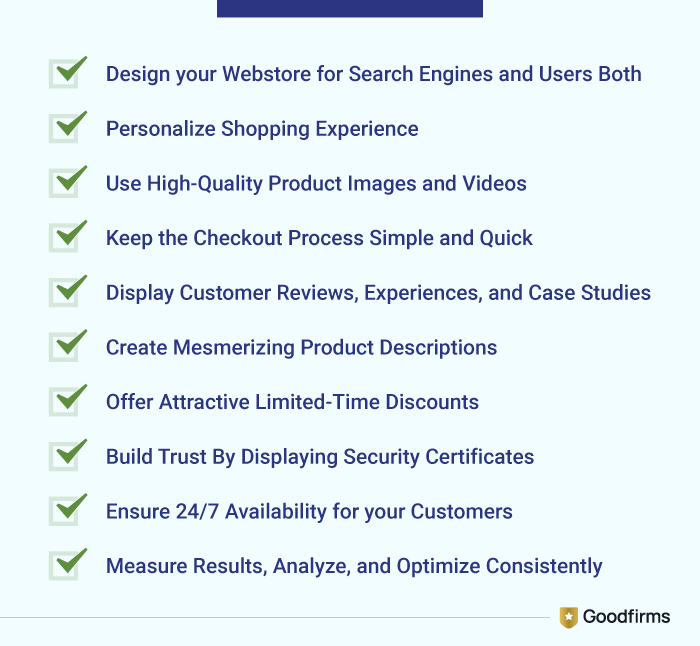
Let’s have a look at this checklist in detail.
#1 Design your Webstore for Search Engines and Users Both
Designing an online store that attracts the attention of users and search engines both means it should rank high in search engines with relevant keywords to drive traffic, and at the same time, should be user-friendly to retain those visitors for a long time and convert them into customers. But, how? The following practices can help you do that:
- Follow a minimalist approach while designing your Shopify store so that it loads quickly.
- Apply clear navigation that helps store visitors to easily find your products and services.
- Make sure that your call-to-action buttons are visible and attractive.
- Use relevant keywords in the content, and optimize images & videos for search engines.
- Display your unique selling points, and popular products & services above the fold.
- Compress images and graphics without losing quality and enable browsing caching to ensure fast loading of your Shopify store.
#2 Personalize Shopping Experience
A personalized shopping experience makes customers feel valued and understood. It also saves their time while they are searching for specific products and services. For example, a returning visitor who finds the products they browsed for in their previous visit can make quick purchasing decisions. Artificial Intelligence-powered personalized product recommendations can instigate repetitive purchases, leading to improved conversions.
Here are some effective Shopify store optimization and customization strategies to be followed to provide a personalized experience to your customers:
- Display product recommendations prominently based on past purchases or browsing history.
- Ensure that your product pages include sections like “Recently Viewed” or “Recommended for You.”
- Automate sending personalized emails and product recommendations to your customers through emails for repetitive sales.
To integrate personalized recommendations into a Shopify store, you can use these AI tools for Shopify store optimization, like AiTrillion, Recom.ai, Rep.AI, LimeSpot, or Nosto. It is always recommended to hire the best AI developer who can help you professionally integrate AI-powered personalization features into your Shopify store for better results.
#3 Use High-Quality Product Images and Videos
Product images and videos influence customers' purchase decisions. So, you need to ensure that your product images and videos are displayed in the right manner to help your customers make quick purchasing decisions. Proper display of products in the form of images and videos can establish trust in the minds of your customers. Ensure that you follow the practices outlined below when applying product images and videos to your Shopify store.
- Apply multiple high-resolution images in different angles so that customers can easily examine them before purchasing.
- Videos should educate about how the product works and are supposed to be clearly visible with an audible voiceover.
- You can also integrate AR/VR features into your Shopify store to enable your customers to have a virtual experience of how your products look and work in real situations.
#4 Keep the Checkout Process Simple and Quick
To maximize sales on your Shopify store, you need to ensure that the checkout process is simple and quick. Many online stores require customers to register or log in before checking out. Sometimes stores ask customers to enter difficult CAPTCHA information during this process. This can even irritate your customer and cause them to abandon their cart. To avoid this situation, you need to follow the practices below and make the shopping experience pleasant for your customers.
- Enable multiple payment options for your customers.
- Allow guest checkout or make login/registration simple with OTP.
- Keep form fields limited to only important information.
- Clearly display the shipping costs and delivery times before checkout.
#5 Display Customer Reviews, Experiences, and Case Studies
Displaying customer reviews, experiences, and case studies can build credibility and trust. When buyers see how happy your current customers are and how successfully you overcame various challenges and completed projects, they are more likely to buy from you. Not only that, but positive and authentic customer reviews on your Shopify store can also boost your search engine visibility and improve brand perception. This effort can demonstrate the transparency, values ,and ethics your business follows and therefore impresses customers to a greater extent. Below are some best practices you can follow:
- Highlight positive testimonials or media mentioned on your online store home page.
- Make it easy and simple for your customers to leave reviews after checkout.
- Offer discounts to your customers in lieu of positive testimonials, photos, and videos.
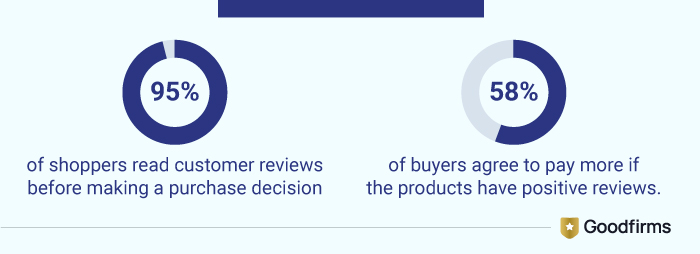
(Source: Globenewswire)
#6 Create Mesmerizing Product Descriptions
Product descriptions on your Shopify store should not only explain their features and benefits, but need to be enticing enough to lure your customers into buying them. Product descriptions that attract customers can motivate them to make purchases without giving a second thought to other deciding factors like price. Below are some effective factors that need to be taken into consideration while writing product descriptions for your Shopify website.
- Describe benefits and outcomes.
- Use simple, persuasive, and emotive language.
- Ensure small paragraphs with enough whitespace and bullet points.
- Integrate your focus keywords naturally within the content.
#7 Offer Attractive Limited-Time Discounts
Shoppers love that they are getting some discounts on their purchases. But, more than that, limited-time offers create the urgency that makes buyers buy in a hurry. This traditional method of creating urgency in purchases has consistently proven effective for all retail businesses, whether online or offline. You can apply the following ideas to make your limited-time discounts fruitful.
- Introduce free shipping on an order of a specific amount.
- Bundle products and keep the price less than if bought separately.
- Set first-time discounts to gain conversions from new visitors.
- Display countdown timers for discounts.
#8 Build Trust By Displaying Security Certificates
Online stores usually require dealing with a lot of customers’ sensitive information, like card details, bank account information, etc. Buyers can share their information with confidence only when they feel that the online store they are purchasing from is secure. Shopify stores come with a free SSL certificate that ensures all data is protected through HTTPS encryption. You need to display these security certificates to reassure customers that they are dealing with a highly secure store to build trust and improve conversions. Below are some steps that are integral to follow to win buyers’ trust:
- Display “Secure Checkout” badge.
- Ensure having an HTTPS padlock icon next to the URL of your Shopify store.
- Use trustworthy payment gateways like PayPal or Stripe.
- Showcase your trust badges and security seals prominently.
#9 Ensure 24/7 Availability for your Customers
Customer support is the backbone of any type of online business. Your customers may need your support at all times, whether day or night, regardless of time zones or holidays. So, it becomes necessary to ensure 24/7 availability for your customers. Buyers these days love to deal with businesses that solve their problems promptly, and this is where 24/7 customer service becomes significant. The following best practices relevant to 24/7 customer support can help your Shopify store to encourage more sales and fewer grievances.
- Use a combination of humans and chatbots while answering customers’ questions or problems.
- Offer support on multiple channels like email, instant messaging, phone, live chat, etc..
- Use CRM to keep track of customers’ information on a real-time basis.
- Ensure to provide personalized support to customers.
- Use global teams if you have customers around the world to meet their time zones and holiday schedules.
#10 Measure Results, Analyze, and Optimize Consistently
Measuring results is very important to know whether you are implementing the right Shopify store optimization strategies or not. Analyzing those results is required to make decisions about future strategies, and optimizing consistently will ensure that your Shopify store is up-to-date as per your buyers’ preferences. There are many tools like Google Analytics, Hotjar, and Lucky Orange that you can use to measure important metrics like:
- Click-Through-Rate
- Visits (Based on Source, Geographical Region, New/Old Users, and Many Other Criteria)
- Bounce Rate
- Goal Conversions
- Cart Abandonment Rate
- Average Order Value
Measuring these metrics and planning future digital marketing campaigns is crucial for gaining more traction from users and expanding into new markets.
So, these were the Shopify store optimization best practices every owner must follow. But what about what Shopify owners should not do? Yes, we are talking about Shopify store performance optimization mistakes one should avoid. Let’s have a look at them so that you can prevent the downfall of your flourishing online business.
Common Shopify Optimization Pitfalls to Avoid
Regardless of how careful you are about following the best practices for your Shopify store optimization, mistakes can happen unintentionally. Let’s learn how to avoid common Shopify optimization pitfalls to ensure the success of your online business.
Choosing the Wrong Shopify Development Company
Make sure that you select the best company for Shopify store optimization services. A professional Shopify development company would not only take care of all the aspects required to optimize your Shopify store but also ensure that it churns considerable profit to meet your business goals.
Underestimating the Power of mCommerce
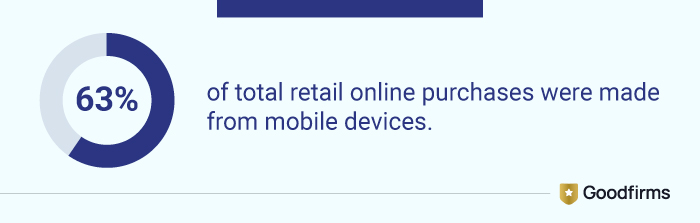
(Source: Statista)
If your Shopify store doesn’t show up on mobile devices properly, then you might miss out on considerable sales opportunities. Therefore, it becomes necessary for you to opt for responsive website design services for your Shopify store. Besides that, professional app development companies can help you launch a user-friendly mobile app for users who are more comfortable buying through apps.
Neglecting Audience Feedback and Analytical Insights
Collect regular feedback from your customers and work on it to improve your Shopify store experience. Neglecting audience feedback and analytical insights can cost you heavily in the long run. Being successful in the eCommerce industry is all about taking care of customers’ demands and preferences, which evolve with time. Customers’ feedback and analytical insights help you understand your customers better and keep you updated on changing buyer behavior.
Applying Highly Aggressive Marketing Tactics
Are you sending “Buy Now” emails too frequently to your customers? There is a chance that of your business emails will get unsubscribed by your customers. Prefer quality over quantity and schedule your email marketing campaigns wisely. Consumers these days get irritated quickly if you bombard them with your highly aggressive marketing tactics. Understand your customers well and send them personalized emails with meaningful messages at regular intervals.
Conclusion: Creating Compelling Shopping Experiences with Shopify
Creating compelling shopping experiences with Shopify is not an easy 8-hour job. It takes time and dedicated efforts that include careful planning, design & development as per users’ preferences, and continuous testing and updating as per the latest trends. Precisely, this Shopify store optimization guide explains that by focusing on personalization, minimalism, transparency, and trust, you can definitely create wonderful experiences for your customers over a Shopify store and convert it into a powerful marketplace.
FAQs
How Can I Make My Shopify Store More Appealing?
Just view your Shopify store from the users’ perspective. Make sure that you use the right design theme for your Shopify store, test it rigorously, prioritize user experience, make it mobile-friendly, use high-quality visuals, and keep the checkout process simple.
How to Personalize Shopping Experience on a Shopify Store?
You can use techniques like showcasing personalized recommendations based on browsing history, sending customized emails to buyers who have abandoned their cart to deliver a personalized experience to your users.
Where Can I Find the Best Shopify Developer for my eCommerce Project?
Go through the list of the best Shopify developers on GoodFirms and apply user-friendly filters, such as geographical location, budget, skills, experience, and more, to shortlist the Shopify development companies according to your preferences.
Does Shopify include SEO Features?
Yes, Shopify includes built-in SEO features that can help you automate the generation of XML sitemaps and customize URL structure to make your content more discoverable in search engines. But, to ensure that your Shopify store ranks higher in search engines, you need to hire a professional SEO company specializing in providing digital marketing services for eCommerce businesses.