Though e-commerce was a buzzword some years ago, today, with digitalization, it has become a norm. We see a total transformation in the way we shop via E-commerce sites. The manual process of customer experience, logistics, and business operations that online stores follow costs a lot of money and effort. Online stores were facing limited personalization, customer interaction management issues, and fraudulent activity detection challenges that made customers second guess while purchasing anything online. However, with Ecommerce rising as one of the lethal industries that has shaped the future of shopping from going out to purchase a product to now pressing the buy button in an online store to place the order for a product that you want.
In recent years, the AI revolution has made a huge impact on the online shopping behavior of customers with more personalized shopping experience and AI-driven E-commerce assistance. With the rise of Artificial Intelligence, shopping experience, and client support have become phenomenal, enabling enhanced security, dynamic suggestions, 24/7 support with AI chatbots & virtual assistance, ad targeting & bidding, user behavior analysis, and so on. Online stores can now utilize AI-powered tools to offer personalized shopping experiences to customers with the assistance of user behavior analysis. Brand marketing and product marketing goals can be effortlessly achieved through AI tools and technologies. There are several AI-powered Ecommerce software solutions that facilitate powerful and functional features to online businesses.
Types of E-commerce models
There are 6 basic types of e-commerce models. They are as follows:
1) B2B (Business-to-business)
B2B e-commerce model relates to sales made between businesses. For example; Sales made between a manufacturer and a retailer/wholesaler. Business bodies are involved in this form of Ecommerce, and it does not entail customers.
2) B2C (Business-to-consumer)
It is a sort of Ecommerce transaction that is made between business and customers and extensively used sales patterns. For instance, when you buy clothes from an online retailer it is considered as a B2C operation.
3) C2C (Consumer-to-consumer)
You guessed it. The name says it all. The consumer-to-consumer e-commerce business model is the transaction between customers. For example; the classifieds section of a newspaper. Here a customer, not a business, sells goods/services to another customer. The goals of C2C are to help buyers and sellers to locate each other.
4) C2B (Consumer-to-business)
C2B is when customers offer products or services of value to businesses. How is that possible? This example will help you to understand: Shutterstock is a company that relies on user photos. Thus, they receive their ‘goods’ from customers. A press release or valuable feedback can also be classified as C2B business.
5) B2A (Business-to-administration)
B2A includes all transactions conducted online between companies and government agencies (administration). This e-commerce model works for marketing your products or services on government levels. Services related to tenders, social security, auctions, etc. are examples of this model.
6) C2A (Consumer-to-administration)
C2A deals with direct communication of the consumer with the government. This type of e-commerce helps a consumer to directly post their queries, concerns, or request feedback or information directly from their local governments. Using C2A, consumers can pay their electricity bills on government websites, pay taxes, or pay their health insurance. This helps to increase efficiency within the government.
7) Peer-to-Peer
Here, each participating member has the same capabilities and can collaborate easily.
8) Mobile commerce
The most predominant practice in today’s generation. Mobile phones are used to initiate a shopping and payment is also made via mobile payment facilities. Most of the sites are optimized now for mobile commerce.
9) D2C
Direct to consumers – the latest trend where brands can sell directly to the consumers.
Impact of AI on E-commerce
It is estimated that nearly 95% of the purchases made globally will be via ecommerce shopping platforms by 2040. Ecommerce has become smarter, faster and more personal as online shopping has become more efficient with AI-integrated tools and technologies. The sophisticated experience of scrolling and exploring multiple online stores for hours to find the right products that match your preferences is now the work of seconds with AI-enabled personalized experience. Big brands like Amazon are investing in generative AI innovations to improve customers' lives, allowing a robust shopping experience with AI-powered store optimization.
As irrelevant product recommendations and suggestions let down the customers with disappointments, the AI evolution in Ecommerce has made it easy to recommend relevant products to customers with the assistance of user behaviour analysis. One can say, AI could become the driving force that offers windows for both transformation and challenges in the eCommerce market if not implemented properly.
Traditional retailers face losses
Traditional brick-and-mortar stores are experiencing difficulty to stand atop competing with e-commerce sites. Amazon is one such example that is currently revolutionizing the online shopping experience. This is because of the facility that buyers can easily compare prices and select goods in more transparent and convenient way with e-commerce platforms like Amazon. As a result, public retailers have lost their enterprise value. Many iconic retailers have either declared bankruptcy or closed down their stores in various locations. For e.g.: Macy’s, Sears etc. As consumers easily get a frictionless shopping experience online, they expect the same in brick-and-mortar stores too. Many international retailers are therefore forced to reduce their store-space in retail centers, or even worse, shut down stores due to low customer footfall.
Small businesses can sell directly to customers
Over time, the tech revolution has enabled businesses to directly connect with customers via social media channels to serve them with online buying options. In fact, social media marketing is among the top eCommerce marketing strategies for small businesses to stand out from the competition. A lot of traditional businesses are looking to build an online eCommerce store application like Sephora, while others are creating seller accounts on firms like Amazon, Flipkart, and other ecommerce giants.
Supply chain management has evolved
The traditional way of shopping involves a long supply chain of distributors and middlemen coming in between the business and the end-user. Artificial Intelligence has saved the day by cutting down the barriers and difficulties that became a nightmare for both sellers and buyers. With demand forecasting and data and inventory control from AI-powered tools, online stores can now focus on more accurate planning and reserve the right stock at the right time and place. Sophisticated tasks like warehouse operations are now easily done with automation, improving overall efficiency.
Customer shopping behavior has changed
Over the past few years, the Ecommerce market has emerged with new players offering more convenient shopping experiences. Customers who were once patiently filling in all the details in the checkout process and were ready to wait for their product to get delivered in 4-5 working days now desire an instant shopping experience. Online stores that provide flexibility, convenience, and speed are more likely to attract a large amount of customers with ease. Artificial Intelligence is performing an essential role in defining the systematic process of optimizing the online buying experience.
Shopping has become a social activity
Today people want to share their experiences with others. Digital marketing helps people do just that, and this has turned shopping into a social activity. Studies indicate that around 64% people check online reviews on Google before they make a purchase. The reviews can be from strangers. People tend to trust reviews more than brands. Retailers have now recognized this power of social media and online review sites to shape their customers’ opinion. They are now actively involved in engaging customers on social media and online review platforms.
Small businesses can sell products in the global market
The old days of small businesses selling products in their local area are gone, and many small business owners are now adapting the new way of selling online to expand their business worldwide. According to Amazon, many entrepreneurs and small businesses have found a way to boost their profit through online selling and reach customers in other parts of the world. Online store platforms like Shopify, WooCommerce, and Amazon seller accounts have played an important role in helping small vendors and entrepreneurs with cost-effective online store options. These platforms also come integrated with AI capabilities to seamlessly perform all the eCommerce-related functions.
Affordable Promotion
Entrepreneurs, small businesses, and local vendors can promote their products online at affordable cost, which helps their businesses reach relevant audiences and boost sales. With the help of AI-powered online stores, businesses can efficiently share and promote the product page with potential customers on the web and attract customers to learn and buy the product. These online stores are available 24/7, which enables an effortless shopping experience for the customers and easy product sales.
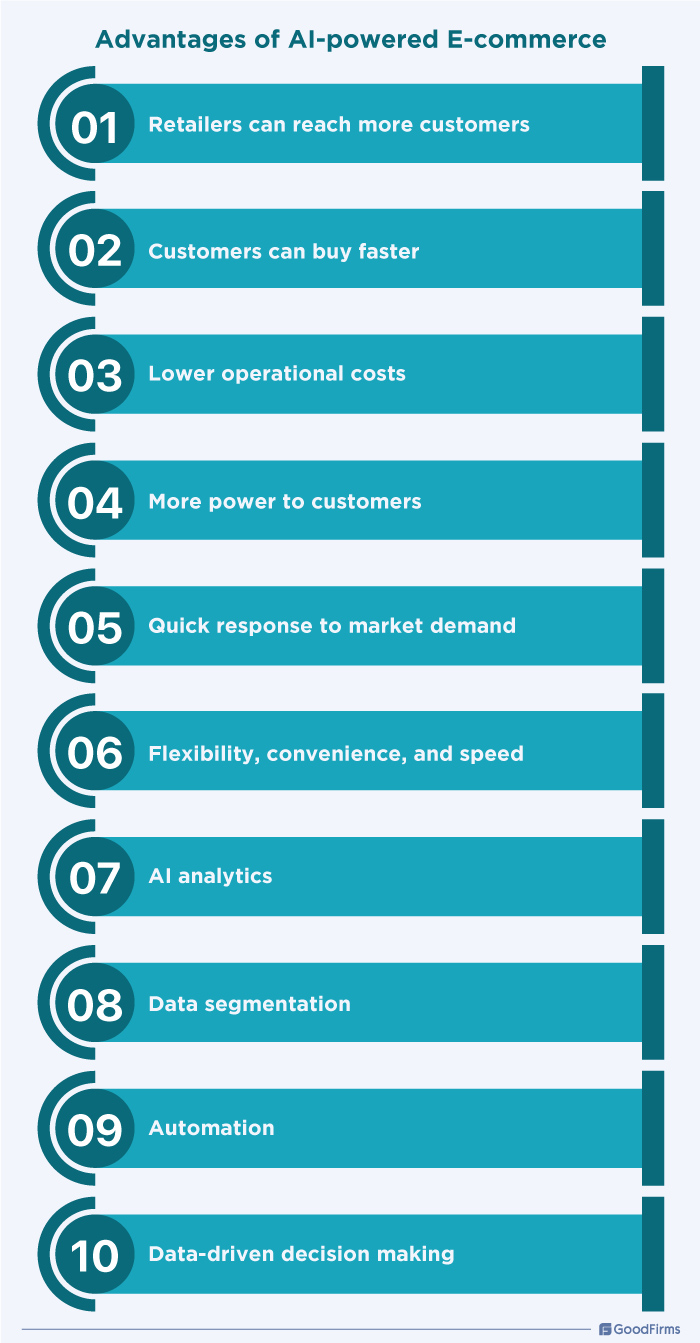
Advantages of AI-powered E-commerce
Shopping has evolved over the years, getting better at each stage from traditional then online and now AI-powered shopping experiences that enables the customers to learn about products and buy it in a more convenient way. The emerging revolution of artificial intelligence offers many advantages. Here, let’s look into it.
1) Retailers can reach more customers
E-commerce has made it easier for companies to generate a global customer base. Since geographical boundaries do not hinder an e-commerce store, it can be made available to anyone and everyone. Artificial Intelligence allows businesses to predict the customer demand of products or services in the future with robust demand forecasting. With the assistance of AI-powered Ecommerce extensions, businesses can determine the ideal pricing for the product or services.
2) Customers can buy faster
E-commerce gives customers the freedom to shop anywhere and at any time and with any retailer. There is no constraint of closing hours/opening hours like that of the traditional brick-and-mortar stores. With subscription-based selling on the rise, delivery times have reduced considerably. AI-powered personalized recommendations cut search time and smart search & filters allow users to find exact matches quickly. Also, predictive reordering enables speed for repeat purchases.
3) Lower operational costs
E-commerce retailers can launch their web stores with minimum property investments and a handful of employees. This means lower operating costs and higher margins. Administrative and repetitive work can be done through automation reducing human labour. AI chatbot provides 24/7 customer support service without large staff. AI-enabled equipment maintenance can prevent breakdown and delays ensuring better operational efficiency.
4) More power to customers
Due to high competition, maintaining the quality of products/services has become compulsory for online retailers. Unsatisfactory reviews from customers can tarnish any brand equity and image for good. So, the customer determines the success of a brand. Artificial intelligence personalization allows a more relevant shopping experience to customers. Smart search & voice provide easier and faster product discovery while AI chatbots provide instant and 24/7 support to the customers.
5) Quick response to market demand
AI-backed e-commerce allows businesses to react according to customers’ demand rapidly and provide the demanded products faster, helping customers with a phenomenal shopping experience. It helps small businesses to react faster and create a robust brand reputation into the market. With the assistance of targeted marketing and data analysis, E-commerce allows businesses to act promptly according to market demand and optimize the online store.
6) Flexibility, convenience, and speed
AI integrated extensions in online stores enable multiple options of payment, shipping process, and smooth & efficient checkout process. It allows customers with the option to get products according to their preferred date & time, get the best delivery options and make the customers shopping experience more fruitful. With Ai-driven approach, stores can save the time and efforts of customers substantially.
7) AI Analytics
AI-powered customer insights, demand forecasting, pricing, and proactive marketing strategies help businesses understand user behavior and preferences, predict trends & plan stocks, set competing & profit boosting prices, and improve targeting & ROI respectively. AI offers instant insights with AI which is one of the major reasons why millions of entrepreneurs choose ecommerce software.
8) Data Segmentation
Artificial Intelligence assists in quick segmentation of the customer data like demographic, behavioural, spending pattern, engagement level, interests, and devices/channels with predictive analysis to improve decision making. Online stores can drive more conversions & sales, get higher customer satisfaction, and increased ROI with targeted marketing, personalized experiences, and better campaign results.
9) Automation
With the assistance of automation, businesses can manage order fulfilment, inventory control, chatbots, and cart reminders which allows businesses to track & update stocks, handle customer queries, and send follow up emails successively. With the assistance of AI-enabled automation, online stores can deliver faster, prevent overselling, provide 24/7 support, ensure higher engagement, make informed decisions, and more.
10) Data-driven decision making
As technology is advancing further, AI-powered ecommerce tools provide data for predictive analysis. This data can be used to set competitive prices to increase the profit margins to boost the decision making process. With the assistance of previously performed insights, AI predicts the potential figures, tactics and techniques to enhance the decision making.
Ecommerce has made the lives of millions of people more convenient than ever. E-commerce has indeed brought about a shopping evolution of sorts; there are some downsides to it. Let’s have a look at them:
Disadvantages of E-commerce Without AI
Businesses that failed to keep up with a change and have not considered integrating AI-enabled solutions are facing major challenges and setbacks competing with modern Ecommerce stores. Let’s explore the few disadvantages of Ecommerce without AI.
High return rates
Smart product recommendations help customers to be satisfied when buying it, whereas irrelevant product recommendations kill the buying urge in customers. With auto image & product analysis, customers can learn more about the product accurately, and low-quality product info makes users disappointed when receiving the product, which increases the chances of the product getting returned. Without AI integration, businesses face high return handling costs, damaged or unsellable items, customer frustration, and reduced profit margins which impact shipping, restocking, & repackaging, inventory loss, lower satisfaction & trust, and return costs cut into revenue.
Soaring marketing costs
Without the assistance of artificial intelligence, online stores face major challenges in managing cost-effective operations. The marketing cycle suffers from poor targeting, low ROI, and higher ad spending. No assistance from AI affects inventory with bad forecasting, over-understocking, impacting lost sales, and wasted money. Without AI, customer services are expensive to scale, while AI-powered manual support teams empower scaling cost-effectively. Daily operations without AI can suffer from inefficient fulfilment & logistics, which is slower and more costly. It impacts missing revenue opportunities, damaging business intelligence, and making delayed & bad decisions.
Retail real estate industry facing losses
The real estate sector is also losing profit margins due to a lack of online visibility and AI-powered real estate solutions. Fewer visitors and buyers make it challenging for the users to capitalize on wasted space and inefficient layout. No assistance from AI causes revenue streams to lower rental income & unfilled units, planning & forecasting suffers from slow & outdated strategies, and omnichannel retail support gets impacted by weak integration with modern retail habits.
E-commerce does have its perks. E-commerce platforms like Shopify have made it quick and inexpensive to get your online store up and running within no time. However, it may not be right for every business. You need to pick the exact requirement. Question yourself as to do you really want full e-commerce or just social media engagement? Or can you conduct your business through eBay or Amazon store?
In today’s changing business scenario any tool to harness the power of e-commerce may become outdated quickly. Keeping up with the changes is an uphill task for small businesses. Of course, you cannot just transplant your business from a physical premise to a digital equivalent without some degree of pain. The companies which adapt and evolve with the changing technology would manage to stay relevant.
With people spending more and more time online in – spending, e-commerce is here to stay , and flourish well in the future. Let’s have a look.
Future of E-commerce
#1 Sustainable Ecommerce
As the Ecommerce sector is rapidly evolving further, environmental impact is a growing concern, therefore businesses are rapidly shifting their focus towards top sustainable e-commerce practices. Big brands like amazon is taking essential steps to maintain environmentally sustainable and socially responsible practices. Using AI applications like demand forecasting, Logistic optimization, and smart packaging enables environmental benefits by minimizing overproduction & waste, lowering fuel use, reducing emissions, and zeroing down plastic & material waste.
#2 Data and Safety Will be Prioritized
As online shopping involves sensitive data information of customers and businesses, the chances of fraud and suspicious activities are higher which is significantly covered by AI-powered cybersecurity tools. Online stores that will integrate fraud detection and cybersecurity extensions will be more likely to mitigate vulnerabilities and avoid future cyber threats. Integrating adaptive authentication, real-time fraud blocking, and AI + Blockchain enables smarter login security, instant prevention of theft, and immutable, traceable transactions correspondingly.
#3 Voice and Visual Commerce
Amazon Alexa voice shopping is popular in the modern Ecommerce market, and it also allows visual search via camera to provide a seamless shopping experience. There are many other big brands like IKEA, Sephora, Pinterest Lens, Snapchat + Nike/Gucci that offer AR/VR online buying solutions. Futuristic AI innovations like multimodal AI(Voice+Visuals) and emotion recognition via voice allow search and shopping via speaking and seeing at once and personalized offers based on tone/emotion successively. Real-time AR shopping and smart mirrors & voice kiosks enable entire stores to experience at-home and in-store voice/visual shopping hybrid experiences.
#4 Livestream Ecommerce
Over the past few years, Livestream Ecommerce has rapidly gained popularity and will soon reach a mature phase. It allows businesses to quickly promote and sell their product and services during live sessions. The future scope and market of livestream Ecommerce is expected to be trillions of dollars in upcoming years, considering it enables direct online marketing to a large pool of viewers, giving a boost to reaching potential future customers. According to statista, China has done an incredible job in making livestream shopping more popular, and other countries are on their way to boosting their livestream shopping journey.
Conclusion
With the tech revolution coming like a tornado, AI-powered tools and technologies will shape the future of Ecommerce stores in coming years. Online stores that are encountering severe challenges nowadays will find AI-driven solutions to assist in increasing profit margins and optimizing online shopping experience. Innovative trends that are set to change the face of e-commerce include; Artificial Intelligence-based shopping, omnichannel retail, digital currencies, AR/VR, and micro-moments to name a few.
Establishing a direct and meaningful connection with customers that extends beyond mere products is the call of the day. Interestingly, there are several free and open source ecommerce software solutions available in the market. Shopify, Woo Commerce, Magento, PrestaShop are a few of the popular names of online store builders.


.jpg)