“You can’t wait for customers to come to you. You have to figure out where they are, go there and drag them back to your store.” - Paul Graham, Entrepreneur and Writer
The eCommerce industry is one of the leading industries that has been significantly hit by the increased digitalization, and the evolving technologies. Strategies that once were widely popular to attract, connect, and retain audiences no longer work in the current era. Google Search is no longer purely keyword-based, AI-driven searches have increased, social media algorithms have evolved, and consumers expect instant personalization, with exceptional experiences. Besides these, other factors, such as saturated markets, rising competition, evolving digital marketing trends, costs, etc., are also posing challenges.
As a result, eCommerce stores are forced to rethink, reengineer, and reinvent their typical approaches to effectively target and attract online shoppers.
Most eCommerce businesses are required to build and use adaptive ecosystems that leverage a combination of AI-powered e-commerce software solutions, best practices, and the latest technologies to attract and engage high intent traffic towards their stores.
If you are already having an ecommerce business and looking to:
- Increase your eCommerce store traffic
- Leverage the latest eCommerce technologies and developments
- Stay ahead of the competition
Then, this blog covers the most popular steps you can take to increase the traffic of your eCommerce store in 2026. This blog also sheds light on the reasons due to which existing traffic generation strategies are no longer sufficient to attract a huge amount of high-quality traffic from different sources.
Why are Your Traditional E-commerce Traffic Generation Strategies no Longer Valid in 2026?
Whether you are selling online and in person; Whether you are selling locally or in international markets; Whether you are selling retail or wholesale; Whether you are selling on desktop or mobile - the only mantra is to impress customers. How you do this will determine your success. This technique has shifted, and in 2026, your approach towards delivering exceptional customer experiences will have to be re-engineered.
Till now, just appearing in the traditional SERPs was the prime focus for eCommerce businesses to connect with customers. But, with the emergence of Gen AI search engines, AI assistants, Agentic commerce, etc., the e-commerce landscape has transformed.
Google’s AI overviews resulted in a 61% drop in organic CTR and a whopping 68% in paid CTR. This simply proves that traditional SEO, paid ads, social media, email marketing, influencer marketing, and other traffic generation strategies are no longer delivering the expected results for eCommerce businesses.
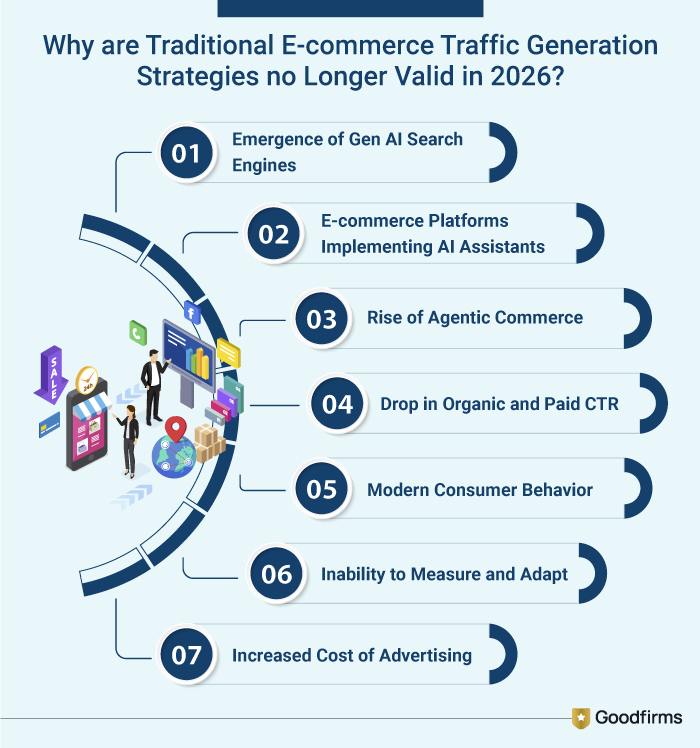
Additional challenges, such as fragmented social media reach, saturated paid advertising, consumers demanding real-time personalization, etc., are the reasons why e-commerce stores need better strategies that can drive maximum traffic towards the online store.
Moreover;
- Social media platforms are also actively expanding their e-shops. For instance, TikTok Shop is one of the fastest growing brands in the US.
- Customer behavior in e-commerce is rapidly evolving and customers desire everything at their fingertips without any hassle involved.
To survive in this evolved competitive market, investing in AI and automation is sure to help e-commerce firms grow and sustain.
80% of eCommerce stores have already invested in AI and automation to understand dynamic user preferences.
Top 5 Steps to Increase the Traffic of E-commerce Stores in 2026
Below mentioned are the top 5 steps to increase the traffic of your e-commerce store in 2026
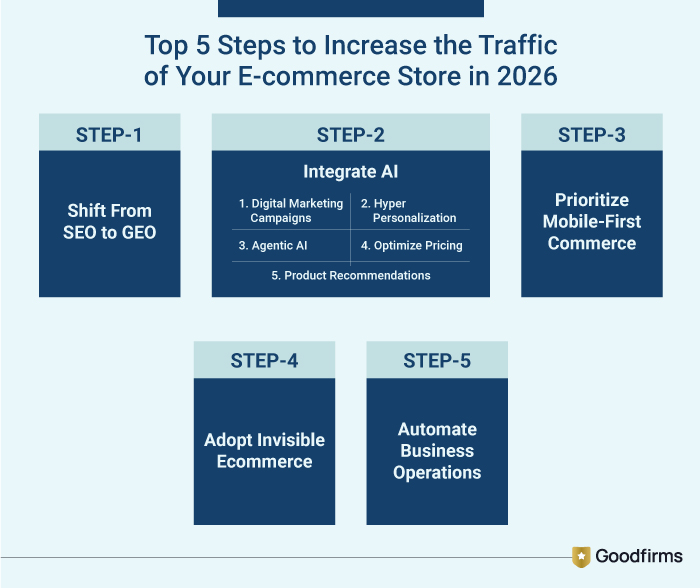
#1 Shift From SEO to GEO:
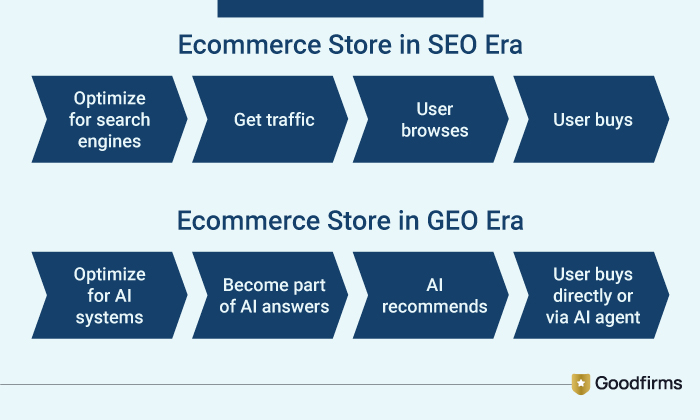
Typical mindset of ecommerce store owner following only SEO:
- “How to get more traffic?”
- “How to rank on Google?”
- Click-through worries
- Visitor-centric
Typical mindset of ecommerce store owner following GEO:
- “How to become the preferred answer?”
- “How do LLMs interpret & recommend us?”
- Trust, accuracy & structured data matter
- AI-agent-centric
With the emergence of generative AI engines, traditional eCommerce SEO is not just enough to get more traffic. In fact, Google AI Overviews already has over 1 billion monthly users. In response to this shift, e-commerce stores should move from SEO to GEO to get cited on AI systems, such as search engines and shopping assistants.
For example: When asked “Best mobile device to buy in 2026”
Google returns:
- AI overview
- Videos
- Discussion and Forums
- Top sites discussing this subject
- Popular products
ChatGPT returns:
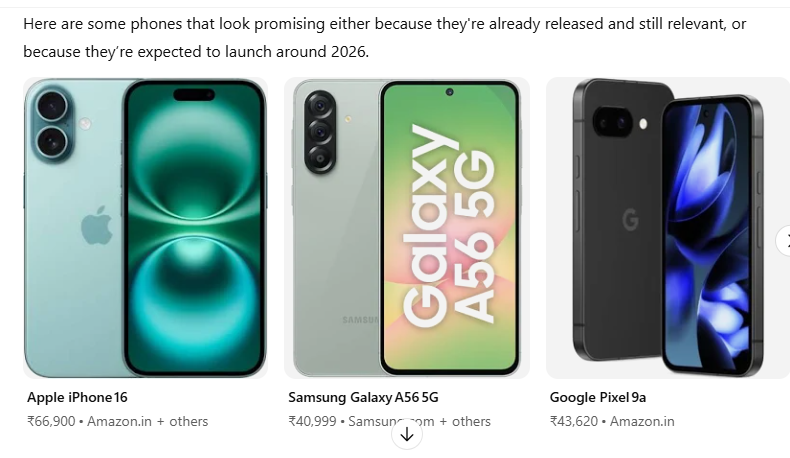
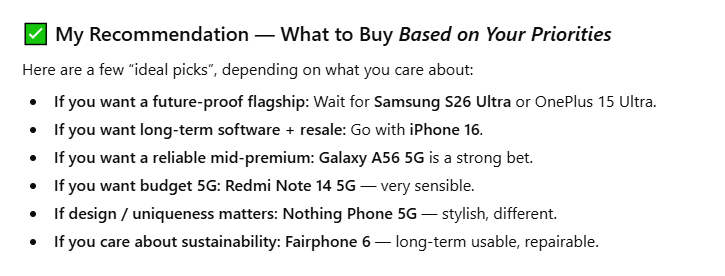
There is a clear-cut difference and users get what they want in one screen. So, to cater to this level, ecommerce stores should create AI-friendly, trustable, and valuable content that can organically make AI search engines pick up your site.
This is an essential step as traditional search engine volume is expected to drop by 25% due to the growth of generative search engines.
42% of Gen AI users already rely on generative engines for shopping recommendations and decision support.
Generative engine optimization, or GEO, is beneficial for eCommerce businesses in optimizing their content structure, policies, answers, and product knowledge in a manner that helps AI engines find, understand, and link back to the online store.
Shopping platforms like Amazon have already integrated AI-powered shopping assistants into their platforms to help users find the most relevant products. GEO can help eCommerce businesses gain traffic from these assistants too, if the stores have listed their products on these platforms.
With good content and proper optimization, businesses get the opportunity to get quoted from AI-powered search engines, bringing more high quality traffic to the stores. Below are a few tips for eCommerce GEO;
- Create pages for common shopping/product questions with clear and factual content.
- Use structured data and canonical links to make pages easily understandable for machines.
- Implement e-commerce software solutions with AI-powered GEO features.
- Place the llms.txt file into the online store’s backend.
- The product pages should have each and every type of key information visible in the HTML format.
- Perform competitor research and monitor customer preferences to identify trending queries and create new question pages for them.
- Focus on conversational cluster mapping for AI discovery.
#2 Integrate AI in Business Functions
Integrating AI in different business functions can also help eCommerce businesses in increasing the traffic of their online stores in 2026. A research reported that businesses that integrate AI-driven automation could see 35% faster operational processes.
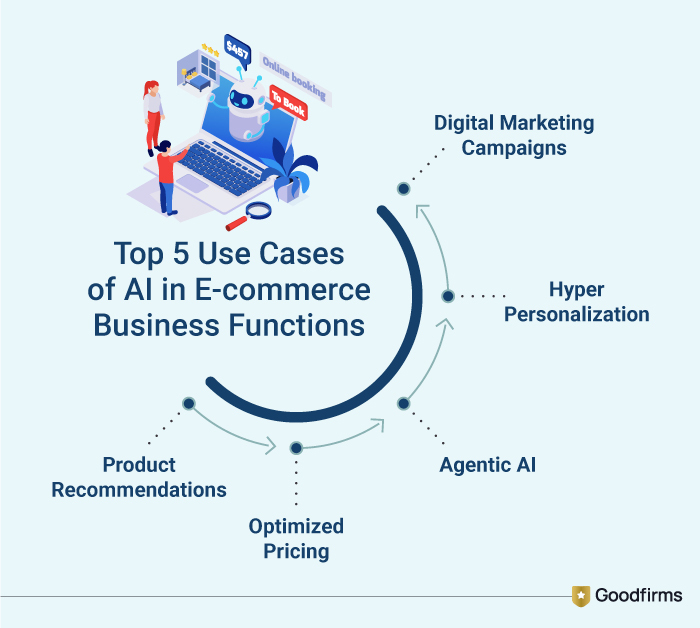
E-commerce stores can integrate AI in digital marketing campaigns to optimize prices, provide product recommendations, hyper personalize experiences, and many more functions, enhancing conversion, and thus traffic.
Leading brands like Walmart are collaborating with Gen AI companies to create AI-first shopping experiences for users.
- Digital Marketing Campaigns
AI allows e-commerce stores to autonomously develop, run, test, and scale digital marketing campaigns across different channels. From more precise targeting, smart bidding, and adaptive campaign optimization to data-driven decision making, quick content and graphics generation, and much more, AI delivers enhanced results throughout the campaign lifecycle with minimal effort.
Goodfirms survey on LLM applications in content writing, SEO and digital marketing revealed that 78% of businesses create faster content through AI and LLM tools.
This is helpful for the online stores in efficiently bringing a high volume of qualified traffic, at times when paid advertising costs are rising rapidly.
Meta reported a 14% year-over-year increase in average price per ad in one of its quarterly reports.
- Hyper Personalization
In 2026, AI-powered hyper personalization allows eCommerce stores to tailor each and every element of the shopper’s journey at the individual level, delivering context-aware, real-time experiences to users.
AI-powered hyper personalization helps online stores dynamically optimize the content, interface visuals, offers, etc., in real time throughout the entire shopping journey.
- Agentic AI
Agentic AI in e-commerce refers to the use of AI to autonomously plan, reason, act, and learn on behalf of online shoppers without minimal human intervention. 47% of shoppers are interested in using AI agents for commerce. Another research stated that 69% shoppers are ready to use AI agents for better deals and personalization. Businesses can target and attract such customers which will increase the traffic too.
Agentic-AI builders can help businesses monitor customer behavior in real time, identify their needs, and then suggest the most relevant products to them. These agents can also apply coupon codes, check inventory, autonomously generate and test micro-landing pages, monitor local delivery performance, etc., enabling dynamic personalization and reduced friction.
For instance, Amazon’s “Buy for Me” feature uses Agentic AI to complete purchases from start to finish on behalf of customers. eBay also uses an Agentic AI-powered shopping agent to supercharge its personalization efforts.
Similarly, Alibaba also uses Agentic AI to ensure enhanced experiences for customers.
As a result, online stores can attract more customers, contributing to their increased traffic.
- Price Optimization
AI is also a reliable choice for e-commerce stores in dynamically setting and optimizing the product prices in real time. This is beneficial for attracting customers that highly focus on prices when purchasing online. Reports indicate that high prices make 48% of shoppers abandon their shopping.
AI-powered eCommerce tools can ingest and analyze a huge amount of data associated with sales, inventory levels, customer preferences, seasonal demand, etc., to optimize the product prices in a balanced manner, meaning neither too high nor too low.
When prices are good, online stores end up getting more traffic and clicks.
- Product Recommendations
AI can analyze data in real time, such as consumer behavior, device, and other insights to serve smart and context-aware product recommendations, driven by real-time insights. Through these AI-powered tailored and dynamic product recommendations, online stores can show more relevant products that customers really need. Owing to the benefits, 61% of businesses already use AI to personalize recommendations for customers.
Traditional recommendation systems only show generic “Customers also bought…”, whereas AI-powered recommendations can adapt to user sessions, enhancing engagement and experience. Higher engagement can lead to longer sessions, increasing the chances of visitors visiting more pages.
AI-powered product recommendations also encourage return visits, meaning repeated traffic.
Here are some leading tips to optimally integrate AI in business functions;
- Implement highly trained AI models with clean data sets, unified schema, and labels.
- Ensure clear policies for AI governance and compliance.
- Train employees on AI models for optimal results and output.
- Start with pilot projects and then scale only once KPIs are successful.
- Leverage human+AI collaboration to make the best decisions.
#3 Prioritize Mobile-First Commerce in 2026
“The adoption rate of mobile is twice that of the internet, three times that of social media, and 10 times faster than PCs.” - Emma Crowe, Senior Vice President of Client Strategy at Somo
Mobile users dominate the internet at present. In fact, mobile devices accounted for 62.54% of total website traffic in the second quarter of 2025 and this is likely to go up to 80% in 2026. A large portion of these users prefer shopping through their mobile phones only. A mobile first eCommerce approach is very crucial to target and attract such users. Google also supports the mobile-first approach and no longer ranks websites that are not accessible through mobile phones.
It is among the top tips to create a marketing strategy for an eCommerce store to drive maximum traffic.
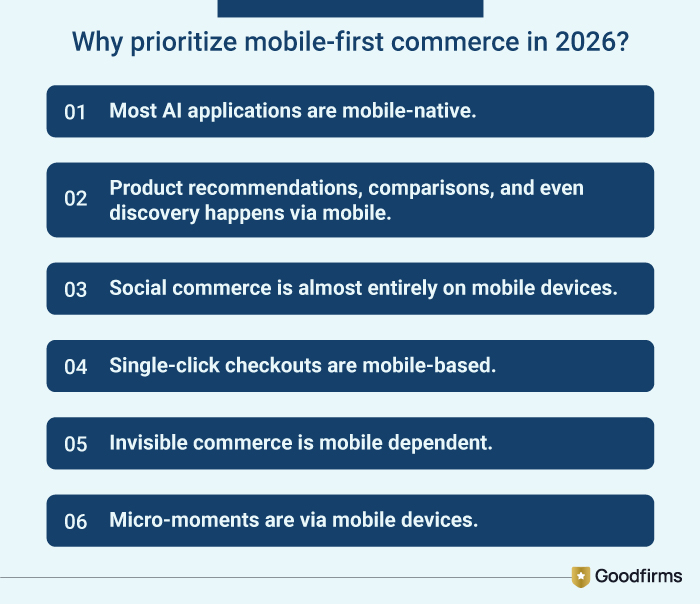
E-commerce businesses leveraging this mobile-native approach can ensure their users with small screens are served with the best version of their online stores. This is done by optimizing the user experience, user interface, checkout flow, navigation, payment options, content, and many more factors for smartphones and small screen devices.
Today’s eCommerce and its convenience lies in how easily users can find their desired products. Implementing a mobile-first eCommerce store in 2026 can help mobile users in quickly finding and visiting the online store.
Additionally, the global Mobile Commerce Market is also anticipated to cross $1.4 trillion in 2025. E-commerce stores that don’t optimize their online stores for mobile-first experiences can miss out on huge opportunities in terms of traffic, sales, and revenue.
Through a mobile-first approach, e-commerce businesses can stay connected with its users using app notifications, push notifications, social integration, etc., that can drive more traffic to the eCommerce website/app. A mobile-first approach also helps online stores expand their reach to emerging markets where mobiles are the primary source for the internet.
E-commerce firms should consider the following things when prioritizing mobile-first eCommerce for more traffic;
- Focus on optimizing the core web vitals for the mobile view to ensure proper structure and experience.
- Implement modern eCommerce tools with enhanced mobile-first optimization capabilities.
- Adopt a mobile-optimized checkout process with simple payment processing in fewer clicks.
- Use high-quality and mobile-compatible content and images for product descriptions, answer pages, and FAQs.
#4 Adopt Invisible Ecommerce
Invisible e-commerce is the process of purchasing a product or service with the help of AI assistants, smart devices, automated subscription systems, embedded shopping, and with little to no conscious decisions from customers. Recurring purchases, automatic re-orders, etc., fall under this category. This is done with the help of auto replenishments, subscriptions, buy again workflows, zero click checkout, etc., that can make the e-commerce steps seem completely disappeared. Through this, eCommerce stores can proactively fulfill customers’ needs, delivering hassle free shopping and user experiences.
A Customer Trends Reports Research revealed, around 65% of US customers alone use “Buy again” features. This number goes up to 71% for subscriptions due to ease of use.
By adopting invisible e-commerce, online stores can streamline the entire purchasing journey for such customers, from selection to payments. This brings repetitive customers, reduces acquisition costs, improves conversion, increases referral users, boosts return visits, etc., that ultimately adds to more traffic.
Here are a few tips to adopt invisible eCommerce for your online stores;
- Integrate subscription and loyalty programs for regularly used consumables.
- Add Buy Again option for 1-click shopping
- Implement AI-powered voice assistants for customers preferring voice commands
- Focus on invisible UI and Zero UI with fewer elements
- Regularly track and optimize the metrics associated with invisible purchases.
#5 Automate Business Operations
Nearly 70% of eCommerce workflows can now be automated with AI integrations.
- Product & Catalog Management Automation
- Inventory & Warehouse Automation
- Order Processing Automation
- Shipping, Logistics & Delivery Automation
- Customer Support & Engagement Automation
- Marketing & Sales Automation
- Reviews & Social Media Automation
- Accounting, Finance & Tax Automation
- Returns & Refunds Automation
- Compliance & Store Maintenance Automation
- AI Search Optimization
Automation is crucial for eCommerce stores in handling large volumes of repetitive tasks. Order management, alerts, fulfillment routing, returns processing, inventory management, supplier onboarding, content generation, CRM, price optimization, product optimization, digital marketing, etc., can be automated to reduce errors, increase efficiency, and free up employees for other tasks that can increase the store traffic.
56% of businesses reported operational efficiency gains after implementing automation.
Automation allows eCommerce firms to faster process and fulfill orders, provide instant updates, handle orders at scale, and deliver seamless user experiences. Through automation, time to market can be reduced, allowing firms to launch new products quickly and attract more traffic.
E-commerce stores can also optimize their supply chain and delivery through automation. For instance, Amazon has deployed automated robots and Gen-AI powered models to lower cost for customers and ensure faster delivery times.
Automate your business operations considering these below mentioned tips;
- Identify and document high volume-based repetitive tasks.
- Implement a robust automation software that supports a huge number of eCommerce integrations.
- Leverage AI-powered exception handling rules to highlight exceptions in orders, inventory, shipments, etc.
- Regularly monitor errors, performance issues, and data integrity.
Guide to Start an Online Ecommerce Store in 2026:
To start an online eCommerce store in 2026, businesses should have a comprehensive approach covering everything from reliable methods and best practices to investment in advanced and modern technologies.
Focusing on the below mentioned steps to start an online eCommerce store in 2026 could help ecommerce stores to rapidly succeed in this competitive landscape;
- Use AI-powered tools to analyze and gather insights related to your brand, and identify your niche, value proposition, and target audience.
- Understand the feasibility and challenges which are critical to launch a business.
- Select a reliable eCommerce software or e-commerce development company from reputed B2B platforms, such as Goodfirms.
- Develop a simple-to-use, feature-rich online store integrating SEO, AEO and GEO.
- Implement AI agents with highly trained models to deliver seamless shopping experiences.
- Set up Agentic AI payment protocols for instant payment from generative engines.
- Integrate AI for automating repetitive tasks, reporting, voice personalization, and performance management.
- Optimize the online store for mobile commerce.
- Implement subscriptions, recurring purchases, automatic re-orders, etc., for invisible commerce.
- Use AI-powered testing tools to identify and eliminate technical glitches, AI biases, and cyber vulnerabilities.
- Launch your store and measure the defined KPIs against benchmarks.
Conclusion
“In the beginning, e-commerce was really about getting commodity products online as cheaply as possible. Now, we’re moving into the more exciting phase of eCommerce, where it’s about emotional products – the things people really cherish.” -Jason Goldberg, Founder of Simple Token
In 2026, online shopping is not just about browsing and buying. Shoppers demand interaction, conversation, and personalization at scale. There is a dire need for e-commerce stores to reinvent themselves to ensure constant delivery of high-quality traffic. This demands well-laid out traffic strategies that blend intelligence and innovation with a multi-sized approach. Generative engine optimization, AI-powered PPC campaigns, hyper personalization, mobile-first approach, influencer API partnerships, etc., are a few integrations with which eCommerce businesses can improve their traffic. These are among the most effective eCommerce marketing tips that online selling platforms can use to turn technology into a sustained traffic engine that can attract the right visitors, every time, across every channel.