Introduction:
A strong social media presence can do miracles for your business, but keeping up with Facebook, Twitter, and Instagram alone can be a task. Social media management tools help you maintain all of your profiles and pages in one place so that you can concentrate on the product or service you're promoting on those platforms.
Here, we'll compare two of the most successful social media management tools, Hootsuite and Buffer, noting where each one outdoes the other and which is the best solution as per your needs.
Overview:
In social media marketing, the two most popular names are Hootsuite & Buffer. Thus, you may find yourself in a dilemma: which one to invest in terms of money and time. At the core, both tools enable you to roster social media posts. For instance, if you plan to tweet a link to your newest blog post at 5:30 a.m., Hootsuite or Buffer can do it for you without you having to wake up at 5:00 a.m. Nevertheless, that’s an obvious look, and each tool has significant modifications that we’ll learn more about.
Wondering which one makes more sense for you? Let’s take a look at the article below to get a more precise concept of Hootsuite and Buffer, which will enable you to determine which is the best social media marketing software for your business.
Buffer was established in 2010 in Birmingham, UK, by software developer Joel Gascoigne together with co-founder Leo Widrich. Initially, Buffer only acted with Twitter. But by the start of 2013, the emerging tool had gained 1,000,000 users, and it now integrates with Twitter, Facebook, LinkedIn, Google+, Pinterest, and Instagram. Whereas Hootsuite is similar to Buffer but with more features. Hootsuite was discovered in 2008 by Ryan Holmes, a Canadian computer programmer. Hootsuite supports all the platforms that Buffer does, but it also promotes YouTube, WordPress, Flickr, Tumblr, and many others, including Xing and Viadeo.
One can have a complete overview of the most suitable SMM tool for their business by exploring the below-listed standard traits -
- Features
- Integration
- Pricing
- Security
- DashBoard Experience
- Team Management
- Analytics
- Customer Care
- Review
- Summary
Features:
Hootsuite is a complicated and sprawling medium with almost infinite possible uses. Once you plan to schedule a post across multiple social media platforms, you can do so with the calendar and communicate directly with followers via Hootsuite's dashboard. Moreover, you can even assign tasks and coordinate with the other team members. Also, through the calendar, one can easily view the weekly schedules and even edit them with the drag-and-drop functionality.
On the other hand, Buffer is a much more contoured and straightforward scheduling tool. One can use this tool to schedule a queue of posts on Facebook, Twitter, and other platforms. In comparison to Hootsuite, Buffer doesn't support multiple social media platforms, but it does offer a variety of alternatives for social automation, including IFTTT & Zapier, which enable you to post automatically. The biggest demerit of Buffer is its inability to interact with the audience through the dashboard, and the second important issue is analytics, which are available only for posts and not for the complete profile.
Some additional features of both tools are debriefed as below -
- Easy to use: it should be a joyful experience while spending a lot of time managing social media solutions through social media software tools. In Buffer, it is simple and has a cleaner-looking layout, whereas in Hootsuite, it is simple to use but doesn’t have an impressive dashboard that helps you become a power user.
- Ad hoc posting: Ad hoc posting enables an SMM professional to post items live, adding more continuity to their social media presence. Both Hootsuite and Buffer possess Chrome plugins that let you post content straight from your browser. However, Buffer makes it in a simpler form. You don't need to select or schedule a day/time for getting your post live; instead, you have to click on the post & Buffer will put it in line where it fits best. On the other hand, Hootsuite enables you to post from a Chrome plugin and has a feature that lets you disable manual scheduling.
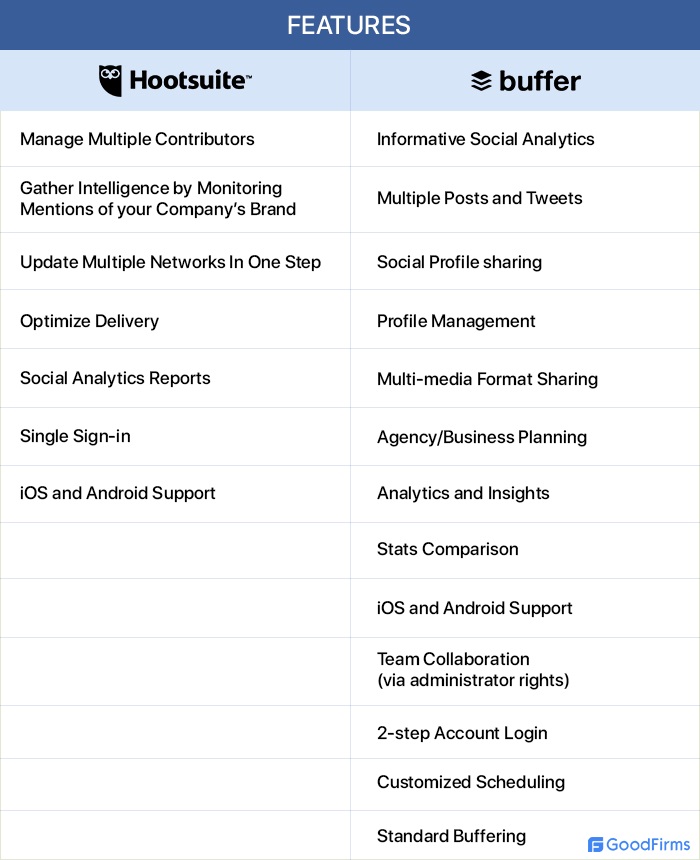
Buffer and Hootsuite serve different needs; however, both tools are brilliant in their own ways. Have a look at the complete overview of the features from the below-displayed image:
Integration:
Both Buffer and Hootsuite have plenty of plugins and extensions that you can install and implement on your personal browsers and preferred apps. One can easily share content through these annexes, even if one is working on some other social media platform. For example, if you have the Buffer extension connected to your browser, you can send tweets or posts to Buffer and reschedule them whenever you log in to a social media account like Twitter or TweetDeck. Whereas Hootsuite has an influential locus in its main plugin called Hootlet, which enables the client to share content from any corner of the web. Both Buffer and Hootsuite support three major social platforms—Facebook, Twitter, and Instagram—as well as an additional peripheral service like Google+ and Pinterest. Overall, Hootsuite leads in terms of integrations, with 129 integrations compared to Buffer's 73.
Pricing:
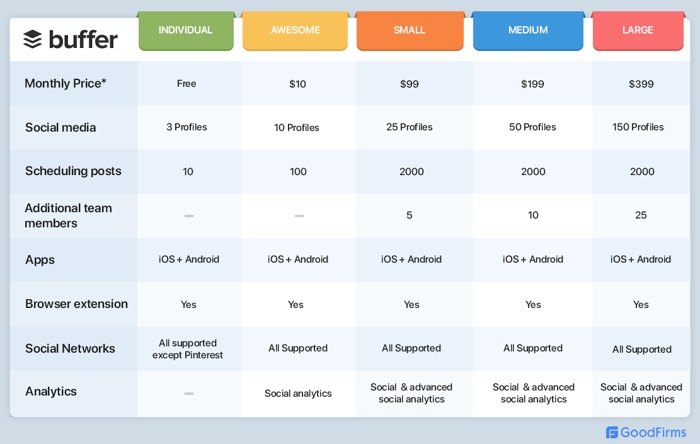
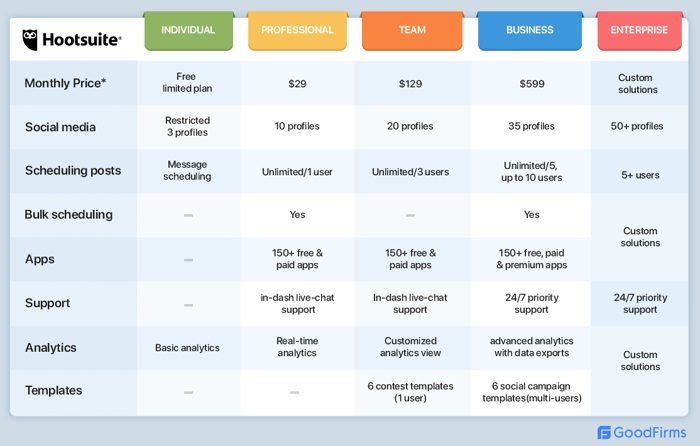
Buffer is cheaper for manufacturers, but Hootsuite offers you more at every level of the chosen plan. Pricing for both Buffer and Hootsuite follows a similar structure. You can add up to three social media accounts on the free version by using both tools, and you can schedule a limited number of posts to each. With Buffer, you can schedule 10 posts per social media account, while Hootsuite is limited to 30 scheduled posts in total.
One can get a glimpse of the image below to get a clear idea of the pricing for both Hootsuite and Buffer.
Security:
With both Buffer and Hootsuite, social media accounts can be accessed authentically in different ways. The benefit of having Hootsuite is that it supports single sign-on, which is often needed by big companies, while it is not available in Buffer. This peculiarity helps in preventing unauthorized access from “outsiders”, including people who have left the company.
Buffer supports 2-factor verification to tighten up security. This factor adds an additional layer of protection to your Buffer account. On the other hand, Hootsuite takes security very seriously. It provides a number of features that will give you peace of mind against any security breaches: from dual approval systems that prevent people from mistakenly posting the wrong content to keeping your passwords and access safe, no matter where you’re accessing it.
Dashboard Experience:
Buffer’s dashboard will display your scheduled posts, whereas Hootsuite shows your timelines, replies, and many other things. The dashboard of Hootsuite is not so attractive, but it’s entirely usable and capable. On the dashboard, you will be able to see the posts, customized hashtags you are following, and even mentions of your firm or products.
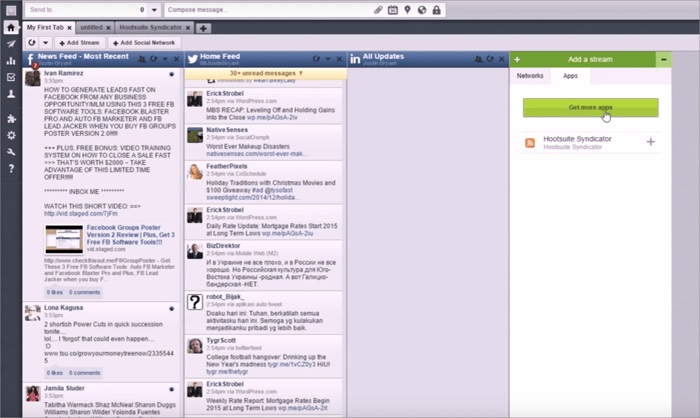
On the other hand, if you only want to manage your scheduled posts, then Buffer is excellent. The Buffer dashboard is sleek and clean, and you’ll only see the queue of your scheduled posts.
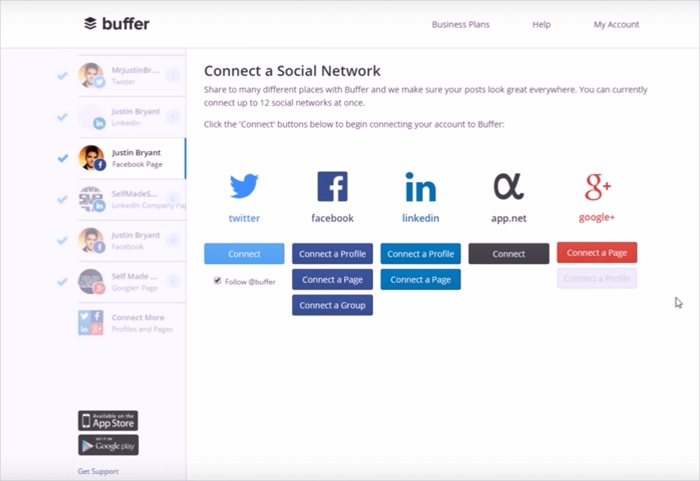
Here, it can be seen that the winner is Buffer, as one can clearly see the scheduled posts in a minimal interface, and it will be easy to see how many posts have been lined up and whether any edits are required for any of them. Whereas in Hootsuite, everything gets overlapped, and one gets confused about what and how to manage things.
Team Management:
If you have a small-scale business, opt for Buffer; for large-scale companies, Hootsuite works well. Depending on the number of social platforms you access and the size of your marketing team, pick the right software solution between the two.
Both tools allow admins to assign members of your organization's team to specific social media accounts. This workflow works fine with Buffer for small companies, whereas for large companies, Hootsuite has more tools.
Using Buffer for small setups, you can manually assign permissions to access social media accounts to each team member. However, Hootsuite allows you to divide your team members into different categories. You can divide them individually, into a group of teams, or into a group of team members.
These bifurcations make the operation of the marketing process accessible on a large scale.
Analytics:
Buffer is basically a publishing and scheduling tool. Its analytics capabilities are considerably more limited than Hootsuite’s. Through Buffer, it only provides analytics for social posts you’ve published, rather than a report for the complete account. If you’re publishing through multiple tools, then Buffer won’t give you a comprehensive picture of how all those posts are performing.
On the other hand, Hootsuite offers a full-suite service for social media management and analytics, including content performance tracking, overviews of all your social profiles, and data on your social referral traffic via Google Analytics.
Customer Care:
When it comes to taking care of customers, both software solutions are winners! Buffer hosts fundamental webinars twice a week, helping new users get a grip on the platform. Whereas Hootsuite has a podcast, Hootcast. However, new episodes are telecast only every couple of months. Meanwhile, Buffer’s blog is bursting with expert insights, case studies, and examples. The main channel for Buffer’s customer support is email, but they’re also very engaged on Twitter. On the other hand, Hootsuite has an active presence on all social media platforms.
Reviews:
According to reviews on Goodfirms, posting on multiple channels at the same time is more convenient with Hootsuite. However, several reviewers agree that Buffer is reliable, simple, and easy to use for scheduling posts and offers light analytics, which is mostly what all business owners need.
Summary:
Buffer and Hootsuite are both successful platforms with millions of users. They possess powerful and useful features that make the lives of countless social media marketers easier.
Buffer, due to its simplicity, is a better option for small-scale businesses as well as for individual companies that only want to schedule their posts on the most popular social media platform. Whereas Hootsuite, due to its complexity and n number of features, is a better option for large-scale businesses with a dedicated marketing department.
Talking about the budget, no need to worry, as both platforms offer free tiers to start with as a beginner. Once you get a grip on either platform, you can upgrade with its further plans provided by both platforms. For users, liability for time and money spent on marketing is a must, and excellent reporting and easy-to-use dashboard views play a major role here. With Buffer, one needs to click on the individual network for reporting, while in Hootsuite, one can see multiple social media marketing networks all in the same window. Thus, with just a few differences, both Hootsuite and Buffer provide great options, and the competition comes down to personal preference depending on what offers you the most as per your needs.