Key takeaways
- An integrated marketing campaign works when every channel carries the same message toward the same goal. Share a Coke, Spotify Wrapped, and Shot on iPhone each built a campaign around one idea that customers could relate to.
- Marketing budgets are flat at 7.8% of company revenue (Gartner, 2026). Reusing one core idea across email, social, and paid channels helps brands get more from the same spend.
- Start with a measurable goal before choosing channels. The goal decides which channels deserve budget, and a few well-matched ones are easier to run well than many.
- Coordination is where most campaigns break down. A shared brief, one content calendar, and consistent tagging keep every team working from the same plan.
- Judge the campaign against its original goal. Funnel-stage KPIs, one shared dashboard, and multi-touch attribution show which channels start the journey and which ones close it.
Behind a brand's popularity is a fully integrated marketing campaign that requires unique perspectives to go beyond simply distributing pamphlets.
Today, a customer sees an ad on Monday, gets an email on Wednesday, and then lands on their website on Friday. Each step carries a different offer, tone, and call to action.
Though in the process, no one made a mistake. Each channel just did its own job. That’s exactly the gap an integrated marketing campaign fills: one message, one goal, and every channel working from the same plan.
It matters more when budgets don’t stretch. Gartner’s 2026 CMO Spend Survey found marketing budgets flat at 7.8% of company revenue, so paying for the same idea three separate times is harder to justify.
Most campaigns don’t struggle because the creative is weak but because the channels were never planned together.
This guide covers seven rules for building integrated marketing campaigns that work, along with examples, a step-by-step plan, and the mistakes to avoid.
Looking for a team to plan and run your next campaign? Compare top digital marketing companies vetted by Goodfirms and find one that fits your goals and budget.
What Is an Integrated Marketing Campaign? Core Elements Explained
An integrated marketing campaign is a coordinated effort that delivers a unified message targeting a specific goal across multiple channels, such as email, social media, paid ads, content, and PR, so customers hear the same story wherever they encounter the brand.
The idea for this strategy comes from integrated marketing communications, an approach Northwestern University’s Medill School helped pioneer. A traditional marketing campaign often runs ads, emails, and social posts as separate projects, each with its own message. Integrated marketing campaigns treat them as a single project with a single goal.
The Four Cs of Integrated Marketing Practices
Medill’s IMC program frames integration around four principles:
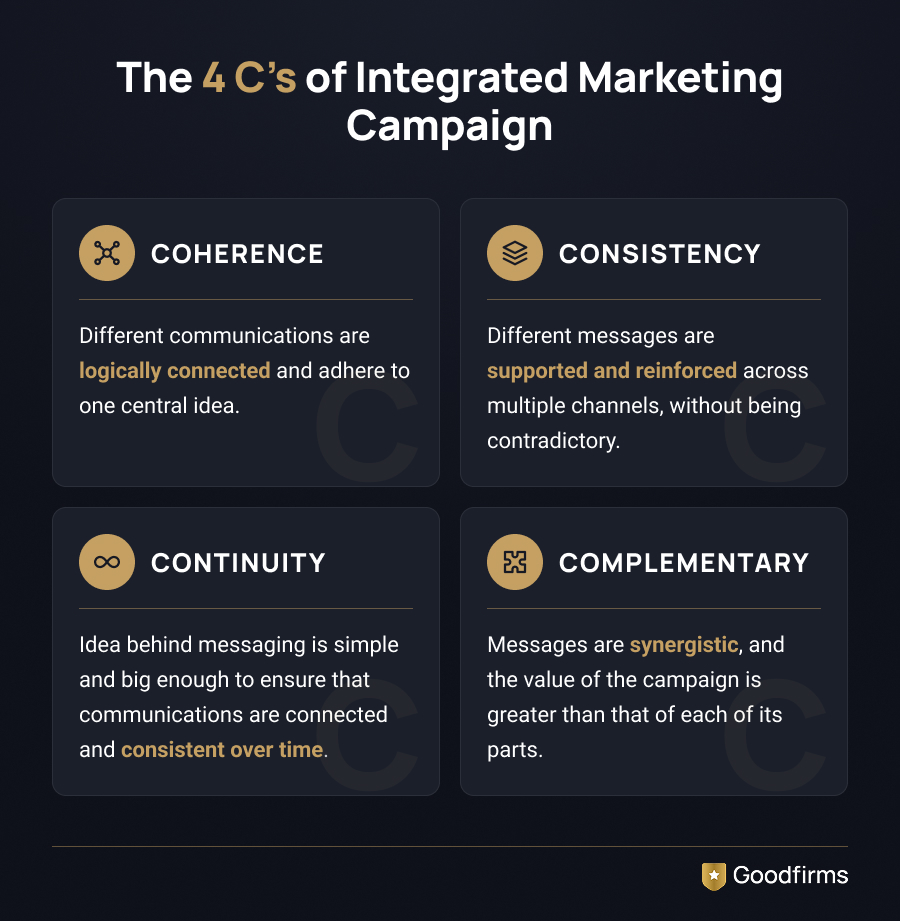
- Coherence: Every channel connects logically to the others, so the campaign reads as one story.
- Consistency: Messages support each other instead of pulling in different directions.
- Continuity: The story holds together over time, not just within a single week of the campaign.
- Complementary: Each channel does a different job, so together they achieve more than any one could alone.
Core Elements of an Integrated Marketing Campaign
Below are the five building blocks of the integrated marketing plan:
- A single campaign message: One central idea that every channel repeats in its own format, so customers recognize the email, the ad, and the social post as the same campaign.
- A defined target audience: Clear segments based on who buys, what they need, and where they spend time.
- Coordinated channels: A deliberate mix of channels, each with a specific role in moving customers from awareness to action.
- Consistent branding and creative: Shared visuals, tone, and calls to action that make every touchpoint look and sound like one brand.
- Shared goals and measurement: One set of KPIs is tracked across channels, so the team can see what works and adjust quickly.
How Does an Integrated Marketing Campaign Work?
An integrated marketing campaign works by building every channel around one core message and goal, adapting that message to each channel’s format, and tracking results together so the whole campaign improves as it runs.
The process has 4 steps:
- Set one core message and goal that every channel will support.
- Adapt the message to each channel’s format, such as an email, a short video, a paid ad, and a landing page.
- Launch the channels in a planned sequence, so each touchpoint builds on the last.
- Track results in one place and shift budget or messaging toward what’s working.
On a campaign brief, this cycle looks simple. Behind the scenes, it needs a shared content calendar, a messaging guide, consistent tracking, and teams that review results together. A sound integrated marketing strategy depends on how tightly those pieces are connected, and that’s the first real decision every campaign team has to make.
Benefits of a Successful Integrated Marketing Campaign
A successful integrated marketing campaign helps brands build stronger brand recognition, stretch budgets further, increase engagement, streamline the customer journey, and provide teams with clearer performance data.
Businesses of every size invest in integrated marketing campaigns for the following reasons listed below:
- Stronger brand recognition and trust: Customers who see the same message across channels begin to remember the brand, and that consistency builds the trust that drives repeat purchases.
- Better use of budget: One core idea and shared creative are adapted for each channel, helping brands reduce duplicate production costs and achieve better results from the same input.
- Higher engagement: Only 2% of people make a purchase on the first contact. These stats clearly signify how rare it is to attract customers at first sight. However, seeing a message in an email and again in a social ad gives them multiple reasons to respond and visit the site.
- A smoother customer journey: Each channel picks up where the last one left off, so customers don’t encounter contradictory offers or have to repeat themselves.
- Clearer measurement: With shared goals and a single view of results, teams can see which channels drive conversions and shift budget toward them.
Which Channels Work Best in an Integrated Marketing Campaign?
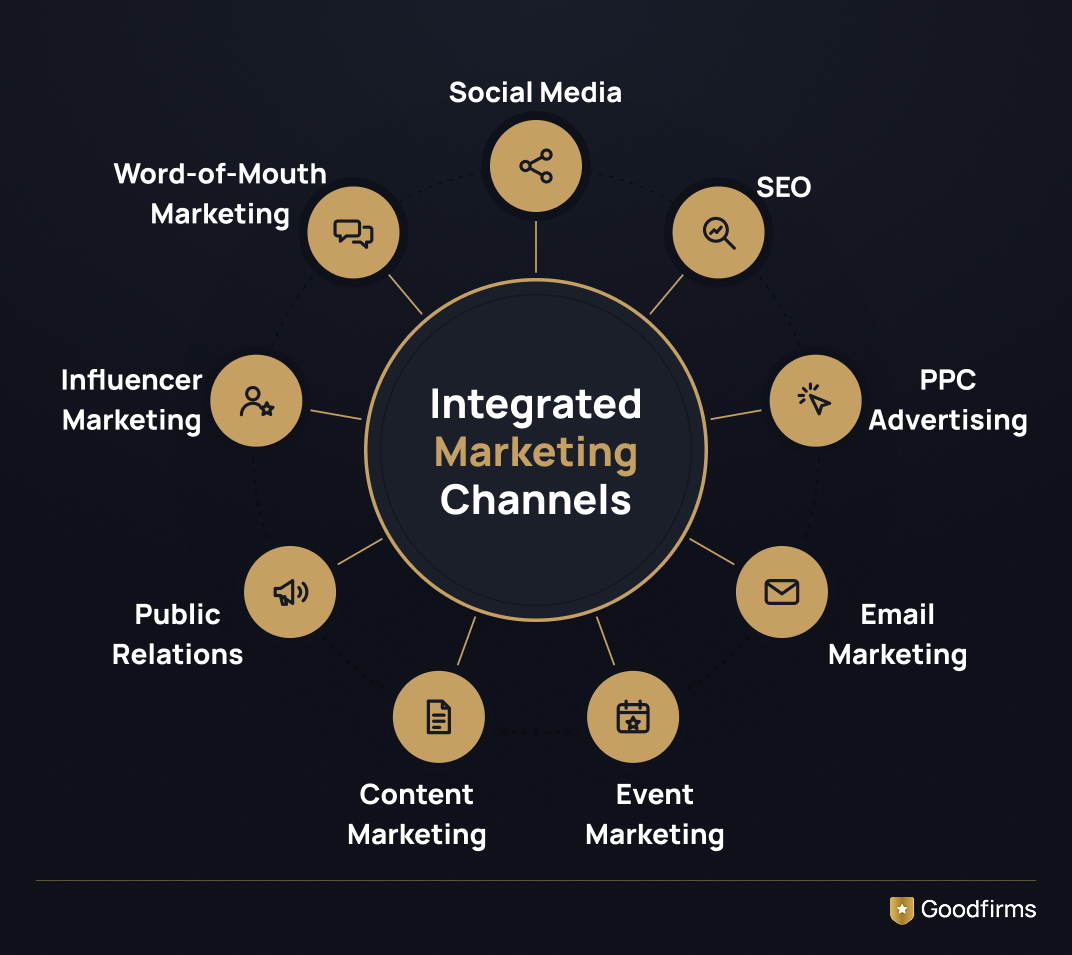
The best integrated marketing channels depend on your campaign goals, target audience, and budget. Businesses can combine different platforms to reach customers, maintain consistent messaging, and guide them toward a desired action.
1. Content Marketing and SEO
Today, instead of reaching out to a salesperson, buyers do most of the research. Increasing the relevance of blogs, guides, and landing pages to help customers discover useful information through search engines. However, businesses can also share this content via email and social media to extend their reach and support their integrated marketing strategy. Goodfirms researchers found out that now 25% of the marketing budget goes on content production and distribution.
2. Social Media Marketing
Social media helps businesses build awareness, engage audiences, and promote products. Campaign posts, videos, and customer stories should reinforce the same message across platforms. Businesses seeking specialist support can explore top social media marketing agencies to coordinate their campaigns.
3. Email Marketing
Email helps businesses nurture prospects and maintain customer relationships through newsletters, product updates, and personalized offers. A well-planned email marketing strategy can also follow up on interest generated through social media, website visits, or events.
4. Paid Advertising
Search ads, display ads, and social media ads help businesses reach specific audiences and drive traffic or conversions. Their messaging should align with other campaign activities. However, top performance marketing agencies can help businesses improve targeting, track conversions, and optimize advertising budgets.
5. Public Relations and Influencer Marketing
Media coverage and creator partnerships help brands build credibility and reach new audiences. Coordinating announcements, creator content, and promotional messaging with other campaign activities creates a more consistent brand experience.
6. Events and Webinars
Events and webinars allow businesses to demonstrate products, answer questions, and build relationships. Email and social media can promote registrations, while follow-up content helps maintain engagement after the event.
The key is to choose channels that complement one another. A multichannel marketing campaign uses multiple platforms to reach customers, while an omnichannel marketing campaign focuses on creating a connected experience across touchpoints. Successful integrated marketing campaigns coordinate these channels around a shared goal rather than treating each one as a separate activity.
7 Rules for Creating a Successful Integrated Marketing Campaign
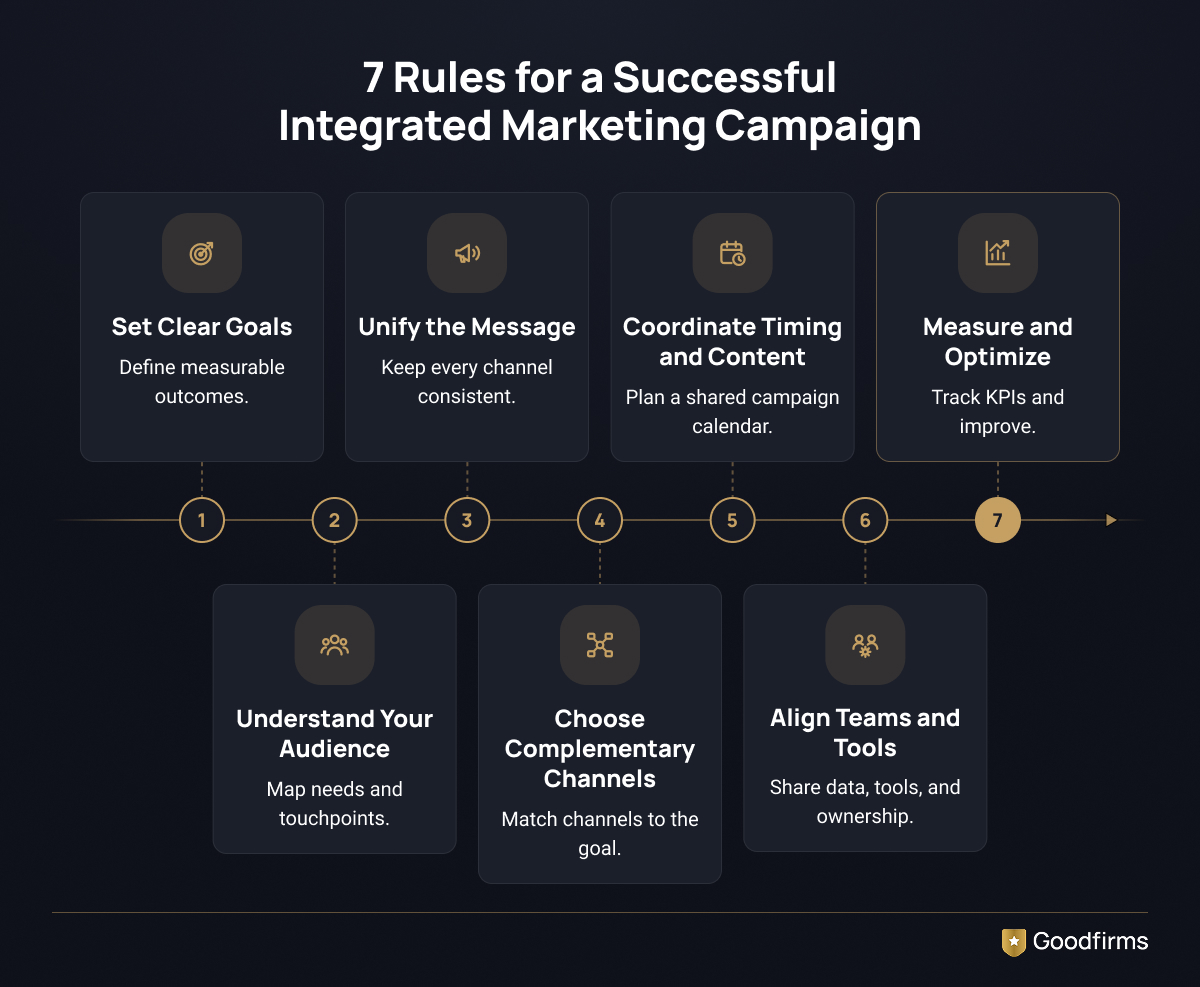
The seven rules for a successful integrated marketing campaign are to set a clear goal, understand the audience, keep one message, choose complementary channels, coordinate execution, align teams and tools, and measure to optimize.
These integrated marketing best practices listed here can be applied to any size, whether a brand runs a campaign on three channels or ten. Each rule is built to complement the other one, but that doesn’t mean to break the order. These rules need to be followed in order when performing marketing strategies.
Rule 1. Set a Clear Campaign Goal Before Choosing a Channel
A campaign goal should be specific, measurable, and tied to a business result, such as 500 qualified leads in 90 days or a 15% lift in repeat purchases. Channels come second because the goal decides which marketing channels really make sense.
Writing the goal down is the first step of any integrated marketing plan. It gives every team the same definition of success and a fixed point for judging trade-offs, such as whether a new channel is worth the budget. Also, every company has different marketing goals; for example, a food business's marketing strategies will be completely different from those of an e-commerce company.
Rule 2. Understand Your Audience and Their Customer Journey
Before considering any product or service, customers go through different phases: awareness, consideration, decision, and retention, each of which calls for a different message and channel. Mapping that journey shows where people first find the brand, where they hesitate, and where they drop off.
Start with data you already have: CRM records, website analytics, and past campaign results. Group buyers into a few clear segments, then note which channels and questions matter at each stage.
Rule 3. Build One Consistent Message Across Every Touchpoint
Integrated marketing communications depend on a single core message that each channel expresses in its own format. The email, the ad, and the landing page should make the same promise in the same voice, even though the wording and length differ.
A short messaging guide keeps this manageable. It should hold the main message, supporting points, tone of voice, visual style, and call to action, so anyone creating an asset starts from the same source.
Rule 4. Choose Channels That Complement Each Other
Integrated marketing channels should be chosen for the role they play, not for how popular they are. A good mix uses one or two channels to reach new people, one to nurture interest, and one to convert it.
Paid social can introduce a product, content can explain it, and email can bring interested visitors back to buy. A few well-matched channels are easier to run well than many that overlap and compete for the same attention.
Rule 5. Coordinate Content, Timing, and Campaign Execution
A cross-channel marketing campaign works when each touchpoint lands in a planned order. A shared content calendar shows what goes live, where, and when, so the teaser, the launch, and the follow-up build on each other.
Timing matters as much as content. If an email promotes an offer before the landing page is ready, or social ads keep running after the offer ends, the campaign loses the momentum that integration is meant to create.
Rule 6. Align Your Teams, Data, and Marketing Tools
Integrated marketing campaigns often stall because teams, data, and tools sit apart. The email, social, paid, and content teams need the same brief, the same calendar, and regular check-ins so messages don’t drift.
Shared tools help here. A CRM and marketing automation platform keeps customer data in one place, and a common dashboard shows results across channels. Teams that follow sound digital marketing practices, such as consistent campaign tagging and shared naming, find it much easier to compare channels later.
Rule 7. Measure Performance and Optimize What Works
Integrated marketing campaign measurement should track results against the original goal, not just channel-level numbers. Reach and clicks show activity, while conversions, cost per acquisition, and revenue show whether the campaign worked.
Review results during the campaign, not only after it. A weekly or biweekly check lets the team move budget toward channels that convert and fix messaging that isn’t landing. The measurement section later in this guide covers metrics and attribution in more detail.
Integrated Marketing Campaign Examples: What Successful Brands Get Right
Successful integrated marketing campaigns connect advertising, social media, content, and other channels around one clear message. The following examples show how brands use different touchpoints to create a consistent experience and make their campaigns more memorable.
1. Coca-Cola: Share a Coke

Coca-Cola’s Share a Coke campaign replaced its logo on bottles and cans with popular first names, encouraging people to find their names and share drinks with friends and family. The brand extended the idea through social media, personalized bottles, digital experiences, and outdoor advertising.
The campaign worked because it made customers part of the message. Instead of simply promoting a product, Coca-Cola gave people a personal reason to engage with the brand and share their experiences.
What businesses can learn: A strong integrated marketing campaign starts with one simple idea that customers can connect with and share across different channels.
2. Spotify: Wrapped
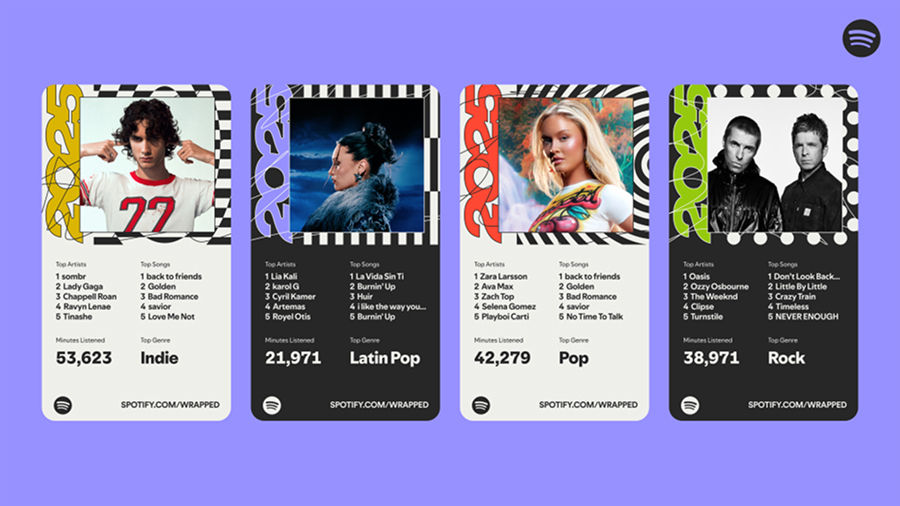
Spotify Wrapped turns users' listening habits into personalized year-end summaries. Users can explore their results in the app and share them on social media, helping Spotify extend the experience beyond its platform.
The campaign connects product data, personalized content, and social sharing around one recognizable concept. Each user receives an individual experience while contributing to a larger conversation about music and listening habits.
What businesses can learn: Personalization can make a campaign more engaging. Give customers something relevant to their interests that they will want to share with others.
3. Apple: Shot on iPhone

Apple launched its Shot on iPhone campaign to demonstrate the iPhone camera’s capabilities using photographs taken by actual users. The brand showcased selected images on billboards and other advertising placements, while social media and digital content helped extend the campaign’s reach.
Rather than relying only on technical specifications, Apple let the photographs demonstrate what its product could do. The same idea connected outdoor advertising, digital platforms, and customer creativity under one recognizable campaign message.
What businesses can learn: Show customers the value of a product through real experiences. User-generated content can strengthen credibility and give an integrated marketing campaign a consistent message across multiple channels.
How to Create an Integrated Marketing Campaign: From Plan to Launch
Follow the steps given below to create an effective integrated marketing campaign:
- Set clear goals: Decide whether you want to increase brand awareness, generate leads, or drive sales. Define measurable targets to track progress.
- Understand your audience: Identify customer needs, preferences, and buying behavior to choose relevant marketing channels.
- Develop a consistent message: Build an integrated marketing strategy around one core message that remains recognizable across platforms.
- Choose the right channels: Combine content marketing, email, social media, and paid advertising based on your goals and budget.
- Create an integrated marketing plan: Set timelines, assign responsibilities, and coordinate campaign activities across teams.
- Track and optimize results: Measure engagement, traffic, leads, and conversions to improve campaign performance.
How to Measure an Integrated Marketing Campaign
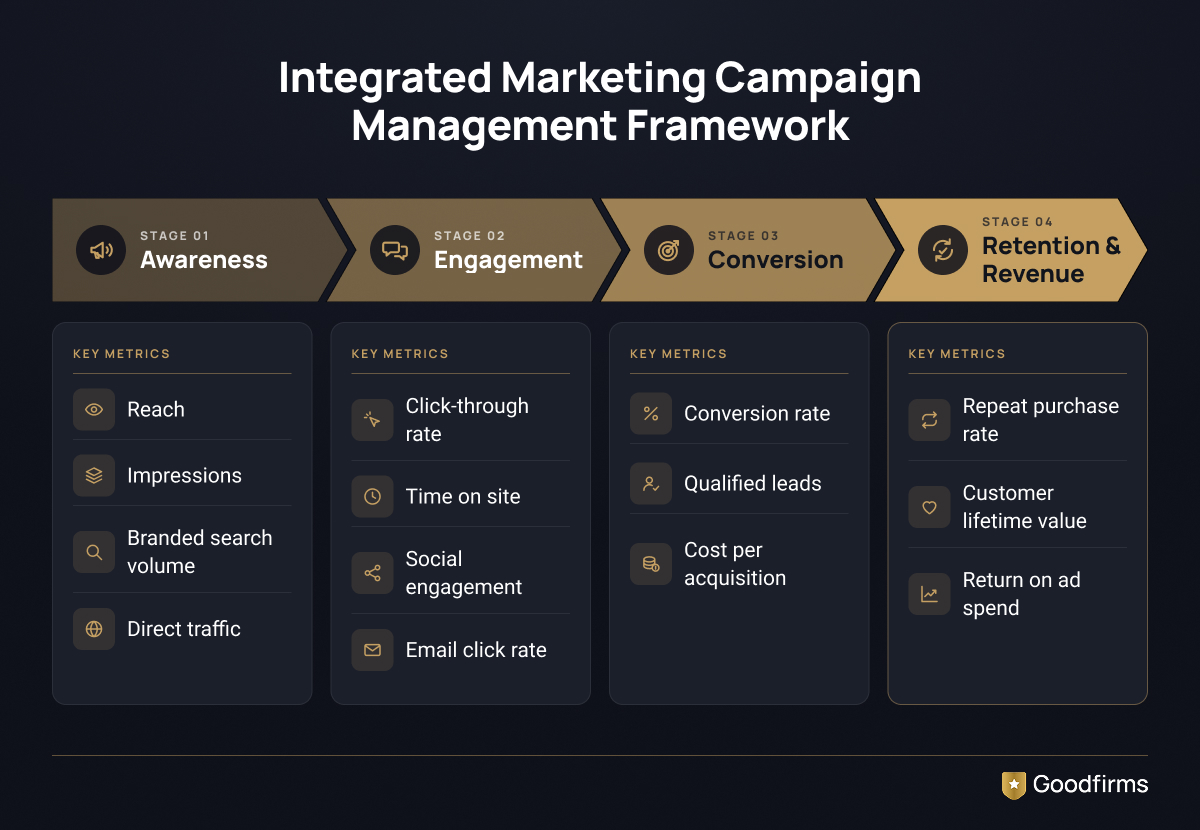
To measure an integrated marketing campaign, set KPIs for each funnel stage that tie back to the campaign goal, track them in one shared dashboard, and use multi-touch attribution to see how channels work together.
Integrated marketing campaign measurement fails when each channel reports on its own. Email shows opens, social shows likes, and paid shows clicks, but nobody can say what the campaign delivered. Choosing metrics by funnel stage fixes that.
|
Funnel Stage |
What It Shows |
Example Metrics |
|---|---|---|
|
Awareness |
Whether the right people are seeing the message |
Reach, impressions, branded search volume, direct traffic |
|
Engagement |
Whether the message is holding attention |
Click-through rate, time on site, social engagement, email click rate |
|
Conversion |
When interest turns into action |
Conversion rate, qualified leads, cost per acquisition |
|
Retention and revenue |
Whether the campaign pays off |
Repeat purchase rate, customer lifetime value, return on ad spend |
Attribution is the harder part. Last-click attribution gives all the credit to the final touchpoint, so it undervalues channels that start the journey, like social or content. Multi-touch attribution spreads credit across all interactions, which better suits integrated campaigns.
To keep the data usable, tag every link with consistent UTM parameters, pull results into one dashboard, and review them on a fixed schedule. Compare against the goal you set in Rule 1, not just against last month’s numbers.
Common Mistakes That Can Undermine an Integrated Marketing Campaign
The most common mistakes that undermine an integrated marketing campaign are picking channels before goals, copying one asset everywhere, spreading budget across too many channels, letting teams work in silos, and judging results by vanity metrics. Most of these happen when a team knows the rules but skips them under deadline pressure. Watch for these six:
- Choosing channels before goals: Teams often start with the channels they already use. Without a defined goal, there’s no way to tell which channels deserve budget, so effort goes where it’s comfortable instead of where it counts.
- Repeating instead of adapting: Posting the same asset everywhere is repetition, not integration. A long-form email and a six-second social video need the same message but different execution.
- Letting the message drift: Campaigns lose focus when each team adds its own angle or offer. Customers then meet different promises across channels, which weakens trust.
- Using too many channels: Spreading budget across every available channel leaves each one under-resourced. Three channels run well will outperform seven that run thinly.
- Working in silos: When email, social, and paid teams plan separately, launches clash and messages overlap. A shared calendar and regular check-ins prevent most of this.
- Tracking vanity metrics: Likes, impressions, and open rates look good in reports but don’t show revenue impact. Anchor reporting to the goal set at the start.
FAQs: Integrated Marketing Campaigns
What is the difference between integrated marketing and omnichannel marketing?
Integrated marketing delivers one consistent message and brand across channels, while an omnichannel marketing campaign builds a seamless customer experience on shared data at every touchpoint. Integrated marketing campaigns can run without full omnichannel infrastructure, which makes them easier to start. Many brands begin with integrated messaging and move toward omnichannel as their data and tools mature.
How many channels should an integrated marketing campaign use?
There’s no fixed number, but most teams do well with three to four integrated marketing channels, and small teams can start with two or three. The right mix depends on where your audience spends time and how much budget and staff you have. Each extra channel needs its own content and tracking, so a lean mix run well usually beats a wide one run thinly.
Can small businesses run an integrated marketing campaign on a limited budget?
Yes. A small business can build an integrated marketing plan around two or three channels, one core message, and creative that gets reused across formats. Start with channels you already own, such as email and social media, and add paid ads once the message proves itself. Integration depends on coordination more than spending, so a clear goal and a shared calendar matter more than a large budget.
How long does an integrated marketing campaign take to show results?
It depends on the channels. Paid ads and email usually show early signals within a few weeks, while content and SEO build over several months. Set review points in your integrated marketing campaign measurement plan, such as a first check at 30 days, and judge results against the goal and timeline you set at the start.
How is AI changing integrated marketing campaigns in 2026?
AI makes an integrated marketing strategy easier to run by speeding up audience segmentation, adapting one message into different channel formats, and pulling results into a single report. It still needs human review because message and brand consistency are the whole point of integration. The best results come when teams use AI to save production time and keep strategy decisions in-house.
Should you hire an agency or run an integrated marketing campaign in-house?
Run it in-house if your team already covers strategy, creative, and analytics and can work from a shared plan. Hire an agency when you lack a specific channel skill, such as paid or social, or need extra capacity for a launch. Comparing top digital marketing agencies on services, industry experience, and client reviews is a practical way to shortlist options before you commit.
Make Your Integrated Marketing Campaigns Work as One
A successful integrated marketing campaign starts with a clear goal. Everything else, from the message to the channels, follows from it.
Keep one consistent message, choose channels that support each other, and measure what works. These habits are what separate a campaign from a collection of disconnected posts and ads.
Search is often the channel that ties it all together. Working with one of the best SEO companies can help your content reach people at the moment they’re looking.
Start small, stay consistent, and build from there.