AI has become a disruptive technology for all business sectors and is being used extensively. As a result, it has become necessary to have regulations for the same. In this blog, we will specifically focus on current AI regulations in the USA.
So, let's get started.
What is AI Compliance?
AI compliance is a process that ensures all AI-powered systems are compliant with the applicable regulations and laws.
It includes keeping a check on both companies and individuals so that they do not break any regulations. AI compliance also ensures that data used to train AI models is used legally and ethically.
AI compliance makes sure that AI systems do not discriminate against any particular individual or group, and deceive anyone.
AI compliance also keeps a check on AI systems and prevents them from invading anyone's privacy. It also ensures that AI-powered systems work in a way that is good for society.
Moving forward, let's discuss the AI legislation & Principles leveraged by the U.S. Government to Ensure Safe AI Systems.
U.S. AI legislation & Principles
The U.S. has several legislative measures in place to keep AI systems safe and accountable. These initiatives are in different stages of enactment and provide organizations with a framework with which to align.
Let's have a look at some of the important laws.
National Artificial Intelligence Initiative Act of 2020
It is meant to direct AI research, development, and assessment across federal science agencies.
The act established the American AI initiative to control the AI activities of various federal institutions.
AI in Government Act & Advancing American AI Act
The purpose of this act is to direct federal agencies to keep AI policies and programs up to date.
The impact this act has had is that it promotes AI adoption within government operations.
Let's learn more about AI regulations in the USA through sector-wise classification:
Sector-wise AI Regulations in the USA
Along with federal and state-level laws, AI developers in the USA should also follow industry-specific compliance. These regulations are more stringent and effective in regulating the use of AI.
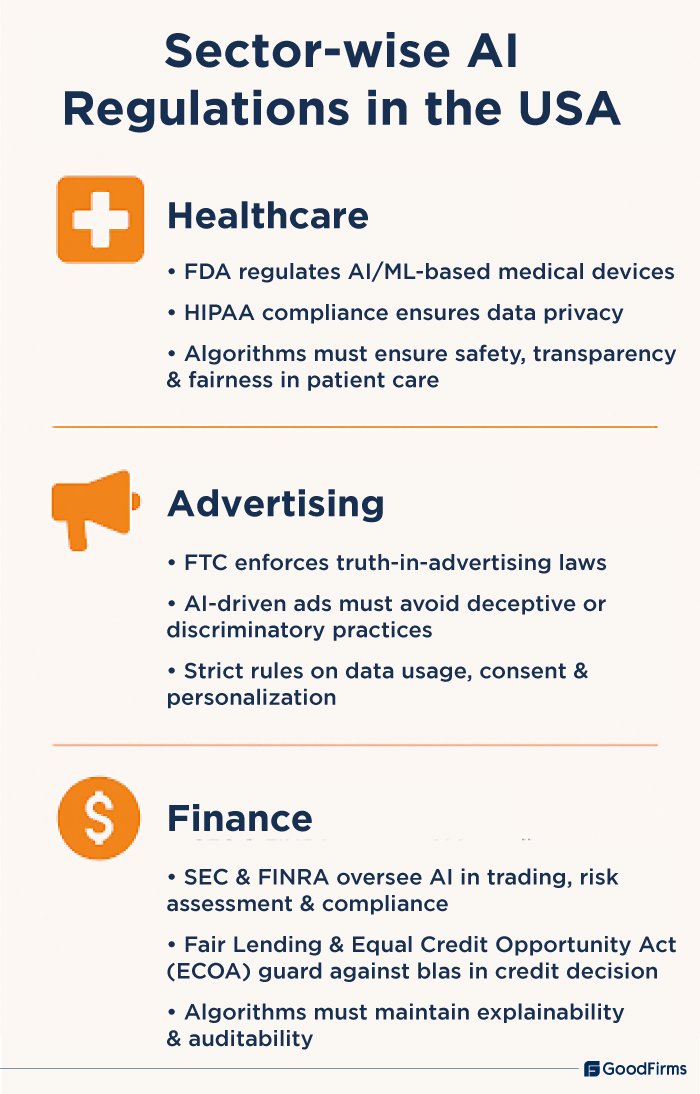
Let's look at three sectors: healthcare, finance, and advertising.
Healthcare
Companies that operate in SaMD, Software as a Medical Device market, whether or not using AI must obtain FDA approval in 2025 depending on the risk level.
In 2024, FDA had issued regulations for Machine learning or ML powered medical devices. The main objectives being to ensure proper patient disclosures and responsible use of data being captured.
U.S. healthcare companies have to state how future model updates will be managed and made compliant with the existing AI regulations.
Advertising
AI use in this sector is monitored by the Federal Trade Commission (FTC). All AdTech and MarTech vendors must ensure that the use of AI in ads or generated content is fair and not misleading.
In 2024, the FTC took action against companies that made use of fabricated AI-generated reviews or endorsements.
FTC violations lead to very heavy penalties, which are adjusted annually. Software developer accessiBe was fined 1 million USD for making false claims about its AI tool.
Workado got a warning for incorrectly stating the capabilities of an AI content detection tool. They have been asked to remove all claims, inform all the users, and submit compliance reports.
A law-related AI firm, DoNotPay has been asked to pay $ 193,000 and also inform customers about the limitations of law-related features of their product.
Firms offering any dynamic pricing optimization or Machine Learning based bidding optimization or advanced segmentation must ensure fair practices to avoid fines.
Finance
In the Finance sector, AI use is monitored by the Federal Reserve, SEC, OCC and FDIC. These institutions focus on fraud detection, credit scoring, customer targeting and algorithmic trading.
Regulations in the finance sector require AI systems to be explainable and do not allow discrimination in lending funds.
Violations related to misuse of AI in lending or credit scoring can lead to penalties of USD 1000 per consumer along with extra settlements.
AI usage in algorithmic trading is also being monitored to prevent systemic risks and market manipulations.
Along with these regulations, other standard anti-money laundering and KYC(Know Your Customer) regulations apply to AI-enabled financial products.
At the state level, New York has a bill which is under review that will make it compulsory to disclose use of AI in taking credit decisions.
Impact of AI regulations on Businesses in the U.S.
U.S. government regulations have a major impact on how businesses operate in their domain. Let's have a brief look at how they are affected.
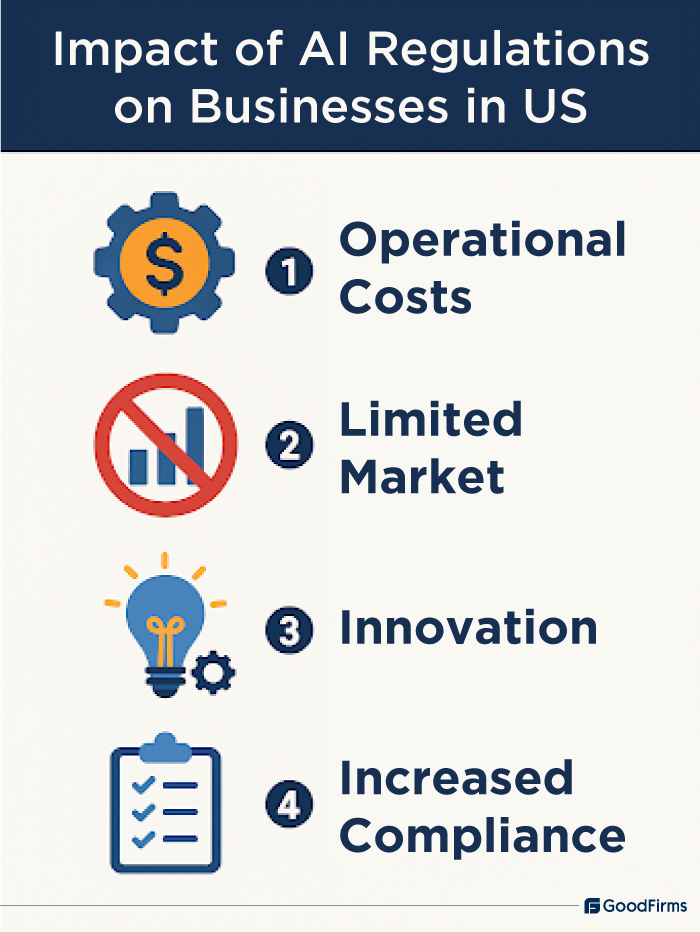
(1) Operational Costs
Following the AI compliance regulations results in more investment in legal counsel, compliance tools and system checks. In case of large organizations, they need to pay for dedicated teams on a long-term basis.
(2) Limited Market
As the regulations of AI vary from state to state, implementing the regulations across the country can be difficult. As products have to adapt to different AI regulations of different states, it decreases productivity and slows down growth.
An AI-based product may not be able to operate in all the states of the USA because of varying regulations.
(3) Innovation
As the AI regulations in the USA are very transparent and clear, it sets the stage for companies to use technology responsibly. This inspires confidence in both investors and consumers.
Businesses that follow AI regulations judiciously differentiate themselves as good innovators and create a good brand image.
(4) Increased Compliance
Businesses making use of AI need to ensure they comply with all state and federal regulations. As a result, they need to continuously audit for data privacy, bias and transparency in finance, healthcare and employment.
Past Cases of AI Non-Compliance
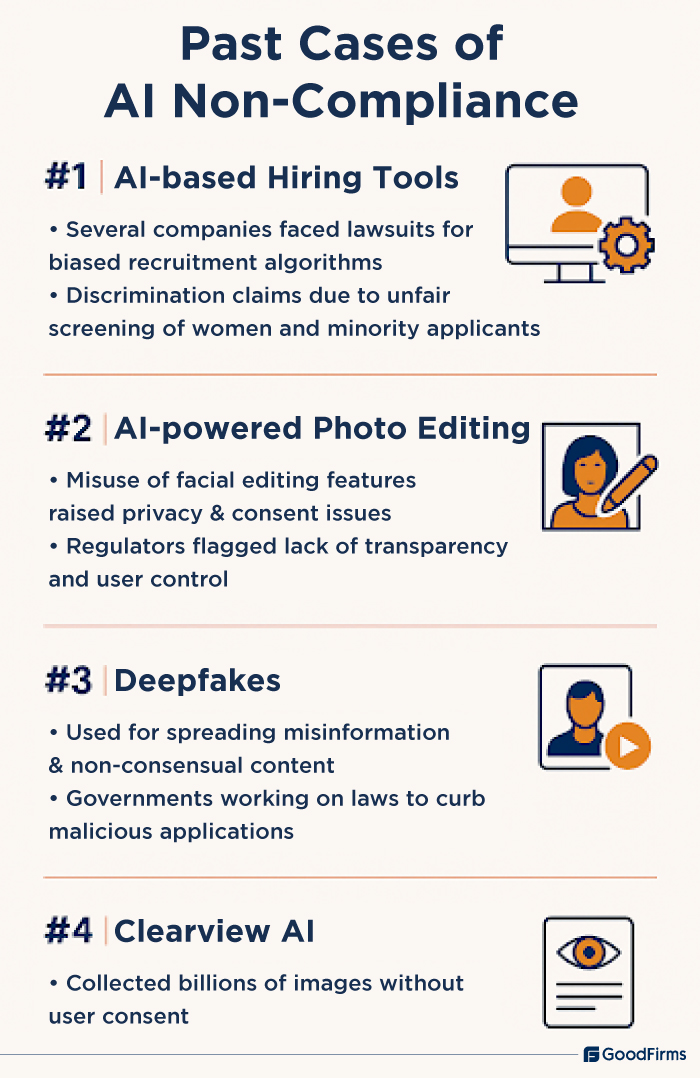
AI has been a center of controversy since it was first introduced due to potential bias in its functioning. Let's have a look at some of these cases to get a clear idea.
(1) AI-based Hiring Tools
Amazon had to remove a secret hiring tool which was AI-based in 2018 as it had shown bias against women candidates.
This AI tool's machine learning model had a tendency to select most candidates who were men, as they were a majority in the IT industry.
(2) AI-powered Photo Editing
There have been many cases of questionable handling of data by apps using AI to edit real photos for enhancement. Facebook had leaked data to a Russian company in 2022.
Similarly, an app called FaceApp stated that photos shared by users were their property.
(3) Deepfakes
Deepfake is synthetic media in which the likeness of a different person replaces another in a video or an image. This AI technology is generally used for negative outcomes like spreading false information and misleading the public.
Deepfake videos have also been used to spread fake videos of Donald Trump and Barack Obama.
(4) Clearview AI
A controversial facial-recognition company called Clearview AI was fined in 2024 by the Netherlands data protection agency. The reason was that they had created an illegal database of billions of facial images from social media.
This has raised significant concerns for privacy and ethics while building databases to train AI.
7 Key Steps to Ensure Successful Development of AI-based Systems
The Executive Order, given by the Government regulation, makes it compulsory to implement seven critical actions while developing AI-based systems to make them fair and transparent.
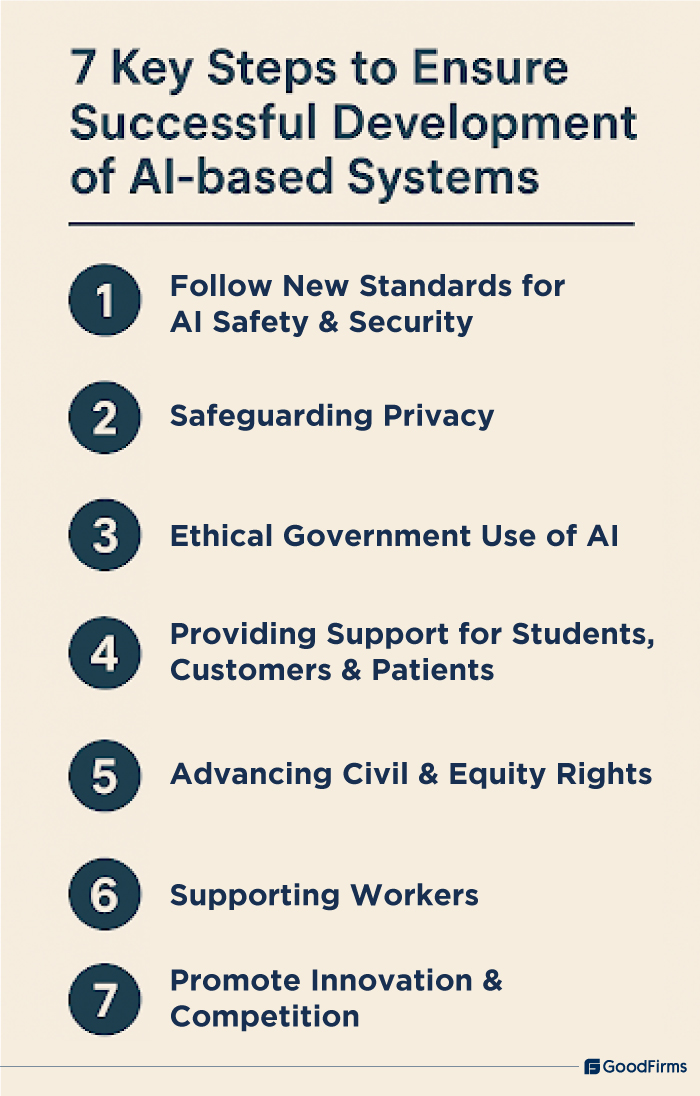
(1) Follow New Standards for AI Safety and Security
With the growing capabilities of AI, the necessity for ensuring safety and security of American citizens is also increasing by the day.
As a result, developers of powerful AI systems are supposed to share safety mechanisms and vital information with the U.S. government.
These regulations also include a ban on the use of AI for developing dangerous biological content.
There are standards set for preventing AI-led deception and fraud due to AI-generated content.
(2) Safeguarding Privacy
Without proper AI regulations, American citizens' privacy is at a very high risk. This technology makes data collection easier and promotes it, as companies use data to train AI models.
As a result, there are regulations to evaluate how agencies gather data and use commercially available data.
(3) Ethical Government Use of AI
AI can help the American government by providing better administration. It can expand the government agencies' capability to monitor, govern and cut down costs.
The regulation requires AI-based agencies to help Government departments in acquiring specific AI services, speed up hiring of AI professionals and issue guidance for agencies' usage of AI.
(4) Providing Support for Students, Customers & Patients
Although AI provides massive advantages for customers, by making products cheaper and easily available, it also increases the chance of misleading and harming American citizens.
As a result, government regulations require the promotion and building of responsible and explainable use of AI.
The regulations want to create an ecosystem that makes use of AI's potential in transforming education.
(5) Advancing Civil & Equity Rights
Some applications of AI can increase the bias and discrimination against certain sections of society. This is rampant in domains such as housing, law, and healthcare.
The Executive Order has provided solutions to ensure that there are civil and equity rights for everyone.
There are enough AI regulations in place to ensure equal treatment for all.
(6) Supporting Workers
AI is completely modifying America's workplaces which provides both better productivity and challenges of greater bias. For this AI regulations and laws have built practices and principles that eliminate these challenges.
(7) Promote Innovation & Competition
The Executive Order on AI regulation clearly states that America should lead the way in AI innovation & competition.
For this, private as well as government organizations will conduct research across the United States, promoting an open, fair and competitive AI ecosystem.
Work on AI-development capabilities of both skilled non-immigrants and immigrants in critical areas.
AI Regulations in Other Parts of The World
We have seen how AI is being regulated in the USA and what are the different acts which have been enacted in its constituent states. Let's have a look at AI regulations in other countries which are economic powerhouses.
China
China's State Council in 2017 issued a New Generation Artificial Intelligence Development Plan. This was meant for developing AI technologies and applications that will make China a leader in the AI segment by 2030.
Since the first development in 2017, China has targeted its actions to particular AI technologies and domain applications.
China has a rule called the Deep Synthesis Rule that regulates the use of deep fake technologies in generating digital content.
European Union
In April 2021, the European Commission released the Artificial Intelligence Act, which was formally signed in June 2024 after revisions and negotiations.
AI systems, which were a clear threat to safety, occupation and rights of people were banned. High-risk AI systems which pose serious risk to safety, health or fundamental rights are allowed but subject to assessments before they are placed in the EU market.
AI systems that have risks of impersonation or cheating need to be validated by information and transparency requirements.
General purpose AI models will have to always maintain the latest technical documentation including content used in training models. Minimal or low risk AI such as video games do not have any AI Act requirements.
United Kingdom
As of now, the UK does not have a general statutory regulation for AI, but it is regulated using existing legal frameworks in various sectors in which AI is used.
The UK government has worked on developing AI policy, action plans, and research institutes.
The approach taken towards AI has varied in the UK depending on the control of the UK government.
Wrapping Up…
AI technology is still in its nascent stage and is growing rapidly with various private and government agencies investing huge sums. However, as we have already discussed, AI-based systems can be biased or discriminate against a section of the society. It can also be used to deceive and impersonate people.
As a result of these vulnerabilities, AI regulation is a must. The USA has come up with AI regulation Acts both at the federal and state level. If you are operating in the AI development segment in the USA, you must take these laws into consideration before launching any AI-based project.
If you are looking for companies that can develop AI-based tools for your firm, look no further than the curated and well-researched list of top AI development companies on Goodfirms.