Key takeaways
- Over half of US teens now use AI chatbots for schoolwork, and 80% of teachers use AI tools too. Students got there first, often before schools had any policy in place.
- AI helps with personalization, accessibility, faster feedback, and lighter workloads. But knowing what a student actually needs, on any given day, still takes a person to judge.
- Bias, academic integrity, privacy, and unequal access are the sticking points now. Getting them right will take clearer school policies and teachers who've actually been trained on the tools, not just handed them.
Generative AI has changed American classrooms faster than almost any technology before it — a shift Goodfirms explored in AI All Set to Transform the Education Landscape. What started as experimental software a few years ago is now a routine classroom assistant. According to the Pew Research Center's survey of US teens, over half have turned to chatbots to look up information (57%) or get help with schoolwork (54%), and 47% say they've used them just for fun. Another survey by PreK-12 marketplace TPT shows 80% of educators reported using generative AI tools in their classrooms.
Thinking about building an AI-powered learning tool? Browse vetted education software development companies on Goodfirms and see who has real classroom deployment experience before you commit.
This blog breaks down how teachers and students are actually using AI, and where it's working and where it's falling short. Let’s dig deeper.
Why AI Adoption in Schools Happened So Fast
Generative AI tools arrived fast in schools, mostly because students got there first. Once chatbots — built by generative AI companies — could answer homework questions, summarize a chapter, or draft an essay outline in seconds, schools had to respond. Some districts banned the tools outright. Others leaned in. Three years later, the leaning-in approach has mostly won out, not because banning failed, but because the tools kept improving and demand from both students and teachers kept growing.
The US Department of Education's own guidance on artificial intelligence in schools makes an important point here: the goal isn't to hand decisions over to a system. It's to keep teachers and students actively involved while AI handles the repetitive, time-consuming parts of the job. That framing, sometimes called “humans in the loop,” is quietly shaping how most school districts are building their AI policies right now.
With policies still catching up, it's worth looking at what teachers are actually doing with these tools day-to-day.
How Teachers are Actually Using AI in the Classroom
Grading and lesson planning are usually the first things teachers mention when you ask what AI has changed about their day. Those two tasks take up more time than almost anything else teachers do, and they're also the tasks AI classroom tools handle reasonably well. A teacher can draft a week's worth of lesson plans in the time it used to take to plan a single day, then spend the time saved actually working with students who are struggling.
Beyond planning and grading, AI is also helping with:
- Adapting reading levels and materials for students with IEPs or 504 plans
- Translating parent communications into multiple languages
- Flagging students who might need extra support based on patterns in their work
- Building practice problems and quizzes tailored to what a class actually needs next
- Supporting professional development by helping teachers reflect on classroom recordings
Much of this runs on tools built by education app development companies that specialize in classroom-specific workflows, rather than general-purpose AI adapted after the fact.
A tool can't replace the teacher, though. It can flag that a reading passage matches a student's level. But a toolcan't know that the student had a rough morning at home and needs some support today. Only a person can make this call.
Teachers aren't the only ones who've adapted quickly — students have moved just as fast, if not faster.
How Students are Using AI in the Classroom
Students adopted AI tools rapidly, often before schools had formal guidance on their use. Mostly, teens use AI chatbots for help with homework, followed by research, brainstorming, and summarizing longer texts. Some of this is exactly the kind of support tutoring has always provided: a patient, always-available helper that can explain a concept a different way when the first explanation didn't click.
The tougher question is where "help" crosses into "doing it for them." Teachers see students turn in polished essays or solved problem sets and wonder how much of the thinking actually happened. It's an open argument in education circles right now — is this a genuine learning tool, or just a faster way to skip the work?
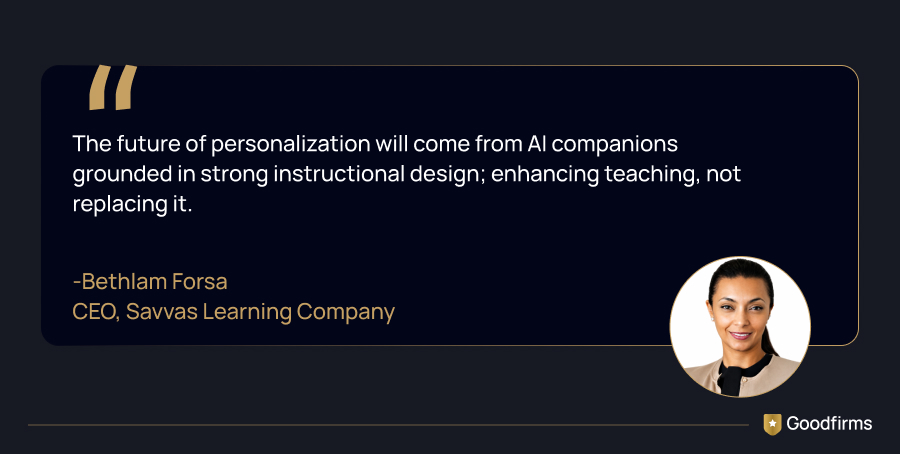
Source: THE Journal, Jan 29, 2026
That tension between help and shortcut looks different depending on where AI is actually being used well.
Where AI is Working Best in Classrooms
A few areas are actually useful, not just hype:
1. Personalization at Scale
A teacher with 30 students can't give each one an individually paced lesson — there simply isn't enough time in the day. Adaptive AI learning platforms fill that gap by adjusting practice problems, reading levels, and pacing for each student in real time, all without adding to the teacher's workload. A student who's struggling with fractions might automatically get extra practice problems, while a student who's ahead moves on to something more challenging, all within the same class period.
2. Accessibility
AI-powered accessibility tools are benefiting students with visual impairments, hearing differences, or learning disabilities. AI-powered text-to-speech reads material aloud for students who struggle with reading. Real-time captioning helps students who are deaf or hard of hearing follow a lesson as it happens. Translation tools enable a teacher to communicate with a family in their home language without waiting for a district interpreter. For students who have spent years working around materials that weren't built for them, these tools are closing the gaps.
3. Faster Feedback Loops
Before the advent of AI, students used to wait days to get a graded essay back. Now they can get feedback on a draft right away and fix it while it's still fresh in their mind. That quick turnaround matters — a comment on a rough draft helps a lot more than the same comment a week later, once the student has moved on to other things. It also means students can revise more than once, so writing becomes more of a conversation instead of a single, one-time submission.
4. Reduced Teacher Burnout
Time saved on paperwork and admin work can go back into the parts of teaching that need a real person: mentoring, encouraging, and noticing when a student needs help before they even ask. Teachers who use AI tools often say they get a few hours back each week. Initially, they used that time for grading or paperwork. Now, teachers use it for one-on-one time with students who need it most, or it just means going home at a normal hour instead of taking work home every night.
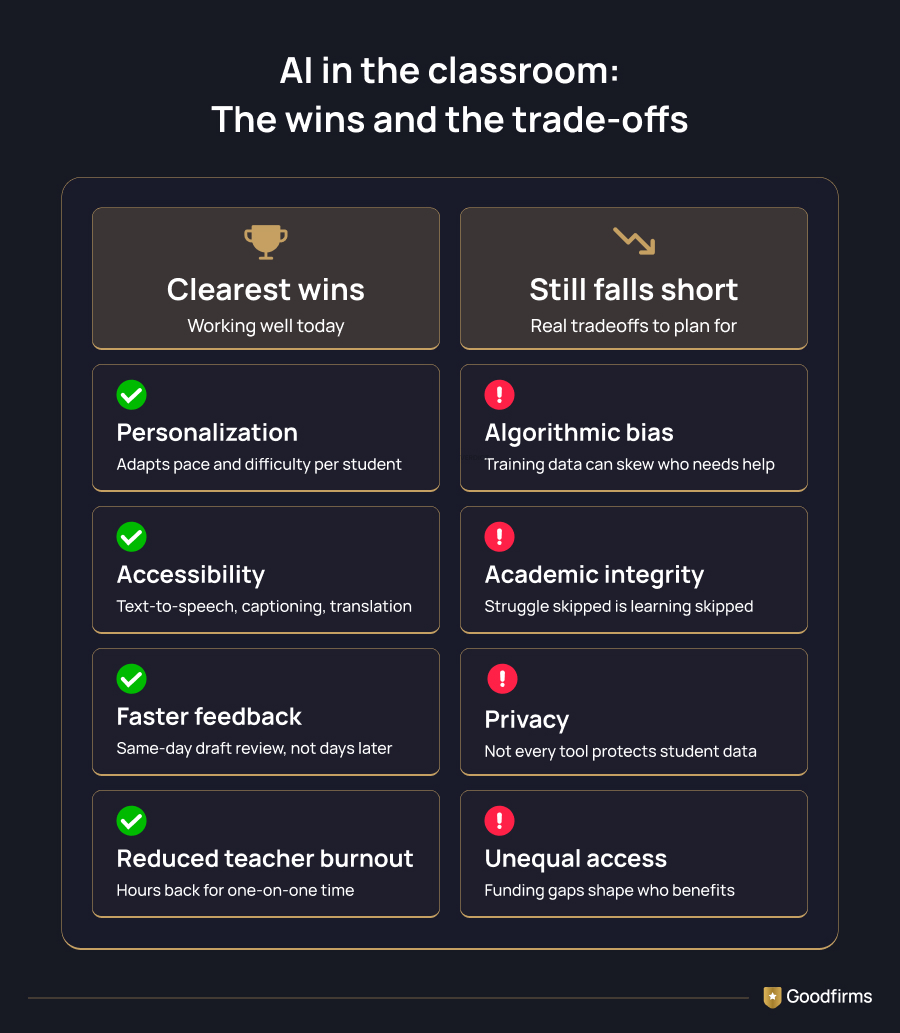
These wins don't come free, though — each one carries a real tradeoff worth understanding.
Where AI in Education Still Falls Short
Every one of these wins comes with a real cost somewhere else.
1. Algorithmic Bias
These tools don't invent bias out of nowhere — they inherit it. Feed a system years of data in which certain students were consistently under-flagged, and it learns that pattern as normal and keeps repeating it. A kid from a community that the data barely captured could go unnoticed for months, not because anyone was careless, but because the tool was never shown enough examples like them to know what to look for. Nobody writes that outcome into a rollout plan. It shows up quietly instead, in who gets extra help and who slips past.
2. Academic Integrity
Leaning too heavily on chatbots can get in the way of real learning. Subjects like math and writing depend on working through difficulty — that struggle is often how understanding actually sticks. When AI does the hard part for a student, the assignment gets finished, but the learning behind it doesn't happen the same way.
3. Privacy
A kid's grades, learning struggles, and behavior notes are just as sensitive as any other record a school keeps — arguably more so, since they follow a student for years. Yet plenty of AI tools on the market haven't been built to comply with privacy laws, such as FERPA, that require student data to be protected. Before anything goes live in a classroom, someone needs to actually track down the answers: where this data ends up, who has access to it, and whether the tool holds up against real privacy law, not just a vendor's word for it.
4. Unequal Access
In a well-funded suburban school, you'll likely find AI tools already integrated into daily lessons, trained teachers on how to use them, and IT support on call when something breaks. Whereas, in an under-resourced rural school an hour away, that same technology might not exist at all — not because the need is smaller, but because the budget is. Left unplanned, AI doesn't level that playing field. It tends to widen it.
These challenges aren't a reason to walk away from AI — they're reasons to plan for it more carefully.
What is Next for AI in K-12 Education
Where AI in K-12 education goes from here has less to do with new technology and more to do with how schools choose to use it. Expect more states and districts to roll out formal rules on classroom use, student privacy, academic honesty, and data security — clearer policies that let teachers use AI consistently without risking students' trust.
Teacher training needs to catch up, too. Knowing how to use a tool isn't enough; teachers also need to spot bias or inaccuracies in AI output and judge when it actually helps a lesson.
Districts will also get pickier about what they buy, often leaning on AI consulting companies to map out a broader strategy instead of evaluating tools one by one — weighing security, accessibility, transparency, and data protection.
Goodfirms reviews education software vendors, and after watching how districts evaluate them, one noticeable thing in 2026 is that technology isn't the bottleneck. The buying process is. Schools compare tools without a consistent framework, pilots stall before contracts are signed, and vendors are picked based on a good demo rather than classroom results. The next real shift may come from districts simply learning to choose better.
Since take-home assignments are easy for AI to finish, schools are leaning more on project-based work, discussions, and in-class writing to gauge real understanding. AI tutoring is also set to grow, giving students extra practice and feedback outside class hours, without taking the teacher out of the picture.
Together, these shifts point to where AI in education is headed next — and it starts with knowing what to look for in a vendor.
What to Look for when Evaluating an AI Edtech Vendor
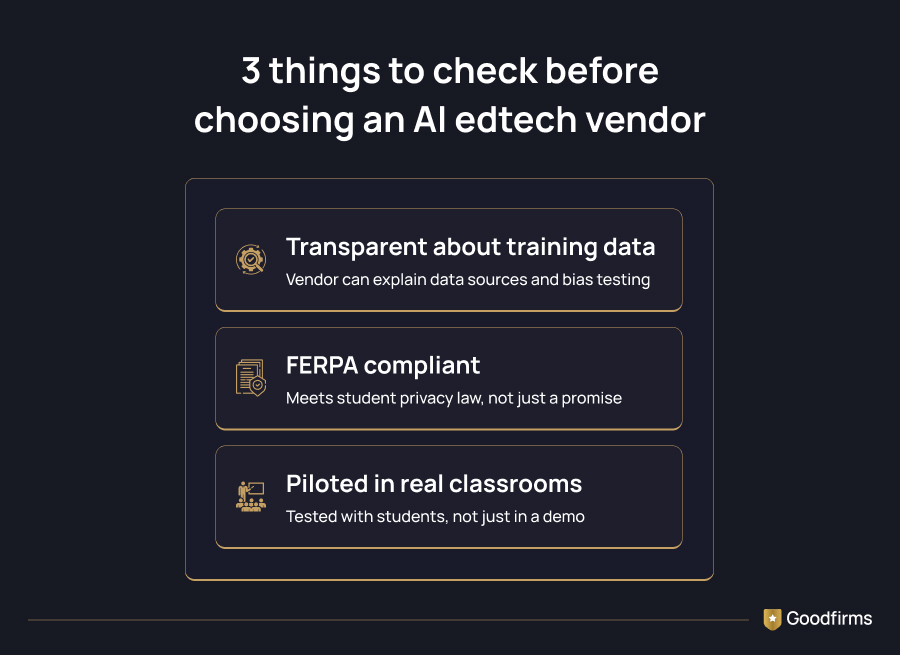
Not every AI tool built for classrooms meets the same bar on privacy, bias testing, or accessibility.
Before a district or school adopts one, it's worth checking a few things: whether the vendor is transparent about training data and bias testing, whether the tool complies with student privacy laws like FERPA, and whether it's actually been piloted in a classroom setting rather than just a demo environment.
Districts weighing options can compare vetted education IT service provider companies side by side, with reviews from schools that have already used the tools in real classrooms — a faster way to separate tools built for teachers from those built solely for a pitch deck.
Getting the vendor right is only part of the picture, though — the bigger question is how well a school puts any of this into practice.
Final Thoughts on AI in American Classrooms
AI in education is already changing how American classrooms work, but how well it plays out in the long term depends on how carefully schools implement it. Done right, AI can cut down on busywork, personalize learning, improve accessibility, and get feedback to students faster. But schools still have real work to do on bias, privacy, uneven access, and academic honesty — and that means clear policies and real teacher training, not just new software.
AI isn't replacing teachers. It's proving most useful as a backup for them. The schools that get the most out of it will be the ones that pair responsible AI use with strong human oversight — using the technology to support teaching without losing the relationships and judgment that education has always depended on.
A few questions come up again and again on this topic — here are the ones worth a straight answer.
FAQs: AI in American classrooms
Is AI actually helping students learn, or just helping them finish faster?
Both, depending on how it's used. AI-based tutoring that explains concepts and checks understanding supports real learning. AI used purely to generate finished work tends to shortcut it.
Are schools required to have an AI policy?
Not universally. Policy requirements vary by state and district, and many schools are still developing their own guidelines rather than following a federal mandate.
Does AI in education replace teachers?
No major education body, including the US Department of Education, is recommending that. The consistent message is that AI should support teachers, not replace their judgment or their relationship with students.
Is student data safe when schools use AI tools?
It depends on the tool. Student data deserves the same protections as any other school record, but not every AI product on the market meets that bar. Schools need to check where data goes, who can access it, and whether the tool complies with student privacy laws before adopting it.
Do all schools have equal access to AI tools?
No. Access varies a lot by district funding and resources. Well-funded suburban schools can typically afford better tools, training, and tech support than under-resourced rural ones, which means AI adoption isn't happening at the same pace everywhere.