Key takeaways
- AI content writing tools easily accelerate content output by 2-5x.
- The best AI content writing tools in 2026 have gone far beyond writing; they help with research, briefing, and content optimization.
- Tools such as Jasper, Surfer AI, ChatGPT, Claude, and more serve different use cases, as one size does not fit all.
- AI tools cannot provide first-hand experience, verified expertise, or original data; humans must supply these.
- Tools used for pure automation without editorial review risk thin content penalties and E-E-A-T failures
Your competitors are publishing more than ever, and a big chunk of it is AI-assisted. Teams using AI tools strategically produce content up to 62% faster (Adobe), and individual writing tasks get done 40% quicker. The gap between teams using these tools well and teams using them badly is only getting wider.
But faster isn't the whole story. Most brands are still treating AI content writing tools like an autopilot: hit generate, publish, repeat. That's the mistake. Used that way, they don't save you; they quietly damage your rankings with thin, generic content that Google has no reason to surface.
This guide is for teams who want to use AI the right way, which tools are actually worth it, what risks to watch for, and how to build a workflow that produces content that ranks and stays ranked.
Discover AI content writing tools on Goodfirms and compare them based on real performance, pricing, and use cases.
What Are AI Content Writing Tools?
AI-generated context is the text produced by Large Language Models (LLMs) rather than written by a human. These models are highly trained on billions of words of text, enabling them to generate coherent, contextually relevant output from a user's prompt.
The critical word is generated, not researched. When you prompt an AI writing tool to produce content, for example, a blog post of 1500 words, it isn't interviewing experts or drawing on personal experience; it is statistically predicting what text patterns and driving content that is the best match of your prompt. This matters enormously for how you use the output.
However, that doesn’t mean AI content writing tools are ineffective. The real value lies in understanding where AI-generated content accelerates workflows, where it still requires human oversight, and which tools are actually delivering reliable results in 2026.
What are the Best AI Tools for Content Writing in 2026
|
Tool |
Best For |
SEO Features |
Free Tier |
|---|---|---|---|
|
Versatile drafting, research |
Plugins + browsing |
Yes |
|
|
Long-form, brand voice, agencies |
Surfer SEO integration |
No |
|
|
SEO-first long-form content |
Core feature (live SERP) |
No |
|
|
Copy.ai |
Marketing copy, workflow automation |
Basic keyword assistance |
Limited |
|
Blogs, ads, product descriptions |
Keyword integration |
Credits |
|
|
Content briefs, SERP analysis |
Built-in SEO core |
Trial |
|
|
Claude |
Complex reasoning, long documents |
None native |
Yes |
|
Budget-friendly first drafts |
Basic SEO assistant |
10K chars/mo |
|
|
AI-powered mind mapping & content structuring |
None native |
Limited |
|
|
AI content humanization & detection bypass |
Paraphrase optimization |
Credits |
1. ChatGPT (GPT-4o)
Most content teams already have ChatGPT open in a browser tab. That's not a coincidence; it handles a wider range of tasks than almost anything else on this list. It covers research, drafts, meta descriptions, repurposing, FAQ generation, and more, and it gets noticeably better the more specific your prompt is.
Best for: Teams and agencies juggling a mix of content types, blogs, emails, ads, and research, who need one tool that can flex across all of them.
SEO strength: Great for generating FAQ sections, how-to structures, and formatted content that tends to get picked up by featured snippets and AI Overviews.
Watch out for: No built-in keyword data or brand voice memory. You'll need to pair it with an SEO tool and edit the output before it's ready to publish.
2. Claude (Anthropic)
If you've ever published a 3,000-word guide and needed it to actually hold together from start to finish, Claude is worth trying. It handles long-context documents better than most, fewer tangents, better paragraph flow, and a lower tendency to invent facts it doesn't know.
Best for: Long-form content that needs real depth, technical guides, whitepapers, pillar pages, where quality matters more than turnaround time.
SEO strength: Content that earns links tends to do so through depth and credibility. Claude's output leans in that direction, and its lower hallucination rate means less time cleaning up before publication.
Watch out for: There's no keyword data here. Claude writes well, but you still need a separate SEO tool to tell you what to write about and how to optimize it.
3. Jasper AI
Jasper is what agencies reach for when they're producing a lot of content across a lot of clients and need it to actually sound consistent. The brand voice training is the real sell; once it's set up, Jasper stops sounding like generic AI and starts sounding like the brand.
Best for: Agencies and in-house teams pushing out 20+ pieces a month who can't afford to re-brief tone and voice every single time.
SEO strength: The Jasper + Surfer integration is genuinely useful; you get keyword and semantic data feeding into the draft from the start, not as an afterthought.
Watch out for: There's no free tier, and it takes real setup time to get the brand voice right. Rush that step, and the output quality suffers for it.
4. Surfer AI
Surfer AI does one thing, and it does it well: it generates content that's built to rank. Before you write a word, you've already looked at what the top-ranking pages are doing, their structure, length, and the terms they use, and you use that to shape the draft.
Best for: SEO professionals and content agencies where the brief is simple: write something that ranks on this keyword.
SEO strength: Real-time content score, semantic term recommendations, and GEO optimization baked in, not bolted on after the fact.
Watch out for: It's priced for SEO-first teams, not general content work. If ranking isn't the primary goal, the cost doesn't justify it.
5. Copy.ai
Copy.ai is the tool you reach for when the brief is simple: “I need 200 subject lines by end of day.” It’s built for speed and high-volume content creation. Its workflow builder helps automate repeatable tasks with minimal manual effort. However, deep integration with SEO tools and software isn’t its strength; it’s designed for fast execution, not advanced SEO strategy.
Best for: Marketing teams, e-commerce brands, and social media managers who work in short-form copy and need it at scale.
SEO strength: Solid for meta descriptions, title tags, and ad copy variations, practical wins for large content catalogs without a lot of manual effort.
Watch out for:Long-form content is inconsistent. The deeper the brief, the more it shows the limits of a tool built for speed over substance.
6. Writesonic
Writesonic sits comfortably in the middle of the market, not the cheapest, not the most powerful, but solid across a range of use cases. Its Chatsonic feature pulls in live data, which matters if you're covering topics where freshness counts. It's also started building toward GEO, which puts it ahead of some competitors on that front.
Best for: Bloggers, creators, and small teams who want a single tool that handles both writing and basic SEO without needing a full platform stack.
SEO strength: Live search data reduces the stale-information problem, and the keyword integration is good enough for most content that isn't targeting the most competitive terms.
Watch out for: Highly technical topics expose the limits of the output. It handles broad content well; niche, specialized content less so.
7. Frase
Frase flips the typical AI content workflow. Instead of starting with a prompt and hoping the output is competitive, you start with a brief built from what's already ranking, the topics, questions, headers, and data points the top pages cover. That brief then drives everything else.
Best for: SEO managers and strategists who want to understand the competitive landscape before a word gets written, not after.
SEO strength: The brief quality alone gives any subsequent draft a head start. Content Score keeps you accountable throughout the editing process.
Watch out for: The writing tool itself is functional, not impressive. Frase is most valuable as a research and briefing platform; pair it with a stronger drafting tool for best results.
8. Rytr
Not every team needs an enterprise platform. Rytr gives you a clean interface, decent short-to-medium form output, and a free tier that actually lets you test things before committing. At $9/month, it's the sensible starting point for someone trying AI content tools for the first time.
Best for: Solo creators, freelancers, and small teams who want to try AI-assisted writing without the overhead of a full platform.
SEO strength: The built-in SEO assistant covers the basics, keyword inclusion, and tone adjustment, which is enough for internal pages and low-competition content.
Watch out for: Competitive SEO content needs SERP data and semantic analysis that Rytr simply doesn't have. Use it to learn the workflow, not to target hard keywords.
9. MindNote
MindNote isn't a writing tool; it's a planning tool that makes the writing better. If you're building topic clusters and the internal linking keeps getting messy, MindNote's mind mapping helps you see the full picture before you start producing content. Pillar pages, supporting articles, gaps in coverage, it's all easier to see when it's visual.
Best for:Strategists and SEO managers who need a cleaner way to map out content clusters before assigning briefs or generating drafts.
SEO strength: Better cluster planning means stronger internal linking, more complete topic coverage, and fewer gaps that competitors can exploit.
Watch out for: This tool doesn't write anything. It's a planning layer, useful before you open any drafting tool, but it won't produce a word of publishable content on its own.
10. GPTinf
The problem GPTinf solves is a practical one: AI-generated drafts often carry detectable patterns that both human editors and AI content detectors flag. GPTinf works on those patterns at the sentence level, restructuring and varying phrasing to produce output that reads more naturally before your editor even opens it.
Best for:Teams running high-volume AI content workflows who want to reduce the editing load before drafts reach human reviewers.
SEO strength:Cleaner, more natural-sounding drafts get through editorial review faster, which means less time between generation and publication.
Watch out for: GPTinf makes the writing sound more human; it doesn't make it more accurate, more original, or more authoritative. Those gaps still need a human to close.
Goodfirms Insight: Scaling content isn't just about speed, it's about reducing friction at every stage. AI humanizer tools help teams cut editing time significantly by turning AI-generated drafts into polished, human-like content that's ready for the human enrichment stage, not a rewrite from scratch.
The mistake most teams make is treating all AI writing tools as interchangeable. In reality, each tool sits at a different point on the spectrum, some are built to fully generate content, while others are designed to assist, structure, optimize, or refine human-written work. Understanding that distinction is what separates scalable content operations from low-quality AI spam.
Generation vs. Assistance - The Spectrum Every Content Team Must Understand
"AI content writing tools" covers a wide range of actual use modes:
Full Generation - You provide a prompt; the AI delivers a complete draft with minimal human involvement. Highest output speed, highest risk of thin content, and E-E-A-T failure. It should never be published without substantial human editing.
Automation -AI runs content workflows at scale. Efficient for repeatable, low-complexity content. High risk if deployed without quality control.
Assistance - AI supports human writers through outlining, ideation, first-draft scaffolding, and research synthesis, while human expertise shapes the final product. Lowest SEO risk. Highest long-term ranking potential. The recommended default.
The more you rely on AI to generate content, the more human review it needs before publishing. That's not a caveat, it's how you keep the output worth reading.
They Are Prediction Engines, Not Thinking Machines
Every word in an AI-generated piece is selected based on statistical probability, which word is most likely to follow the previous words in this context. The model optimizes for linguistic plausibility, not factual truth. This is why AI content can sound authoritative while being factually incorrect.
Use AI writing tools for what they're good at: structure, language, format, and supply what they cannot provide: expertise, experience, original data, and verified facts.
That balance matters even more because search engines are no longer evaluating whether content was written by AI or humans; they’re evaluating whether the content is genuinely useful, accurate, and trustworthy to readers.
Google’s Stance on AI Content - What You Need to Know
Search engines like Google do not penalize AI content tools; they penalize low-quality output. Content created with tools like ChatGPT or Jasper AI can rank well if it is helpful, accurate, and human-reviewed.
Google's March 2026 core update, which began rolling out on March 27 and completed on April 8, reinforced this direction. Per Search Engine Land's coverage, the update was described by Google as "a regular update designed to better surface relevant, satisfying content for searchers from all types of sites," with no specific targeting of AI content.
Independent analysis by Aleyda Solis found that established brands, specialist sites, and data-rich sources gained visibility, while aggregators and thin-content sites lost ground. Sites with strong E-E-A-T signals, human editing, and genuine depth maintained or improved rankings.
Bottom line: AI tools are safe—poor usage is not.
AI Content SEO Best Practices - What Works in 2026
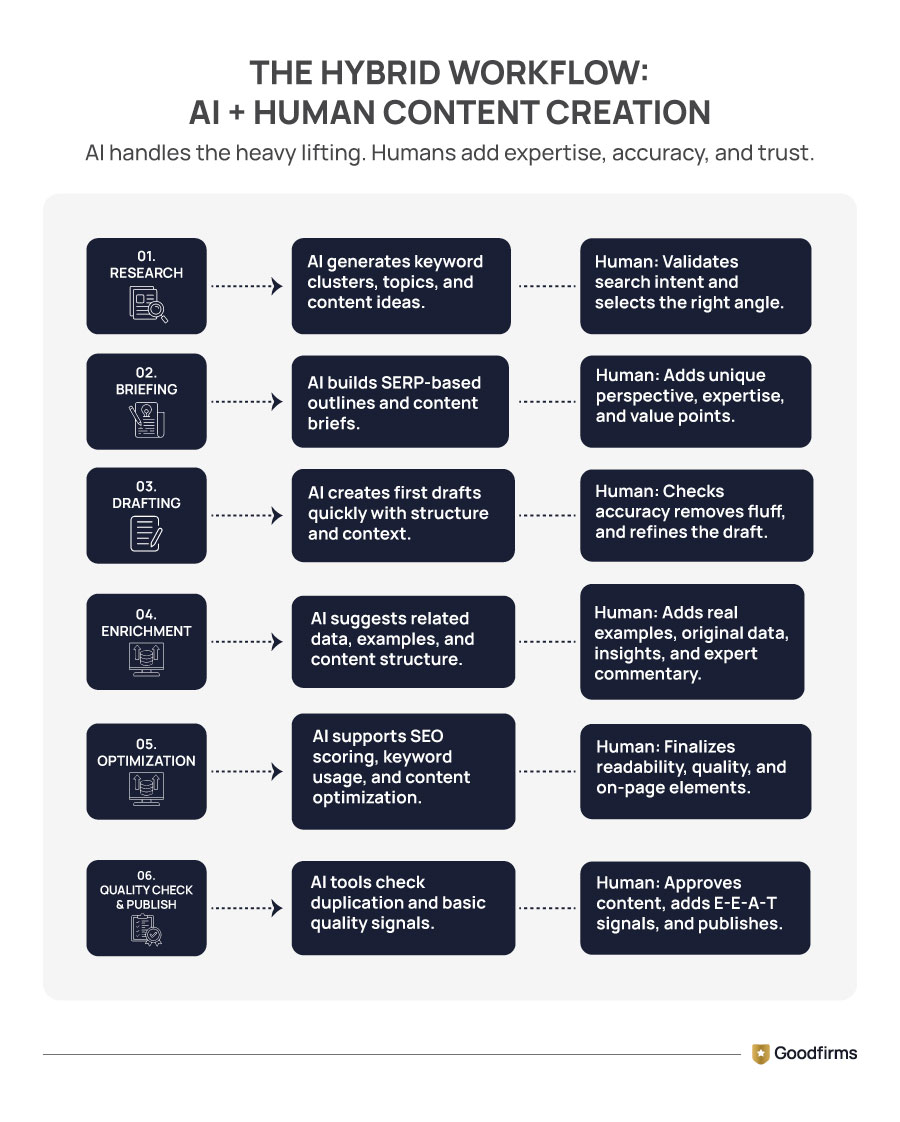
The Hybrid Workflow (AI + Human)
The most effective strategy combines AI speed with human expertise across every stage:
- Research: AI generates keyword clusters; humans validate intent
- Briefing: AI builds SERP-based outlines; humans add unique angles
- Drafting: AI creates first drafts; humans check accuracy
- Enrichment: AI suggests structure; humans add examples, data, insights
- Optimization: AI supports SEO scoring; humans finalize content quality
- Quality Check: AI detects duplication; humans approve before publishing
Use tools like Frase and Surfer SEO for workflow efficiency.
How to Use AI Without Hurting Rankings
- Brief first, prompt second — define intent, keywords, and angle
- Use the right tool — SEO tools for research, AI tools for drafting
- Fact-check everything — remove hallucinations
- Add human value — real examples, expert insights, original data
- Apply E-E-A-T signals — author bio, sources, credibility
- Optimize for AI + search — structured headings, FAQs, schema
Build Topical Authority
Create content clusters (pillar + supporting pages), interlink them, and publish consistently. AI enables scale, but authority comes from depth and expertise.
Operationalizing the Workflow with Content Management Software
To execute this workflow effectively at scale, use content management software to manage drafts, streamline review stages, and maintain structured publishing schedules, ensuring the human review process remains consistent and never overlooked. Once the workflow is operational, the next challenge is visibility because publishing AI-assisted content is easy, but consistently ranking it in modern search results requires a very different approach.
How to Rank AI-Assisted Content in 2026
AI-assisted content ranks when it focuses on quality, intent, and credibility, not just automation.
High-performing content:
- Starts with clear search intent, not just keywords
- Uses AI for structure, but adds human expertise and insights
- Includes verified facts and credible sources
- Demonstrates E-E-A-T through examples, author credibility, and expert review
- It is part of a topical cluster with strong internal linking
- It is regularly updated for freshness
Low-performing content:
- Is published with little or no human editing
- Contains hallucinations or unverified claims
- Lacks originality or depth
- Exists without a clear content strategy
- Fails to satisfy user intent, leading to poor engagement
The key takeaway: Search engines don’t penalize AI, they penalize low-quality content. With the right workflow, AI becomes a powerful tool to scale high-quality, ranking content, especially when paired with dedicated SEO software that ensures proper optimization, intent alignment, and performance tracking.
The Future of AI Content Writing Tools and SEO
AI has eliminated the advantage of publishing more; anyone can scale content now. The real differentiator is quality, depth, and expertise, which AI alone cannot provide. Brands that combine AI efficiency with human insight and authentic voice will stand out.
Generative Engine Optimization (GEO)
With AI-driven search (like Google AI Overviews and tools such as ChatGPT), ranking isn’t enough; you need to be cited in AI answers.
Focus on:
- Clear, fact-based content
- Strong authority signals
- Up-to-date, verifiable information
Human + AI = Winning Formula
AI alone lacks originality; humans alone can’t scale. The future is hybrid content, combining speed with expertise for sustainable SEO success.
Conclusion
AI content writing tools are powerful, mature, and genuinely transformative for content operations in 2026. Jasper, ChatGPT, Surfer AI, Copy.ai, and Frase have earned their place in professional content workflows, not because they replace human expertise, but because they amplify it.
To get it right: choose the right tool for the job; use assistance mode, not generation mode; fact-check everything; build E-E-A-T signals deliberately; and think in clusters, not individual articles.
Used with strategy and editorial discipline, AI content writing tools are one of the most significant productivity advantages available to any content marketer today. If you're starting out, pick one tool in assistance mode, not generation mode, run it for 30 days, measure ranking impact on 3 to 5 target pages, and then decide whether to expand. That's how a tool becomes a workflow, and a workflow becomes a competitive edge.
Frequently Asked Questions
1. What are the best AI content writing tools in 2026?
The top tools for different needs: Surfer AI for SEO-optimized long-form content, Jasper AI for brand-consistent content at scale, ChatGPT for versatile drafting and research, Copy.ai for marketing copy and workflow automation, and Frase for content research and briefing. For free options, ChatGPT's free tier and Claude.ai deliver strong results.
2. Is AI-written content good for SEO?
AI-written content can rank well when enriched with human expertise, verified facts, and a first-hand perspective. Raw, unedited AI output consistently underperforms because it lacks originality, depth, and E-E-A-T signals. The editorial workflow around the tool is the variable, not the tool itself.
3. Can Google detect AI-written content?
Google doesn't use a binary AI detector. Its quality evaluation systems assess signals, originality, depth, factual accuracy, engagement, many of which correlate with unmanaged AI content. Well-edited AI content that demonstrates genuine expertise and E-E-A-T signals is functionally indistinguishable from human-written content in Google's evaluation.
4. Does Google penalize AI content?
Not for being AI-generated. Google penalizes low-quality content, spam, and content produced primarily to manipulate rankings, which are often outcomes of careless AI tool use, but not inherent to the tools themselves.
5. What are the risks of AI-generated content for SEO?
The primary risks are hallucinated facts, thin content that fails Google's Helpful Content criteria, duplicate output from shared AI models, E-E-A-T gaps that suppress rankings in competitive niches, and brand credibility damage from generic-sounding content. All are manageable with a disciplined human review workflow.
6. How do AI content tools support creative writing?
Tools like Sudowrite and Claude are effective for creative content, helping writers develop narrative direction, overcome creative blocks, generate story alternatives, and maintain voice consistency across long-form pieces. The writer retains full creative direction; AI handles the generative exploration that fuels creative momentum.