“AI will change everything.” We all hear this line almost daily.
But the truth is, AI is changing everything. Slowly, stubbornly, and often in ways we don’t notice until it’s already part of how we work.
According to a McKinsey survey, 78% of respondents said their organizations are using AI in at least one business function.
Today, AI development companies are optimizing customer service tools, supply chains, fraud alerts, and many apps we use daily with AI. The real question now is how fast your organization can move from talking about AI to actually using it.
This blog isn’t another checklist of “top AI industry trends.” It’s a field guide for leaders who want to move past the noise, focus on what works, and scale their business with AI, without getting lost in jargon or hype.
If you are ready to explore how AI is already at work and how to put it to better use, you are in the right place.
Where AI Is Taking Businesses Right Now
AI has quietly become part of the furniture. Market numbers back this up. Companies are set to spend approximately $375 billion globally on AI infrastructure alone in 2025, which will rise to $500 billion in the next year.
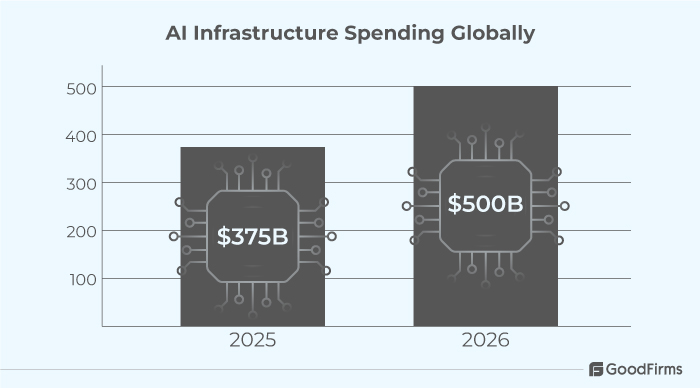
Job postings for AI-related roles are also growing at a pace we have not seen in tech for a long time. That’s not hype. It’s a signal that companies see AI not as an experiment but as infrastructure, the same way they once treated cloud computing.
So, what’s behind the push? Part of it is survival. Customers expect speed, personalization, and smooth experiences by default. Competitors are finding ways to slash costs and make faster decisions with AI. In addition, there is the ongoing pressure to adopt AI to digitize every corner of the business.
Of course, it’s not all seamless. Many firms are still grappling with messy data, legacy systems, and talent gaps. But the overall momentum is undeniable.
In 2025, AI industry trends aren’t about “what might be possible.” They are about “what do we need to do today to keep up.”
Top 10 AI Industry Trends Businesses Must Act On Today
Let’s explore the AI industry trends that are making business operations faster, smarter, and more reliable than ever before.
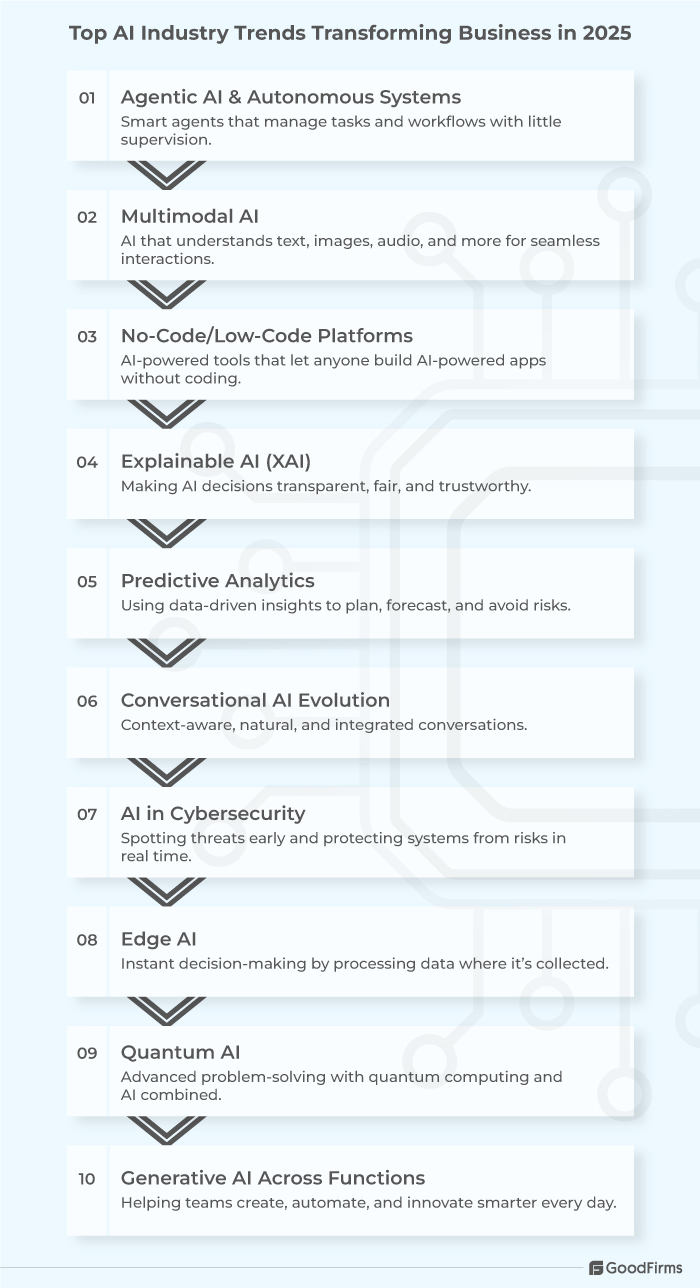
1. Agentic AI and Autonomous Business Systems
Agentic AI can actually act on its own. It does not need commands to take any action. It makes its own decisions and helps get work done by understanding the context and learning patterns.
You can think of these agents like apps, but way more powerful. Just like you open a different app to check emails or set reminders, agents handle entire processes without needing constant input. They can schedule meetings, answer questions, or even fix common tech issues, all without you lifting a finger.
The best part? You don’t have to be a tech expert to use them. There are tools that allow building agents without coding. For more complex tasks, developers can build advanced agents or partner with top AI agent builders that connect different systems and handle bigger workflows.
For example, a sales team could set up an agent who tracks stock issues and suggests alternatives before they cause a delay. HR teams could use one to answer routine questions or help onboard new hires. These agents take care of repetitive work so that employees can focus on tasks that require human intervention.
Of course, humans are still in charge. It’s not about handing over everything to AI. Clear guidelines are needed to decide what agents can and can’t do. People still need to review and supervise their work.
2. Multimodal AI for Enhanced User Experiences
Multimodal AI helps systems “see,” “hear,” and “read” all at once. Instead of working with just text or images, it processes multiple types of information together.
So, if a customer contacts you with a question, a photo of the issue, and a voice message explaining the problem, multimodal AI can pull all that together. And it will offer faster and more accurate support. Or think about an online store that needs product descriptions. Multimodal AI automatically generates product descriptions by scanning images, saving time.
It’s not just about customer service. Healthcare apps can analyze medical scans alongside patient notes, helping doctors make better decisions. Public agencies can blend satellite data, maps, and traffic reports to improve infrastructure planning and safety.
The power of this technology lies in making interactions seamless. It’s about removing friction and letting users communicate naturally, without needing to adapt to the system.
3. AI Democratization Through No-Code/Low-Code Platforms
Platforms like Bubble, Webflow, and StackAI let users create apps, automate tasks, and build workflows without writing a single line of code.
Using such AI-powered tools, marketing teams can personalize campaigns without IT support. HR departments automate recruitment processes. Small businesses build customer-facing apps quickly, cutting costs and accelerating innovation.
The rise of these platforms is reducing dependencies on other teams. Because, you can build it yourself, as you want, when you want. On the other hand, you can also partner with top low code/no-code development agencies and build your own use-case-specific workflow.
4. Explainable AI for Regulatory Compliance and Trust
AI can feel like a black box. You put in data, it gives you results, and you have no idea, “How did it get there?” Explainable AI or XAI solves that. It shows how decisions are made.
This matters a lot in finance or healthcare. A bank needs to explain why a loan was approved, and a hospital needs to know why an AI flagged a particular diagnosis. XAI helps trace decisions and uncover hidden biases. Whereas it is also essential to meet regulations like GDPR or the EU AI Act.
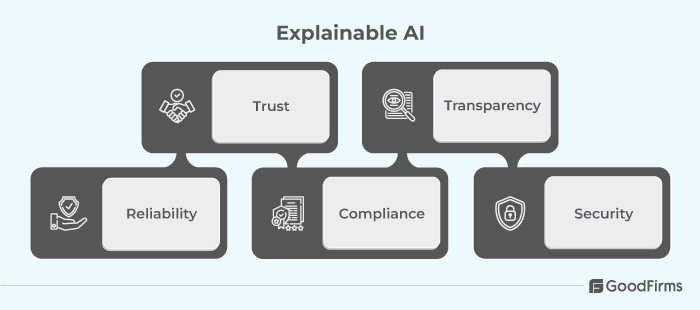
It is not just about the rules but about building trust. Customers feel confident in decisions. Employees understand how the system works. Regulators see that you’re being fair.
5. AI-Powered Predictive Analytics for Strategic Planning
Predictive analytics is all about visualizing the future. AI looks at past data to spot trends, risks, and opportunities. It turns messy numbers into valuable insight.
- Finance teams can detect fraud early or predict cash flow.
- Retailers can forecast demand and manage inventory smarter.
- Manufacturers can catch machine problems before they cause downtime.
- Supply chain managers get early warnings about delays.
- Marketing teams see which campaigns are likely to work best.
The payoff? Businesses move from reacting to planning. Teams act with confidence. Decisions are faster, smarter, and less guesswork because predictive analytics turns data into insights you can actually use.
Need a hand with that? You can find a list of top Machine Learning companies to get started.
6. Conversational AI Evolution Beyond Chatbots
Chatbots were just the beginning. Today’s conversational AI goes way beyond answering simple questions. It remembers what you have said before. Conversations now feel natural instead of robotic.
Take voice assistants, for example. They help schedule meetings, draft reports, and even walk users through complex tasks. Customer service platforms now handle multi-step conversations. They keep track of context, so users don’t have to repeat themselves every time.
Moreover, businesses are plugging conversational AI into tools like CRMs or help desks. A sales rep can ask for customer details and instantly get answers. HR teams use AI to guide employees through benefits questions without jumping on a call.
7. AI in Cybersecurity and Risk Management
Cybersecurity teams are always racing against new threats. AI helps them stay one step ahead by spotting risks quickly and responding before things get out of hand.
AI can flag unusual activities like odd login attempts or suspicious transactions in real time. Banks use this to catch fraud before it spreads. Healthcare providers protect sensitive patient data from cyber attacks. Insurance companies also rely on AI to spot fraudulent claims.
The best part? AI keeps learning. As cyber threats evolve, AI tools get better at spotting new patterns, helping businesses stay protected no matter what comes next. To get a head start, you can also explore a curated list of top-rated cybersecurity companies.
8. Edge AI for Real-Time Decision Making
Edge AI complements cloud computing. Critical tasks happen on the edge, while larger data analysis stays in the cloud. Because, in some cases, waiting for data to travel back and forth between devices and the cloud can slow down critical decisions. Auto vehicles need to react instantly to road conditions or obstacles.
Edge AI solves this by analyzing data right where it’s collected, such as on devices, sensors, or machines. In this case, it processes the information on the spot. Vehicles can make split-second decisions without relying on a remote server.
Moreover, processing data locally means higher privacy. Sensitive information does not need to be sent across networks, reducing the risk of data breaches.
9. Quantum AI for Complex Problem Solving
Quantum AI perfectly combines quantum computing and artificial intelligence to tackle complex challenges.
Quantum computers process information in ways classical systems can’t. It can analyze huge datasets, spot patterns, and find solutions faster and more efficiently. Industries like pharmaceuticals are using it to speed up drug discovery. Quantum AI simulates molecular interactions that would take years for traditional computers to calculate.
While fully mature quantum AI solutions are still a few years away, companies are already experimenting with hybrid models. These combine classical AI with quantum algorithms to boost performance where it counts.
10. Generative AI Integration Across Enterprise Functions
Generative AI has become a part of how teams get work done every day. Different departments are finding ways to use it to save time and work smarter.
Marketing teams use AI to create content and personalize messages. It helps them reach the right customers at the right time. They can also analyze feedback to see what is working and what is not.
HR teams are using AI to speed up hiring and training. It helps by sorting through resumes and suggesting questions for interviews. It can even create onboarding materials that are tailored to each new employee.
Finance teams are also seeing big benefits. AI can pull together reports, spot trends, and give quick insights. That way, teams can make better decisions without getting bogged down.
The best part is you don’t need to be a tech expert. Many platforms are simple to use and don’t require coding skills. That said, it’s not something you just switch on and forget. You still need to make sure your goals are clear and your data is clean and ready. If you want to see how generative AI is being applied across industries, it’s worth exploring top generative AI companies that are delivering creative and efficient solutions.
How Businesses Can Benefit From AI Industry Trends
Spotting the AI industry trends is one thing. Figuring out how to actually use them inside your business is another. Let’s find out what you can do.
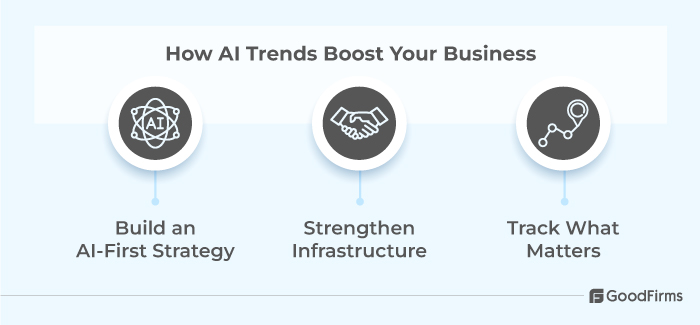
Developing an AI-First Business Strategy
AI is not an afterthought. The companies moving fastest are the ones treating it as part of their core business strategy. For some, it’s customer service. For others, it’s the supply chain.
The most innovative leaders prioritize a few high-impact areas instead of trying to “AI everything” at once. It also helps to build an internal framework. Who owns AI projects? How do you pick which ideas get funded? All these are a must because projects drift or die quietly without clarity.
If you’re looking for expert help in implementing AI solutions, you can explore top AI development companies to find trusted partners who can guide you through the process.
Building AI Infrastructure and Capabilities
Technology is only half the story. Sure, you need data pipelines, cloud platforms, and the right tools. But you also need people who know how to use them. That doesn’t always mean hiring an army of data scientists. In many cases, it’s about upskilling the teams you already have so they can work with AI tools directly.
Partnerships can also fill the gap. Many companies lean on vendors or startups for the heavy lifting while they build internal expertise slowly. A good approach is to find an AI consulting company for your business that aligns with your industry and goals.
Measuring ROI and Success Metrics
How do you know if your AI project is working? Cutting costs is one metric, but it’s not the only one. Faster decision-making, improved customer satisfaction, and reduced risk all matter too.
The danger is chasing vanity metrics like bragging about “AI adoption” without tying it to outcomes. The companies doing this well set KPIs upfront, track progress, and aren’t afraid to shut down projects that don’t deliver. AI isn’t magic. It needs accountability like any other investment.
Challenges and Considerations in AI Adoption
Companies that gloss over these challenges usually end up frustrated down the road. Let’s break down the most prominent ones leaders are currently running into.
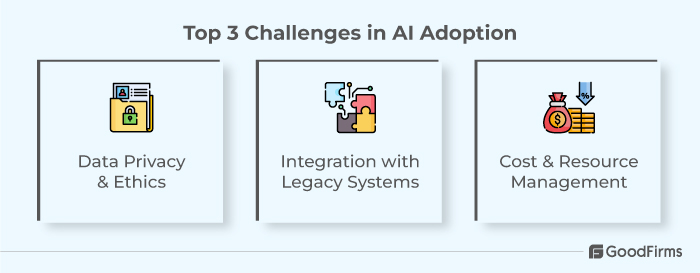
Data Privacy and Ethical AI Considerations
As AI runs on data, privacy concerns are front, right, and center. Regulators in the US, Europe, and Asia are tightening rules. Customers are more sensitive than ever about how their information is used.
There’s also the issue of bias. An AI model trained on skewed data will carry those biases into its decisions. For businesses, it is a reputational risk. And so more companies are now adopting responsible AI frameworks. Building in checks for fairness, transparency, and compliance.
Integration Complexities and Legacy Systems
One of the least glamorous but most stubborn challenges is integration. Many companies still run on legacy systems that don’t play nicely with modern AI platforms. Finding a partner for custom software development can help bridge this gap.
It’s not just the tech either. Employees need training, workflows need rethinking, and leadership has to manage resistance. AI adoption is an organizational shift.
Cost Management and Resource Allocation
AI is not cheap. Cloud processing, data storage, and vendor contracts add up quickly. Some projects start small but balloon once they scale. That is why budget planning is crucial.
The hidden cost? Talent. Skilled AI professionals are expensive and in short supply. Businesses either pay top dollar to recruit or invest heavily in training existing staff. Either way, it’s a real commitment. That is why companies that plan resources carefully tend to see smoother rollouts and fewer half-built initiatives.
Moving Forward with AI
You don’t need to master all the AI industry trends overnight. What matters more is building the right mindset, staying flexible, and being willing to experiment.
Start by identifying areas where AI can make a real difference in your organization. Identify places where errors keep piling up. Run small pilot projects to learn what works and where improvements are needed. Invest in training so your teams feel confident, not overwhelmed. Partner with the right vendors instead of trying to reinvent the wheel. And once you see results, scale step by step rather than going all in at once.
The best businesses aren’t always the biggest. They are the ones that move quickly, adapt fast, and learn from experience. AI is giving everyone the chance to rethink strategies and build something more innovative for the future.
So don’t wait. Take the first step today. Start small, stay curious, and focus on solving real problems. The companies that act now will be the ones leading the pack tomorrow.
Frequently Asked Questions
What are the top AI trends businesses should focus on in 2025?
In 2025, businesses are embracing AI tools that go beyond automation. Trends like agentic AI, predictive analytics, conversational interfaces, and explainable AI are helping teams work smarter, make faster decisions, and improve customer experiences. These trends are becoming essential for staying competitive.
How can AI help businesses improve customer service and decision-making?
AI helps by handling repetitive tasks, analyzing customer feedback, and providing real-time insights. It personalizes interactions, predicts trends, and alerts teams to potential issues before they arise — making customer service smoother and decision-making more efficient.
Is AI only for tech experts, or can non-technical teams benefit too?
You don’t need to be a tech expert to use AI anymore. No-code and low-code platforms make it easy for marketing, HR, and operations teams to implement AI tools. These solutions let teams create workflows, automate tasks, and access data-driven insights without relying heavily on IT support.
What are the biggest challenges when adopting AI in a business?
The main challenges are managing data privacy, integrating AI with existing systems, and controlling costs. Businesses also need to ensure they have the right skills and infrastructure. Planning and clear strategies are key to overcoming these hurdles.
How does explainable AI build trust in business operations?
Explainable AI helps by making AI’s decision-making process transparent. It shows how recommendations are formed and helps businesses meet regulations. This builds trust among customers, employees, and regulators, ensuring that AI-driven decisions are fair and accountable.
What’s the first step for businesses looking to implement AI?
Start by identifying pain points where AI can add value, such as inefficient processes or recurring issues. Run small pilot projects, train teams to use new tools, and partner with trusted vendors. With a step-by-step approach, you can scale AI solutions gradually and effectively.