Imagine having someone who can make decisions, perform, and solve problems on your behalf. Can this be even real? Yes, it is possible in reality.
Autonomous AI agents have the capability to operate independently and get difficult and repetitive tasks done in a click of a time. But, how is that even possible?
Autonomous agents learns and adapt to dynamic environments. They can process data, navigate through complex situations, and learn from past and present conditions, which helps them execute tasks and make decisions.
The modern software development companies in USA, also known as early adopters, have started using autonomous AI agents for coding, debugging, and testing to build innovative and flawless software in less time while engaging fewer software developers.
But, many leaders in the software development industry find autonomous AI agents a threat to the jobs of U.S. developers, as the companies will now need fewer human resources, because AI agents would now be doing tasks and making decisions just like or better than humans.
So, now the question arises: Will the use of autonomous AI agents prove to be a threat or a catalyst for the U.S. developer market?
This article can give you the answer to this question as it uncovers everything you need to know about autonomous AI agents, how they are shifting the landscape of the software development market, and to what level software development companies have penetrated this emerging technology into their software development processes to build innovative and flawless solutions.
So, let’s quickly start by understanding autonomous AI agents and then dive deeper to ultimately determine whether this progress in the tech world is a threat or catalyst for the U.S. developer job market.
What is an Autonomous AI Agent?
An autonomous AI agent is an advanced version of traditional AI that can comprehend and respond to queries and also execute tasks without human intervention. When an autonomous AI agent is given an objective, it keeps on executing tasks until that objective is achieved. For example, an autonomous AI tool, when given a particular functionality to be created for software, keeps on coding, debugging, testing, and then repeating the same cycle without human intervention until the task is complete.
Typical AI tools follow predefined rules. On the contrary, autonomous AI agents have the ability to operate dynamically, decide, and act according to current conditions, which makes them worth using for complex tasks in software development, customer service, sales, marketing and many other business facets.
Autonomous AI agents don’t need human help to get tasks done and make decisions. But, they definitely need humans to provide prompts that enable them determine objectives and goals to be met.
To know more about AI agents, let’s have a look at their capabilities..
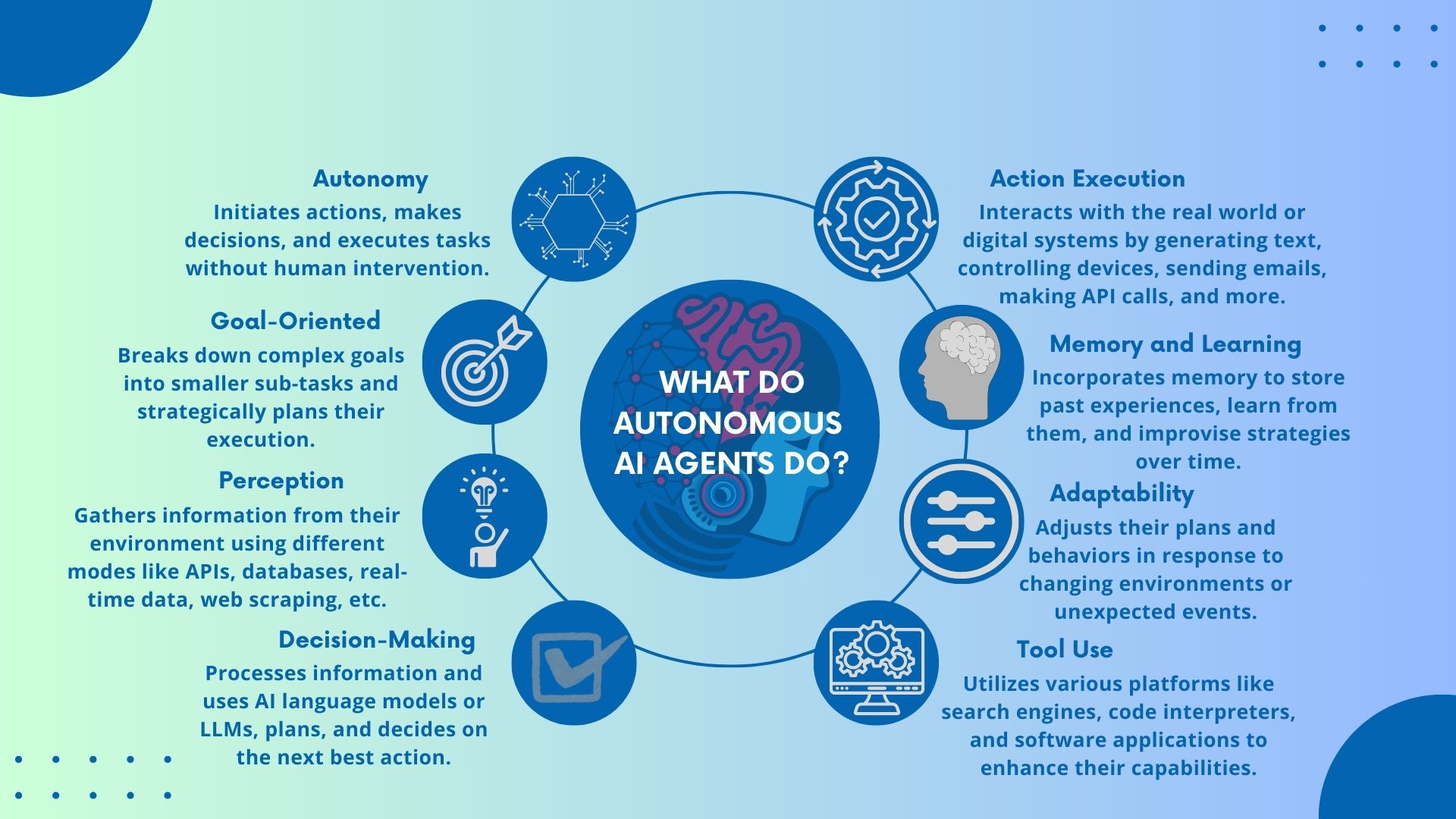
Capabilities of Autonomous AI Agents
Autonomous AI agents are new-generation AI tools that are designed to make decisions and execute tasks independently, with minimal or without any human intervention. Let’s have a look at its capabilities.
So, how did autonomous AI agents progress to the level it is today? The fact is that they have evolved a lot. From traditional AI agents that used to work based on predetermined rules to independent systems that make decisions and execute tasks independently, autonomous AI agents have come a long way in acquiring the features they have today. Let’s have a look at the evolution of autonomous AI agents.
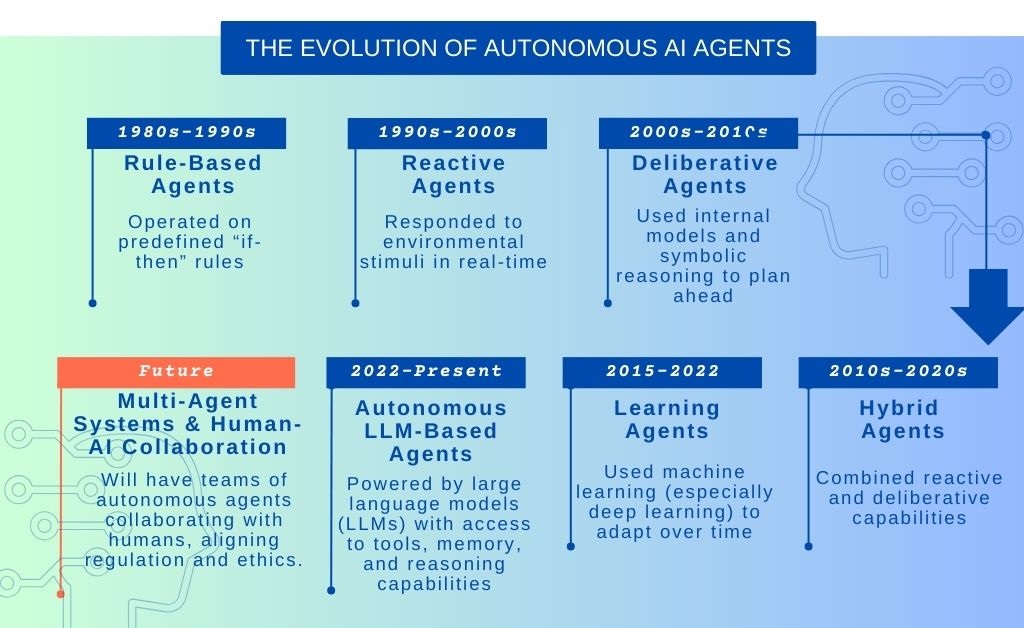
After getting a glimpse of the above evolution graph, you might have noticed that traditional AI is all about following instructions inputted by human users, whereas autonomous AI agents are adaptive systems that have the capability to initiate actions and make decisions on their own after learning from experiences. They work under minimal supervision.
Autonomous AI agents are not just tools; they are a collaborative force helping humans to achieve the achievable.
So, there are two different options that software developers can use while building systems - traditional AI and autonomous AI systems.What is the difference between both of them?
Traditional AI V/S. Autonomous AI Agents
Autonomous AI agents are smarter and more capable than traditional AI tools. Here's what sets them apart:
| Point of Difference | Traditional AI | Autonomous AI Agents | |
| Goal-Oriented Autonomy | Executes specific tasks like autocompleting a sentence. | Sets sub-goals, decides next steps, and iterates based on feedback. | |
| Goal-Oriented Autonomy | Executes specific tasks like autocompleting a sentence. | Sets sub-goals, decides next steps, and iterates based on feedback. | |
| Learning and Adaptation | Relies on static training data and autonomous agents. | Learns in real time, improves with every interaction, and adapts to new strategies based on past experiences. | |
| Decision-Making | Requires constant human input to make decisions. | Makes decisions independently based on evaluated environments and prioritized tasks. | |
| Operations | Operates in silos | Uses multiple tools and APIs, fetches data, performs analysis, and generates reports from external tools. | |
| Memory and Context | Not capable enough to maintain memory and context across interactions. | Understands long-term goals, acts as per past actions, and avoids redundant steps, making it more collaborative and human-like software development tasks. | |
| Evaluate and Self-Correct | Not capable enough to evaluate and self-correct. | Revisits the code if the test fails, and if the API call breaks, it tries alternate solutions. |
The performance of Autonomous AI agents is not any kind of magic. They are backed by modern technologies that work together in harmony.
So, how exactly do they work?
From understanding the current state of the environment to making decisions and then learning from results, autonomous AI agents work based on a consistent loop of analysis and action. With a proper blend of language models, memory systems, and integrated tools, they have gained the capability to execute tasks and make decisions without any human input.
In this section, we’ll uncover the inner workings of these intelligent agents and show how each part—input, planning, execution, and feedback—comes together to make autonomy possible.
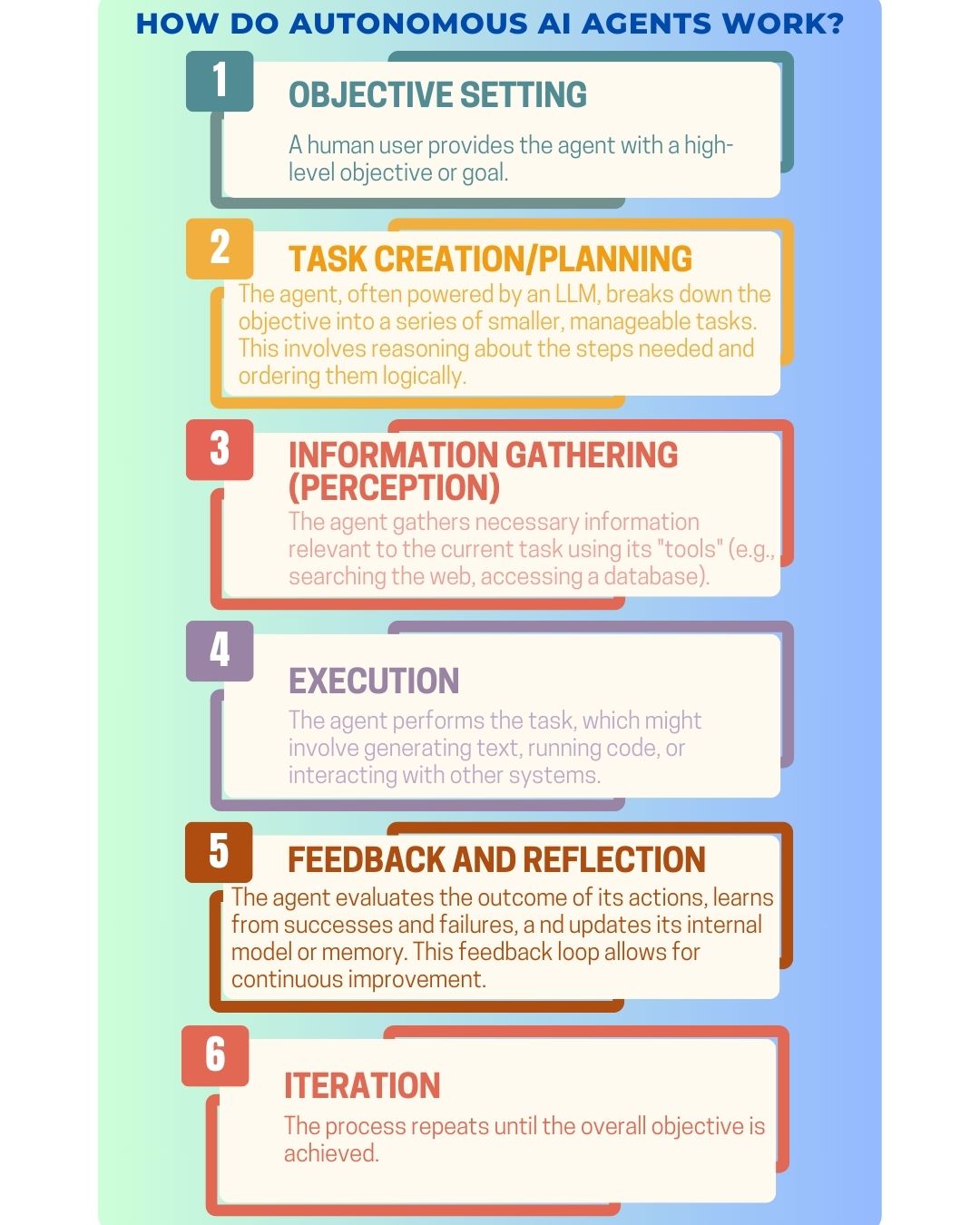
So, now that we have complete information about Autonomous AI agents, how they are different from traditional AI, and how they work, let’s have a look at how autonomous AI agents are shifting the landscape of software development to get into the depths of this subject.
Are Autonomous AI Agents Transforming the Landscape of Software Development? If Yes, How?
Factually, yes. Autonomous AI agents are transforming the landscape of software development. But how? From writing code to deployment, autonomous AI agents are changing the custom software development process in the following six different ways.
#1 Automation in Routine Coding Tasks
AI agents are now smart enough to write boilerplate code, refactor legacy code, and generate test cases and documentation.
Outcome: Software developers are now spending less time on repetitive tasks and more on innovative tasks like system design, architecture.
#2 Increased Speed in Software Development Life Cycles
AI agents can now speed up software development processes and time to market by automating coding, testing, documentation, testing checks, deploying updates, and integrating directly with CI/CD pipelines.
Outcome: Software development companies now benefit from quick and quality deliverables.
#3 Improved Accuracy in Debugging and Self-Testing
Autonomous AI agents have the ability to detect bugs, run, suggest, and fix errors without any human intervention.
Outcome: Debugging and testing tasks, which used to take a lot of time, can now be automated and completed within minutes.
#4 24/7 Software Development is Now Possible
Unlike humans, autonomous AI agents can work around the clock across different time zones, manage overnight builds, and keep projects running when the human team is vacationing.
Outcome: Empowers global and remote-first teams and ensures projects are completed within deadlines.
#5 Software Developers’ Roles are Shifting
As autonomous AI agents do all the heavy lifting, software developers are becoming more of prompt engineers and AI supervisors.
Outcome: Improved accuracy in writing codes, testing, task management, and execution, high-level system design, and strategic planning.
#6 Welcoming Non-Technical Talent Pool
Now, even non-technical users can build simple apps and junior developers and freshers can contribute meaningfully in their early stages of career.
Outcome: Software development becomes easy for non-technical users.
Basically, autonomous AI agents are no longer mere buzzwords. They are quietly shifting the landscape of software development. Let’s have a look at how the best software development companies in the United States are using autonomous AI agents and benefiting from them in terms of revenue generation, popularity, and growth.
How Do Software Development Companies Utilize Autonomous AI Agents?
Modern software development teams are using autonomous agents to automate tedious and complicated tasks, enhance quality, save time, and improve code quality throughout the software development process. Many of the top AI companies in the USA are leading this transformation and integrating this technology into their software development process to enhance planning, development, and maintenance. Here are the different ways software development companies utilize autonomous AI agents.
Quick Code Generation
There are autonomous AI agents available like GitHub Copilot built by Microsoft and or Amazon CodeWhisperer which act as real-time collaborators that write code snippets, suggest functions, and even generate full modules based on simple prompts.
How Does it Benefit?
These AI agents can help software developers to take less time in boilerplate coding and enable junior developers to learn coding on the go.
What are its Use Cases?
Software developers input functionality in simple, plain English, and AI agents generate syntactically flawless code.
Accurate Bug Detection and Fixing
Autonomous AI agents that are integrated into CI/CD pipelines have the ability to autonomously scan codebases and detect bugs, vulnerabilities, and performance issues.
List of Autonomous AI Tools for Bug Detection and Fixing
- SonarQube AI integrations
- DeepCode by Snyk.
How do they benefit?
They help consistently improve without manual testing for every minor bug or issue.
Smart Testing Agents
AI agents are being used to write, run, and evaluate test cases based on code changes or user behavior analytics.
What are their use cases?
Testing AI detects the parts of the app impacted by a new commit and creates relevant test scenarios automatically. They offer AI-driven test automation with minimal human involvement.
List of Autonomous AI Testing Tools
- Testim
- Functionlize
Agile Project Management & DevOps
AI agents help manage sprint backlogs, assign tasks, predict delivery timelines, and even suggest task prioritization based on team velocity.
Example of AI Agents for Project Management & DevOps
Atlassian’s integration of AI in Jira uses autonomous insights to forecast delays and recommend fixes.
What is the benefit of using autonomous AI agents for project management & DevOps?
More efficient planning with less micromanagement.
Intelligent Documentation
Some AI agents auto-generate documentation from code comments or project structure, which helps update technical documentation regularly.
Examples of Autonomous AI Agents Used for Documentation
- Sourcery
- Tabnine
Functionalities of AI Tools for Documentation
AI tools for documentation read function names, variables, and dependencies to explain the code's purpose and usage.
AI-Powered Code Reviews
Autonomous agents assist in peer reviews by scanning for style, structure, and logic flaws.
Examples of AI Tools for Code Reviews
- Codacy
- CodeGuru (by AWS)
Benefits of Using AI agents for code reviews
These AI agents for code reviews evaluate PRs with human-like comments and improvement tips, they can speed up review cyrcle and enforce coding standards.
Security Automation
AI agents monitor for dependency vulnerabilities, injection risks, and misconfigurations without developer intervention.
AI tools for security automation
- Dependabot (GitHub)
- Snyk AI
- StackHawk
How do AI tools for security automation benefit?
Security becomes proactive rather than reactive.
So, now we know autonomous AI agents have proven to be quite beneficial for software development companies by upscaling their processes and helping them to deliver quality. This is the reason why there is growth in Autonomous agents market.
As per a recent report, the global autonomous agents market size was valued at USD 2.98 billion in 2024 and is expected to grow from USD 4.24 billion in 2025 to reach USD 70.59 billion in 2033 with a CAGR of 42.12% over the forecast period (2025–2033).
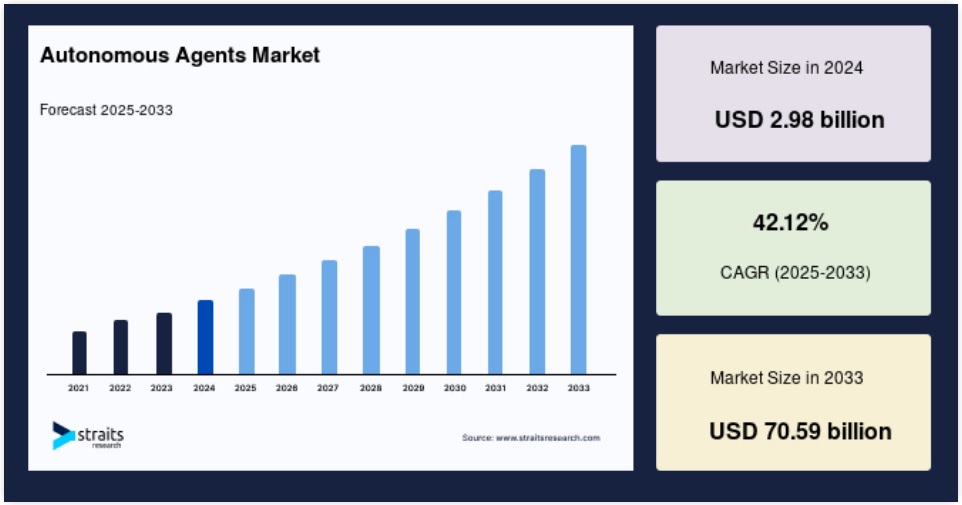 (Source: straitsresearch)
But what would be the impact of this growth on the U.S. developer market? Are autonomous AI agents a catalyst for innovation or a threat to jobs? Let’s have a detailed look at the same.
Impact of Autonomous AI Agents on U.S. Developer Job Market: Catalyst for Innovation or Threat to Jobs?
The rise of autonomous AI agents is transforming the software development landscape—and with it, the dynamics of the U.S. developer job market. Are these tools ushering in a golden era of productivity, or are they quietly eroding the need for human coders? The answer may be a bit of both.
Are Autonomous Agents Catalysts for Innovation?
Autonomous AI agents like GitHub Copilot, Amazon CodeWhisperer, and Tabnine are supercharging developers’ capabilities.
Faster Delivery:
These autonomous AI agents help in completing routine coding tasks within seconds, which enable developers to focus on optimization, creativity, innovation, and architecture.

(Source: mit-genai.pubpub)
Upskilling Opportunity:
Developers are learning to manage, refine, and extend AI outputs—evolving into higher-level system thinkers and code strategists.
Startup Acceleration:
Small teams can now compete with larger firms, thanks to AI agents that reduce the manpower needed to build MVPs.

(Source: Buildin7)
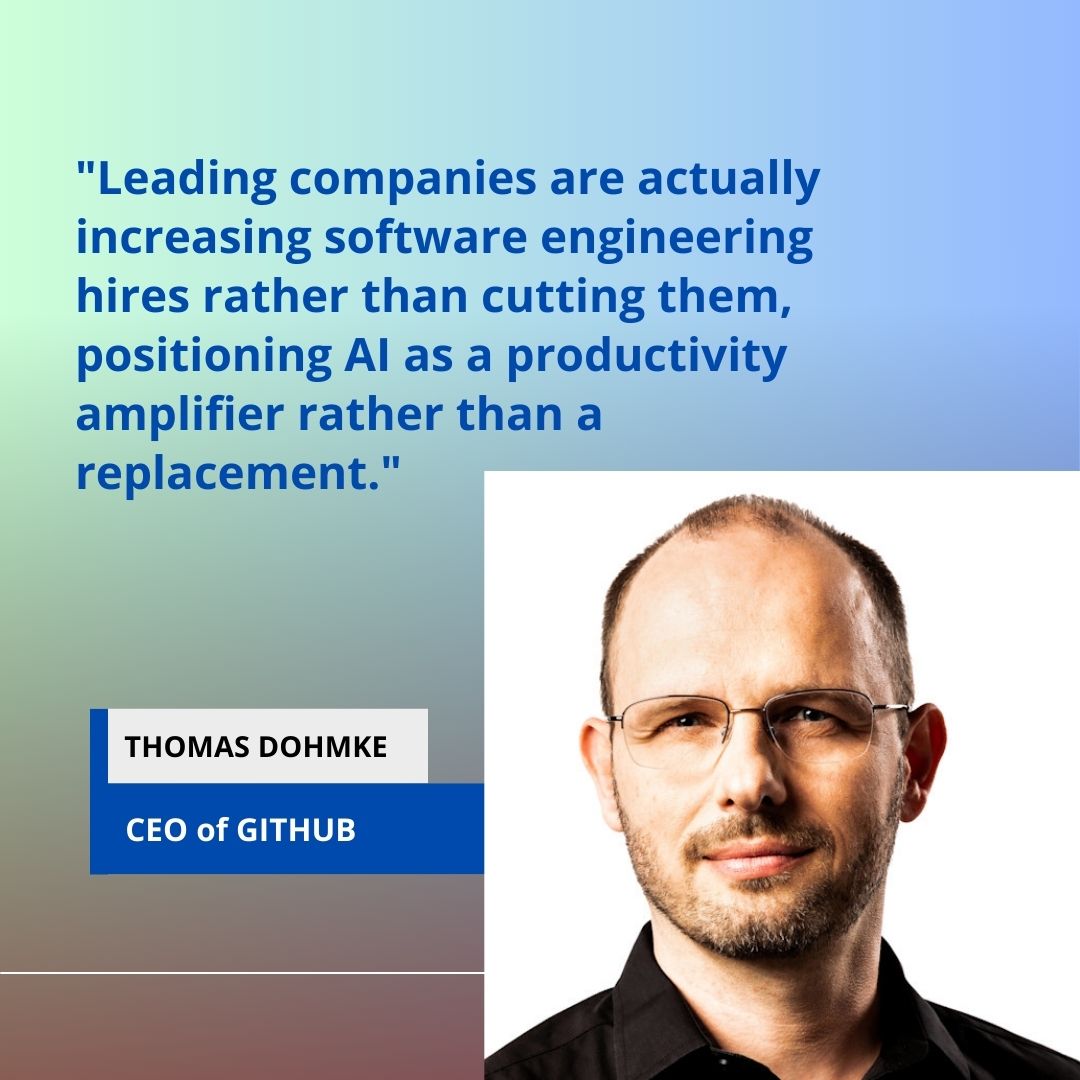
Key Insight: Rather than replacing developers, these agents are acting as “force multipliers”—boosting speed, quality, and creativity.
But, the question still remains unanswered - are autonomous agents a threat to software developers’ jobs? Let’s find out.
Are Autonomous Agents a Threat to Software Developers’ Jobs?
However, not all the effects are positive or evenly distributed.
- Job Polarization: Junior or entry-level coding jobs are under pressure, as AI agents increasingly handle repetitive or boilerplate tasks.
- Redefined Skills: The significance of remembering syntax or debugging the code line-by-line is getting outdated. On the contrary, AI integration, prompt engineering, and oversight are becoming more in action.
- Efficiency Over Employment: Many organizations may reduce manpower and may prefer leaner teams supported by autonomous AI tools.
Precisely, developers who fail to update themselves with the latest AI tools may find themselves sidelined in a rapidly shifting market.
Moving deep into this subject, let’s get to know the perspectives of developers and the industry’s reactions to autonomous AI agents.
How Do Software Developers Perceive and Industry React to Autonomous AI Agents?
As autonomous AI agents become important to the software development workflow, the software development industry is experiencing a difference between how developers and companies are perceiving their accelerating influence. While software development companies find autonomous AI agents very useful and time-saving collaborators, at the same time, developers are finding the same technology a threat to their jobs.
Below is the breakdown of how software developers and the industry are reacting to this emerging technology.
Innovators Adopt Enthusiastically
A huge segment of software developers working with startups and tech-forward companies have found autonomous AI agents as productivity boosters and therefore integrated into their development processes.
On this subject, the viewpoint of one of the software developers said that - “Autonomous AI tools free me from repetitive tasks so I can focus on solving real problems.”
As the adoption of AI tools increases amongst software developers, the use of GitHub Copilot, CodeWhisperer, and ChatGPT for coding, documentation, and automation is accelerating.
Currently, software developers who are using autonomous AI agents in their software development processes are experiencing improved code quality, better software development speed, and enhanced creativity.
Skepticism and Unease Among Traditionalists
Some seasoned software developers find it problematic to be overly dependent on AI. They question its accuracy, transparency, and the possibility of diminishing foundational coding skills.
On this topic, the viewpoint of a software developer was - “AI might seem to be helpful now, but what will happen when we stop having the calibre of understanding how the code works?”
There are many concerns, like AI-generated code might have subtle bugs, there may be a loss of human intuition in system design, and the possibility of ethical/legal questions about code ownership can increase.
It is likely that AI adoption outstrips efforts to set standards and governance, which can lead to long-term quality and security concerns.
Software Industry Responds Strategically
Tech companies are actively investing in autonomous AI, not just in the form of tools but also as platforms. Hi-tech companies like Microsoft, Amazon, and Google are integrating AI agents in their software development tools and cloud platforms. Whereas, enterprises are applying AI agents to reduce outsourcing projects, and fil their skill gaps. On the other hand, startups are building entire development workflows using AI-first architectures.
The software development industry is responding in a quite positive direction, depicting that AI-assisted development is not just a trend, but the future standard to be accepted.
Focus on Human-AI Collaboration is Growing
Instead of focusing on using human resources or AI, tech companies are planning strategies to combine humans and AI. Humans don’t need to compete with AI; they need to learn to collaborate with AI. The most emerging roles that depict the collaboration of humans with AI are prompt engineers, AI workflow architects, ethical AI advisors, and more.
In short, software developers are now learning to delegate repetitive and routine tasks to AI while they focus more on creativity, strategy, and ethics.
As per Langchain’s survey of 1300+ companies, 51% have autonomous agents in production, and 78% have active plans to implement agents into production soon.
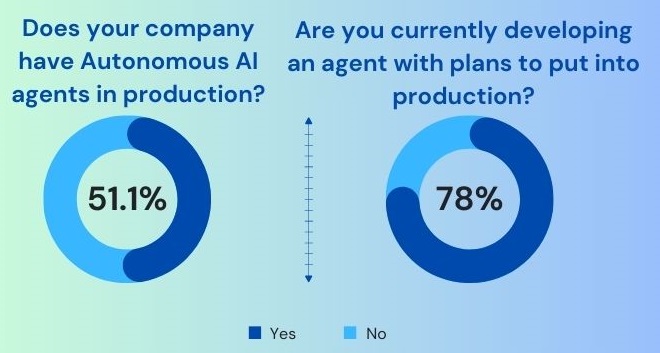
(Source: Langchain)
The software developer community is navigating through this major transformation while balancing excitement with caution. Of course, opinions vary, but one thing is clear: AUTONOMOUS AI AGENTS HAVE PERMANENTLY CHANGED THE LANDSCAPE. Whether as assistants, co-pilots, or future collaborators, they’re becoming essential to the evolution of the modern developer.
Final Words: Adapting Autonomous AI Agents is About Balancing Hard Work With Smart Work
Many professionals have discussed a misconception that relying on AI agents signals a shortcut mindset—a laid-back approach to building software. But in reality, the smartest software developers know that embracing autonomous AI isn’t about just getting jobs done with minimal human effort. It’s about evolving with the tools that define the future.
For instance, companies like GitHub use Copilot to assist in code generation, while Salesforce integrates AI agents to automate workflows in their developer ecosystem. Even startups are using tools like Replit’s Ghostwriter or Cognosys autonomous agents to build MVPs faster and more intelligently.
Also, Many of the top AI consulting companies in the USA, such as OpenXcell, are actively helping organizations integrate autonomous agents to accelerate innovation and stay competitive in the software landscape.
Using autonomous AI agents to automate routine tasks, boost productivity, and spark innovation isn't a sign of weakness—it’s a strategic advantage. The best minds in tech aren't afraid of these tools—they’re mastering them, training them, and reshaping what’s possible with them.
In today’s rapidly changing tech landscape, ignoring AI can prove to be orthodox. Adapting autonomous AI agents is not about avoiding innovation and creativity; it is about being smart and agile. Software developers need to rise to adapt to AI, collaborate, and lead alongside it.