Key takeaways
- AI adoption is accelerating fast — 88% of organizations now use AI in at least one business function, making ChatGPT integration a business priority, not just a tech trend.
- ChatGPT delivers measurable business value — from automating up to 70% of customer interactions to reducing communication costs by up to 40%.
- Your tech stack and AI model choice define your budget — GPT-5.5 for complex reasoning, GPT-5.4 Instant for everyday tasks, and GPT-4.1 for long-context documents are among the most popular API models in 2026.
- ChatGPT Development costs vary widely — from $25,000 for a basic MVP to $500,000+ for enterprise-grade solutions, with ongoing API and maintenance costs to factor in separately.
- Geography significantly impacts hiring costs — developers in India and Southeast Asia cost 50–70% less than their North American counterparts, without necessarily compromising on quality.
- Not all ChatGPT developers are equal — look specifically for skills in prompt engineering, RAG architecture, LLM expertise, backend integration, and a portfolio of delivered AI products.
- Feature prioritization saves money — build your core generative text functionality first as an MVP before investing in polish, integrations, and advanced UX.
- The right hiring process matters — defining requirements, shortlisting via verified platforms like Goodfirms, reviewing portfolios, and discussing pricing and communication upfront will save you from costly mistakes.
- API costs are a recurring expense — factor in per-token pricing separately from your development budget, as these scale with user volume and query complexity.
- The best ChatGPT developers are collaborators, not just vendors — communication, transparency, and cultural fit are just as important as technical capability.
Businesses that invest in artificial intelligence development today aren't just keeping up — they're pulling ahead.
As per The State of AI in 2025, 88% of organizations now use AI in at least one business function.
Ready to go AI-first? Explore top ChatGPT development companies and start building — today.
Naturally, businesses are being opportunistic, trying to find creative ways of integrating AI models like ChatGPT into their service and product offerings.
But here's the challenge most businesses run into: How do you find, evaluate, and hire ChatGPT developers who can actually deliver results — and do it without blowing your budget or your timeline?
That's exactly what this guide answers. We'll walk you through how to find and shortlist top ChatGPT development companies, what to look for, and how to collaborate effectively, so your AI investment turns into a real competitive edge.
But, Wait. Before you start searching for the right partner, it's worth understanding exactly what ChatGPT can do for your business, and where it fits.
How can ChatGPT be Relevant for Your Business?
The ChatGPT API has been out for a while, and businesses are coming up with innovative ways of integrating the latest GPT models into their offerings.
Apps like Duolingo and Snapchat are using ChatGPT to enhance their existing products, while Tech Giants like Microsoft are creating entirely new AI-based product lines using GPT. CRMs like Salesforce and Hubspot are offering never seen before AI-powered services and productivity, and project management apps like Notion and Taskade are offering in-app, general-purpose ChatGPT powered assistants.
At the core of ChatGPT's ability to understand user queries and generate human-like responses is natural language processing — the technology that allows machines to interpret, analyze, and respond to human language in a meaningful and contextually accurate way.
We are witnessing an explosion of AI-powered apps, and if experts are to be believed, then this is just the beginning of what is yet to come. ChatGPT's capabilities are rooted in deep learning, which is a branch of AI that enables models to learn from vast amounts of data and generate responses that feel remarkably human.
How are Businesses Benefiting From ChatGPT Integration?
- Automating customer support: ChatGPT-powered chatbots are dramatically reducing the burden on human support teams.
- Improving User Engagement: ChatGPT integration is keeping users more engaged across platforms.
- Improving Existing product lines: Businesses are embedding ChatGPT into their existing offerings to make them smarter and faster.
- Creating brand new products and services: ChatGPT is not just improving what exists — it's powering entirely new business models.
- Offering better in-app personalization: ChatGPT's ability to understand context and user intent is enabling hyper-personalized in-app experiences.
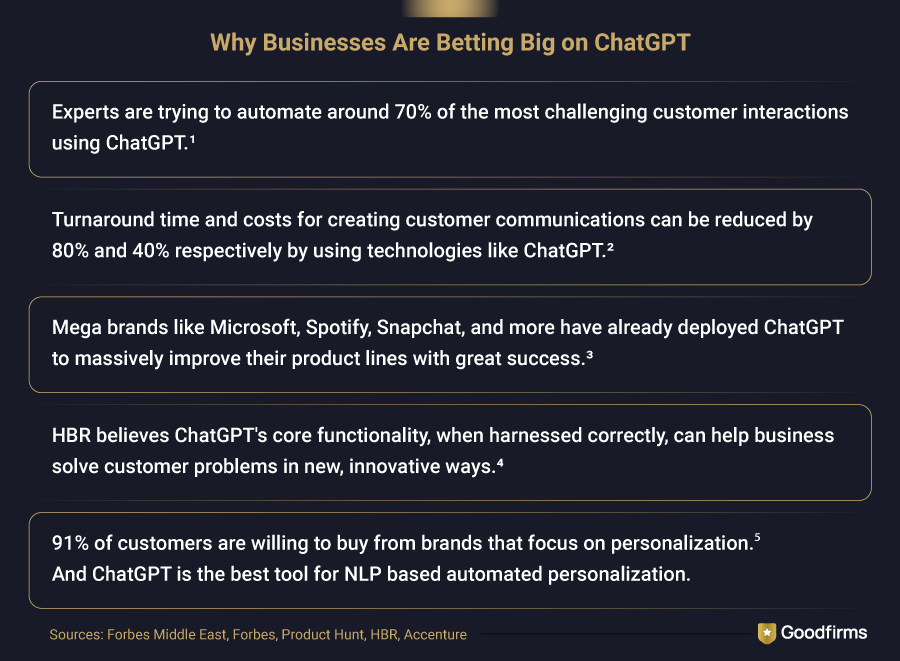
The opportunity is clear — and the numbers speak for themselves. But translating that opportunity into a real, working product takes more than enthusiasm. Before you hire a ChatGPT developer, there are critical technical and strategic factors you need to get right from the start.
Top Considerations Before Hiring ChatGPT Developers
But before you rush to push your next big AI product to the market, take note of the following considerations. These will not only inform the technical aspects of building a ChatGPT app but also better equip you to hire ChatGPT developers who are genuinely the right fit for your project.
Choosing the Right Tech Stack
What tools, technologies, frameworks, etc, should you be using to build your ChatGPT application? That’s an important question to consider because it’ll define what your app can do and who can use it. You’ll then need to hunt for devs particularly good at these technologies and frameworks to get the best results. Here is a quick breakdown of what you need to know:
As far as frameworks are concerned you need not look any further than your usual web or app framework. All you’ll need to integrate ChatGPT in your app is the ChatGPT API and a custom interface that collects input and displays the output.
If you are building the application from scratch as opposed to integrating AI in your app, you need:
- A web or mobile app frontend framework like React, Angular, Flutter or more.
- For server-side data communications, use systems like MongoDB or MySQL.
- Obtaining output and training the model are both possible with the ChatGPT API, so no additional framework or tool is needed here.
Identify what AI model you need
OpenAI offers a wide range of different models, while some of these are geared towards efficiency and keeping computing costs low, others are cranked up to give the best quality answers possible. The best model for you to use obviously depends on the depth you need in your answers and your API budget, but the general rule to remember is the better, more complex the answers the longer and more expensive the model will be. Here are three of the most popular API models for ChatGPT:
| AI Model | Best For | Context Window | Availability |
|---|---|---|---|
| GPT-5.5 | Flagship reasoning, agentic work | Large | Plus, Pro, Enterprise |
| GPT-5.4 Thinking | Complex reasoning, research, coding | 256K – 400K | Paid tiers |
| GPT-5.4 Instant | Everyday tasks, speed | Standard | All plans incl. Free |
| GPT-5.3 Codex | Agentic coding, debugging | Large | API + Codex platform |
| GPT-4.1 | Long-context, documents | 1M tokens | API |
| GPT-4o | Voice, audio, multimodal | Standard | API |
| GPT-5.4 nano | High-volume, budget tasks | Standard | API |
Goodfirms’ Insight: Teams that move from ChatGPT to the API typically reduce costs by 30–50% by avoiding over-provisioned subscriptions and routing work more efficiently.
Now that you have a clearer picture of the technology powering your ChatGPT application, the next natural question is, what will it cost to actually build it? The answer isn't one-size-fits-all. Your budget will largely depend on the complexity of your use case, the AI model you've chosen, and the development team you bring on board.
How Much Does it Cost to Build a ChatGPT Application in 2026?
In 2026, ChatGPT development costs typically range from $25,000 for a basic MVP to $200,000+ for enterprise systems, mainly driven by the complexity of agentic AI workflows. The cost of your ChatGPT application is likely to vary depending on its type and complexity.
Cost by Project Type / Complexity
| Project Type | Cost Range | Timeline | Best For |
|---|---|---|---|
| MVP / Proof of Concept | $25,000 – $50,000 | 4–6 weeks | FAQ bots, internal tools, early validation |
| Mid-Range App | $50,000 – $200,000 | 4–8 months | SaaS platforms, customer support bots |
| Enterprise Solution | $200,000 – $500,000+ | 8–18 months | Full agentic AI, compliance-heavy industries |
| Custom LLM from Scratch | $500,000 – $5,000,000+ | 12+ months | Building a ChatGPT-like model |
These are the fixed approximate costs that you need to spend on your ChatGPT project. What if you want to hire ChatGPT developers on an hourly basis? Below are the approximate hourly costs across different regions — so you can budget smarter before you commit.
Hire ChatGPT Developers in 2026 — Hourly Rates by Region
To help you budget more effectively, here's how ChatGPT developer rates stack up across the world's major hiring destinations:
| Region | Junior | Mid-Level | Senior |
|---|---|---|---|
| North America | $50–$80 | $80–$120 | $120–$200+ |
| Western Europe | $50–$70 | $70–$110 | $110–$150 |
| Eastern Europe | $25–$45 | $45–$70 | $70–$90 |
| Latin America | $30–$45 | $45–$70 | $70–$100 |
| India | $15–$30 | $30–$60 | $60–$100 |
| Southeast Asia | $10–$20 | $20–$35 | $35–$55 |
| Australia | $60–$80 | $80–$110 | $110–$150 |
So, how do you calculate the total cost of your ChatGPT app project based on hourly pricing?
Hourly Cost of a ChatGPT Developer X Project Timeline = Total Cost of ChatGPT app development.
Compared to hiring a ChatGPT developer in the U.S., hiring a ChatGPT developer in Eastern Europe or ChatGPT developer in India can result in savings of 50–70%. For full-time AI positions, Eastern Europe pays between $30,000 and $70,000 annually, while India typically pays between $20,000 and $50,000.
Regardless of whether you follow fixed cost or hourly cost pricing model, you need to consider API usage costs which is also termed as per token pricing while budgeting for your ChatGPT app development project.
API Usage Costs (Per Token Pricing — 2026)
The API landscape now includes a wide range of models, from GPT-4.1 Nano at $0.10 per million input tokens to o1 at $15 per million input tokens, giving developers more pricing flexibility than ever.
A practical example: A mobile app with 10,000 daily active users making 5 API calls each at an average of 500 tokens per call would consume roughly 25 million tokens per day — approximately $50/day in input costs alone, or roughly $1,500/month.
Basically, the total cost of your ChatGPT app development project would depend on the features you choose. Adding features that you are not going to use would unnecessarily add up to your project cost. Therefore, the next logical question is — what exactly should you be spending that budget on? Not all features deliver equal value, and prioritizing the right ones from the start is what separates a product that works from one that simply exists.
Let’s have a look at the features you should prioritize for your ChatGPT application to keep your project costs under control.
What features should You Prioritize When Building a ChatGPT Application?
ChatGPT-powered apps come in all shapes and forms. However, the most prominent feature within these, and consequently the one you should prioritize building, is the tailored chat or 'generative AI' ability itself.
How you use ChatGPT to improve or create new products depends on your business, the type of use case you want to develop, your existing product ecosystem, etc. However, trying to build a polished product from the beginning can be expensive and time-consuming, draining you of your resources as well as any time-to-market advantages you may be standing to enjoy.
Instead, it would be wise to only focus on your product's core functionality first, in this case, personalized generative text. Create an MVP-like product equipped with your core features first and focus on things like polished UX design, optimization, and integrations later. This allows you to ensure that there is enough demand for your product before fully committing to it and also helps generate data that can be used to optimize your product mid-development.
Before you begin developing your ChatGPT-driven product development process, you need to know what you want to build. This won't just help you find the right development partner but also help you streamline the development process beforehand.
4 Tips to Figure Out the Requirements of Your ChatGPT Project
Chances are, you already have a pretty good idea of what you want. Most business owners we speak with come in with a clear vision of how they want AI to work for their business. But if you're still figuring it out — that's completely fine. Here are a few tips to help you get there:
1. Look For Inspiration Around You
Your competitors and major brands around the globe are looking to hop on the AI bandwagon just like you. Look into these use cases to see if you could do something similar for your product.
2. Get Your Team Involved
Rope in the junior sales reps, the marketing interns, department managers, and developers alike. These folks may not fully understand your company's entire operations, but they know the specific areas they work with very well. Getting your team to brainstorm novel ChatGPT applications can yield surprisingly great results
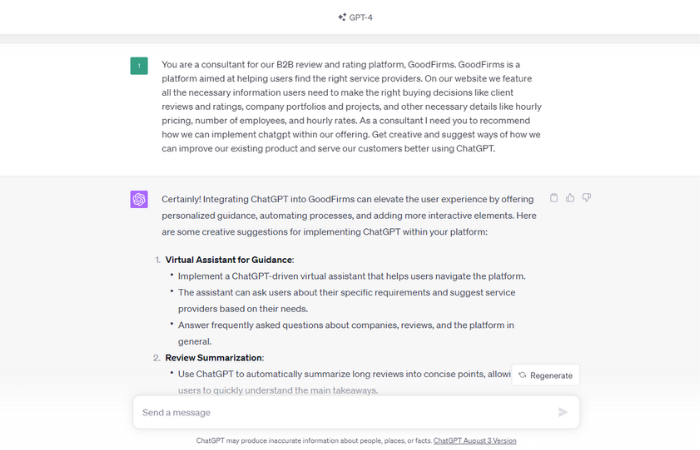
3. Ask Chatgpt Itself
When in doubt, it doesn't hurt to take some machine advice, does it? We did the same for our platform Goodfirms, and the results speak for themselves.
4. Don't Build A Feature Just For The Heck Of It
AI may seem like a very tempting opportunity, especially with every company trying to build products using these models. But if you can't find a legit use case for AI that genuinely improves your product and/or adds value to your end user, then don't bother with AI. You'll simply blow your cash reserves by building a generic product that no one wants to use.
Now that we know how much a ChatGPT application can cost, which features to prioritize, and figuring out your project requirements, the next step would be to what to look for in a ChatGPT developer and how to find one that is ideal for your project.
What to Look for in a ChatGPT Developer?
Hiring the wrong developer for a ChatGPT project isn't just costly — it can set your entire product timeline back by months. The skills required to build a production-grade ChatGPT application go well beyond general software development. Here's exactly what to evaluate before you make a hire.
1. Strong Grasp of Large Language Models (LLMs) and the OpenAI Ecosystem
The foundation of any ChatGPT application is a deep understanding of how large language models work — not just how to call an API, but how to work with them intelligently.
A strong ChatGPT developer should be able to demonstrate:
- Solid understanding of how GPT models process tokens, context windows, and generate responses
- Familiarity with the full OpenAI model family — from GPT-5.4 Instant for everyday tasks to GPT-5.4 Thinking for complex reasoning — and the ability to select the right model for the right use case
- Experience with the OpenAI API, including the Responses API, function calling, tool use, and streaming
- Knowledge of model limitations such as hallucinations, context drift, and prompt injection — and how to mitigate them in production
A developer who only knows how to send a prompt and receive a response is not the same as one who understands why a model behaves a certain way and how to engineer around its weaknesses.
2. Prompt Engineering and Optimization Skills
Prompt engineering is one of the most underrated — and most critical — skills in ChatGPT development. It is the difference between an AI that gives your users helpful, accurate responses and one that confuses or misleads them.
Look for a developer who can:
- Design structured system prompts that consistently guide model behavior
- Use techniques like chain-of-thought prompting, few-shot examples, and role assignment to improve output quality
- Optimize prompts for token efficiency — reducing unnecessary verbosity that drives up API costs
- Build and maintain a prompt testing framework so that prompts are evaluated against real inputs before deployment
- Adapt prompts as models are updated, since a prompt that works on GPT-5.3 may behave differently on GPT-5.4
Prompt engineering is not a one-time task. It requires ongoing iteration, and a developer who treats it as such will save you significant cost and frustration down the line.
3. Experience with RAG, Vector Databases, and Knowledge Integration
Most real-world ChatGPT applications need to work with your data — not just the general knowledge baked into the model. This is where Retrieval-Augmented Generation (RAG) comes in, and it is one of the most in-demand technical skills in AI development today.
A developer with strong RAG experience will be able to:
- Build pipelines that ingest, clean, chunk, and vectorize your business data — from PDFs and databases to emails and CRM records
- Integrate vector databases like Pinecone, Weaviate, or ChromaDB to store and retrieve relevant context at query time
- Design retrieval logic that pulls the most relevant information before passing it to the model, reducing hallucinations and improving accuracy
- Keep knowledge bases fresh with automated update pipelines so the AI is always working with current data
- Balance retrieval depth with latency and cost — knowing when to retrieve more context versus when it adds unnecessary overhead
Without RAG experts, your ChatGPT application will be limited to what the model already knows — which is rarely enough for specialized business use cases.
4. Backend Development and API Integration Proficiency
A ChatGPT application does not exist in isolation. It needs to connect to your existing systems — your CRM, helpdesk, e-commerce platform, internal databases, and authentication layer. This requires strong backend development skills alongside AI expertise.
Your developer should have demonstrated experience in:
- Building robust backend architectures using Python, Node.js, or similar, with clean separation between the AI layer and business logic
- Integrating the ChatGPT application with third-party services via REST APIs and webhooks — Salesforce, Zendesk, Shopify, Slack, and others
- Implementing secure authentication, session management, and role-based access controls
- Designing for scalability — so the application handles traffic spikes without performance degradation or runaway API costs
- Setting up logging, monitoring, and alerting so that issues are caught before users notice them
A developer who is strong at AI but weak at backend architecture will deliver something that works in a demo but struggles in production.
5. A Portfolio of Delivered AI Products — Not Just Experiments
Perhaps the most important thing to look for is evidence that the developer has taken a ChatGPT application from idea all the way to production — and that real users have depended on it.
When reviewing a candidate's portfolio, look for:
- Live applications — not just GitHub repositories or demo videos, but products that have been deployed and maintained
- Measurable outcomes — cost reductions, accuracy improvements, user retention metrics, or other results that prove the product delivered real value
- Handling of edge cases — how did they deal with hallucinations, unexpected inputs, or model updates that broke existing prompts?
- Documentation and handover quality — a developer who documents their prompt strategies, architecture decisions, and API configurations is one who understands that software is maintained, not just built
- Experience across industries — a developer who has built ChatGPT tools for customer support, internal knowledge management, and content generation will bring broader problem-solving instincts than one who has only worked in a single domain
A strong track record of delivered AI products is the clearest signal that a developer can handle the full complexity of your project — not just the technically interesting parts.
Now that you know exactly what skills and qualities to evaluate, you're in a far stronger position to hire ChatGPT developers with confidence. Let's look at how to find the right development company that can bring your project to life exactly as envisioned.
How to Find the Right ChatGPT Development Company in 2026?
There are many ways to go about this. You could tap into your network on LinkedIn or start with a simple Google Search, only this time, it's AI-powered!
Google SERP results are riddles with ads and sponsored results. And even if you were to opt for the partner that ranks #1 In SERPs, there is no way to tell if they are good developers. Their ranking simply indicates their expertise in SEO, not development!
So how do we get around this issue?
Look for the Best ChatGPT Developers on Goodfirms
Simply head over to Goodfirms and search for “ChatGPT Development Companies.” Adjust the filters as per your needs, and pick the companies that you may find relevant.
Since Goodfirms lists only top-performing ChatGPT firms with high-quality, verified portfolios, you can be sure of finding good firms at Goodfirms!
But on a serious note, You'll need to pick around 10-20 companies that best fit your needs. The selection criteria for this can be based on factors like:
- The company's authority/ranking on Google
- Quality of their website/landing page
- Ratings on Goodfirms and similar platforms
- Other specific criteria like location or pricing
Shortlist the Best Partners based on Portfolio, Reviews, and Experience
The next step is to take a deep dive into the portfolios and experiences of these companies to better gauge if they are a good fit for your particular project. Check their portfolios on Goodfirms and the company’s website both.
Although, keep in mind that companies are likely to exaggerate their expertise on their websites. Whereas on third-party platforms like Goodfirms, the projects, and experience mentioned on a company profile typically undergo verification before going live.
To check a company's portfolio on Goodfirms, Simply head over to a company's profile and scroll down to the portfolio section.
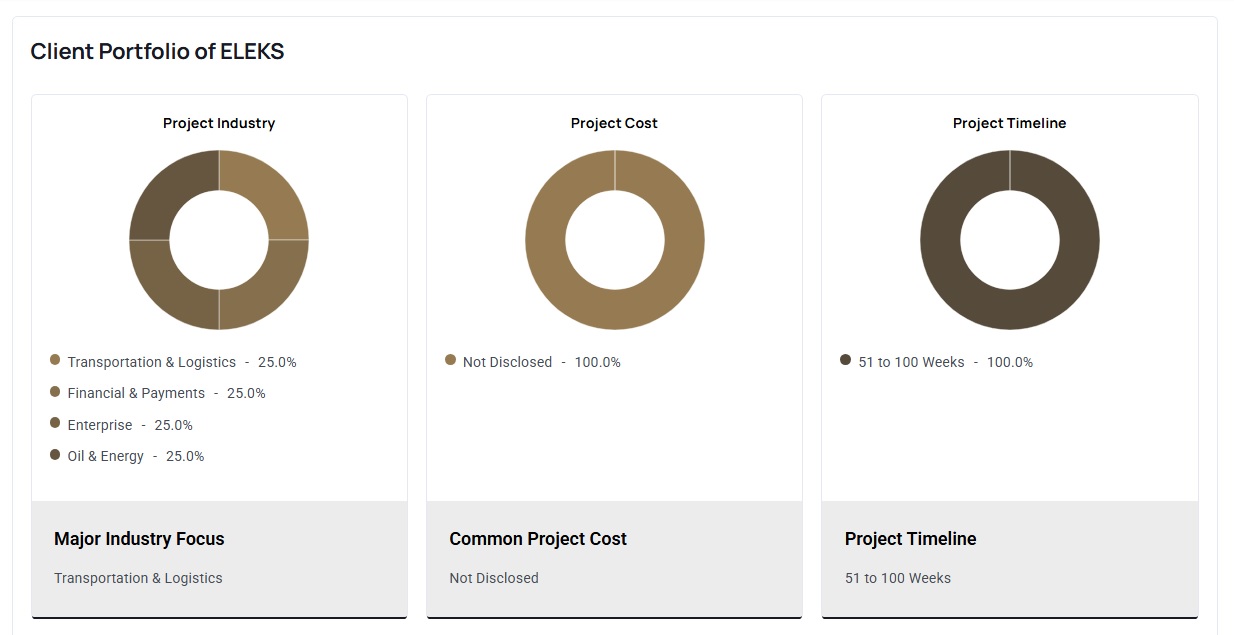
Besides just a list of projects or portfolios, Goodfirms provides a lot more information on a company profile. There are reviews and ratings from a company's past clients that can help you evaluate the quality of their service. There is also a focus area that highlights the strengths of the company in question. Some companies even have a CEO interview tab that lets you have some inside information about the company's culture, staff, and work style.
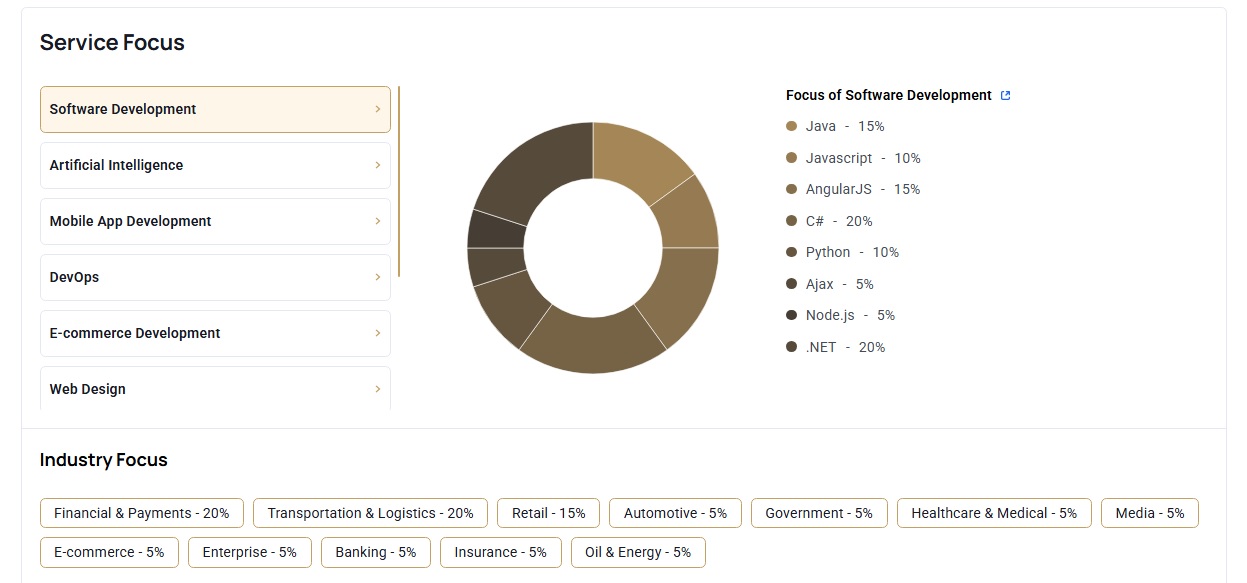
It is recommended to take into account all of this information to shortlist a handful of partners (3-4 at most) that you are interested in working with.
What to do if you can't find your desired company on Goodfirms?
While we have an extensive list of the best ChatGPT application development companies out there, it is possible that you are interested in working with a company that either isn't listed on our platform or doesn't feature extensive information on their profile. Gathering reliable company information, in that case, is up to you and can be a bit challenging, but here are a few tips to go about it:
Check Google Reviews:
Google Reviews are a great way to get the ball rolling when it comes to identifying a company's expertise. They'll help you figure out a company's market presence as well as their client satisfaction rates.
Check Their Website and Projects
If a development firm brands itself as a chatGPT development company, it'll surely have a landing page exploring its services in depth. Explore their website to understand their skill set better and assess their portfolio in depth. Watch out for the type of products they've built in the past; it's always a plus if they have served your industry and niche before. Look for applications of skills and technologies like machine learning, NLP frameworks, and UI development in previous projects that the company delivered.
Use Platforms like Linkedin and Glassdoor:
Finally, check out the team members on platforms like Linkedin. This can give you a better idea of the team's skill level and expertise. Furthermore, platforms like Glassdoor can assess a company's work culture and environment.
It is hard to tell to what extent these observations correlate with the quality of services these companies can provide, but given the lack of information, that's the best we can do here.
You've done the research, reviewed the portfolios, and narrowed down your list. Now comes the part where things get real. Reaching out to your shortlisted companies is not just about firing off an email — it's about opening a conversation that gives you a genuine sense of who these teams are, how they work, and whether they're the right fit for your project. How you approach this process will directly influence the quality of the partnership you end up with.
Reach Out To Your Shortlisted Companies (Prepare To Hire Chatgpt Developers!)
Here’s a systematic approach towards reaching out to shortlisted ChatGPT development Companies and get them onboard.
Discuss the specifics of your Project / Get a Roadmap
Once you've picked a few good partners, it's time to discuss the details of your project with them. Let them know what you need them to build and ensure they understand your project requirements. Depending upon what stage your project is at, as well as the type of development you need them to pursue, you may need to get these companies to sign an NDA contract.
At this stage, it helps to ask the development company to get you a project roadmap. This will require their sales rep to involve the developers and project managers. It'll also help you gauge if your development partners have a realistic and functional understanding of your requirements.
Ask for a roadmap and see if it fits your timeline and requirements.
Figure out what OpenAI models to use (API + Tech Stack)
This may seem obvious, but trust me when I say this can be easy to overlook — when hiring a ChatGPT development firm, it is important to find developers experienced with the necessary technologies and frameworks needed for your project.
The most important aspect to consider here, as mentioned above, is the OpenAI development. OpenAI offers numerous models, with different context and answer capabilities, via their API. What model to use depends on the traffic you are expecting on your application as well as the level of depth and detail you need in your answers.
API costs can mount up really quickly, even with a modest amount of API calls, so appropriate model selection is crucial. You also need to ensure that your development partners have experience working with these models and are comfortable with managing API - database interaction.
Discuss Pricing
Another major aspect to consider is the overall cost of developing the project. If you've used Goodfirms to find companies, you would have noticed that we provide pricing-related information for every listed company. That's a good enough estimation of a company's hourly rate, which, when combined with the expected development time, can give us a reasonable estimate of the project's cost.
Bear in mind this is simply the development cost. API and operational costs will be separate and recurring expenses.
Make sure to thoroughly discuss the app development cost of your project before hiring a partner. While costs may vary depending on the size and scope of the project, it is crucial to get a reasonable quote from developers before hiring them.
Ensure Efficient Communication
Outsourcing is less about delegating and all about collaborating. Before committing to any AI development company, you'll need to ensure a good communication channel is in place.
Communicating can be especially difficult when outsourcing from another part of the world.
To overcome these challenges, ensure you agree on a common time set aside for communication that works for both parties.
Discuss Future Maintenance and support, and ensure a level of transparency in terms of payment methods, ability to deliver, and limitations.
Ready to Hire a ChatGPT Developer? Here's Your Next Step
The businesses winning with AI in 2026 aren't necessarily the ones with the biggest budgets — they're the ones that hired smart. From understanding your requirements and picking the right model to shortlisting vetted development partners on GoodFirms, every step in this guide is designed to help you make that hiring decision with clarity and confidence. Whether you're planning to hire ChatGPT developers ortop AI consulting companies to guide your broader AI strategy, GoodFirms has you covered. The AI race is already underway. The sooner you find the right partner, the sooner your business starts pulling ahead.