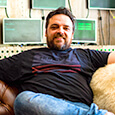
Please introduce your company and give a brief about your role within the company?
CodigoDelSur is the development company I founded 11 years ago. We work exclusively for US-based companies and startups, and are specialized in Mobile App development but also create Web and custom Software products. In this period, we’re worked on over 200 projects. Startup success cases in our portfolio include Skout (over 220M users), Kindara (#3 fertility app in the US), and Toymail (received funds from Shark Tank), for example.
Regarding my role, I’m the CEO and I define the strategic vision of the company, lead the business development team, and I participate actively in personnel management, as our team is our core value, I’m still involved in the hiring process of new collaborators.
What was the idea behind starting this organization?
Well, in fact when it all started, I wasn’t aiming at creating a business and even less would I have imagined it would wind up being an 85 people team and the main software exporter of our country. Everything developed gradually, starting by being only myself developing for the US from my tiny apartment and evolved from there.
What is your company’s business model–in house team or third party vendors/ outsourcing?
CodigoDelSur is a service provider, what we sell is our team’s development hours on a Time & Materials basis. All the work we do is in-house, we’re currently 85 people and they’re all working full time at our office. One important thing about our business model is the fact that we’re not only development providers, but we also play the role of Product Owner, mostly when working for a non-technical client. Our team gets very involved with the client’s business model.
How is your business model beneficial from a value addition perspective to the clients compared to other companies' models?
One of the main points in which we’re different from our competitors is that we don’t work on a fixed budget or timeframe basis. We charge for the hours dedicated to each project, and I believe that translates into generating value constantly. We don’t commit to huge deadlines and work in a hurry just to meet them. Instead, we commit to the backlog generated on each sprint and diligently tackle those tasks, ultimately leading to an increase in the quality of each deliverable. We don’t aim at generating a great number of business deals, we aim at generating high-quality deals, projects that imply a high technical complexity. So that’s our main value, we’re not a large scale software factory, we don’t provide a bulk service for low profile projects; we aim at providing an elite service of small teams and highly technical profile.
What industries do you generally cater to? Are your customers repetitive?
We’re in the Mobile and Web app industry, but we don’t have a specific vertical we stick to. We’ve worked on several healthcare, education and drone projects, but we’re quite industry agnostic! We’ve worked on projects for most industries really, finance, social networking, broadcasting, agriculture, law; endless. What we’ve seen is that there’s a profile of the sort of clients we have; we’re quite experienced working with startups. We’re actually quite specialized in building products from scratch for startup founders with innovative ideas. Quick prototyping and MVP creation is our main focus.
Mention the objectives or the parameters critical in determining the time frame of developing a web app.
Given we don’t work on a fixed timeframe or fixed budget basis, we don’t normally provide time-based estimations. However, we’re quite confident about the fact that creating a prototype for an app, something not ready to be launched to the market yet but valuable to show to potential investors, to pitch to incubators or national agencies of product creation promotion; takes around 1 and 2 months in general. Then, an MVP (minimum viable product) something that can be launched to the market to validate its original idea, tends to take between 3 and 4 months of development; and creating instead of an MVP, a more mature marketable product takes between 8 and 12 months. So instead of us estimating the features the product needs to have, we go for the Lean methodology, making sure to create what’s required for the product to be valuable for users.
How much effort in terms of time goes into developing the front end and back end of a web app?
As aforementioned, creating an average MVP takes between 3 and 4 months of development and this implies a team working full time comprising a frontend developer, a backend developer and a UX/UI designer who normally works full-time for the first month, and they’re all led by a project manager. We can also incorporate a QA engineer to the team if required, but it all really depends on what the client wants and their budget. So, that’s the average time required to build an average MVP of a web app.
What are the key parameters to be considered before selecting the right platform for a web application?
In general, we always suggest not choosing the “new kid on the block” just because. In these past 10 years we’ve witnessed that there might be various platforms which seem super “hot” at the time and are selected because of that apparent popularity and then even stop existing; such as the cases of Pars, so it’s necessary to be very careful in that sense. It’s always important to find a balance between not choosing a super stable yet outdated platform, and choosing the latest and hottest one just because it seems like the way to go due to a market hype but that winds up not reaching its maturity or has a very reduced amount of development talent who knows it. This is something I always advise on, choosing a platform which is quite widely known so not to generate an over-dependence on a reduced group of specifically qualified people.
Which platform and technologies do you prefer to use in development of your web apps?
We’re currently using Node.js for backend, React.js for frontend which are two of the most popular and modern ones; and that we believe hold those two qualities: stability, critical mass in its communities and being modern from a technological standpoint.
Do you offer website design templates or customized website design, and do you have a responsive website design?
We don’t work on templates, as everything we do is custom made onto creating unique and high-quality experiences. We never work on templates on any of the UI/UX work we undertake, we create user experiences from scratch, with our high profile UX/UI team. And yes, the vast majority of the web products we create require responsiveness.
Which Content Management System do you prefer to use (Wordpress, Joomla, Drupal etc)?
Given the type of products we create, we don’t use CMS and we try to avoid using them. Whenever a CMS has been required by one of our clients we’ve custom created it for them. But if we had to choose among them, the few times we’ve had to use one, we’ve used Wordpress.
Do you provide website maintenance services?
Our speciality is product creation. Once the product has been built, we normally tend to help onboard the project to our clients’ DevOps teams who will later be in charge of its maintenance. We do maintenance for very specific clients due to the close relationship we have with them.
What are the key factors that you consider before deciding the cost of a web application?
We don’t work on a fixed time-frame or fixed budget basis, we work by the hour. We’ve observed that an average MVP costs approximately $80K US dollars, a prototype can cost around $20K US dollars. Nonetheless, it will always depend on the amount of time invested in this product.
What kind of payment structure do you follow to bill your clients? Is it Pay per Feature, Fixed Cost, Pay per Milestone (could be in phases, months, versions etc.)
We charge per hour and specifically per 2-week sprint.
Do you take in projects which meet your basic budget requirement? If yes, what is the minimum requirement? If no, on what minimum budget you have worked for?
The minimum we’ve worked has been a month, so two sprints. That’s technically the minimum engagement we’ve worked for; but in general, there’s not much you can do in a month. This could be the case of someone with a rather advanced prototype who needs to finalize it, but our regular enrollment is for an MVP which is a 3-4 month relationship in average.
What is the price range (min and max) of the projects that you catered to in 2018?
We’ve got a wide variety of projects in this aspect, we’ve had 2 month prototypes which we charged around $20K US dollars for and projects we’ve worked for the entire year with a 20 people team and charging over $1 Million US dollars for. So this varies a lot, according to clients’ needs.
Kindly share your feedback on how Goodfirms has been doing so far in increasing your visibility among potential clients.
Goodfirms has been a great help for clients to find CodigoDelSur, we’ve seen how the site has progressed, and how we continue receiving more contacts through them. They’ve achieved a highly-regarded positioning as a referent with regards to evaluation of different companies in the industry and we’re very happy to witness this growth and to have been considered to be part of their list of high-profile development companies; as well as for this possibility to present our company.