Key takeaways
- Nearly 4 in 10 U.S. merchants (about 40%) now accept crypto at checkout, yet most businesses still can't tell you their real cost basis on a single wallet.
- Crypto accounting software and crypto tax software aren't the same thing; one runs your books year-round, the other only calculates what you owe at tax time.
- Pricing ranges from free to over $3,000 a month, and transaction volume is what decides where you land, not how many features you want.
- Several of the biggest platforms in this category, including Bitwave, Cryptio, and TRES Finance, don't publish pricing; you have to request a quote.
- Integration with QuickBooks, Xero, or NetSuite matters more than any single feature, since a tool that doesn't sync with your ledger creates more work, not less.
44% of businesses now pay each other in crypto, according to Goodfirms own survey of 530 companies. But ask most finance teams to pull a clean report on those payments, and they'll struggle.
Bitcoin, stablecoins, DeFi trades, none of that fits neatly into a system built for dollars and cents. So finance teams end up with mismatched wallets, missing cost basis, and a close that takes way longer than it should. And it's not just B2B payments driving this: four in ten U.S. merchants now accept crypto at checkout too, a number that was closer to a rounding error two years ago.
That's where the right software makes the difference. Once you've chosen your crypto accounting software, browse vetted software development companies on Goodfirms to help you integrate and customize it around your workflow.
Best Crypto Accounting Software at a Glance
Here's how the eight tools stack up on price, integrations, and features. We'll get into the details on each one right after.
|
Tool |
Best For |
Key Features |
Pricing |
|---|---|---|---|
|
Koinly |
Businesses needing broad exchange coverage and multi-country tax support |
800+ exchange, wallet, and blockchain integrations; FIFO, LIFO, and Average Cost methods; DeFi and NFT support; audit reports |
Free (portfolio tracking); $49/tax year (Newbie, 100 transactions); $99 (Hodler, 1,000); from $199 (Trader, 3,000+) |
|
CoinTracker |
Accountants and crypto-active businesses |
QuickBooks and Xero integration; TurboTax/H&R Block export; tax-loss harvesting on Prime and above |
Free tier; $59/year (Base, 100 transactions) up to $599/year (Advanced Ultra 10,000 transactions); Enterprise pricing on request |
|
CoinLedger |
Straightforward, cost-effective crypto tax reporting |
DeFi and NFT support; multiple tax-software integrations; unlimited report reruns |
Free portfolio tracking; $49 (Hobbyist, 100 transactions) up to $199 (Unlimited, 3,000+ transactions), per tax year |
|
Ledgible |
CPA firms and institutions managing multiple clients |
300+ exchange, wallet, and NFT integrations; real-time collaboration; Enterprise Accounting sub-ledger for businesses |
Crypto Tax starts at $49/tax year and scales with transaction count; Enterprise Accounting priced by usage (contact for quote) |
|
Cryptio |
Enterprises needing audit-grade GAAP/IFRS reporting |
Automated categorization and reconciliation; NetSuite, Xero, and QuickBooks integrations; SOC 1 and SOC 2 Type 1 & 2 audited |
Fully custom, quote-based (no published tiers) |
|
TRES Finance |
Institutions with heavy multi-chain and DeFi activity |
200+ blockchain and exchange coverage; AI-driven reconciliation; GAAP/IFRS reporting |
Custom pricing (demo required, no published rates) |
|
Cryptoworth |
Businesses active in DeFi, NFTs, and GameFi |
300+ chain, wallet, and exchange connections; QuickBooks, Xero, and NetSuite integrations; SOC 2 secured |
Business Starter from $300/month (50 connections, 50,000 transaction lines); Enterprise custom |
|
Bitwave |
Large enterprises with complex on-chain treasury operations |
Block-by-block DeFi tracking; built-in AP/AR payment processing; SOC 1 and SOC 2 Type 2 certified |
Fully custom, tailored pricing across startup, enterprise, and institutional tiers (no published rates) |
What Is Crypto Accounting Software?
Crypto accounting software is a platform that tracks, values, and records a business's cryptocurrency transactions for bookkeeping, tax, and financial reporting.
It connects to wallets, exchanges, and blockchains, applies cost-basis methods like FIFO or WAC, and turns raw transaction data into journal entries and reports your finance team can actually use.
Unlike traditional accounting tools built for fiat currency and fixed balances, this software is designed to handle crypto's moving parts: fluctuating prices, multiple wallets, and transactions that can trigger several taxable events at once.
Why Do Businesses Need Crypto Accounting Software?
Businesses need crypto accounting software because manual tracking can't keep up with crypto's volume, volatility, and complexity. Once a company holds digital assets or transacts in crypto regularly, spreadsheets become unreliable, and the risk of reporting errors increases quickly.
Here's what this software solves for:
- Volatile pricing: Every transaction needs an accurate USD value at the exact time it happened, not an average or estimate.
- High transaction volume: Businesses using crypto for payments, payroll, or trading can generate thousands of transactions a month.
- Multiple wallets and exchanges: Data is scattered across platforms, and manual reconciliation invites errors.
- Regulatory compliance: Standards such as GAAP and IFRS, along with evolving tax rules, require accurate, defensible records.
- Audit readiness: Auditors need a clear trail from every reported figure back to the transaction that created it.
Without dedicated software, finance teams end up spending hours reconciling data that should take minutes, and a single missed transaction can throw off an entire close.
How We Evaluated the Best Crypto Accounting Software
We evaluated crypto accounting software based on integrations, accuracy, compliance, and pricing transparency, not just how many transactions a tool can import. Here's what we checked for each platform before listing them:
Integrations
How broadly the platform connects to wallets, exchanges, and custodians, and whether it syncs cleanly with accounting systems like QuickBooks, Xero, or NetSuite without manual re-entry.
Cost-basis accuracy
Whether the tool correctly applies cost-basis methods such as FIFO, LIFO, or WAC, and whether it can track basis consistently across multiple wallets rather than pooling it.
Reconciliation
How well the platform matches its recorded balances against what wallets and exchange accounts actually hold, and how clearly it flags discrepancies before they reach the books.
Compliance depth
Support for GAAP and IFRS reporting standards, along with the ability to generate audit-ready records that trace back to the original transaction.
DeFi and multi-chain support
How the tool handles complex activities such as staking rewards, liquidity pools, and cross-chain transfers, which often require more than basic transaction syncing.
Pricing transparency
Whether pricing is published upfront or requires a sales call, and how costs scale as transaction volume and entity count grow.
Every tool on this list meets a baseline for reliability, but each brings a different strength depending on your business size and use case.
List of the Best Crypto Accounting Software Tools for Businesses
Koinly
Koinly is built for businesses and accountants who need broad exchange coverage without a steep learning curve. It connects to 800+ exchanges, wallets, and blockchains, and handles both individual filings and business-level reporting through its dedicated accountant tools.
Key Features
- FIFO, LIFO, and Average Cost calculation methods
- DeFi, staking, and NFT transaction support
- Error reconciliation and auto balance verification
- Tax reports for 20+ jurisdictions, including Form 8949
Pros
- Wide exchange and blockchain coverage
- Clean, easy-to-navigate interface
- Strong international tax report support
Cons
- Priced per tax year, not as an ongoing subscription
- Less suited to complex, high-volume DeFi accounting than enterprise tools
Pricing: Free (portfolio tracking); $49/tax year (Newbie, 100 transactions); $99 (Hodler, 1,000); from $199 (Trader, 3,000+) (Source)
CoinTracker
CoinTracker fits accountants and crypto-active businesses that need clean handoffs into existing tax and accounting workflows. It syncs directly with QuickBooks and Xero, and exports straight into TurboTax and H&R Block for tax season.
Key Features
- QuickBooks and Xero integration
- Tax-loss harvesting on Prime plans and above
- Multi-client support for accounting firms
- Automated spam and scam token detection
Pros
- Strong accounting software integrations
- Reliable for teams already using QuickBooks or Xero
- Scales up to very high transaction volumes
Cons
- Pricing climbs quickly at higher tiers
- Some users report slower support response on lower plans
Pricing: Free tier; $59/year (Base, 100 transactions) up to $599/year (Advanced Ultra, 10,000 transactions); Enterprise pricing on request (Source)
CoinLedger
CoinLedger keeps things simple: import transactions, get a tax-ready report, done. It's a solid fit for businesses that want dependable reporting without paying for features they won't use.
Key Features
- DeFi and NFT transaction support
- Integrations with multiple tax filing platforms
- Unlimited report reruns after purchase
- IRS Form 8949 and capital gains reports
Pros
- Straightforward, budget-friendly pricing
- Fast onboarding and clean dashboard
- Good customer support reputation
Cons
- Fewer accounting-specific features than dedicated business tools
- Transaction classification may need manual cleanup
Pricing: Free portfolio tracking; $49 (Hobbyist, 100 transactions) up to $199 (Unlimited, 3,000+ transactions), per tax year (Source)
Ledgible
Ledgible is built with CPA firms and institutions in mind. Its accounting product functions as a proper sub-ledger for businesses, while its tax product connects directly into professional tax software like UltraTax CS and Lacerte. A partnership with Thomson Reuters integrates Ledgible's data into the ONESOURCE Tax Information Reporting platform, which directly addresses Form 1099-DA compliance for accounting firms.
Key Features
- 300+ exchange, wallet, and NFT integrations
- Real-time collaboration on tax documents between accountants and clients
- Enterprise Accounting sub-ledger with QuickBooks, NetSuite, Xero, and Advent Geneva integrations
- SOC 1 and SOC 2 Type 2 audited
Pros
- Strong fit for accounting firms managing multiple clients
- Direct integration with professional tax software, not just consumer tools
- Institutional-grade compliance credentials
Cons
- No free version
- DeFi coverage is narrower than platforms like Bitwave or Cryptio, since it leans toward centralized exchange activity
Pricing: Crypto Tax starts at $49/tax year and scales with transaction count; Enterprise Accounting is priced by usage (contact for quote) (Source)
Cryptio
Cryptio is built for enterprises that need audit-ready books, not just categorized transactions. Its compliance controls were co-designed with Big Four auditors, and the platform has processed over $3 trillion in transaction volume across 450+ enterprise clients, including Circle, Gemini, and MetaMask.
Key Features
- Smart Contract Accounting Engine for automated DeFi transaction categorization
- NetSuite, SAP, Xero, QuickBooks, and Oracle integrations
- GAAP and IFRS-compliant valuation using pricing data from Kaiko and CoinGecko
- SOC 1 and SOC 2 Type 1 & 2 audited
Pros
- Strong audit and compliance credibility, built alongside Big Four auditors
- One of the widest ERP integration footprints in the category
- Trusted by major enterprise and institutional clients
Cons
- No published pricing, so evaluating cost takes a sales conversation
- Overkill for smaller businesses with simple crypto activity
Pricing: Fully custom, quote-based (no published tiers) (Source)
Tres Finance
Tres Finance is built for institutions with heavy multi-chain and DeFi activity. Fireblocks acquired the company in early 2026, a sign that custody infrastructure providers see accounting as critical financial plumbing. Its AI-driven reconciliation engine matches transactions across five data points, including token amounts and cost basis, with reported accuracy above 99%.
Key Features
- 200+ blockchain, exchange, and custodian connections, plus 10,000+ bank account links for fiat reconciliation
- AI-driven reconciliation and automatic detection of staking, LP positions, and bridging transactions
- Built-in AI Analyst for plain-English financial queries
- GAAP and IFRS reporting support
Pros
- Deep DeFi and cross-chain transaction handling
- AI Analyst simplifies pulling financial answers without a report-building process
- Backed by expert CPA support
Cons
- No personal portfolio tracking, so it's not built for individuals
- Pricing requires a demo, with no self-serve option or published rates
Pricing: Custom pricing (demo required, no published rates)
Cryptoworth
Cryptoworth targets businesses active in DeFi, NFTs, and GameFi, with one of the broader integration networks in the category, including native support for NFT marketplaces like OpenSea and Rarible and GameFi ecosystems like Axie Infinity. Its accounting plans push clean journal entries directly into QuickBooks, Xero, or NetSuite.
Key Features
- 300+ chain, wallet, and exchange connections, plus 100+ DeFi protocol integrations (Uniswap, Curve, Yearn, and others)
- QuickBooks, Xero, and NetSuite integrations
- Staking tax-liability tracking across Ethereum, Solana, and Polygon
- SOC 2 secured
Pros
- Broad DeFi, NFT, and GameFi protocol coverage
- Transparent starting price compared to other enterprise tools
- Positive feedback on integration speed and support responsiveness
Cons
- Entry tier pricing still steep for very small businesses
- Full-service and audit-assist tiers require custom quotes
Pricing: Business Starter from $300/month (50 connections, 50,000 transaction lines); Enterprise custom (Source)
Bitwave
Bitwave is built for large enterprises with complex on-chain treasury operations. It offers block-by-block DeFi tracking across major protocols like Uniswap, Aave, Compound, and MakerDAO, and includes built-in accounts payable and receivable for businesses that pay or invoice in crypto and stablecoins.
Key Features
- 80+ blockchain integrations with custodians like Coinbase Prime, Fireblocks, and BitGo
- Built-in AP/AR and bulk stablecoin payment processing
- Multi-book accounting for simultaneous tax and GAAP treatment
- SOC 1 and SOC 2 Type 2 certified
Pros
- Deep DeFi and multi-chain support, tracked block-by-block rather than summarized
- Payment processing built directly into the platform, not bolted on
- Strong enterprise security credentials
Cons
- No published pricing, so cost isn't transparent upfront
- Built for enterprise scale, not smaller businesses managing a handful of wallets
Pricing: Fully custom, tailored pricing across startup, enterprise, and institutional tiers (no published rates) (Source)
Key Features to Look for in Crypto Accounting Software
The right crypto accounting software should connect to every wallet and exchange you use, apply accurate cost-basis calculations, and generate audit-ready reports without manual cleanup. These eight features separate a tool that actually saves time from one that just adds another spreadsheet to manage.
Wallet and Exchange Integrations
The platform should connect directly to every wallet, exchange, and custodian your business uses. API-based integrations pull transaction data automatically, while fintech development companies can help build custom connections when your existing financial systems need more flexibility.
Automated Transaction Categorization
Good software sorts trades, transfers, staking rewards, and DeFi swaps on its own using rule-based logic. This cuts down the manual sorting work that piles up fast during a busy monthly close.
Transaction Reconciliation
Reconciliation checks that your recorded balances match what your wallets and exchange accounts actually hold at any point in time. Blockchain analytics can provide deeper visibility into on-chain transactions, helping businesses identify discrepancies and maintain more reliable records.

Cost-Basis Tracking
The software should support methods such as FIFO, LIFO, and weighted average cost (WAC), and apply them consistently across all wallets. This keeps your gain and loss numbers accurate and easy to defend.
Tax and Financial Reporting
Beyond basic tax forms, the platform should produce GAAP- and IFRS-compliant financial statements on demand. Businesses need reporting that goes further than what individual crypto tax filers typically use.
Accounting Software Integrations
The platform should sync cleanly with accounting tools like QuickBooks, Xero, or NetSuite, pushing journal entries directly into your ledger. This makes crypto activity part of your normal books, not a side process.
Multi-Chain and Multi-Asset Support
Businesses holding assets across multiple chains need software that can accurately track each asset, from NFTs to less common tokens. Blockchain development companies can also help businesses build and integrate solutions that handle cross-chain transactions without losing critical asset or transaction data.
Audit and Compliance Capabilities
Every reported number should trace back to the exact transaction that created it, with the accounting policy applied clearly documented. This lets an auditor follow the trail without extra spreadsheets or guesswork.
How Much Does Crypto Accounting Software Cost?
Crypto accounting software ranges from free to over $1,000 per month, depending on whether you're an individual filer, a growing business, or an enterprise managing complex on-chain activity. Pricing scales primarily with transaction volume and the depth of integrations you need. Here's how the market breaks down:
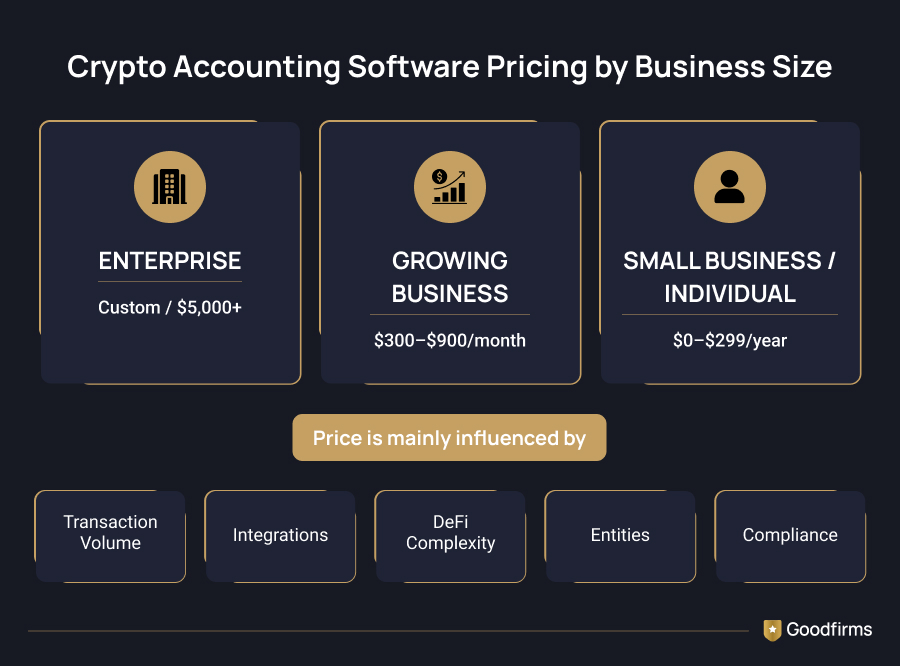
Individual and small business plans ($0–$299/year)
Tools like Koinly and CoinLedger offer free portfolio tracking, with paid tiers starting around $49 for low transaction volumes and scaling toward $299 as volume grows.
Growing business plans ($300–$900/month)
Platforms like Cryptoworth and Cryptio serve businesses that need automated categorization, multi-entity tracking, and direct syncing with QuickBooks, Xero, or NetSuite.
Enterprise and institutional plans (custom, often $5,000+/year)
Tools like Bitwave, TRES Finance, and Cryptio's top tiers don't publish pricing at all. Costs scale with transaction volume, entity count, and the depth of ERP integrations like Oracle NetSuite or Sage Intacct.
What actually drives the price is transaction count, the number of integrations you need, how deep the DeFi and multi-chain support goes, and whether you need dedicated compliance or audit support.
Key Trends in Crypto Accounting Software
Crypto accounting software is shifting toward automation, real-time compliance, and deeper AI-driven reconciliation as regulatory requirements tighten and transaction volumes grow. A few trends are shaping where the category is headed in 2026:
- Fair value accounting is now standard: FASB ASU 2023-08 replaced the old impairment-only model with fair value measurement, requiring platforms to support real-time pricing feeds and separate balance sheet reporting for crypto assets.
- Per-wallet cost-basis tracking is becoming mandatory: IRS Revenue Procedure 2024-28 requires businesses to track cost basis by wallet rather than pooling it across accounts, pushing platforms to rebuild how they calculate gains and losses.
- AI is taking over reconciliation: Tools like TRES Finance now use AI to match transactions across token amounts, fiat values, and cost basis automatically, cutting down the manual review that used to eat up a close.
- DeFi and multi-chain support keep deepening: As nested protocols and cross-chain bridges become common, platforms are investing in smart contract engines that can decompose complex transactions into individual accounting events without manual tagging.
- Global compliance frameworks are expanding: Regulations like the OECD's CARF and the EU's DAC8 require crypto service providers across dozens of jurisdictions to collect and report transaction data, and platforms are racing to support them.
- Stablecoins and tokenized payments are pulling accounting into treasury: As more businesses pay vendors or accept customer payments in stablecoins, accounting platforms are adding built-in payment processing alongside their reporting tools. This shift is also driving demand for crypto banking software development as businesses build infrastructure for managing digital-asset payments and financial operations.
Crypto Accounting Software vs. Crypto Tax Software
Crypto accounting software and crypto tax software solve different problems. Accounting software manages ongoing bookkeeping and financial reporting for a business, while tax software focuses narrowly on calculating gains, losses, and tax liability for filing.
|
Aspect |
Crypto Accounting Software |
Crypto Tax Software |
|---|---|---|
|
Primary Purpose |
Ongoing bookkeeping, journal entries, financial reporting |
Calculating gains, losses, and tax liability |
|
Typical User |
Businesses, finance teams, accounting firms |
Individuals, small filers |
|
Output |
GL-ready journal entries, audit-ready financial reports |
Tax forms and filing reports |
|
Frequency of Use |
Continuous, tied to the accounting close |
Periodic, usually at tax time |
|
Integrations |
ERPs and accounting systems like QuickBooks, Xero, NetSuite |
Tax filing platforms and tax preparers |
|
Scope |
Multi-wallet, multi-entity, full financial picture |
Transaction level-gain / loss calculations |
If your business only needs to file crypto gains at tax time, dedicated tax software may be enough. If you're managing recurring transactions, multiple wallets, or need books that hold up to an audit, you need proper crypto accounting software.
How to Choose the Right Crypto Accounting Software
The right choice depends on your transaction volume, integrations, and compliance needs, not just which tool has the longest feature list. Here's what to weigh before deciding:
- Match the tool to your scale: A small business with a few hundred transactions doesn't need the same platform as an enterprise processing millions.
- Check integration fit first: If you already run QuickBooks, Xero, or NetSuite, confirm the platform syncs cleanly before looking at anything else.
- Weigh DeFi and multi-chain needs: If your business holds assets across chains or interacts with DeFi protocols, prioritize tools built for that complexity.
- Confirm compliance support: Look for GAAP or IFRS-compliant reporting and audit-ready records if your books need to withstand external review.
- Factor in pricing transparency: Published pricing is easier to budget for; custom-quote tools may cost more but often include dedicated support.
FAQs: Crypto Accounting Software
What is crypto accounting software?
Crypto accounting software is a platform that tracks, values, and records a business's cryptocurrency transactions for bookkeeping, tax, and financial reporting. It connects to wallets, exchanges, and blockchains to automate what would otherwise be manual crypto bookkeeping.
What is the best crypto accounting software in 2026?
The best crypto accounting software depends on your business size and use case. Bitwave and Cryptio lead for enterprise-grade compliance and DeFi depth; Cryptoworth suits NFT and GameFi-heavy businesses; and Koinly or CoinTracker work well for smaller teams needing broad exchange coverage.
How much does crypto accounting software cost?
Crypto accounting software pricing ranges from free portfolio tracking to over $1,000 per month. Small business plans typically run $49 to $299 per year, while enterprise crypto accounting automation tools often use custom, quote-based pricing.
What features should crypto accounting software have?
Look for wallet and exchange integrations, automated transaction categorization, reconciliation, cost-basis tracking (FIFO, LIFO, or WAC), and accounting software integrations with tools like QuickBooks or Xero. Multi-chain support and audit-ready reporting matter too, especially for businesses handling DeFi activity.
Is crypto accounting software different from crypto tax software?
Yes. Crypto accounting software handles ongoing bookkeeping and financial reporting for a business, while crypto tax software focuses narrowly on calculating gains, losses, and tax liability for filing, usually for individuals rather than businesses.
What is the best crypto accounting software for small businesses?
Small businesses generally do better with crypto accounting software that offers transparent, lower-cost pricing, such as Koinly, CoinLedger, or Cryptoworth's entry-level plan, rather than enterprise tools built for high-volume transactions.
Can crypto accounting software integrate with QuickBooks or Xero?
Most established platforms support QuickBooks and Xero integration, including Cryptio, Ledgible, Cryptoworth, and CoinTracker. This lets crypto transactions sync directly into your existing accounting system instead of being tracked separately.
Final Words
The right crypto accounting software depends on how many transactions you handle, which tools it integrates with, and how strict your compliance requirements are. A small business tracking a few transactions in QuickBooks needs something very different from a large company managing crypto across many chains.
If crypto is part of how your business gets paid, look for the right crypto invoicing tools and a reliable cryptocurrency payment gateway built for that workflow. As your holdings grow across wallets, solid crypto treasury management solutions become just as important as the accounting software itself.
Check the integrations you need, compare pricing, and try it out before you commit fully.