Now, more businesses embrace digital infrastructure. In such a scenario, without an efficient server management regime, businesses will be vulnerable to server downtime, data loss, performance bottlenecks, security breaches, and even complete network failures. Such failures affect the day-to-day business operations, customer trust, and eventually lead to huge financial losses. Server management software is a robust set of tools that aim at ensuring the prevention of such failures, as well as reducing server management problems, downtime, and in turn costs for any business.
Studies have shown that downtime costs the world's top 2,000 companies $400 billion per annum. In view of the increased awareness of the need for better server management, the global server management software market is forecast to hit USD 26.1 billion by 2033. Furthermore, artificial intelligence-driven server management tools make sure to optimize server performance and automate monitoring and faster resolution of issues, making the tools indispensable for uninterrupted business continuity in 2025 and beyond.
Server Management System - What Does It Constitute?
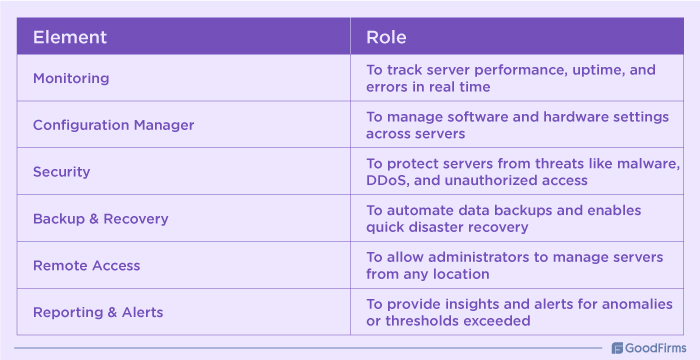
Before we go into the detailed functions and benefits of server management software, here is a table highlighting the essential elements or components of a server management system for businesses:
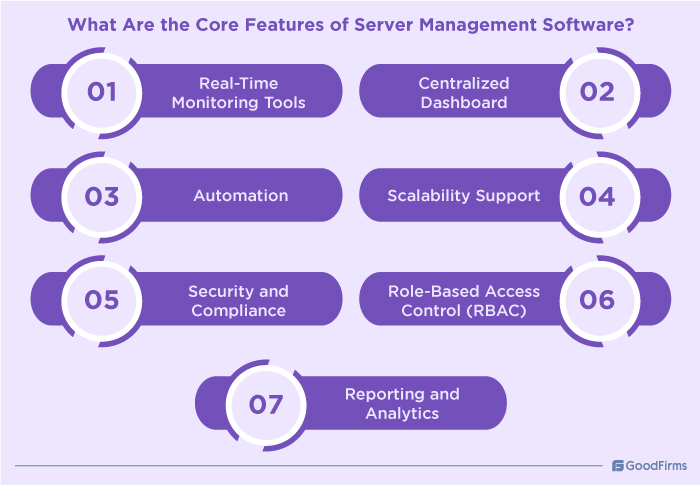
What Are the Core Features of Server Management Software?
The ultimate goal of a server management system is to streamline the operation, configuration, and maintenance of servers. However, server management is not just about keeping the servers on, it also involves keeping the servers running smoothly and securely with minimal manual intervention. Below are the essential features in server management software that are a must for seamless and flawless server management for businesses in 2025;
#1 Real-Time Monitoring Tools
Monitor server health, CPU usage, memory utilization, disk space, network activity, and notify of any drops in performance or abnormal activities.
#2 Centralized Dashboard
Interface where all metrics, logs, alerts, and the status of critical systems are recorded and presented in one place so that administrators make quick, data-driven decisions.
#3 Automation
Automate away human intervention, reduce manual error, enhance efficiency; patches, scheduled backups, etc.
#4 Scalability Support
Ensure that the software supports vertical and horizontal scaling to meet business growth.
#5 Security and Compliance
Includes firewall, antivirus integration, encryption, and user access control so that it complies with industry regulations like GDPR, HIPAA, and ISO standards.
#6 Role-Based Access Control (RBAC)
Only allows authorized users through role-based access to make critical changes for better security and accountability.
#7 Reporting and Analytics
Detailed analytics and reporting on server performance with usage pattern analysis, failure prediction, and strategic planning features.
How Server Management Tools Help Ensure Business Continuity
Server management software tools offer significant and measurable advantages to businesses looking to enhance uptime, security, and efficiency. Let’s understand the common problems in server management and learn how efficient server management tools help eliminate or reduce these issues;
#1 Server Failures and Downtime
Businesses commonly suffer from sudden, unexpected server failures that result in halting of business operations; this is particularly damaging in eCommerce and banking. Server management tools typically help identify risks early, trigger proactive responses, and drastically reduce downtime for organizations.
#2 Infrastructure Security and Cyber Threats
As cyber threats are constantly evolving with increasing use of technologies, it is becoming more challenging for businesses to protect and secure data on the servers. Server management software tools help detect intrusion attempts and secure configurations by monitoring vulnerabilities in real-time and applying patches, enhancing overall IT infrastructure security.
#3 Troubleshooting Takes Time
Troubleshooting translates into significant waste of time for businesses. Server management software usually offers task scheduling, automated alerts, and resource optimization, which can allow IT teams to save valuable time that would otherwise be spent on troubleshooting and instead focus on strategic initiatives and improving efficiency.
#4 Outages Bring In Extra Cost
Server and network management software assists in protecting companies from unforeseen outages and security breaches, sharply reducing costs. Also, centralized server management may reduce operational costs by cutting the number of IT staff required.
#5 Issues with Regulatory Compliance Management
Compliance management is always difficult and must be done on time and diligently to avoid fines and legal complications. Server management tools make audits and compliance easier where stringent data protection regulations exist, by offering features such as retention of detailed logs of user activity, generation of reports, and regulatory report automation.
#6 Disaster Recovery
Typically, businesses lose precious data when hardware fails or upon cyberattack. Data would have to be securely stored and backed up on a routine basis to gain quick access and recovery time as required.
The advanced server management systems keep regular, automated backups and enable the fastest recovery to minimize downtime, loss of data, and damages from hardware failure or cyberattack.
#7 Lack of Scalability Impairs Growth
As organizations grow, server-management tools successfully accommodate similar expansions in infrastructure while adding more servers or moving to the cloud or hybrid environments.
#8 Remote Server Management Issues
Remote server tools provide the ability for administrators to diagnose, update, and fix any system from anywhere. Such flexibility is invaluable in distributed or hybrid work setups.
#9 Reduced Customer Experience Impacts Business Outcomes
Improved server performance means improved application speed, site uptime, and user satisfaction - enough to give a competitive edge to businesses. By adopting server management software, the business is fortified and made agile with a trustworthy digital infrastructure behind it for growth and innovation.
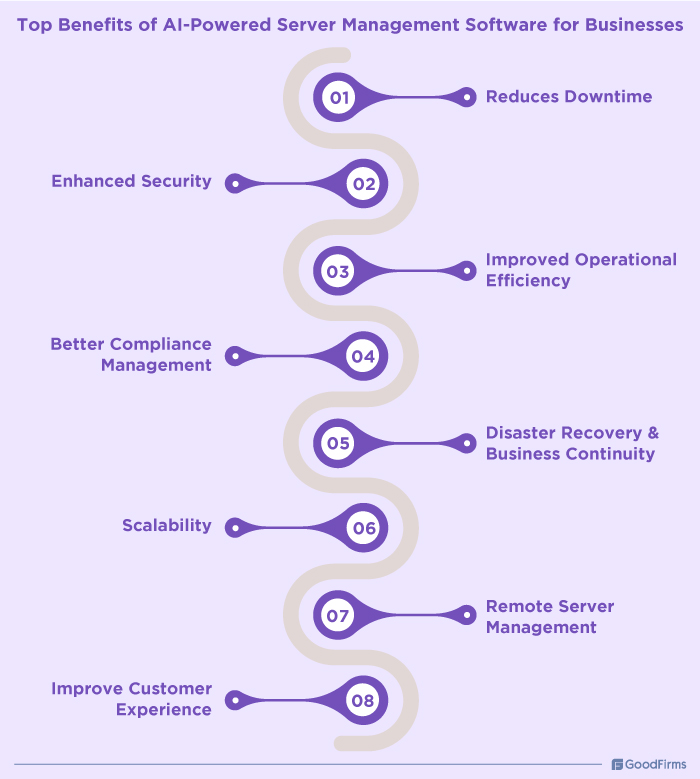
The image below summarizes and highlights the benefits of server management software for businesses;
How AI-Enhanced Server Management Tools Will Change the IT Infrastructure
Integration of AI in server management tools is changing how IT infrastructure is maintained, optimized, and secured. In today's digital environment, complexity and scale increase with every passing day; therefore, AI-powered tools have become a necessity for efficient server operations. Global AI market is expected to touch USD 1.81 trillion by 2030. Listed here are some ways AI is changing server management and what future innovations might entail:
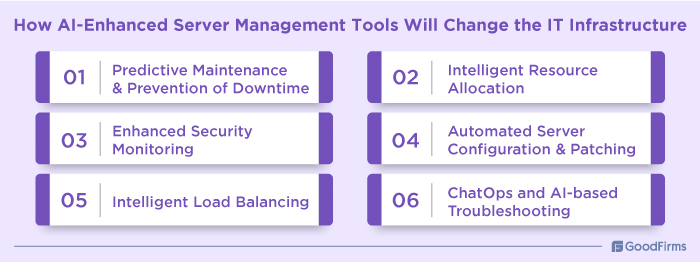
Predictive Maintenance and Prevention of Downtime
An AI-powered system analyzes server logs, usage patterns, and historical data to provide anticipatory warnings about possible hardware failures or system crashes before their occurrence. This sort of proactive approach, therefore, hugely reduces unplanned downtime and in turn, contributes to the increased reliability of service.
The way forward: Real-time data from IoT sensors would be incorporated into AI models for pinpointing predictions at a minute level as the models advance.
For instance, IBM Watson AIOps employs machine learning to detect anomalies, correlate incidents, and forecast outages before these affect performance, thus reducing unplanned downtime by predicting failures from historical and real-time data pertaining to hybrid cloud environments.
Intelligent Resource Allocation
Artificially intelligent systems dynamically allocate CPU, memory, storage, etc., depending on workload conditions. Hence, optimal performance and cost avoidance are ensured.
Future prospects: In the wake of future AI developments, real-time workload prediction will become more accurate, allowing for auto-scaling and adaptive resource provisioning in hybrid and multi-cloud environments.
Likewise, Google Cloud Active Assist uses AI for analyzing usage patterns in order to recommend optimal sizing of VMs, elimination of idle resources, and so on — thereby maximizing potential resource efficiency and minimizing cloud costs with minimal human intervention.
Enhanced Security Monitoring
AI enhances server security by continuous monitoring of anomalies, unauthorized access attempts, and suspicious patterns of behavior. Unlike rule-based systems, AI can also use behavioral analysis to detect a zero-day threat.
Microsoft Defender for Cloud, an ideal example for this, uses AI to determine threats, analyze behaviors, and provide adaptive recommendations for securing server workloads. Its AI threat detection capabilities protecting the servers also go into hybrid and multi-cloud environments to increase server security in real time.
Future prospects: Future systems will use federated learning to discover threats among multiple environments while preserving privacy of the data, thus forming a more balanced and distributed architecture of security in server management.
Automated Server Configuration and Patching
AI takes the grunt work of configuring systems, updating software, and patching them. By learning about correct configurations and their outdated fellow counterparts, it strives to keep servers up-to-date and in compliance.
Red Hat Insights, for example, is an AI-powered predictive analytics tool that identifies misconfigurations and suggests patches, and automates remediation workflows for Linux-based servers, thereby giving a proactive taste to configuration management through ML and automated policies.
Future prospects: Soon, AI will own the entire patch life-cycle; from vulnerability detection to rollback-safe deployment, pushing everything close to zero-touch IT.
Intelligent Load Balancing
Through AI, network traffic can be intelligently distributed among multiple servers based on real-time demand and performance metrics, thereby reducing latency and maximizing user experience.
AWS combines its elastic load balancing with AI-powered auto scaling to optimize server traffic distribution based on application metrics and/or patterns. The system itself would adjust traffic routing intelligently with minimal latency during usage peaks and drops.
Future Prospects: Future load balancers will explore reinforcement learning to fine-tune distribution strategies with time, taking into account changes brought about in user behavior, regional demands, and infrastructure on its own.
ChatOps and AI-based Troubleshooting
AI-powered Chatbots and virtual assistants (ChatOps) can interpret logs, suggest fixes, or apply corrections based on input in natural language, thereby cutting down on response time and reducing human intervention.
The future: server management with the rise of large language models and AI-driven diagnostics may become fully conversational and context aware, offering real-time voice or chat-based resolutions.
The ServiceNow Virtual Agent with Predictive Intelligence uses NLU and ML for server issue troubleshooting, tasking, and escalation if necessary. It provides AI-powered conversational support for IT teams, thus reducing time-to-resolution and operational overhead.
Let’s have a quick glimpse at some more trends and technologies that will aid in transforming and enhancing server management in the future for businesses.
Other Remarkable Trends and Innovations in Server Management Tools That Businesses Cannot Ignore
Apart from AI, server management systems will further witness great evolution in the coming times. Apart from that, the other trends that will rule the future of server management for businesses to know are;
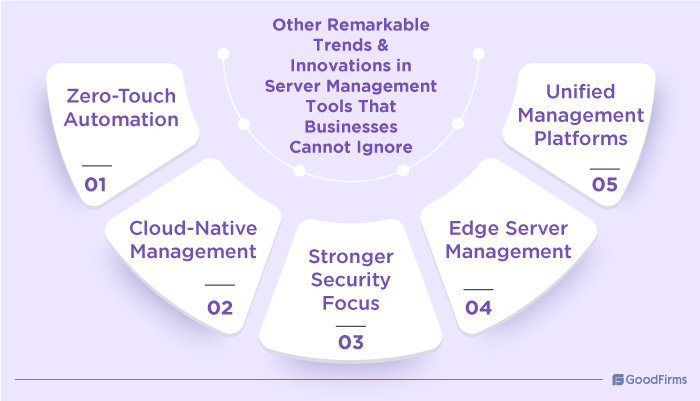
- Zero-Touch Automation: IT automation will evolve toward zero-touch provisioning and maintenance. Systems would configure themselves, update themselves, and even fix issues without any human intervention—thereby maximising uptime and minimising admin effort.
- Cloud-Native Management: Increasing cloud adoption will bring in the shift of server management solutions to a cloud-native paradigm, thereby providing thorough support for AWS, Azure, GCP, and private clouds. Hybrid management tools will be integral to any company working in both cloud and on-premise environments.
- Stronger Security Focus: Cybersecurity will be integrated into the core mechanism. Tools will provide threat intelligence feeds for analysis, detection of anomaly patterns, and automated incidents response mechanisms. Endpoint detection and response (EDR) will be incorporated in the server management suite.
- Edge Server Management: IoT and edge computing enabled and, with it, decentralized servers at edge locations will need to be dealt with. A method of lightweight and distributed server tools will come into being to provide efficient management over these environments.
- Unified Management Platforms: Enterprises will tend to migrate toward one unified platform for server, network, and application monitoring instead of juggling multiple tools while putting forth effort to improve visibility and reduce complexity. As digital transformation gains momentum, businesses must rise above by investing in modern server management tools that are intelligent, scalable, and security-first.
Why Businesses Must Embrace Remote AI-Powered Server Management Tools in 2025
Remote server management tools allow IT workers to monitor and control servers from practically anywhere. These are the tools to be trusted in our post-pandemic work culture, where some sort of remote work attained wide acceptance. It is of utmost importance to have matters of tests, software updates, restarting of systems, and resolving any issue be just a quick turnaround from a formerly face-to-face onsite-error scenario.
Why Does Remote Server Management Matter?
Remote access enables businesses to stay open in times of crises such as natural calamities or serious health emergencies. It can also allow for around-the-clock monitoring with fewer members on the site.
Must Have Features in Remote Server Management Software
- Access through VPN or SSH
- Remote reboot and shutdown
- Automated patching
- Alerts and Notification System
- Integration with mobile apps or cloud dashboards
Remote Server Management Tools - Advantages
Organizations enjoy greater flexibility in cutting travel and onsite personnel expenses, besides being in quick response to advertised problems by the server. It is usually secured through access logging and multifactor authentication protocols. These kinds of tools and services are worth it for any company working from multiple locations visibly or concretely. And with the hybrid way of working, more than just a choice are these kinds of tools.
Choosing the Right Server Management Tools
When deciding on a server management tool, businesses must review their specific requirements, such as server count, infrastructure type (cloud, on-premise, or hybrid), compliance requirements, and budget. Preference should be given to those that allow automation, scaling, and real-time monitoring. Good customer support is also desired. Furthering their list may be integration with current software, ease of use, and the vendor's reputation. In short, an exhaustive evaluation should determine if the tool follows long-term IT strategy and contributes to operational efficiency.
Here is a list of top rated, AI-powered server management software that businesses must know;
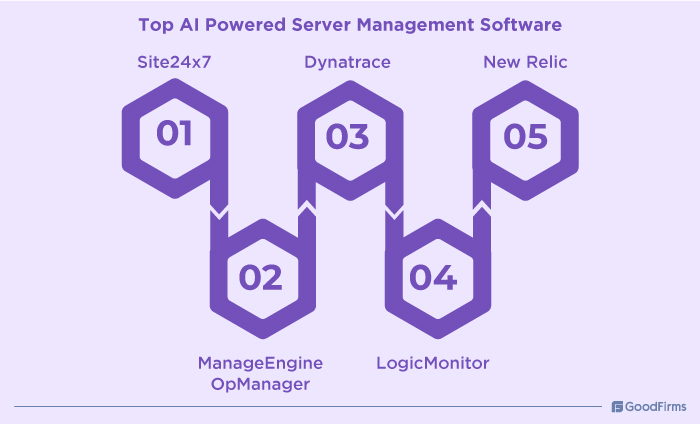
#1 Site24x7
Ranking among the top server management software in the world, Site24*7 is a well-known name. The AI-based software provides a rich toolkit that covers every server management requirement a business may have, such as AI-driven recommendations, predictive analytics, intuitive real-time alerts to reduce MTTD and MTTR, AI insights about capacity planning, an in-depth RCA and inventory report, auto healing, incident remediation, over 80 KPIs checking server health, and many more. This company provides a 30-day free trial of the software with several paid plans commencing at USD 35 per month.
#2 ManageEngine OpManager
ManageEngine Opmanager is one of the most flexible and efficient server management software that provides operational management of servers for organizations of any size. Managing, monitoring all the servers on Windows, Linux, Solaris, AIX & UX, it tracks over 300 server performance metrics, monitors 130+ server vendors out of the box, monitors & controls essential processes and services, recognizes hardware failures in servers with instant alerts, and automates the remediation and troubleshooting monitoring. It also offers AIOps features like AI-based predictive analytics, security, and compliance monitoring. It has a quote-based pricing model with a 30 days free trial.
#3 Dynatrace
Dynatrace is an AI-based server management software known for its capacity management and server performance monitoring capabilities. The software leverages AI to automatically identify the dependencies within your environment and provide advanced observability metrics, logs, and traces. The company facilitates a subscription-based pricing model with multiple plans to suit diverse business needs.
#4 LogicMonitor
LogicMonitor is a unified server management platform created for predictive, AI-powered enhanced IT operations. The software provides comprehensive server management, network monitoring, security, and remote monitoring tools, along with AIOps tools like AI-driven recommendations, anomaly detection, automated incident response, automated root cause analysis, incident prioritization, integration with ITSM tools, predictive analytics, real-time monitoring, and security & compliance monitoring. The company allows a flexible, subscription-based pricing for LogicMonitor starting at USD 22 per month.
#5 New Relic
New Relic is a leading server management solution offering hybrid IT observability and network performance monitoring tools for businesses worldwide. The software provides AI-powered workflow automation, predictive analytics, AI-driven recommendations, real-time monitoring, and more to optimize server performance, increase resilience, and reduce downtime. The company allows a quote-based pricing to ensure maximum value to its customers.
Wrapping Up
Server management software is no longer optional-it is one of the tenets for business continuity by 2025. Tools provide all the answers to security, uptime, and agility. Do not wait till the last minute! Empower your IT infrastructure today, and the next generation of your business will thank you.
“AI has the potential to be more transformative than electricity or fire”
(By Sundar Pichai, CEO, Google)
Once AI matures enough, its integration onto server management shifts the paradigm from manual oversight to autonomous, intelligent operations. The future therefore must be in self-managing infrastructure that learns, adapts, and evolves to meet business needs.