Key takeaways
- Buyers now complete 57-70% of their research before sales even enters the conversation. Your content is the pitch now, not the sales representatives.
- Search-driven content converts leads at 14.6%, nearly 9x the rate of outbound at 1.7%.
- 97% of B2B buyers say reviews drive their purchase decision, and 94% trust verified reviews even more than the vendor's own claims.
- A typical B2B deal involves seven stakeholders researching independently, so content built for one persona loses the other six by default.
- 95% of marketers use AI to produce content, yet one batch of 2,000 AI-written articles drove just 1,062 total clicks, proof that a real B2B content marketing strategy still needs a plan, not just AI output.
Most B2B content marketing never earns its budget back. The content gets published, shared once on LinkedIn, and forgotten by the following week, while the team that made it moves on to the next deliverable.
Meanwhile, the buyers to whom this content was supposed to reach have already left the place. A Gartner survey found that 67% of B2B buyers now prefer a rep-free purchasing experience, and 45% say they used AI during a recent buying decision. They are researching, shortlisting, and half-deciding before a salesperson ever calls them.
In other words, sales calls are no longer the deal-makers or deal-breakers. Your content is. If your competitors' content answers the buyer’s questions first and with clarity, you have lost the deal.
In 2026, the real shift is this: buyers now pick a winner through their own research — often before any sales conversation. So if your content isn't showing up and helping them decide, whereas a competitor's is, they choose the competitor instead of you.
This guide will take you through what it actually looks like in practice: how to build a strategy from the start, where most teams quietly get it wrong, and how AI and search behavior are changing what "good content" even means this year.
Ready to bring in expert hands? Compare best b2b content marketing agencies on Goodfirms and shortlist a partner by rating, pricing, and portfolio.
What Is B2B Content Marketing?
B2B content marketing is the practice of creating content that helps another business make a buying decision, not content that simply mentions your product. A blog post that ranks but doesn't move a buyer closer to a decision hasn't done its job, no matter how much traffic it earns.
It differs from B2C content in one key way: B2C drives a fast, emotional purchase made by one person, while B2B supports a slower decision made by several people, often a CFO weighing budget, a user weighing usability, and an IT lead weighing integration, all at once.
Because of this, B2B content relies on proof over persuasion, using data, case studies, and comparisons instead of slogans, with formats shifting to match each stage of that decision.
Goodfirms surveyed 552 B2B professionals across 25+ countries; 97% said reviews influence their purchase decisions, and 94% said verified reviews increase trust. Proof isn't optional in B2B content; it's how buyers actually decide.
What Is a B2B Content Marketing Strategy?
A B2B content marketing strategy is a framework for deciding what content to create, who it's for, and how it's measured against a business goal. It maps each format to a stage in the buyer's journey, rather than publishing content in isolation, so every piece has a clear purpose tied back to that goal.
The formats that actually carry a B2B strategy:
- Blog articles and guides: build search visibility for research-stage questions
- Case studies: the highest-trust format; a name and a number beats any claim you make about yourself
- Whitepapers and research reports: original data makes you a source others cite
- Webinars and video: best for complex products a buyer needs to see work
- LinkedIn thought leadership: where early vendor opinions form, especially from named individuals over company pages
- Email newsletters: keep a buyer warm across a months-long decision
- Interactive tools (calculators, assessments): let buyers self-qualify before sales gets involved
Most B2B content marketing strategies fail not from picking the wrong format, but from picking one and ignoring the rest.
Why Every B2B Business Needs a Content Marketing Strategy in 2026
B2B businesses used to follow the assumption that content supports sales while sales close the deal; however, it no longer works like this. Now, based on Statista research, the deal is largely won or lost before a rep ever gets looped in.
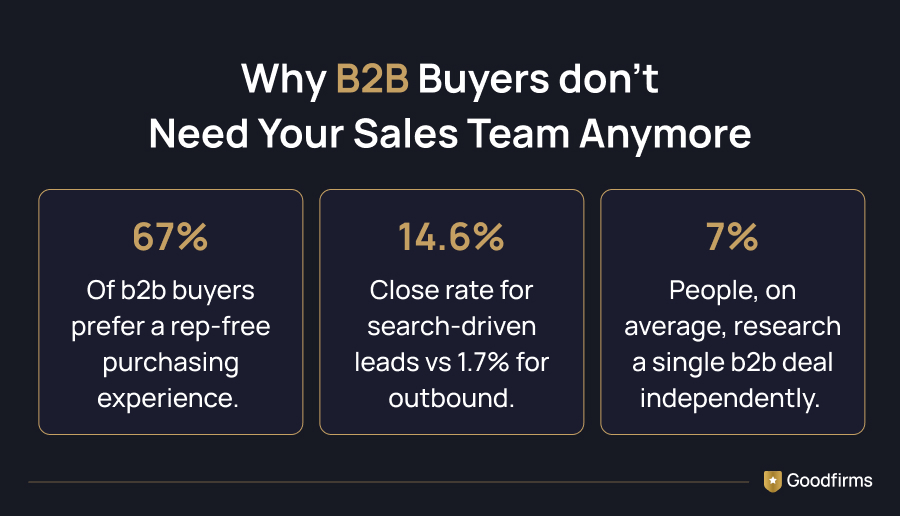
- B2B buyers are now 57% to 70% through their research before a sales conversation even starts.
- 67% and 45% used AI during a recent purchase decision.
- A typical B2B deal now involves around seven people inside one organization, each researching independently.
- Search-driven leads close at 14.6%, against 1.7% for traditional outbound.
- Every buyer group now includes someone who will ask an AI tool to summarize or compare vendors before a meeting is booked. No content means no presence in that comparison.
- Paid ads stop working the moment the budget does. Content that ranks or gets cited keeps bringing in buyers long after the campaign that funded it has ended.
If your content isn't built to answer those questions before a buyer reaches sales, someone else's content already is. Now, let’s move ahead to look at the process of building the top content marketing strategy for b2b businesses.
How to Build a Winning B2B Content Marketing Strategy (Step-by-Step)
There's no shortage of b2b content strategy frameworks and b2b content marketing strategy templates floating around online. Most fail for the same reason: teams skip straight to writing content without doing the groundwork in the first few stages, then wonder why nothing ranks or converts months later.
Stage 1: Define Your Business Goals and Clear KPIs
If your content goes on a website without a goal, it’s just publishing. Before anyone writes a word, decide what a win actually looks like this quarter: pipeline (demo requests, MQLs), authority (backlinks, share of search), or retention (content that reduces churn). Pick one primary goal, not five; chasing all of them at once is how teams end up with content that does none of them well.
Once you have a clear goal, add a clear number to ensure clear KPIs, as referring to “More traffic” isn’t a KPI; it’s a confusing approach. A specified number of leads helps the writer with exactly what a piece needs to do before they even start working. It also helps you optimize your content using concrete factors rather than guesswork.
Stage 2: Understand Your Target Audience and Buyer Journey
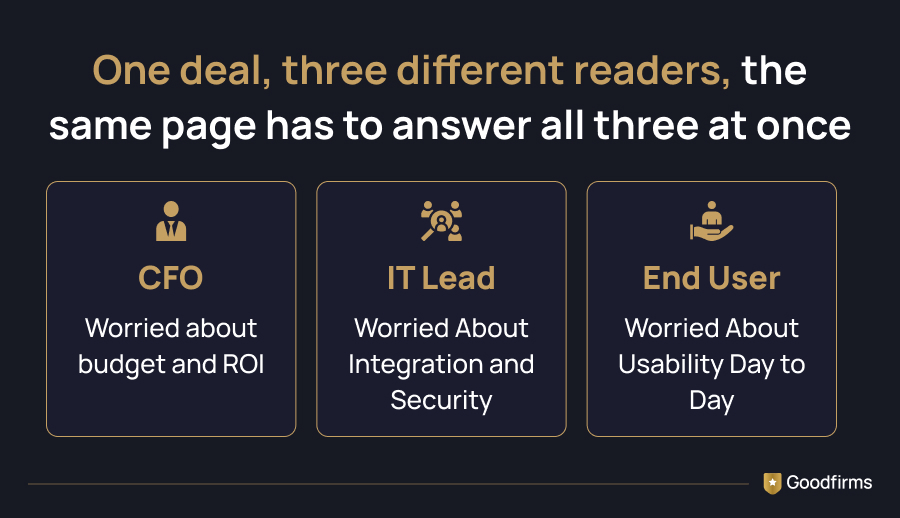
If you are planning a goal-driven B2B content marketing strategy, that means you are probably building around actual buyers’ questions, not your product’s feature list. To make a perfect content marketing strategy, you need to map your audience by role, not only by company size.
Imagine a CFO as an end user, while an IT lead, on the other hand, reads completely differently. Even with the same account, content written for one user will definitely fall apart for another.
Content strategy needs to be optimized based on journey stage: begin with awareness content that presents a problem, not a solution; then move to consideration content that allows comparison and trade-offs; finally, decision content that proves you are a safe choice with pricing, guarantees, and named client outcomes.
Coming directly to "why choose us" content before a buyer has even framed their problem is one of the most common reasons B2B content gets ignored early in the funnel; it's answering a question nobody's asked yet.
Stage 3: Conduct Keyword and Competitor Research
The moment you have identified your target market, move ahead and identify the keywords your actual buyers type, not the phrases your team uses internally; however, these two rarely match, as internal words are never in real search data. To identify relevant keywords, you must check SEO tools like Semrush, Ahrefs, or even Google Search Console’s existing query data to see real search volume and where the intent gaps are.
Once you are done with keyword research, check what’s already ranking for those terms. If the top 3 results seem outdated or unanswered, that’s the right time for you to take that place. But if they are already the latest and most comprehensive, ensure you work on a sharper content piece with the opinions that others don’t take.
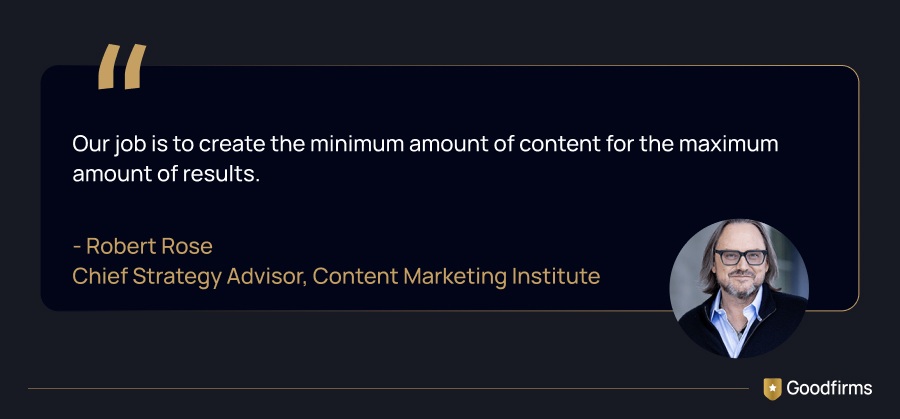
Robert Rose, Chief Strategy Advisor at the Content Marketing Institute, has spent years pushing back against the industry's obsession with output, arguing the real job is to "create the minimum amount of content for the maximum amount of results."
Stage 4: Develop High-Value and Multi-Format Content
The best b2b content marketing examples separate themselves from the market: they commit to a format that matches the buyer's need instead of defaulting to another blog post. A pricing calculator answers a question a 2,000-word guide never will. A B2B SaaS content marketing strategy, for instance, often gets more from one sharp comparison page than from ten generic feature posts.
Build a mix on purpose: long-form guides for search, case studies for trust, and at least one interactive or video asset a quarter for buyers who won't read 2,000 words no matter how good it is. None of this scales without the right backend; either teams juggling multiple formats and contributors typically outgrow a basic blog editor fast, which is where a proper content management system earns its keep, handling versioning, workflows, and multi-author publishing without the chaos.
Long-form guides often perform best when supported by complementary tools such as CRM Software for lead tracking, Email Marketing Software for nurturing campaigns, and Marketing Automation Software for workflow management. Many organizations also work with experienced SEO Companies to ensure content assets are aligned with search demand and buyer intent.
Stage 5: Optimize Content for Search Engines, AEO, and GEO
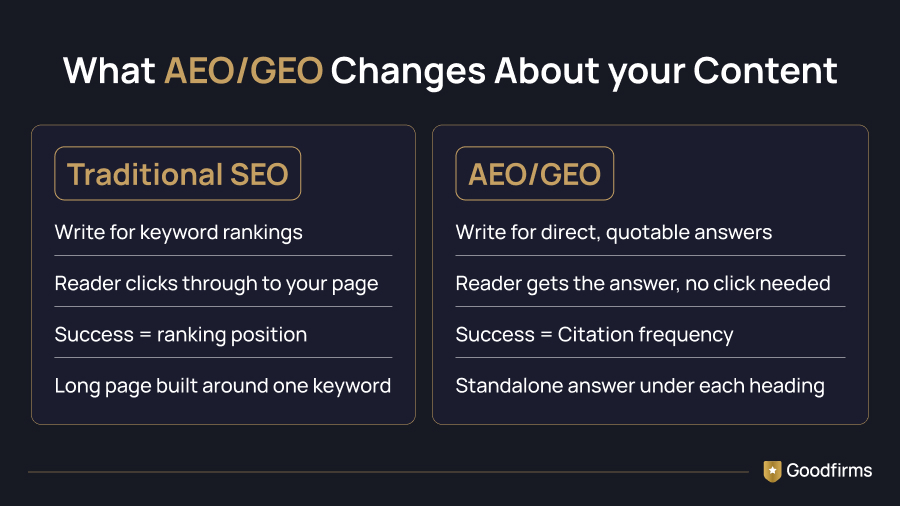
Traditional SEO is necessary but no longer sufficient — over 60% of Google searches in the US now end without a single click to any website, which is exactly why AEO and GEO exist as separate disciplines. AEO means answering questions cleanly enough that an AI Overview can lift the answer directly. GEO means using specific, checkable claims a generative engine trusts enough to cite.
In practice: answer the core question in the first two lines under every heading, write FAQs that stand alone without needing the rest of the article for context, and use exact numbers with sources instead of "many businesses report." Both are cheap to add, and increasingly decide whether you get cited at all.
Stage 6: Distribute and Repurpose Your Content
One good content piece shouldn't be published once. You can turn it into a LinkedIn carousel, an email sequence, or a comparison one-pager; the same research can help you create three or more pieces of content, increasing content visibility. This is where a real LinkedIn content strategy comes in. Buyers form opinions from people's posts long before they ever land on your company blog, so put the insight behind a founder or a subject-matter expert, not the brand account. This strategy will definitely take customers to your website.
There's also a whole layer of distribution you'll never see in your dashboard. Buying-committee conversations happen in Slack channels and peer groups you're not in; someone forwards a link, and it lands in your analytics as plain "direct traffic," no trail attached. You can't chase that conversation. What you can do is make sure something worth forwarding actually exists: a sharp one-pager, a stat card people want to send along.
And don't publish once and walk away. If a guide was worth the time it took to research and write, it's worth showing up again in three or four channels, a few different formats, over the next month, to the parts of your audience who haven't seen it yet.
Stage 7: Measure Performance and Continuously Optimize
Go back to the KPI from Stage 1 and check the piece against it, not against vanity numbers like pageviews. If the goal was to lead requests and you got traffic with no conversions, the content reached the wrong audience or answered the wrong question.
Update: don't just publish and forget. A guide that ranked well a year ago with outdated stats will quietly lose its position; refreshing data and internal links every few months is often cheaper than writing something new.
Common B2B Content Marketing Strategy Mistakes to Avoid
Most B2B content doesn’t fail due to its writing. It fails because of decisions made before anyone opened a document.
- No one defined what success looks like: Teams publish for months against a vague goal like "more visibility," then can't explain the growth that content actually produced for them.
- Content is written for the wrong buyer stage: Decision-stage content ("why choose us") gets published to an audience that hasn't even framed the problem yet, so it gets ignored, not because it's wrong, but because it's early.
- Everything sounds like everyone else: Most B2B content restates the same points the top 3 competitors already made, with no new data, no real example, and no stance. There's no reason for a buyer, or a search engine, to pick it over what's already ranking.
- It's treated as a one-time task, not a system: A single case study gets published once and forgotten instead of resurfacing across LinkedIn, email, and sales decks for months; the effort gets spent once and thrown away.
- Nobody checks it against the goal afterward: Teams look at traffic, call it a win, and move on, without ever asking whether that traffic turned into the pipeline the content was supposed to generate.
These are strategy problems, not execution problems, which is why publishing more rarely fixes them. Better decisions before writing do.
B2B Content Marketing Best Practices for 2026
Ever come across content that felt written to satisfy a checklist rather than a buyer? Businesses getting real results in 2026 tend to be doing something differently.
Always make sure to say the useful thing first. If a reader has to wade through two paragraphs of setup before you make an important point, you've definitely lost the ones reading on their phone between meetings.
Be specific. "A leading provider" and "many businesses" are the two phrases doing the most damage in B2B content right now; they usually mean the writer didn't have a real example handy. Naming the actual client, tool, or number costs nothing extra and lands completely differently.
Remember it's not one buyer. A typical B2B deal involves around seven people, and content written for only one of their concerns quietly loses the other six.
Also ensure you source your numbers, plan for reuse before publishing, and go back and update old stats before they quietly cost you your ranking. These are just considered small practices, but creates a huge impact on the success of your business.
A piece that only repeats what the top 3 results already said gives no one a reason to pick it over other competitors. So, try to deliver something unique for the readers.
How AI Is Transforming Your B2B Content Marketing Strategy in 2026
AI is rapidly changing B2B Content marketing strategy from two directions at once: how buyers research, and how marketers produce. A strategy built for only one side is already behind.
On the buyer side:
- Buyers increasingly research and shortlist using AI tools before a sales conversation ever happens, which means content now has to satisfy two readers at once: a human skimming for relevance, and an AI system deciding whether your page is specific enough to cite.
- Trust still runs through expertise, not volume. 75% of decision-makers say they trust thought leadership content more than most other content types, which argues for fewer, sharper opinion-driven pieces over a high volume of generic ones.
On the production side:
- 95% of B2B marketers now say their organization uses AI-powered applications in some form, and AI tools have become the single largest area of B2B marketing investment for 2026 at 45% of budget, ahead of events and owned media.
- Generative AI use in at least one marketing workflow has climbed to 87%, up from 51% just two years ago; adoption has moved from early-stage experimentation to the default.
- Adoption without judgment has a real cost. One tracked experiment generated 2,000 AI-written articles over 16 months, and the entire batch drove a combined 1,062 clicks, a clear signal that AI output without a strategy behind it doesn't move the needle just because it exists.
The distinction that actually matters: AI makes a good strategy faster. It makes a bad one faster to publish. The teams seeing real gains are using it to execute a plan that already exists, not to invent one on the fly.
FAQs - B2B Content Marketing Strategy
What’s the difference between B2B and B2C content marketing?
B2B content marketing is usually for a buying committee weighing a slower, data-driven decision, leaning on case studies and comparisons instead of emotion. B2C content moves one person toward a faster purchase. Knowing what B2B marketing strategy demands- multiple stakeholders, longer cycles — is what separates content that converts from content that just ranks.
What B2B content marketing trends shape the future of B2B businesses?
The clearest shift in content marketing strategy is content built for AI answer engines alongside traditional search, named individual expertise outperforming anonymous brand voice, and formats expanding well past blog posts into calculators, comparisons, and short video. A solid b2b content map for 2026 accounts for all three rather than treating SEO as the only channel that matters.
How do you measure the success of a B2B content marketing strategy?
To track the success of your content strategy, ensure you look at leads and pipeline generated by each piece, not pageviews or shares. Connect content to your CRM so you can see which pieces led to leads, then compare that against the KPI set in Stage 1 of your content strategy.
What are the most effective B2B lead generation tactics that actually work in 2026?
Some of the key B2B lead generation practices involve working on SEO-driven guides answering real buyer questions, case studies with named clients and real numbers, LinkedIn content from named individuals, and interactive tools that let buyers self-qualify before sales gets involved.
What AI tools are B2B content marketers using the most in 2026?
Most of the AI content writing tools used by B2B teams are ChatGPT or Claude for drafting, Uber Suggest, Surfer SEO, or Semrush for keyword research, and Perplexity for source-checking, using them to execute an existing b2b content marketing strategy template rather than invent one from scratch.
Is content marketing still worth investing in for B2B businesses in 2026?
Yes, it helps buyers complete more research independently before contacting sales, which is why content marketing matters so much for B2B right now. It's often the only thing shaping a buyer's opinion before a rep gets a chance to.
How long does it take for a B2B content marketing strategy to deliver results?
Three to six months for SEO content to start ranking, six to twelve for pipeline impact. LinkedIn thought leadership can shift buyer perception in weeks. Planning a goal-oriented B2B content marketing strategy means setting these timelines early, not after the first quarter falls short.
Final Thoughts
A B2B content marketing strategy in 2026 isn't optional groundwork before "real" marketing campaigns start; it's one of the most important things, handling most of the convincing before your sales representatives. The businesses winning right now aren't publishing more; they're building content that answers real questions clearly enough for a buyer, or an AI system, to trust it.
Start with one clear goal, build content for the actual people making the decision, and check it against results instead of traffic. That's the difference between a strategy and a publishing habit.
Need help executing this end-to-end? Compare skilled digital marketing agencies on Goodfirms and shortlist a partner by rating, pricing, and expertise.