Key takeaways
- Trust decides patient choice, not just visibility.
- Compliance is the foundation of healthcare marketing, not a constraint on it.
- Reviews, local SEO, and zero-click search now need active, ongoing management.
- Massive growth in the digital health market (USD 199.14B in 2025 → USD 573.53B by 2030) confirms this shift is real.
Valued at USD 427.24 billion in 2025, the global digital health market has grown to USD 491.62 billion in 2026 and is projected to reach USD 2,351.24 billion by 2034, at a CAGR of 21.60%. That kind of growth doesn't happen without providers investing heavily in digital channels to reach patients where they already are.
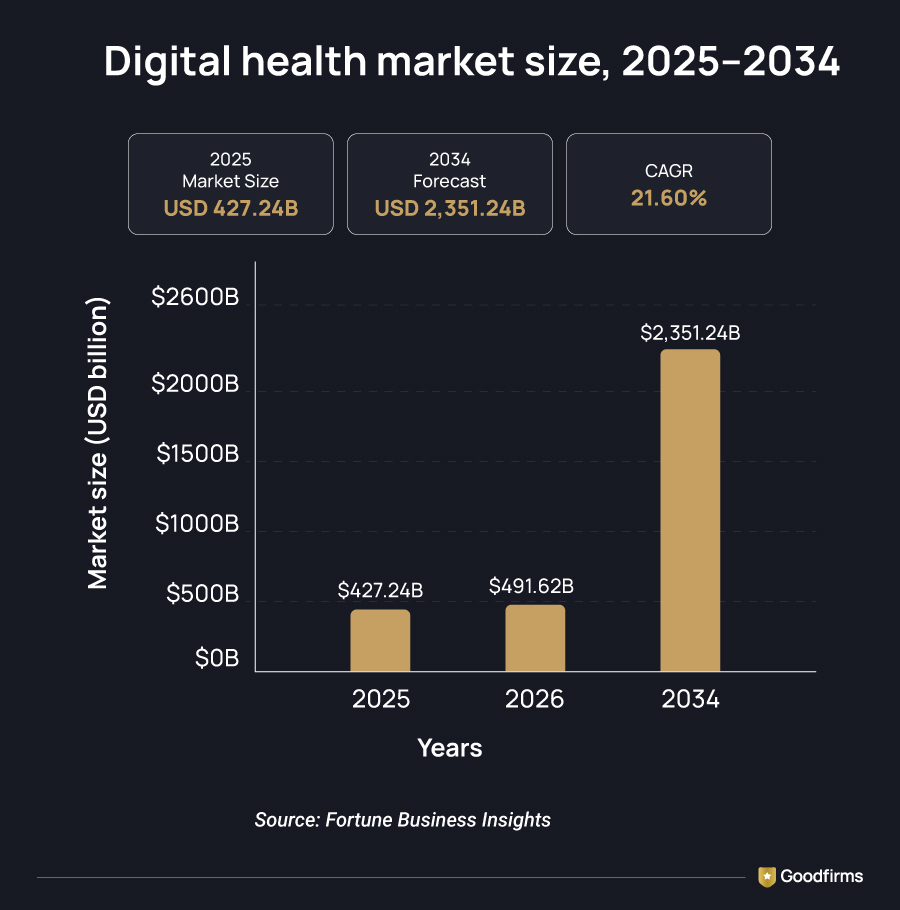
Numbers like that point to one conclusion: digital marketing drives patient acquisition for hospitals, clinics, and independent practices alike.
This blog explains why it matters in healthcare right now, its key benefits and challenges, and where the industry is headed next. Getting all of that right, though, still comes down to who's running the strategy.
Goodfirms' research-backed platform lists verified healthcare digital marketing companies, along with the broader roundup of top digital marketing companies, if you're comparing specialists against full-service firms
Let's start with why it matters.
Why Digital Marketing Matters in Healthcare
Today's healthcare consumer looks nothing like the patient of a decade ago. People are healthier, living longer, and relying on healthcare organizations less than before — but when they do need care, they rarely just walk into a clinic. They do their homework first.
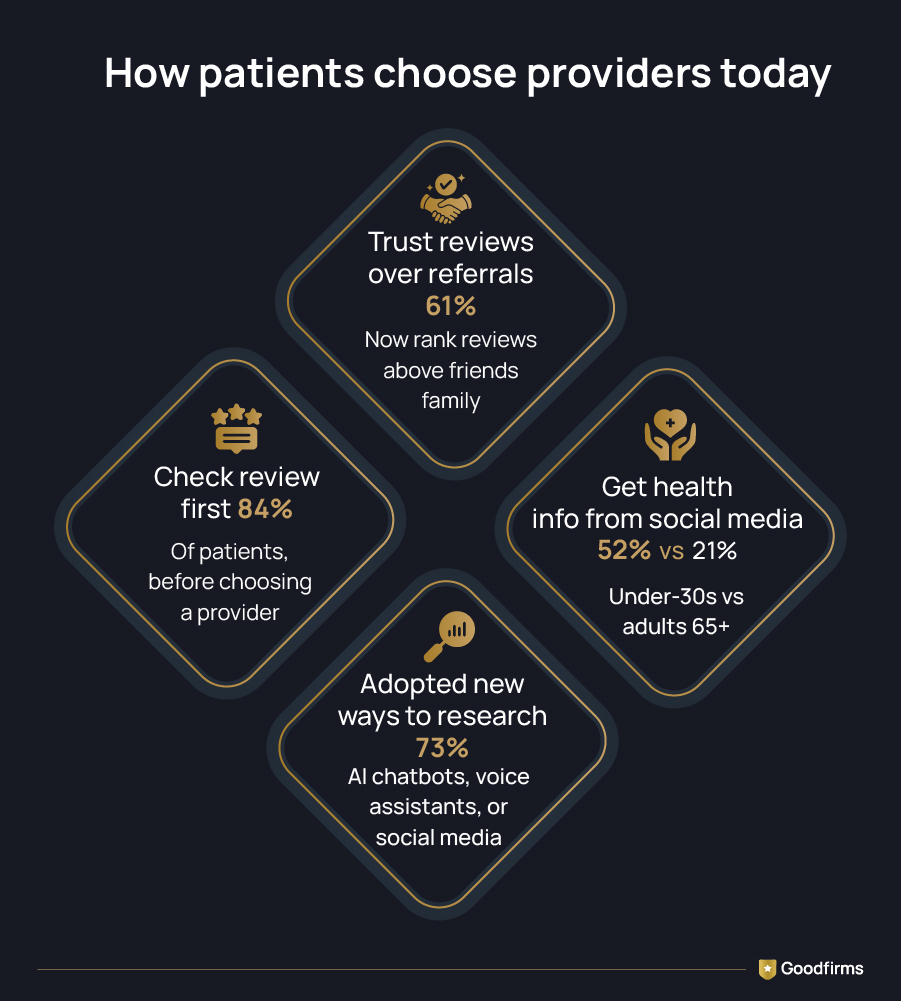
Extensive online research has made patients far more particular about the services they choose, backed by ready access to physician reviews, ratings, and forums where they can compare notes with others managing similar conditions. When rater8 surveyed over 1,000 US patients in December 2024, 84% said they'd checked reviews before choosing a new provider. More telling, 61% said they'd trust those reviews over what a friend or family member told them.
By the time rater8 ran a follow-up survey in June 2025, the pattern had already begun to shift — 73% of patients said they'd adopted a new way to research providers in the past year, whether that was an AI chatbot, a voice assistant, or a social platform. Specifically, 35% said a provider's social media presence had factored into their choice, and 25% had turned to voice assistants to research providers altogether.
Speed, ease of communication, and convenience - these are what are pulling healthcare consumers toward online services — and providers who aren't visible where this research happens are being filtered out before they even get a chance.
That single behavior shift changes everything about how a healthcare organization needs to show up. It changes what marketing means for a hospital or practice. It is not about running a flashy ad campaign and expecting foot traffic.
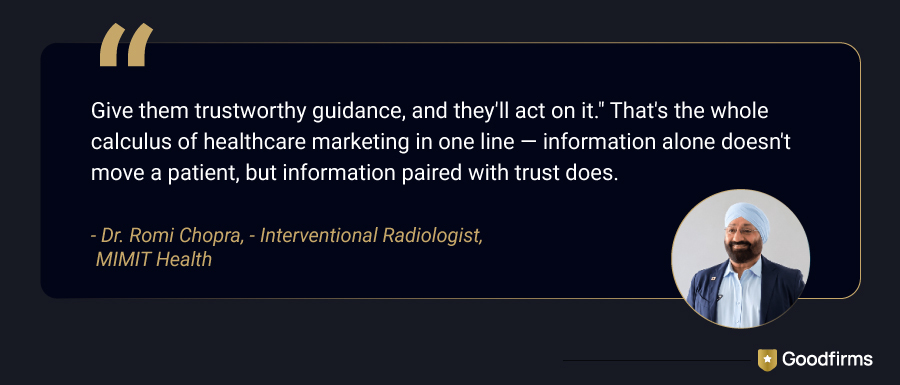
Healthcare decisions are personal, sometimes urgent, and often tied to fear or vulnerability. A patient searching for an oncologist or a pediatric specialist isn't browsing casually — they're trying to make the right call for themselves or someone they love. Most industries just need someone to notice their ad. Healthcare needs someone to trust it enough to hand over their care.
Source: CIMSS Innovative Solutions
There's also a hard business case behind this. Organic search consistently outperforms other channels in bringing new patients to a provider's website, and it's often the first place a hospital or clinic gets found — or overlooked. If a hospital or clinic isn't visible and credible in that moment of search, a competitor down the street will be in line.
Younger patients make this even more pronounced. A late-2025 Pew Research Center survey found that 52% of adults under 30 get health information from social media at least sometimes, compared to just 21% of adults 65 and older — a gap that widens further when it comes to trusting and acting on what they find there. That's a real shift from how healthcare referrals used to work, and it means a provider's digital footprint now carries weight that used to belong almost entirely to word of mouth.
Once an organization knows patients search first, the next question is simple: what will they gain from it if they show up well?
What Are the Benefits of Digital Marketing for Healthcare Organizations?
Healthcare organizations that invest in digital marketing see gains in a handful of specific areas, starting with how patients engage with them day to day.
-
Stronger Patient Engagement
A patient portal that skips the phone call for test results. A scheduling widget that books a follow-up in seconds, no hold music required. An email that actually says something useful, not just "we miss you." Small tools like these keep the relationship going after the patient walks out the door, so a question doesn't have to wait until the next visit to get answered. That kind of easy, ongoing contact is often the difference between a patient who follows through on a treatment plan and one who quietly drops off — and it's usually why they come back next time instead of starting their search over with someone new.
Many organizations strengthen retention and communication through dedicated patient management software that streamlines scheduling, messaging, and follow-up care.
-
Wider Reach in Underserved Areas
A well-built website and targeted local campaigns reach people, a physical location alone never could — someone two hours from the nearest specialist, or a patient who simply can't take a weekday off work to drive there. Telemedicine is actually closing that gap faster than most people realize: FAIR Health's Q1 2026 Telehealth Regional Tracker found telehealth use grew 7.8% in rural areas, outpacing the 6.2% growth in cities that same quarter. For a lot of these patients, a video visit isn't a convenience — it's the difference between getting care and going without.
As telemedicine adoption accelerates, many providers are partnering with experienced healthcare app development companies to build patient portals, virtual care platforms, and mobile health applications. Providers looking to expand access to remote care can explore leading telemedicine software solutions designed for virtual consultations and digital patient management
-
Sharper Targeting
A new parent looking for pediatric care and a retiree managing diabetes aren't the same audience, so why send them the same message? Digital channels let healthcare marketers actually talk to each group directly instead of writing one message and hoping it lands with everyone — a pediatric practice can build a landing page and email sequence around "what to expect at your baby's first checkup." In contrast, a chronic care clinic builds its practice around managing a diagnosis long-term, and neither group has to wade through content meant for the other. That's the difference between an ad someone scrolls past and one they actually stop for.
-
Measurable Results, Tighter Budgets
Unlike a billboard or a radio spot, digital campaigns come with real numbers attached: website visits, call tracking, appointment conversions, and cost per new patient. That visibility means healthcare marketers can see what's working, cut what isn't, and defend their budget with data instead of guesswork. Organizations that invest seriously in digital marketing in healthcare see a meaningfully higher return than those still relying on traditional channels.
None of this comes free, though.
What Challenges Does Digital Marketing Face in Healthcare?
Healthcare marketers face a handful of obstacles that most other industries don’t.
-
Strict Compliance Requirements
HIPAA and similar patient-privacy laws shape almost every marketing decision — what a patient testimonial can include, how a chatbot can respond to a patient's question, and even how a review request is worded. Getting this wrong doesn't just damage the organization's reputation; it undermines its ability to operate effectively. It can also lead to real fines and legal consequences.
-
Earning Trust in a Skeptical Market
Health decisions are mostly risky, and patients are quick to abandon a provider after even one poor digital experience. A confusing website, a slow-loading page, or a string of unanswered negative reviews can negatively impact months of good marketing work in a single visit.
-
Meeting Google's Content Bar
Health topics fall under what Google calls YMYL — "Your Money or Your Life" — content, and the search engine holds these pages to a stricter standard than almost anything else it ranks. Generic, vague, or unattributed medical content struggles to rank at all, no matter how well it's optimized technically.
-
Limited Budgets, Smaller Practices
Most small clinics don't have a marketing budget, let alone someone who knows SEO or paid ads. So while big hospital systems keep growing their reach, smaller practices miss out on patients they could've had.
-
Balancing Empathy and Promotion
Patients making a personal health decision don't respond well to marketing that feels too 'salesy.' Finding the right tone, one that's helpful without feeling cold, and caring without sounding like a sales pitch, is tougher than it sounds.
-
Keeping Up with Fast-moving Platforms
Search algorithms, social media formats, and now AI-generated search summaries all change faster than most healthcare marketing teams can track. What worked to attract patients last year, whether that's a particular content format or an ad targeting approach, can quietly stop working with little warning, and healthcare's compliance layer makes it slower to adapt than most industries.
Knowing the risks doesn't have to mean playing it safe.
What are the Best Practices for Healthcare Digital Marketing?
A handful of practices, applied consistently rather than in a single campaign launch, are what separate healthcare organizations that grow their patient base from those that spend money without seeing results.
-
Put Compliance First
A single social post that reveals too much about a patient's condition, even by accident, can cost more than a bad quarter's marketing budget — it can trigger a HIPAA violation with real fines attached. That's the risk healthcare marketers carry that almost no other industry does. The practices that handle this well don't treat compliance as a legal sign-off at the end of the process; they build it into the workflow from day one. A patient testimonial doesn't get published without written consent on file. A new hire doesn't touch a campaign before walking through what can and can't be said about a patient's condition.
-
Invest in Local SEO
Most patients search for care near them rather than researching providers nationwide. This means local visibility is crucial for healthcare providers. If you optimize for local search engine optimization (SEO), it ensures that your platform/ practice is one of the first to pop up when potential patients search for healthcare services in your area. Start with a Google Business Profile that's actually filled out — half-empty listings lose before anyone even clicks. After that, ask real patients for reviews and write pages that name the actual neighborhood instead of generic copy. Practices with complete profiles see more calls and direction requests than those with incomplete ones.
Healthcare providers without in-house search expertise often work with specialized local SEO Companies to improve visibility in local search results and Google Maps. To expand organic growth beyond local visibility, many organizations partner with experienced SEO Companies to strengthen search performance and patient acquisition.
-
Build Content around Patient Questions
Content that actually works in healthcare answers a real question someone typed into Google at 11 pm: symptoms, treatment options, recovery timelines, and insurance coverage. The pages that perform best are the ones written like someone anticipated exactly what the reader was scared to ask. Content written or reviewed by a qualified clinician generally performs better than generic marketing copy, both in earning reader trust and in meeting Google's E-E-A-T standards for medical (YMYL) content, which explicitly call for demonstrable expertise on health topics.
-
Treat Reviews as a Core Channel
One unanswered bad review can quietly push away dozens of future patients over the course of a year. Asking happy patients for reviews and replying to every review, good or bad, shouldn't be something you do once every few months. It needs to be a regular part of your marketing.
Worth pointing out: most healthcare websites still treat their reviews section as decoration — a static widget bolted onto a page — rather than an active part of the conversion funnel. Reviews only pull their weight when they're recent, responded to, and visible right where a patient is deciding whether to call, not buried on a separate testimonials page nobody clicks.
-
Use Social Media to Inform
Social media platforms help engage with patients in real time. Healthcare providers can leverage these online platforms to post educational content, such as seasonal health tips, explainer videos, and myth-busting posts. They can then see consistently stronger engagement than those who only post promotional updates about services or offers. Healthcare brands seeking stronger patient engagement can also collaborate with social media marketing companies that specialize in content strategy and community management.
-
Don't Overlook Phone Calls
A lot of healthcare marketing focuses entirely on getting someone to a website, then stops. But for many patients, especially older ones or those with urgent concerns, the next step is picking up the phone. Making sure that call gets answered promptly and handled well matters just as much as the digital funnel that led to it. Practices that struggle with after-hours inquiries often turn to experienced call center services companies to ensure patients receive timely support and assistance with appointments. If you're weighing whether to handle this in-house or bring in outside support, our recent breakdown of call center outsourcing in 2026 walks through the tradeoffs in more detail.
-
Run Targeted Ad Campaigns
Digital advertising enables you to target by demographics, behavior, and interests — which matters more in healthcare than almost anywhere else, since the right message needs to reach the right patient at the right moment. Google Ads and Facebook Ads both support this level of precision. Organizations investing in paid acquisition frequently work with specialized PPC agencies to manage healthcare advertising campaigns across Google and social platforms. However, healthcare advertisers must stick to broader demographic and behavioral signals rather than targeting by health condition, per platform policy.
Here's a sign it's working: LocaliQ's 2025 benchmark report, drawn from over 3,500 US healthcare search ad campaigns, found that cost per lead fell for 63% of the healthcare businesses measured — even as it rose across the broader industry.
Getting the fundamentals right matters today — but a few shifts are already changing what "showing up" will mean next.
What's Next for Healthcare Digital Marketing? (Future Trends)
A few shifts are already reshaping where healthcare digital marketing is headed next.
-
Near-universal Digital Research
Most patients already search for healthcare providers online before booking an appointment — and soon, nearly all will, not just most. Organizations that aren't visible and credible in that research phase will increasingly be invisible to the patient altogether.
-
AI Handles First Patient Contacts
Symptom checkers, chatbots, and automated intake forms are already handling a growing share of that first patient interaction. rater8's June 2025 survey found that 26% of patients had already chosen a physician based on an AI tool's input, putting AI nearly on par with personal referrals (28%) as a decision factor. It's changing what a patient's very first contact with a healthcare brand even looks like.
-
Zero-click Search Reshapes SEO
As AI-generated search summaries answer more health questions directly on the results page, a growing share of health queries may never lead to a website visit at all. That means healthcare content strategy needs to think beyond clicks and toward being the source those AI summaries actually pull from.
-
Continued Growth in Digital Spend
Healthcare's digital marketing budgets have been climbing steadily and show no sign of leveling off, as more organizations shift dollars away from traditional channels and toward the digital tactics that are actually driving new patients through the door.
-
Privacy Compliance as a Constraint
Regulators are increasing scrutiny of tracking tools used on patient websites — a Feroot Security analysis of 19 major cases from 2023–2025 found healthcare organizations have paid over $100 million in penalties for privacy violations tied to tracking pixels. The old tracking tools are becoming less reliable, not because they've disappeared, but because different web browsers now block or allow them inconsistently.
The safer path forward: collect data directly from your own patients (not through third-party trackers) and build privacy protection into your marketing tools from the start, rather than bolting it on later.
None of this happens without the right partner. Here's what to actually check before signing on with one.
How to Choose the Right Digital Marketing Agency for Healthcare
Not every digital marketing agency is built for healthcare, and picking the wrong one can cost more than a wasted budget. A few things worth checking before signing on with any agency:
- Real healthcare experience, not just general marketing skills. Ask for case studies or client examples specifically from hospitals, clinics, or medical practices, not just healthcare-adjacent industries.
- A clear, working knowledge of HIPAA and patient privacy. An agency that can't explain how it handles protected health information in a testimonial or ad campaign isn't ready for this space.
- A track record with local SEO and Google Business Profile management, since that's where most patient searches actually start.
- Transparent reporting. You should be able to see exactly what your budget is producing: calls, appointments, and cost per new patient, not just impressions and clicks.
- Verified reviews and delivery history, rather than just a polished pitch deck.
This is exactly where doing a bit of homework up front pays off. Goodfirms is a research-backed reviews and ratings platform that evaluates healthcare digital marketing companies based on real client feedback, real portfolio work, and pricing that isn't hidden until a sales call.
This list makes it easier to shortlist a partner based on actual delivery history rather than marketing promises.
If your search extends beyond healthcare-specific firms, the broader list of curated digital marketing companies on Goodfirms is worth a look too, particularly for organizations weighing specialist healthcare agencies against larger, full-service firms.
Concluding Remarks
Patients now behave like consumers everywhere else: they Google their symptoms, compare providers, read reviews, and often decide who to call before they've spoken to a single person at your practice. The organizations staying ahead of the curve are the ones treating trust, compliance, and patient experience as the foundation of their marketing, not a constraint on it.
When you get the fundamentals right — local SEO, honest content, responsive review management, and a partner who actually understands healthcare — the results tend to follow. If you skip them, a competitor with a stronger digital presence will happily take the patient instead.
FAQs - Impact of Digital Marketing on the Healthcare Industry
What is digital marketing in healthcare?
It's the same tools any business uses to market itself — SEO, content, social media, email, paid ads — just aimed at a much harder job: getting a patient to trust a provider enough to hand over their care. A retail brand just needs someone to notice an ad. A hospital or clinic needs someone to believe them. That's why patient privacy and compliance shape almost every decision here in ways they simply don't in most other industries, and why credibility has to be earned before a patient acts on anything a practice says.
Why is digital marketing important for hospitals and clinics?
Most patients now research a provider online before booking an appointment, often comparing several options and reading reviews first. A hospital or clinic that doesn't show up — or doesn't look trustworthy when it does — loses that patient to whichever competitor got there first.
What are the biggest challenges in healthcare digital marketing?
HIPAA sits over almost every decision a healthcare marketer makes, from what a testimonial can say to how a chatbot responds. On top of that, Google holds health content to a higher standard than nearly anything else it ranks, so vague or generic pages rarely perform well. And because a health decision carries real weight, patients don't readily extend trust — a single unanswered bad review can undo months of otherwise solid marketing work.
How do I choose a good healthcare digital marketing agency?
Look for real healthcare experience, clear HIPAA knowledge, a track record with local SEO, and transparent reporting on calls and appointments, not just clicks. A sales pitch will tell you what an agency wants you to hear. Verified reviews and actual past work tell you what they've really delivered — that's what to check before shortlisting anyone.
What's the biggest trend shaping healthcare digital marketing right now?
Patients used to click through to websites for health information. Now Google often just answers the question right there on the results page, and the click never happens. Ranking well isn't enough anymore — the content has to be good enough that it's the source an AI summary actually pulls from, not just a page that happens to sit in position one.