Key takeaways
- Compliance ranks you before content does. Hide your licensing details or skip age-verification signals, and Google quietly caps your rankings no matter how good the content is.
- Paid ads barely work in this space because most platforms heavily restrict gambling promotions, making organic search the only growth lane operators can actually rely on.
- One high-authority backlink from a relevant site outperforms fifty weak ones from gambling directories that most sites won't touch to begin with.
- Waiting six to twelve months isn't a sign something's broken. It's simply what real, durable rankings take to build in this industry.
Walk into any gambling company, and you will get to hear the same complaint everywhere: "We're doing everything right, and we still can't rank."
Wait, let’s get through one of the most common uncomfortable truths: everything right often means the same generic checklist everyone else is running too. In addition to this, not doing something exceptionally great.
Gambling SEO doesn't work by the usual SEO rules. Google treats it as YMYL territory, which means licensing details, age verification, and responsible gambling messaging carry as much weight as your keywords do. Miss that, and no amount of content polish will save your rankings.
But here's the flip side: because paid advertising is so heavily restricted in this space, organic search is one of the few growth levers gambling operators can actually pull hard on. The sites that understand this and build around it end up with a real, lasting edge.
That's what this guide is for. It covers actual strategies, mistakes, and timelines that decide who ranks and who doesn't in gambling search.
And if you'd rather hand this off, Goodfirms' top gambling SEO companies list is a good starting point for finding an agency that's actually done this before.
What is Gambling SEO?
Gambling SEO is the practice of optimizing casino, sportsbook, and iGaming websites so they rank higher in search results for gambling-related queries. This practice covers factors such as keyword targeting, site structure, content quality, technical performance, and link building, all highly customized around an industry that search engines treat with far more caution than most.
Whether you're running a sportsbook, an affiliate site, or a full iGaming & Casino Platform, the same underlying rules apply.
Unlike most other verticals, Gambling SEO has to work around strict advertising policies, regional licensing rules, and Google's YMYL (Your Money or Your Life) content standards. Sites that ignore these factors often see their rankings capped, no matter how strong the content itself is.
In practice, this means a casino SEO strategy has to account for age-verification signals, responsible gambling messaging, and jurisdiction-specific disclaimers alongside the usual on-page and off-page work. Turns out, this is exactly why generic SEO playbooks rarely translate well to gambling operators; the rules of the game are simply different.
How Does Gambling SEO Differ from Traditional SEO?
Gambling SEO differs from traditional SEO in several ways, primarily in how much compliance and trust shape every ranking decision. While a typical website can grow through keywords and backlinks alone, a gambling site seeking to rank also has to prove it's licensed, age-gated, and transparent about odds and risks before Google will rank it at all.
|
Factor |
Traditional SEO |
Gambling SEO |
|---|---|---|
|
Content Standards |
Standard quality guidelines apply |
Falls under YMYL; E-E-A-T signals carry extra weight |
|
Link Building |
Broad guest posting and outreach work |
Many publishers reject gambling links; relies on niche iGaming sites, affiliate networks, and PR |
|
Paid advertising |
Google Ads can support growth alongside SEO |
Heavily restricted in most regions, making organic ranking a necessity, not just a channel |
|
Trust Signals |
Reviews and backlinks are usually enough |
Requires visible licensing, age verification, and responsible gambling messaging |
|
Regulatory Risk |
Minimal impact on rankings |
Non-compliant content can be capped or de-indexed regardless of quality |
Additionally, this table also signifies why a normal SEO checklist doesn’t work efficiently here, as gambling operators are essentially optimizing for two audiences at once: search engines and regulators.
Effective Strategies for Successful Gambling SEO
Here's how to get your gambling site ranking and stay ahead of the competition.
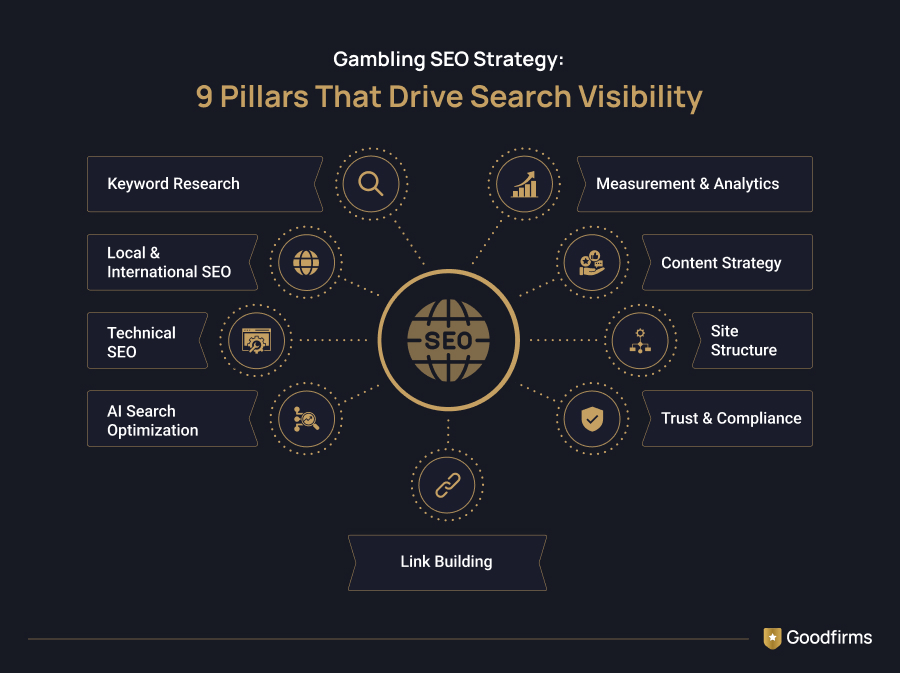
Conduct Keyword Research for Gambling Websites
Start with the basic keyword research: "online gambling," "sports betting," "iGaming." These seed terms tell you what people are searching for at a high level.
Once you have terms like this, be sure to dig deeper. Someone searching "how to play blackjack online" or "best slots for beginners" is closer to converting than someone typing a generic term. Run these through a keyword tool to check search volume and difficulty, and see what your competitors already rank for; it's often the fastest way to spot a gap. However, a quick look at the best SEO tools and software in 2026 can help businesses narrow down which platform fits their workflow before they commit to one.
One thing to keep in mind: gambling keywords are volatile. A game restricted in one state can lose search volume almost overnight, so gambling keyword research isn't a set-it-and-forget-it task.
Build a Search-Friendly Website Structure
Your visitors shouldn't have to hunt for what they want. Ideally, when structuring a website, you should follow an approach that allows users to reach any game, promotion, or article in 3 clicks or fewer.
Group your pages logically: slots, sportsbook, poker, live dealer, and link related content together. If a blog post mentions Texas Hold'em, link it to your full poker guide to build more credibility and deliver information. This is internal linking, and it does double duty: it keeps visitors on your site longer, and it helps search engines understand how your pages relate.
Additionally, keep URLs short, hyphenated, and keyword-rich. It's a small thing that adds up across a large site, and it's a core part of any real gambling website optimization effort.
Optimize Gambling Websites for Technical SEO
Gambling sites tend to run heavier than most other live odds feeds, chat widgets, and age-verification pop-ups. All of that can drag load times down fast.
Compress images, minify code, and fix redirect chains before they pile up. Mobile matters even more here: a large share of betting activity now happens on phones, so a slow or clunky mobile experience will cost you both rankings and conversions.
In addition, run your pages through a speed-testing tool every so often. Technical SEO for gambling websites isn't a one-time audit practice, as new features tend to reintroduce the same problems.
Create High-Quality Gambling Content
Quality content is still the core of any gambling content strategy. Mix short posts, game rules, bonus breakdowns, and industry news with long-form guides that go deep on a single topic.
These factors show that structure matters as much as length. Build topic clusters: a pillar page on "How to Play Poker," linked out to variations, strategies, and common mistakes, each targeting a related keyword. This builds topical authority and keeps readers moving through your site.
Good gambling content answers a real player's questions related to bankroll management and how bonuses actually pay out, rather than churning out another generic "top 10" list. Operators without an in-house content team often turn to one of the top content marketing agencies to maintain consistent output without sacrificing quality.
Build Trust and Compliance Signals
Because gambling falls under Google's YMYL guidelines, trust signals carry serious ranking weight. That means your licensing details, age restrictions, and responsible gambling resources need to be visible, not buried in a footer.
Furthermore, transparency around bonus terms and payout odds helps too. Sites that skip this often see rankings stall even when everything else, such as content, links, and technical SEO, is in good shape. Google treats gambling as a higher-scrutiny category, which comes with multiple restrictions.
Build an Effective Gambling Link-Building Strategy
Here's the hard truth: most mainstream publishers won't link to gambling content, no matter how good it is. So gambling link building calls for a narrower playbook.
Team up with affiliate marketers, iGaming associations, and betting review sites. Pitch gambling-friendly news outlets directly. Some operators even build backlinks through payment processors that list partner platforms on their own sites, a channel most industries don't have to think about.
A handful of relevant, high-authority links will outperform dozens of weak ones, so quality is worth the extra outreach effort.
Optimize for Local and International Gambling Markets
Gambling laws shift by country, and often by state. A single, one-size-fits-all page rarely holds up across markets.
Instead, build separate pages for each licensed region, matched to local currency, payment methods, and legal disclaimers. Search behavior differs by market too; bettors in different countries phrase the same query differently. An online gambling SEO approach built for one region won't automatically translate elsewhere without real localization work.
Optimize Gambling Content for AI Search
AI Overviews are already answering plenty of gambling questions directly, without a click. To show up there, lead each section with a clear, one- or two-line answer before going into detail.
Structured FAQs and comparison tables help too; they're easy for AI systems to lift and cite. Plus, specific, self-contained definitions tend to outperform vague ones. What earns a featured snippet in Google is increasingly the same thing that gets surfaced in AI-generated answers. For teams that want to track exactly how visible their content is across AI Overviews and chat-based search, Goodfirms' top AI visibility tools list is a useful place to start.
Monitor and Measure Gambling SEO Performance
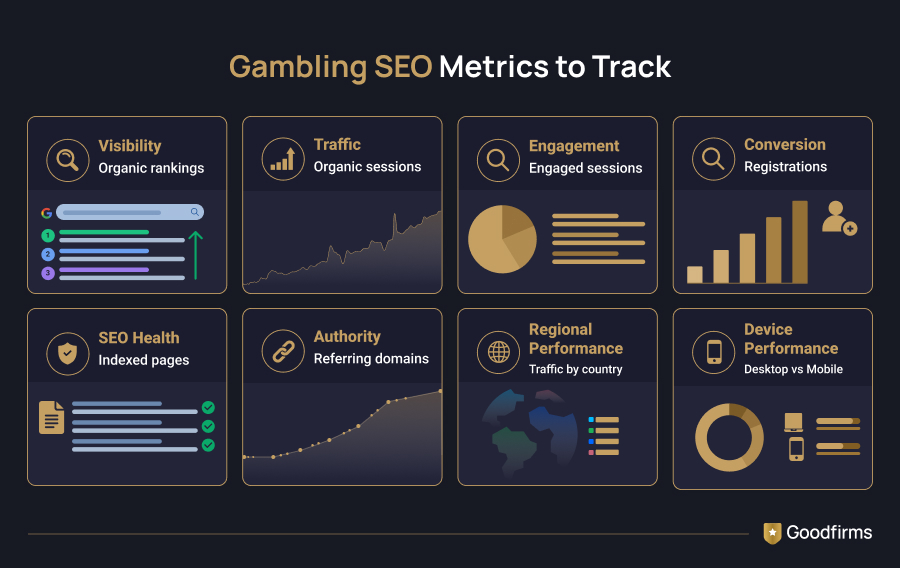
None of this works if you're not watching the results. As Peter Drucker put it, "What is measured is managed," and nowhere is that truer than in gambling SEO, where rankings, traffic, and conversions can shift fast when a regulation or algorithm changes.
Track rankings, organic traffic, and conversions monthly. Keep an eye on sudden ranking drops after a policy update, traffic shifts when a competitor publishes something new, and changes in conversions by region or device. Treating gambling SEO best practices as an ongoing, responsive process, not a checklist you finish once, is what actually keeps results steady.
Common Gambling SEO Mistakes to Avoid
A lot of gambling sites get the technical basics right and still can't crack the top rankings. Usually, it comes down to a handful of repeat offenders covered here.
Skipping Licensing and Compliance Details
Many sites bury licensing information in a footer link nobody clicks. Since Google treats gambling as YMYL territory, this hurts; no amount of good content fully compensates for a site that looks vague about who's running it.
Chasing Keywords You Have No Shot At
Everyone wants to rank for "online gambling." Almost nobody new actually does. Established sites hold years of authority there, so targeting that term instead of something specific just wastes time better spent on winnable keywords.
Publishing Thin or Duplicate Content
Five nearly identical pages for five slightly different slot variations, none saying much, is a common trap. Google notices the pattern fast, and none of those pages end up carrying real ranking weight
Using Risky Link-Building Tactics
A quick batch of links from low-quality gambling directories looks like progress for about a month, then the penalty hits. Recovering from that costs far more time than building links slowly from the start.
Neglecting Mobile Performance
A chat widget or age-gate pop-up that works fine on desktop can make a mobile page nearly unusable. That's a real problem, since most betting traffic actually happens on phones.
Ignoring Regional and Legal Differences
A page built around one country's currency, rules, and phrasing doesn't just underperform elsewhere; it can look outright non-compliant the moment it's viewed from a different jurisdiction.
Treating SEO as a One-Time Project
Regulations shift, competitors publish new content, and algorithms update constantly. Sites that set things up once and stop monitoring tend to slide back down within months, not years.
How to Choose the Right SEO Agency for Your Gambling Business
Picking the wrong agency can cost months of rankings, and in a regulated industry like gambling, the stakes are higher than usual. Here's what actually matters when evaluating a gambling SEO agency or iGaming SEO agency.
Gambling-Specific Experience
Not every SEO agency understands this space or has expertise in gambling services. Look for a casino SEO agency or iGaming SEO agency with a proven track record in gambling, since generic playbooks rarely account for licensing rules, ad restrictions, and YMYL standards.
Compliance Knowledge
A good agency should already understand how licensing, age-verification, and responsible gambling messaging affect rankings. If they can't speak to compliance confidently, they're likely applying tactics that won't hold up under scrutiny.
White-Hat Link Building
Ask directly how they build links. Casino SEO services relying on bulk directory submissions or link farms put your site at real risk; a transparent agency explains their outreach process in detail, not vaguely.
Real Case Studies
Request examples from actual gambling or betting clients, not general SEO wins. Case studies with ranking data, traffic growth, and timelines tell you far more than a polished pitch deck.
Clear Reporting
You should get regular, understandable updates, not just a dashboard link. An agency offering solid casino SEO services walks you through what changed, why, and what's coming next, in plain language.
AI Search Readiness
SEO is shifting toward AI Overviews and AI-driven search. An agency still focused purely on traditional rankings may already be behind; ask how they're adapting content for AI visibility.
How Long Does Gambling SEO Take to Show Results?
Gambling SEO takes 6 to 12 months to show measurable ranking improvements and often 12 to 18 months for a brand-new domain competing in this niche. The timeline stretches longer here than in most industries because of the competition, compliance layers, and trust requirements involved.
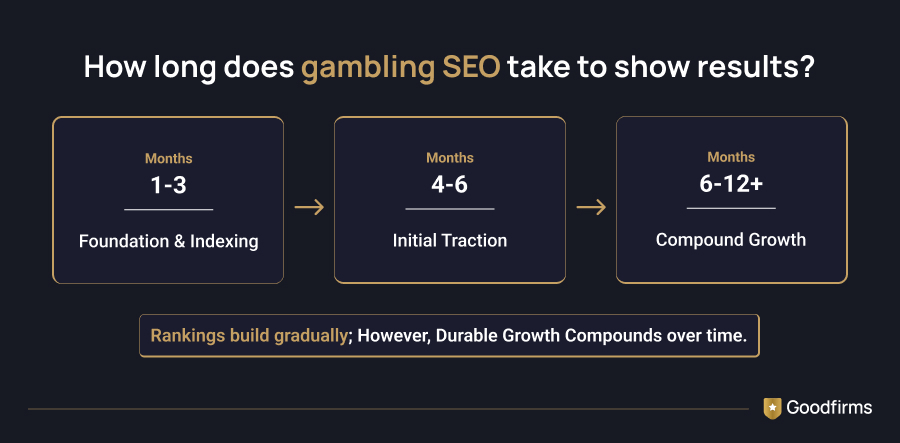
Months 1-3: Foundation and Indexing
Early work focuses on technical audits, compliance checks, and site structure, alongside long-tail, low-competition keywords like niche betting guides. Rankings aren't visible yet, but impressions and indexing activity start showing up in Search Console data.
Months 4-6: Initial Traction
Rankings for medium-difficulty keywords begin climbing as Google builds confidence in the site's topical authority. Organic traffic starts trending upward, though gains at this stage are usually gradual rather than dramatic.
Months 6-12+: Compound Growth
This is where durable rankings for competitive head terms like "online gambling" or "sports betting" start materializing, backed by a stronger backlink profile and consistent publishing. Growth compounds rather than jumps, which is typical of mature SEO efforts.
Why Gambling SEO Takes Longer
- Extreme competition: Established global operators hold deep authority and backlink profiles, making it harder for newer sites to break into top positions quickly.
- YMYL scrutiny: Google holds gambling sites to stricter E-E-A-T standards, so building enough trust to rank takes longer than in most industries.
- Regulatory complexity: Shifting regional gaming laws, geo-targeting requirements, and compliance disclaimers add ongoing technical and content work beyond standard SEO.
FAQs - Gambling SEO
How much does gambling SEO cost?
Most gambling SEO costs land somewhere between $2,500 and $10,000 a month on a retainer basis, depending on the size of your operation. Smaller sites can get started for less, while large operators operating in multiple markets often incur higher costs. Gambling SEO costs run higher than in other industries, mainly because quality backlinks are harder to earn and agencies need to understand the regulations in each market they work in.
Is paid advertising necessary alongside a gambling SEO strategy?
Not necessarily, but it helps in the short term. Since platforms like Google Ads heavily restrict gambling promotions in many regions, organic visibility through gambling SEO often ends up carrying more long-term weight than paid campaigns can.
Can a new gambling website compete with established brands through SEO alone?
Yes, though it takes patience. New sites gain traction faster by targeting long-tail, low-competition keywords first, then building authority gradually rather than competing directly for high-volume terms like "online gambling" from day one.
Do backlinks matter more for gambling websites than other industries?
They carry extra weight here, mainly because fewer mainstream sites are willing to link to gambling content at all. A smaller number of relevant, high-authority backlinks tends to move the needle more in this niche than in less restricted industries.
Does responsible gambling content actually affect SEO performance?
Yes, visible responsible gambling messaging is one of the trust signals Google weighs under its YMYL standards. Sites that skip this often see rankings capped, even when their gambling content strategy and technical SEO are otherwise strong.
Final Words
Gambling SEO isn't complicated in theory. It just takes discipline in execution.
Get the fundamentals accurate, such as sharp keyword targeting, a clean site structure, content that answers real questions, and compliance signals Google can actually see.
Skip any one of those, and the rest won't carry the weight alone. Results often take time here, usually 6 to 12 months, longer for a new domain. That's normal, not a red flag. However, the competition is real. The regulations are real. Progress still happens, just gradually.
If outside help makes sense, Goodfirms best SEO companies list is a solid place to start comparing agencies with a real track record. In-house or outsourced, the approach stays the same. Consistency wins this over time.