Key takeaways
- Building Trust Through Visible Security: Since neobanks lack physical branches, highlighting your security systems in marketing will help build customer trust.
- Highlight Speed as Your Biggest Advantage: Unlike traditional banks, neobank accounts can be opened in minutes. Promote this speed feature in your marketing campaigns to win customers.
- Rope in Influencers to Accelerate Customer Acquisition:Partnering with finance experts will make your bank feel more human and build credibility.
- Turn App Downloads into Salary Deposits: A download is just the beginning; with features like early paydays and automated savings, prompt users to deposit their full monthly paycheck.
- Use Helpful Alerts to Retain Users: Avoid sending generic emails; instead, use data to provide helpful tips, like spotting a forgotten subscription, to prove your value, and keep users from leaving your app.
For decades, banking authority was measured by the height of marble pillars and the thickness of vault doors. But in today's time, the physical footprint has become a liability. The era of brick-and-mortar dominance is officially over and has been replaced by a branchless, borderless, and friction-free digital reality.
If you are a fintech founder, executive, or someone who is interested in neobanking, you aren't just building an app; you are re-engineering the human relationship with money. But in the marketplace, where the barrier to entry is low and the cost of noise is rising, the 'build it, and they will come' philosophy is a recipe for failure.
Explore proven digital marketing strategies with top fintech marketing experts experts on Goodfirms to scale your neobank.
The Rise of Neobanks: Why Digital Marketing is Your Strategic Engine
The meteoric surge in Neobank development isn't accidental. It is strongly driven by a fundamental shift in consumer expectations that traditional banks struggle to meet:
- Neobanking turns a "prospect" into a "customer" in under 180 seconds.
- By cutting out the costs of physical branches, neobanks offer lower fees and more competitive rates.
- The use of AI provides financial forecasting rather than simply retrospective analysis.
- Prioritizing mobile-first experiences that reflect the flexibility of social media.
However, these advantages alone do not guarantee growth. In a crowded fintech landscape, digital marketing plays a crucial role in communicating these benefits, reaching the right audiences, and converting interest into active users. Through targeted campaigns, performance marketing, and strong digital branding, neobanks can effectively showcase their value and accelerate customer acquisition.
Traditional Banking to Neobanks: Key Industry Numbers
The transition from traditional to digital-only banking is no longer a "future trend"; it is a current economic mandate. If you are looking to secure a foothold in the fintech space, the data provides a clear roadmap of the opportunity at hand:
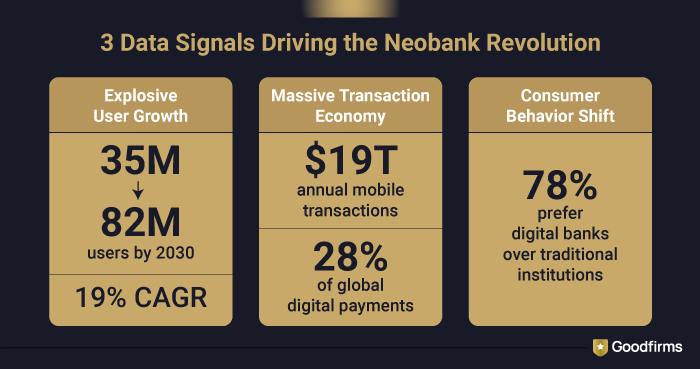
These Research & Markets and Global Growth Insights figures highlight a critical reality for every fintech leader: The future of banking is digital, and your growth depends entirely on your marketing performance.
In a world without physical storefronts, your digital presence is your branch. To capture a share of that $19 trillion ecosystem, you must master fintech digital marketing to build trust in a branchless world.
Beyond simple brand awareness, digital marketing and advertising efforts must be carefully designed to move users from downloading the neobank’s mobile banking app to becoming active, long-term customers. Many users may download a banking app after seeing an ad or recommendation, but that action alone does not guarantee meaningful engagement.
To bridge this gap, neobanks need strategies that guide users beyond the initial install, encouraging them to complete onboarding, verify their identity, link accounts, and begin using the platform for everyday transactions.
Unique Marketing Challenges for Neobanks
Despite having strong word of mouth and phenomenal growth, neobanks still face a unique set of marketing obstacles.
It operates without physical infrastructure, which simply means that its growth depends entirely on how well it recruits, converts, and retains users in this highly competitive digital landscape.
1. High Competition in Customer Acquisition
The fintech environment is becoming more saturated with players fighting for the same digital audience, including:
- digital wallets
- neobanks
- fintech apps
- Traditional banks are going digital
Neobanks often operate with lower customer acquisition costs, but standing out in a highly competitive fintech market remains challenging.
2. Building Trust Without Physical Branches
Trust is the cornerstone of financial services, but digital-only banks must establish credibility without face-to-face interaction.
Neobanks must rely on:
- strong branding
- transparent communication
- seamless user experience
- credible digital presence
3. Regulatory Advertising Restrictions
Marketing in financial services needs strict compliance with industry regulations and policies.
Fintech campaigns must consider:
- financial regulations
- KYC requirements
- data privacy laws
4. Low Switching Barriers
Digital banking makes it incredibly easy for customers to switch between financial apps.
As a result, neobanks must continuously focus on:
- retention
- engagement
- product stickiness
To overcome these challenges and build sustainable growth, neobanks must adopt a structured marketing approach that guides users through every stage of the customer journey.
The Neobank Marketing Funnel
Neobanking growth is not a single event; it is a continuous lifecycle. It is not traditional banking, where a customer walks in and stays with them for decades out of habit; digital banking needs a precisely engineered journey to move a user from curious scroller to a loyal advocate.
To scale effectively, the founders must optimize these touchpoints. By viewing the growth through this structured funnel, you can identify exactly where users are dropping off and where your neobanking digital marketing is giving the highest ROI.
The Neobank Customer Journey
Successful neobank growth depends on optimizing the entire customer lifecycle, which is:
Awareness → Acquisition → Activation → Retention → Advocacy
|
Funnel Stage |
Objective |
Example Channels |
|---|---|---|
|
Awareness |
Build brand visibility |
SEO, social media |
|
Acquisition |
Drive sign-ups |
Paid ads, referrals |
|
Activation |
Complete onboarding |
UX optimization |
|
Retention |
Increase engagement |
loyalty programs |
|
Advocacy |
Turn users into promoters |
referral programs |
This whole funnel illustrates how neobanks move users from discovery to long-term advocacy. Every stage has different objectives and needs different marketing channels and tactics to perform effectively.
At last, the goal is to make the user become your advocate. Satisfied customers are the best brand promoters; they drive organic growth through referrals and word of mouth.
Neobank Digital Marketing Blueprint: Acquire, Convert, and Retain
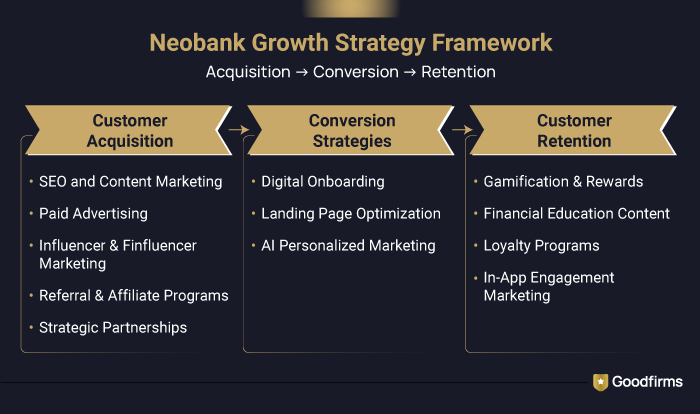
Sustainable growth in the branchless banking sector is never the result of a single "silver bullet" channel. Instead, it is the product of a synchronized growth engine that aligns acquisition, conversion, and retention into a single, fluid customer lifecycle.
For fintech founders and product teams, the true challenge extends far beyond the initial Neobank development phase including neobank app development cost, timeline, techstack and more. The goal is to build a scalable architecture where digital banking marketing does more than just attract eyes; it attracts the right users, removes friction during sign-up, and embeds your platform into their daily financial habits for the long term.
Customer Acquisition Strategies for Neobanks
The foundation of neobanking growth lies in attracting users with high intent. The success needs a multi-layered neobank customer acquisition strategy which perfectly blends with organic discovery and paid performance with trust-building content and strategic ecosystem partnerships to drive sustainable, low-cost growth.
1. SEO and Content Marketing
The search-driven content remains one of the most high-impact organic growth strategies for fintech companies.
High-Intent Keywords
Neobanks can attract organic traffic through keywords such as:
- best digital bank
- zero balance account
- online banking apps
- fintech solutions
High-Performing Content Formats
Content that consistently drives fintech traffic includes:
- Financial guides
- Budgeting tutorials
- Fintech comparisons
- Banking product explainers
- Personal finance blogs
Example Content Topics
- “Best digital banks for freelancers”
- “How to open a bank account online.”
- “Digital banking vs traditional banking”
Expert Tip
Build strong topical authority within fintech niches such as:
- crypto banking
- SME banking
- personal finance
- digital wallets
This approach allows a neobank to rank for thousands of long-tail search queries and drive sustained organic growth.
2. Paid Advertising
If SEO is your long-game for brand authority, performance marketing is your fast-track to market share. It helps neobanks to bypass traditional inertia and capture high-intent users through data-driven, scalable acquisition.
Google Ads
It is ideal for:
- high-intent search queries
- fintech product discovery
- account sign-up campaigns
Social Media Ads
The key platforms include:
- TikTok
These platforms are effective for:
- brand awareness
- product demonstrations
- lead generation
Neobank campaigns often achieve high click-through rates, mainly around 5.5% compared to traditional bank ads, which is 2.3%, making performance marketing a powerful growth channel.
3. Influencer & Finfluencer Marketing
Financial influencers, often known as finfluencers, are a new marketing trend, and they have become important distribution channels for fintech brands.
Neobanks commonly collaborate with:
- YouTube finance creators
- Instagram fintech educators
- personal finance bloggers
These partnerships amazingly help to expand reach, also building trust with digitally savvy audiences.
The Best Influencer Campaign Formats
- app walkthrough videos
- financial education content
- fintech product reviews
- budgeting challenges
As digital trust increasingly shapes financial decisions, finfluencer marketing is becoming a powerful channel for neobank growth.
4. Referral & Affiliate Programs
Referral marketing remains one of the most cost-effective growth strategies in fintech marketing.
Typical referral programs include:
- bonuses for existing users
- Rewards for newly referred users
Common Incentives
- ₹500 signup bonus
- free debit card
- cashback rewards
Effective word-of-mouth marketing significantly reduces acquisition costs.
Goodfirms Insight:Digital campaigns and referral ecosystems can account for up to 55% of neobank user acquisition by 2030. Fintech brands that combine performance marketing with strong referral incentives often scale faster while keeping customer acquisition costs under control.
5. Strategic Partnerships
Strategic partnership ecosystems serve as a high-velocity distribution lever, easily embedding your financial products into established user workflows to drive rapid, large-scale adoption within a broader neobank vendor ecosystem.
Common Partnership Channels
- eCommerce platforms
- fintech apps
- payroll platforms
- gig economy companies
These integrations help embed banking services directly into user workflows and can generate up to 30% of new customers.
Conversion Strategies: Turning Sign-ups into Active Customers
Traffic acquisition is merely the entry point. A sophisticated conversion architecture ensures that top-of-funnel interest is systematically transformed into active, verified account holders.
1. Frictionless Digital Onboarding
A successful onboarding experience should take less than five minutes, which often depends on robust KYC software and digital onboarding solutions and seamless backend integrations.
Key optimizations include:
- instant KYC verification
- automated document scanning
- biometric authentication
- simplified forms
It reduces onboarding friction and lowers user drop-off rates.
2. Landing Page Optimization
In a branchless ecosystem, your landing page is your primary credibility tool. Success depends on a conversion-centric design that prioritizes transparent fee structures and ironclad trust signals to validate the user's decision in real-time.
Key Elements
- clear value proposition
- trust signals
- customer testimonials
- product demos
- transparent fee structures
Example Value Propositions
- “Open a bank account in 2 minutes.”
- “Zero balance account.”
- “No hidden charges.”
These messages help users quickly understand the product value.
3. Personalized Marketing with AI
Using an AI-driven marketing engine allows neobanks to transcend their generic outreach by understanding behavioral data and delivering hyper-personalized financial experiences that can resonate at the individual level.
Examples include:
- personalized financial offers
- customized spending insights
- targeted product recommendations
AI-driven personalization can increase engagement by more than 25%. These capabilities are typically powered by advanced AI-driven fintech solutions that enhance user engagement and targeting precision.
Customer Retention Strategies for Neobanks
Acquisition is a capital-intensive entry point, but sustained engagement is your primary driver of margin expansion. In the neobanking landscape, a high-retention model is the only way to offset rising CAC and ensure the platform's long-term viability.
1. Gamification & Rewards
Gamified experiences encourage users to interact more frequently with financial apps.
Examples include:
- savings challenges
- milestone rewards
- achievement badges
- cashback incentives
Some neobanks also integrate interactive content and gamified finance experiences to boost engagement.
2. Financial Education Content
Educational resources help build long-term trust with customers.
Popular formats include:
- budgeting guides
- credit score improvement tips
- investment education
- savings strategies
Providing useful financial insights positions the brand as a trusted advisor.
3. Loyalty Programs
Reward-based loyalty programs encourage users to stay active within the ecosystem.
Examples include:
- cashback rewards
- premium feature upgrades
- referral bonuses
- exclusive partner deals
Retention rates in neobanks are expected to increase from 70% to 82% by 2030.
4. In-App Engagement Marketing
The most effective retention strategies occur directly inside the product experience.
Key engagement tools include:
- push notifications
- targeted email campaigns
- AI chatbots
- personalized financial dashboards
Key Metrics Every Neobank Should Track
To lead the market, one should measure what matters. Integrating high-performance digital banking growth strategies needs a proper data-driven framework that moves beyond vanity metrics to focus on real-world unit economics and platform health.
Metric Category
Key Indicators
Acquisition
Cost Per Acquisition (CPA), CAC, Ad ROI
Engagement
Transaction Volume, App Usage Frequency
Retention
Churn Rate, Customer Lifetime Value (CLV)
Acquisition Metrics - Cost Per Acquisition (CPA)
- Customer Acquisition Cost (CAC)
- Conversion ra te
- Ad ROI
These metrics measure how efficiently a neobank attracts and converts new users.
Engagement Metrics - Monthly active users
- App usage frequency
- transaction volume
Engagement metrics show how actively customers interact with the banking platform.
Retention Metrics - churn rate
- retention rate
- customer lifetime value
Retention metrics measure how strongly a Neobank keeps its customers engaged and continues generating long-term value from existing users.Insight: The average customer lifetime value (CLV) could grow from $650 to $1,050 by 2030 as engagement increases.
Future Trends in Neobank Marketing
The landscape of Neobank digital marketing is changing toward a more integrated, intelligent, and human-centric ecosystem.
As the technology matures, the most successful platforms are those that move beyond generic outreach to embrace the future-defining pillars:
AI-driven hyper-personalization
It is important to work with advanced AI tools that will personalize financial experiences by analyzing user behavior, spending patterns, and financial needs to deliver tailored recommendations and offers.
Embedded finance partnerships
Banking services will integrate into:
- marketplaces
- SaaS platforms
- gig economy apps
This allows financial products to be embedded directly into everyday digital platforms.
Community-led growthOnline communities will drive:
- product feedback
- referrals
- brand loyalty
Strong communities help neobanks build trust and encourage organic growth.
Data-driven marketing automation
Predictive analytics will help identify:
- churn risks
- upsell opportunities
- behavioral insights
It enables marketing teams to optimize campaigns and improve customer retention.
Strategic Principles for Successful Neobank Marketing
To achieve market dominance in the digital-only era, the most successful fintech companies move beyond basic promotion to embrace a user-centric growth philosophy. To master Neobank digital marketing, one needs a relentless focus on three core principles that bridge between a simple app download and a lifelong financial partnership:
Customer Trust First
In a branchless world, transparent communication is the primary vehicle for building long-term credibility and user confidence.
Seamless User Experience
In the competitive fintech landscape, a frictionless user experience often carries more weight in driving adoption than the specific product features themselves.
Data-driven Growth
- Successful neobanks use analytics to:
- optimize acquisition
- personalize engagement
- reduce churn
Final Thoughts
Building a market-leading neobank needs a delicate balance of aggressive acquisition and relentless retention. By synchronizing your product evolution with a strategic marketing approach, you can create a growth engine that transforms one-time visitors into long-term advocates.
Success in this space is no longer about having the most features; it is about who provides the most seamless, trustworthy, and data-driven experience. Integrating new technologies and embedded partnerships will be the key to maintaining a competitive edge in the coming years.
As you refine your roadmap, remember that every data point represents a human financial journey. Prioritizing user trust and platform stickiness will help turn your digital bank into a compounding asset for the future.