Key takeaways
- U.S. Python developers charge $40–$200/hr; offshore teams in India and Southeast Asia bill $15–$80/hr for comparable skills.
- Fixed-price projects range from $1,500 for automation scripts to $1.5M+ for enterprise healthcare or fintech platforms.
- Hidden costs add 30–50% to quoted prices — QA, scope creep, and infrastructure rarely appear in initial proposals.
- A wrong Python hire costs roughly 30% of their first-year earnings in recruitment, onboarding, and lost productivity.
- Monthly retainer overhead runs $6,620–$8,570 once management time, cloud infrastructure, and tools are factored in.
- Budget at 1.5x the quoted price — a $100,000 proposal typically lands at $150,000–$200,000 after scope changes.
Here’s the direct answer: the cost of hiring Python developers is around $40-$200 per hour in the U.S. If you are looking for a fixed cost estimate, the cost of developing a Python automation script can cost anywhere from $1,500 to $5,000, whereas a Python-powered healthcare analytics platform can cost you around $40,000 to 120,000+ .
Basically, Python development cost depends on multiple variables, like the hourly rate of the app developers you hire, the features and complexity level of your project and its timeline, and the hiring model (freelancer, agency, or dedicated team) you choose.
Cut development costs by 60%—browse top-rated Python Developers on Goodfirms.
This pricing guide can help you understand the different factors that impact Python development cost in 2026 and make the right budgeting decisions for your project.
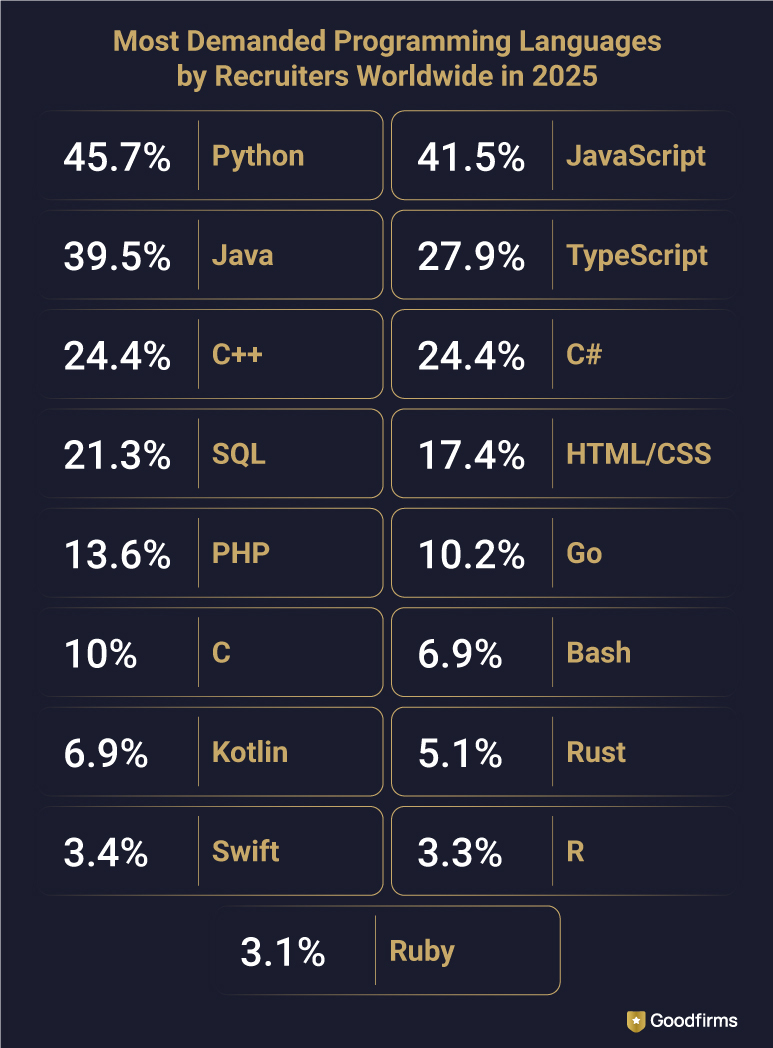
And cost, in large part, follows demand. According to Statista, the most in-demand programming language among recruiters in 2025 was Python. 45.7% of recruiters are looking to hire people with this programming skill, followed by JavaScript, Java, Typescript, C++, C#, and more.
High demand means competitive rates. But the bigger cost variable isn't the talent — it's the scope of what you're asking them to build. One of the biggest cost differentiators of a Python development project is the pricing model you follow - fixed, hourly, monthly retainer, or staff augmentation. Let’s have a look at how much your Python development project would cost based on each pricing model, which can help you make the right decisions and save costs.
Python Development Cost: Fixed Price Model
Fixed price means the scope, budget, and timeline are agreed upon up front. You pay for an output, not for time. Milestones trigger payments. Delivery against those milestones is what the vendor is accountable for — not hours logged.
The fixed-price model transfers delivery risk to the vendor, which sounds like a client advantage until you realize that vendors price risk into fixed quotes. A vendor who cannot estimate accurately will pad the quote to cover uncertainty. A vendor who can estimate accurately will price closer to the actual cost. The difference between the two is vetting, specifically.
Fixed-price suits narrow, well-specified builds where the requirements will not change. A landing page, an API integration, a standalone reporting tool, a defined automation workflow — these scope well enough that fixed pricing works cleanly. A fixed price model would not suit to a SaaS platform, an AI-enabled product, or any system expected to evolve based on user feedback. Locking evolving requirements into a fixed contract guarantees either scope disputes or a product that stops at the milestone boundary rather than the market need.
Best for: Well-defined builds, one-time projects, client-side teams with limited bandwidth to manage developers day-to-day
What to negotiate before signing: A formal change request process with written scope change pricing. Milestone definitions tied to user stories, not vague percentage-completion figures. A warranty clause covering defects for 30–60 days post-delivery.
Let’s have a look at Python development cost by project type as per fixed pricing model.
Python Development Cost by Project Type (Fixed Pricing Model)
No two Python projects carry the same price tag. A script that automates your weekly sales report and an AI platform that scores credit risk in real time are both "Python projects" — but they sit at opposite ends of the investment spectrum. Before you request a single vendor quote, understanding what category your project falls into is the fastest way to verify the numbers.
Below is a breakdown of the five most common Python development categories, what each realistically costs in 2026, and what quietly pushes budgets higher than expected.
1. Python Web App Development Cost
Python's web frameworks — Django, FastAPI, and Flask each carry different cost implications depending on your project's scope and complexity. Here is a closer look at Django's features and why it accelerates web app development — useful context before you commit to a framework and a budget.
The framework you choose, the features you need on day one, and the number of users you're designing for your Python based web app development project will each move the needle considerably.
The most common budgeting mistake here is treating all web apps as equivalent. An internal operations tool for a 15-person team and a customer-facing SaaS platform with real-time features, third-party integrations, and role-based permissions are not the same build. They shouldn't carry the same quote.
|
|
|
|
|---|---|---|
|
|
|
|
|
|
|
|
|
|
|
|
|
|
|
|
Key Takeaway: Five factors drive cost more than anything else in this category: the complexity of your UI/UX, how many third-party services need to be integrated, whether you need real-time functionality, how granular your user permissions are, and your expected concurrent user load. Large enterprise platforms comparable to mature SaaS products can push well beyond $500,000 when all of these factors compound.
2. Python Mobile App Development Cost
Python's mobile frameworks — Kivy, BeeWare, and Flet — handle everything from lightweight cross-platform prototypes to data-heavy enterprise apps with Python backends. The framework you pick, whether you're targeting iOS, Android, or both, and how much native device behavior your app needs, will each shift the cost considerably.
The most common mistake here is equating Python mobile development with native Swift or Kotlin builds. Python is not a native mobile language — it reaches mobile through frameworks, and that distinction matters when scoping timelines and budgets. A simple Kivy prototype and a BeeWare-powered enterprise app with native UI, offline sync, and backend APIs are fundamentally different investments.
|
|
|
|
|---|---|---|
|
|
|
|
|
|
|
|
|
|
|
|
|
|
|
|
Key Takeaway: Four factors move the needle more than anything else in this category: whether you need native UI behavior or can work with Kivy's custom rendering, how many device-level integrations your app requires (camera, GPS, push notifications), whether the app needs to function offline, and how complex the Python backend powering it is. Web apps built for regulated industries — healthcare, fintech, insurance, eCommerce — carry a compliance overhead that pushes budgets toward the higher end regardless of feature count. One structural advantage Python does hold: a single codebase deployable across iOS and Android typically saves 30–40% compared to maintaining two separate native builds.
3. Cost of Building Python-Powered Data Analytics and Engineering Platforms
Python's dominance in data work is built on a deep ecosystem — Pandas, NumPy, SQLAlchemy, PySpark, and Airflow, among others. When businesses need to move, clean, transform, or visualize data at scale, Python is usually the tool reaching for. It's consistently ranked as the top language businesses hire Python developers to use for data analytics work.
The complexity jump from a reporting dashboard to a full analytics platform is steep. A dashboard pulls from existing data and presents it. A full platform ingests raw data, cleans it, routes it through transformation pipelines, stores it intelligently, and makes it queryable — often in near real time.
|
|
|
|
|---|---|---|
|
|
|
|
|
|
|
|
|
|
|
|
Key Takeaway: Industry context adds cost that generic estimates miss. A data pipeline built for a healthcare organization, for example, must satisfy HIPAA compliance requirements — meaning architecture reviews, audit trails, encrypted storage, and developers who understand both Python and healthcare data governance. That combination commands a higher rate and longer timeline than a comparable build in an unregulated industry.
4. Python Development Cost for FinTech, HealthTech, and Regulated Industry Applications
Python is deeply embedded in financial services — algorithmic trading, risk modeling, payment processing, and regulatory reporting all run on it. Healthcare data platforms, eCommerce marketplaces, insurance scoring systems, and compliance-heavy enterprise tools do too. Technical complexity is one cost driver. Compliance architecture is the other — and in regulated industries, it has a mandatory floor regardless of feature count.
Developers working in these verticals need more than Python proficiency. They need working knowledge of PCI-DSS for payment systems, HIPAA for healthcare data, and GDPR for anything touching EU users. That specialization is reflected in both hourly rates and project timelines, since compliance review cycles add scope that a standard Python web build doesn't carry.
|
|
|
|
|---|---|---|
|
|
|
|
|
|
|
|
|
|
|
|
Key Takeaway: Regulated industry projects have a cost floor regardless of feature scope. Even a narrowly scoped healthcare analytics tool needs compliant data handling from day one. You cannot integrate compliance architecture after launch. It requires building it from the start.
5. Cost of Building Python Automation Scripts and Workflow Tools
For most businesses, Python automation starts with a specific pain point — a manual process that runs daily, a report that someone builds by hand every Monday morning, or two tools that don't talk to each other. Python solves these problems efficiently, and the projects are usually tight in scope.
A single developer with strong Python fundamentals can handle most automation work. You don't need a team, and you don't need months of planning. What you do need is honest scoping upfront, because the cost gap between a simple script and a multi-system automation platform is significant.
|
|
|
|
|---|---|---|
|
|
|
|
|
|
|
|
|
|
|
|
Key Takeaway: Scripts connected to third-party APIs or live data sources don't stay static. APIs change, data structures shift, and edge cases surface after go-live. Set aside 15% to 20% of your initial build cost each year for maintenance — it's rarely optional.
The fixed-price model works best when you know exactly what you are building. When the scope is less clear — or when you need flexibility to adapt mid-build — the hourly pricing model is the more practical choice. Here is how it works and what it costs.
Python Development Cost: Hourly Pricing Model
Where hourly works well is where scope genuinely cannot be locked down upfront. A technical audit, a legacy code review, a proof-of-concept sprint, or ongoing bug triage — these tasks resist fixed quotes because the work surfaces unpredictably. Hourly gives you flexibility when that flexibility has real value.
Where it breaks down is on any project where the scope drifts. Without milestone accountability, hours accumulate against moving targets. A six-week hourly engagement that produces a half-built product is a budget failure that the hourly model enabled — because nothing in the contract required a deliverable.
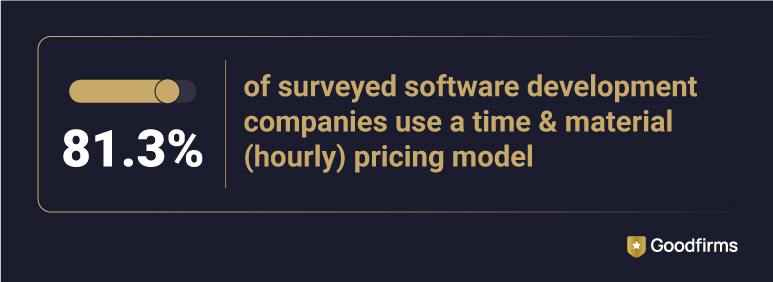
According to Goodfirms’ research Custom Software Development Cost Survey 2026 - What Startups and SMEs Need to Know, 81.3% of surveyed software development companies use a time & material (hourly) pricing model, as it satisfies clients’ need for accountability and flexibility to pay only for work done.
Best for: Exploratory work, undefined scope, ongoing technical support, short-burst tasks
The hourly model is exactly what it sounds like — you pay for verified time, billed at an agreed rate. No deliverable commitments, no milestone locks. The developer works, the clock runs, you pay.
What to negotiate before signing: A weekly hour cap. A clear deliverable or output standard per billing cycle. Using screenshot-verified or ticketing-system-verified time tracking rather than self-reported hours is mandatory if you select the hourly pricing model.
Once you decide on the hourly model, the next question is straightforward: what does an hour actually cost? The answer depends on two things — the experience level of the Python developer and the region you hire from.
Hourly Cost of Hiring a Python Developer - Based on Experience Level
Geography, experience, and skills create a rate gap wide enough to reshape your entire project budget. An experienced Python developer can cost you more than a junior Python developer. But if your project demands experienced developers’ skills or AI/ML specialization, then you need to hire accordingly. If you want to keep your project costs under control, you can hire Python developers in India, the Philippines, or Vietnam, as you get to hire Python developers from this region at a lower rate with the same skill and experience levels you get in Python developers in the U.S., Canada, UK, France, and Germany.
|
|
|
|
|
|---|---|---|---|
|
|
|
|
|
|
|
|
|
|
|
|
|
|
|
|
|
|
|
|
|
|
|
|
|
|
|
|
|
|
Experience level sets the base rate. But the technology a developer specialises in can push that rate significantly higher — sometimes by 20–40% above the regional average. Here is what Python developers charge based on their area of technical expertise.
Hourly Cost of Hiring a Python Developer - Based on Technical Expertise
|
|
|
|
|
|---|---|---|---|
|
|
|
|
|
|
|
|
|
|
|
|
|
|
|
|
|
|
|
|
|
|
|
|
|
AI/ML specialists command higher hourly rates because the talent pool is genuinely small — demand has outpaced supply for years. Here is why Python became the dominant language for AI and ML development, and what that means when you are hiring for it.
Now you have the rate data — by region, seniority, and specialization. The next step is putting those numbers to work. Here is how to calculate the actual cost of a Python project using the hourly model, with a real-world example broken down phase by phase.
How to Calculate the Cost of a Python Development Project Based on an Hourly Pricing Model?(Real-World Example)
Every hourly-based Python project cost starts with one equation:
Total Project Cost = Total Development Hours × Developer Hourly Rate
Let’s have a look at an example based on a real-world scenario.
Real-World Scenario: A SaaS startup wants to build a customer-facing Python web application with Django — user authentication, subscription billing via Stripe, an admin dashboard, and a reporting module. They hire a Python development company in India that proposes the following quote for their project segmented into different phases.
|
|
|
|
|
|
|---|---|---|---|---|
|
|
|
|
|
|
|
|
|
|
|
|
|
|
|
|
|
|
|
|
|
|
|
|
|
|
|
|
|
|
|
|
|
|
|
|
|
|
|
- | - |
|
|
|
|
- |
|
|
|
|
|
- | - |
|
The calculation above assumes you already know who you are hiring. In practice, that decision comes first — because the same 391 hours cost $15,488 with a freelancer and nearly $46,000 by outsourcing your Python project to the best app development company. The engagement model you choose determines where your number lands.
Python Engagement Models — Hiring Freelancers vs. Outsourcing to Professional Python Development Companies
The engagement model determines the total cost more than the hourly rate. Most businesses compare advertised rates and stop there. That is where the underestimation starts.
Hire a Freelance Python Developer
Bill hourly with no obligation beyond the assigned task.
Freelancers are fast to engage and straightforward to budget for short, well-scoped tasks. A targeted script, a bug fix, a one-off integration — these suit the freelance model. The problem surfaces with anything longer. No redundancy if they go dark mid-project. No QA layer. No escalation path when the architecture decision made in week two becomes a production problem in month four. You can hire Python developers from Upwork at an hourly rate of $20-$30. The rate looks clean until the hidden management overhead is counted.
Outsourcing to a Professional Python Development Company
Fixed price billing, which includes costs from project discovery to maintenance.
Professional development companies charge more per hour than freelancers — and that gap is real. What closes it is everything the rate includes. Project management, QA, code review, IP agreements, and developer continuity are built into the engagement, not invoiced separately or left to you to arrange. When a freelancer exits mid-project, you absorb the rehiring cost, the onboarding time, and the knowledge gap they leave behind. A development company covers that internally. The hourly rate looks higher on the quote. But once delays, rework, and management overhead are counted against the freelancer engagement, the total cost comparison rarely favors the cheaper rate.
Freelancers vs. Professional Python Development Companies: Cost Comparison (Hourly Rate)
|
|
|
|
|
|---|---|---|---|
|
|
|
|
|
|
|
|
|
|
Hence, outsourcing your project to a professional Python company can cost you 30-50% more than hiring freelancers. But, poor code quality from unvetted freelancers consumes 30–50% of sprint capacity in rework. Moreover, your senior engineer spending 25% of their time coordinating a freelance Python developer, spending ten hours per week on management instead of architecture or feature delivery, and the freelancer's lower rate quickly loses its edge on anything beyond a short, well-scoped task. Besides cost, there are other differences too between hiring a freelance Python engineer and outsourcing to a professional Python development company. Let’s have a look.
Freelancers vs. Python Development Agencies: What Each Model Covers
|
|
|
|
|---|---|---|
|
|
|
|
|
|
|
|
|
|
|
|
|
|
|
|
|
|
|
|
|
|
|
|
|
|
|
|
|
|
|
|
Freelancers and professional Python development companies both work on hourly or fixed terms, which suits defined, time-bounded work. When your product is in continuous development and needs a team embedded in your workflow month after month, a different model applies entirely, which is known as the “monthly retainer model.” Let’s have a look at the details.
Python Development Cost: Monthly Retainer Model
A monthly retainer model means you engage a defined group of developers — typically one to five people — on a monthly salary basis. They are embedded in your sprint cycle, your communication channels, and your codebase. They are not shared across other client projects. The billing is monthly, and the relationship is ongoing rather than project-bounded.
The stronger argument for this model is operational, not financial. The team of Python developers working on the project knows why the architecture decisions were made, where the technical debt lives, and what the next sprint needs before the planning meeting starts. That accumulated knowledge has real commercial value — and it compounds over time.
According to the 2025 State of DevOps Report - Teams using dedicated development structures report faster sprint velocity.
The monthly retainer model requires more management input than the fixed-price model. You direct the work, set the priorities, and own the delivery. If your team lacks the bandwidth to manage a developer day-to-day, this model produces the same accountability gaps as unsupervised hourly freelancing. Retainer hours without a sprint plan routinely run 20–30% over budget in the first quarter, because priority disputes cost engineering time.
Best for: Products in continuous development, SaaS platforms, AI-enabled builds, anything that evolves sprint-by-sprint.
What to negotiate before signing: Developer continuity guarantees — specifically, what happens if your assigned developer exits mid-engagement. IP assignment coverage from day one. A named developer rather than a "team" allocation that lets the vendor rotate staff without notice.
The cost of your Python development project if you follow monthly retainer pricing model, depends on the salary of Python developers you hire. Let’s have a look at annual salary of Python developers in different regions which can help you estimate your Python development cost.
Python Developers’ Salaries in Different Regions
|
|
|
|---|---|
|
|
|
|
|
|
|
|
|
|
|
|
|
|
|
|
|
|
|
|
|
|
|
|
|
|
|
|
|
|
|
|
|
|
|
|
|
|
|
|
|
|
The salary of your Python developer would be the visible number. The overheads below are the ones that have the power to quietly inflate your budget while using the monthly retainer model.
Overheads to Budget for When Using a Monthly Retainer Model
The monthly retainer fee is what you agree to pay. It is not everything you end up paying. Below are the extra costs you need to pay for your Python development project if you go for the monthly retainer pricing model.
Recruitment Costs: One cost most retainer budgets skip entirely is recruitment. Finding, vetting, and onboarding the right Python developer costs$6,200–$30,000 per senior hire, you need to count that in before the first monthly invoice arrives.
Your Team Spends Time Managing the Developer: Retainer developers do not manage themselves — task assignment, sprint reviews, and daily coordination fall on your senior engineer or product manager.
Example: For a $180,000/year engineer, 25% management overhead costs $45,000 in lost productivity annually — without appearing on a single invoice.
Cloud and Server Costs Are Not in the Retainer: The retainer covers development hours only — AWS, GCP, or Azure costs are entirely separate and grow with usage. A Python MVP starts at $100–$500/month in cloud infrastructure; a SaaS platform at scale runs considerably higher.
Tools and Software Licenses Add Up Separately: CI/CD pipelines, testing environments, and project management tools are not included — expect $200–$800/month in additional tool costs for a small team.
The First Month Runs Below Full Productivity: Every developer needs ramp-up time — budget the first month at 60–70% effective output, not 100%.
Work Beyond the Monthly Hour Cap Costs Extra: Most retainers cap at 80–176 hours/month — anything beyond triggers overtime billing or scope renegotiation. Define what is included and what is not before signing, or coordination hours quietly eat into your development budget.
Retainer Rates Increase Every Year: Most vendors revisit pricing annually — a $3,200/month retainer at 7% escalation becomes $3,664/month by year three, adding $7,800+ over a three-year engagement.
Offshore Retainers Carry Currency Fluctuation Risk: A 5–8% currency shift over six months can raise your effective monthly cost without any rate change from the vendor — most relevant for UK, EU, Australian, and Gulf-based businesses hiring offshore.
Each overhead above adds a separate line to your real monthly spend. Here is what they look like when everything is counted together.
Python Development Cost: What the Full Monthly Overhead Looks Like
|
|
|
|---|---|
|
|
|
|
|
|
|
|
|
|
|
|
|
|
|
|
|
|
|
|
|
|
|
|
The monthly retainer model makes sense when your product needs a dedicated team over the long term. But if you already have an engineering team and simply need to move faster or fill a specific skill gap, a staff augmentation model fits better — without the full retainer overhead.
Python Development Cost: Staff Augmentation Model
Staff augmentation can be a combination of fixed, hourly, and monthly retainer pricing model. You bring in one or more developers through a provider — they work inside your existing team from a remote location, follow your processes, commit to your repositories, attend your standups — but they are employed and managed by a professional Python development company which can be offshore, onshore, or nearshore.
Staff augmentation is increasingly popular in 2026 because it balances cost efficiency with reliability. You manage the developer's day-to-day work, but the Python development company you partner with for staff augmentation handles contracts, HR, and often quality oversight. The practical effect is that you get control of in-house without the $10K–$30K recruitment cost, payroll setup, or benefits administration of a direct hire
Where augmentation earns its place is on defined-duration capacity needs. A six-month feature build that requires two additional backend engineers. An AI pipeline project that needs a specialist for 90 days. A data engineering sprint that the existing team cannot absorb without slipping other deliverables. These types of situations can be addressed by staff augmentation.
Where it does not work is as a substitute for building a coherent engineering team. Rotating augmented developers through a product repeatedly creates the same knowledge loss problem as high freelancer turnover.
Best for: Existing engineering teams that need additional capacity or a specific skill set for a defined period.
What to negotiate before signing: Dedicated placement — a named developer, not a pooled resource. Notice period for developer replacement. Rate lock for the engagement duration so provider-side staff changes do not trigger repricing.
Choosing the Right Pricing Model for a Python Development Project: A Practical Decision Framework
The question to answer before selecting a model is not "which is cheapest?" It is "where does delivery risk sit, and am I equipped to manage it?"
|
|
|
|---|---|
|
|
|
|
|
|
|
|
|
|
|
|
|
|
|
The right pricing model protects your budget from the outside. Hidden costs erode it from the inside. Here's what to watch for, regardless of which model you go with.
Hidden Python Development Costs: What the Invoice Does Not Show
The development quote covers roughly 60–70% of what your Python project actually costs in year one. The rest comes from categories most vendors never put in writing. Here are the ones not covered anywhere else in this guide.
- QA and testing are quietly dropped from low quotes — QA and testing typically account for 15–25% of total development hours and are often removed to make a proposal look competitive. If testing is not line-itemed in the quote, ask specifically where it sits.
- Scope creep adds 10–20% per feature — scope creep affects 52% of all projects per PMI research, with each out-of-scope feature adding 10–20% to the total budget. Most contracts do not define how change requests are priced until after signing — which is exactly when your negotiating position is weakest.
- Developer replacement costs up to 21% of annual salary — when a Python developer leaves mid-project, replacement costs hit up to 21% of annual salary in direct costs alone, before rework is calculated. This cost can easily arise if you have hired a freelancer or a low-cost Python development company.
Goodfirms’ Insight: Apply a 1.5x rule when budgeting: if a vendor quotes $100,000, plan for $150,000–$200,000 once hidden costs and scope changes are absorbed. That is not pessimism — it is what actual project outcomes consistently show.
The best way to avoid hidden costs is to hire a company that does not create them. Here is what to look for before you sign with anyone.
How to Select the Best Python Development Company?
Thousands of Python development companies operate globally in 2026 — offshore, onshore, and nearshore — each claiming to be the right fit for your project. Most look credible on a website. Fewer deliver what they promise once the contract is signed. Below are tips that help you find the right Python development partner.
- Check their portfolio for projects similar to yours — a company that has built Django-based SaaS platforms before will scope, price, and deliver yours more accurately than a generalist agency picking up Python work on the side.
- Read verified client reviews — star ratings mean little without reading what clients say about missed deadlines, communication gaps, and post-launch support. Look for patterns across multiple reviews, not a single glowing testimonial.
- Ask for a phase-by-phase cost breakdown upfront — request a detailed breakdown of costs for different project phases and services, and negotiate payment schedules, milestones, and any extra fees before signing. A vendor who cannot break down their quote by phase is either inexperienced or deliberately vague.
- Run a small paid discovery phase before committing — before committing to a long-term contract, ask a potential Python development firm to perform a technical audit or a small paid discovery phase. How they handle a small, defined task tells you more than any sales call.
- Confirm IP ownership and NDA terms from day one — every line of code your developers write should belong to you. Verbal assurances are not enough. Get it in the contract before work starts.
- Test their communication style early — schedule video calls to assess communication style and language skills, and pay attention to responsiveness throughout initial interactions. Slow replies during the sales stage get worse once the project is running.
- Check their industry experience, not just Python experience — most successful projects rely on a Python development team with a proven track record in your specific industry. A healthcare platform needs developers who understand HIPAA, not just Django.
Still have questions about what your Python project should cost? Here are the ones most buyers ask after working through every section above.
Python Development Cost in 2026: FAQs Answered
Does Python development cost more than other programming languages?
Python itself is free — no licensing fees. Costs are comparable to those of other languages for standard web builds. AI and data engineering specializations push rates higher due to lower talent supply.
How much does a bad Python hire actually cost a business?
As per a recent report, a wrong hire can cost 30% of an employee’s first year earnings.— far more than the rate difference you saved upfront.
How do time zone differences affect Python development cost?
Time zone gaps slow decisions, extend sprint cycles, and add coordination overhead that never appears on an invoice but consistently inflates total Python development cost over time.
Is it cheaper to build a Python MVP first and scale later?
Yes. Limiting scope to three to five core features can reduce a $200,000 full build to a $60,000 MVP — validating the product before committing the full budget.
How does technical debt affect long-term Python development cost?
Poor code quality consumes 30–50% of sprint capacity in rework. A $40,000 Python app built carelessly can generate $60,000 in fixes within two years.
That covers the questions. Here is the bottom line.
Conclusion: Python Development Cost Reflects the Decisions Behind It
Python development cost is not a number — it is a decision. Every variable in this guide: project type, developer location, pricing model, engagement structure, and hidden overheads, moves that number up or down before a single line of code is written.
The businesses that budget accurately are the ones that define their project category first, choose the right pricing model second, and vet their development partner third — in that order, not the reverse.
Finally, there are three things to take away from this pricing guide: The businesses that walk away with accurate budgets are the ones who applied the 1.5x rule, chose the right pricing model for their scope, and vetted their software development company before signing — not after.