Let’s start with an interesting stat: 32% of mobile app developers worldwide use React Native for building apps.
Not a big number, agreed, but good enough to get businesses thinking: “Why React Native?”
There are numerous reasons, but if I had to single out one, it’s its cross-platform compatibility. Using React Native, mobile app developers can “write code once, and deploy it anywhere.”
That means React Native app developers don’t need to code differently to build an app for iOS and Android-powered devices.
The same logic applies to healthcare apps as well. React Native’s cross-platform compatibility enables healthcare businesses to build cross-platform apps more quickly, allowing them to hit the market faster and accelerate revenue growth. It also helps them serve their patients better, improving efficiency and productivity, leading to business sustainability and growth.
Long story short, React Native is really the perfect choice for developing healthcare apps?
This article aims to cover everything you need to know about React Native for healthcare app development, providing you with answers to all your questions, dispelling myths, and uncovering all the facts on this subject.
Let’s start with the fundamentals of React Native and what makes it a perfect framework for building healthcare apps.
Fundamentals of React Native
React Native is an open-source framework that serves as a platform for mobile app development. It includes pre-built components, libraries, and reference material that help healthcare app developers build cross-platform mobile apps with ease. React Native is popular among mobile app developers as it provides a basic structure for an application, which can be customized according to the app's needs, rather than building it from scratch.
Let’s have a look at some attributes of React Native.
Includes a Large Community of Tech Experts: React Native boasts a vast community of tech experts who can provide guidance on mobile app development using this framework.
Works Like Native Applications: Mobile apps built using React Native behave like native applications, which means they run faster and more efficiently than other non-native apps.
Enables Code Reusability: React Native includes reusable components that can be used while coding for multiple mobile applications.
Saves Cost: React Native’spre-built components enable faster development, which leads to saving developers’ time and overall costs.
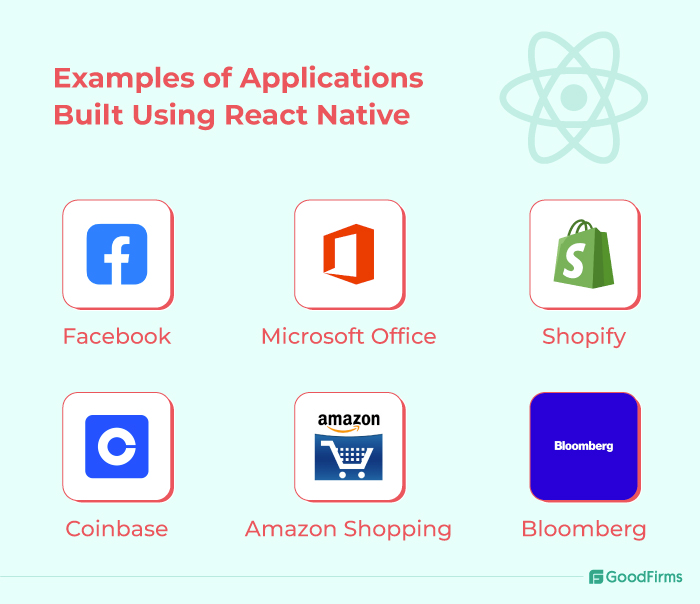
Some of the examples of applications built using React Native include:
Now that we know the attributes of the React Native framework, let’s have a look at what makes it a perfect framework for healthcare applications.
What Makes React Native a Perfect Framework for Healthcare Applications?
The healthcare industry differs from other industries when it comes to ethics, standards, and regulations. Healthcare companies need to meet FDA, HIPAA, and GDPR regulations to stay compliant, and therefore, choosing a robust framework for building apps becomes extremely critical. One wrong choice in selecting the tech stack used for building healthcare apps can lead to disaster and shut down the business.
So, what’s the solution?
The solution is choosing React Native for healthcare apps.
Before diving deeper into why React Native continues to dominate the cross-platform ecosystem, let’s take a look at some recent facts and figures that highlight its growing impact on mobile app development.
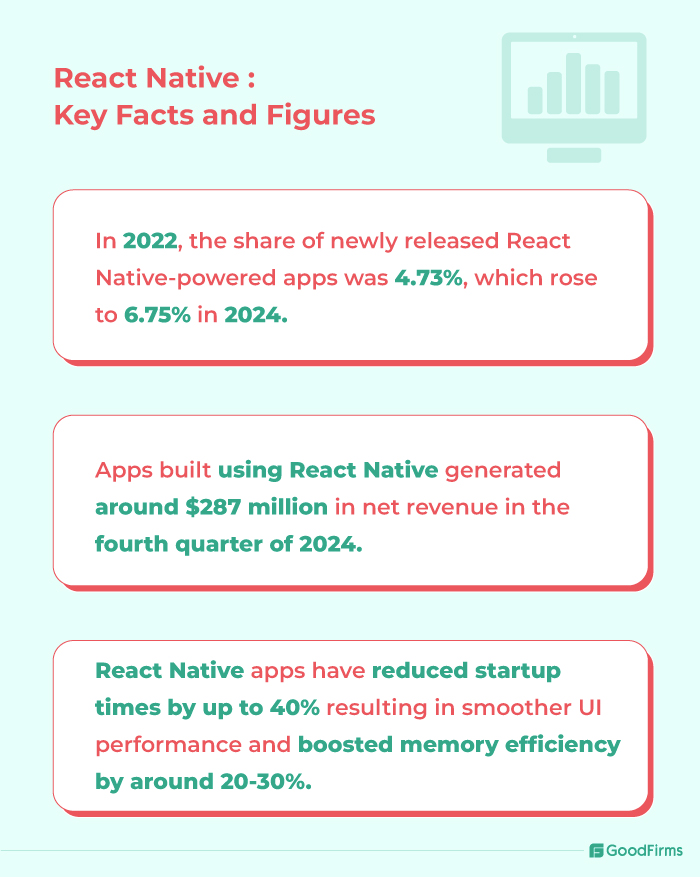
(Source: (makeitnew, appfigures, headout.studio)
Moving further, let’s have a look at why React Native is beneficial for healthcare app development.
Why Use React Native for Healthcare App Development?
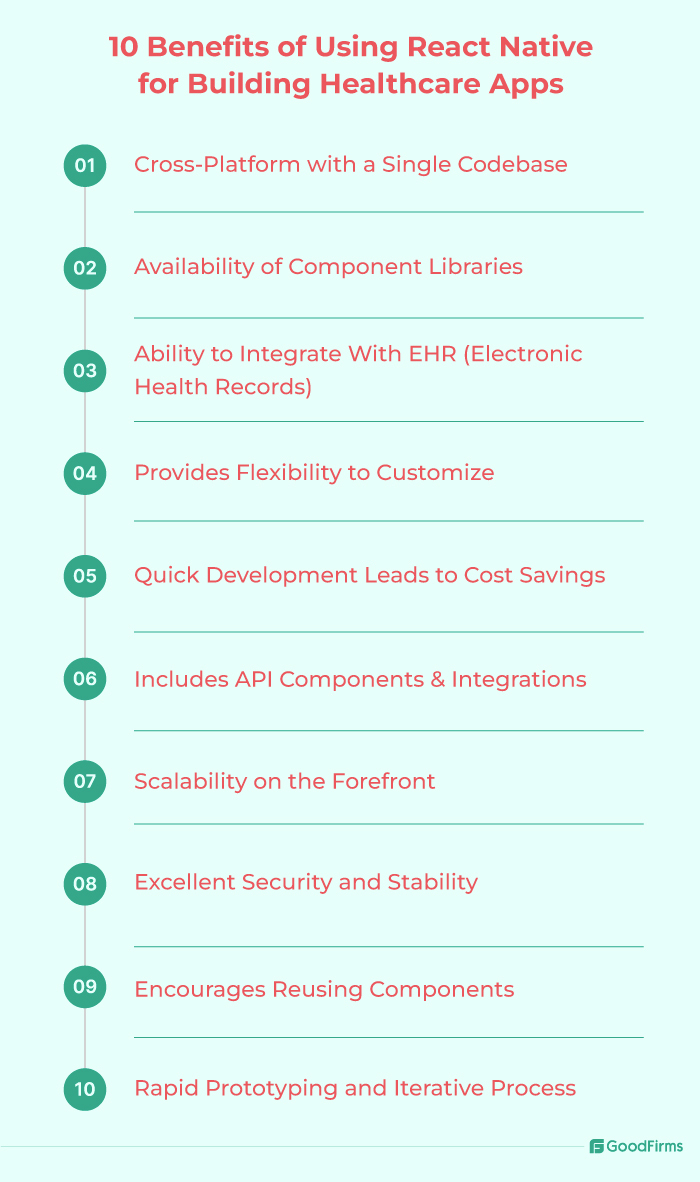
You would all agree to the fact that healthcare apps are quite different from eCommerce, travel, or entertainment-related apps. A healthcare mobile app needs to be highly secure, reliable, responsive, accessible on multiple devices and platforms, and compliant with GDPR or HIPAA regulations. As healthcare apps require handling sensitive information about patients, the security standards and compliance become mandatory. React Native can help you build applications that match the requirements of the healthcare industry. Let’s have a look at the benefits of using React Native for building healthcare apps in detail.
Cross-Platform with a Single Codebase
React Native is the first framework to introduce cross-platform app development. It made it easy for developers to code once and make the app work on both iOS and Android. When it comes to the healthcare industry, businesses need to reach out to diverse audiences using different devices and platforms. That makes React Native a perfect Framework for healthcare applications as it helps in building cross-platform applications that offer a native like user experience.
 |
React Native has been a game-changer for healthcare app development because it enables teams to build cross-platform apps with a single codebase, which drastically reduces development time and cost. In healthcare, where compliance and timely delivery are critical, that speed matters. Adil Advani, Associate Product Owner @ Securiti |
Availability of Component Libraries
React Native is enriched with a huge ecosystem of component libraries and ready-to-use plugins, which can drive speedy development. It provides pre-built solutions for functionalities that are highly used in healthcare applications, telehealth platforms, and patient portals. Some of the React Native component libraries include:
- React Native Camera: for capturing images of patients and their health records, scanning documents relating to patients’ identification, prescriptions, etc.
- React Native Maps: for integrating location-based information, which is highly useful for people looking for local healthcare centers and clinics.
- React Native WebView: for displaying web content within healthcare apps, patient portals, and telehealth platforms.
 |
One thing that makes React Native stand out is that it works well with native tools like the camera and GPS. It helps a lot when making apps that a lot of people can use and that need to keep private health information safe while still being reliable and following the rules. William Fletcher, Chief Executive Officer @ Car.co.uk |
Ability to Integrate With EHR (Electronic Health Records)
React Native allows apps to integrate with EHR (Electronic Health Records), enabling patients and healthcare providers to access the patient data in a secure way. Healthcare apps built using React Native also help patients and healthcare providers to conduct seamless interactions between them and establish long-term associations.
 |
React Native applications are good at connecting with third-party APIs, from plugging into an Electronic Health Record (EHR) system to fetching data from wearables through the Apple HealthKit and Google Fit platforms, or implementing telehealth video functionality. Ameer Draidy, Digital Marketing Expert @ circulardesign |
Provides Flexibility to Customize
Every patient is different, and when they use an interface specially designed for them, it becomes easier for them to trust the healthcare service provider. React Native is flexible enough to create customized user interfaces, which gives power to healthcare businesses to provide personalized experiences to every patient, delight them, and retain them on a long-term basis.
 |
React Native provides developers with the flexibility to customize and to maintain shorter project timelines and still produce a great product. Because it works seamlessly, quickly, and maintains expandability, it has become the most reliable tool in producing healthcare education applications. Allen Liu, Tech Lead & Content Specialist @ FreSound |
Quick Development Leads to Cost Savings
Building an app using React Native means writing code once and using it for both iOS and Android. Usually, a healthcare app with minimal features can cost around $50,000. So, it is already expensive to build a healthcare app, but when React Native’s single codebase works on iOS and Android, developers can save their time and therefore can reduce development costs to a great extent.
 |
Using React Native, I have built solutions that have gone live with full-feature, cross-device compatible platforms in less than 3 months, with development costs of less than $25K. Elizabeth Moffett, Respiratory Health Advocate and Expert Advisor for Omhale. |
Includes API Components & Integrations
A healthcare app requires several integrations, and that includes huge costs relating to API development, integration, and data sharing. This may also raise security and privacy issues, as well as make complying with regulatory requirements difficult. Thankfully, React Native is here to handle integrations and data privacy issues with ease with the help of its API components, third-party libraries, native modules, and stellar state management.
 |
One of the most significant advantages of React Native is its strong ecosystem of libraries that enable secure communication, real-time updates, and wearable integration, which become critical for health-related applications. Aziz Bekishov, CEO @ DC Mobile Notary |
Scalability on the Forefront
In this quickly transforming digital world, health care apps require coping with the latest demands and expectations of patients. In that case, React Native can be of great help as it is built for scalability and has the ability to expand app features as and when required to fulfill patients’ growing requirements with each coming day.
 |
React Native is the “silver bullet” for healthcare app development. As it integrates well with secure APIs and encryption libraries, making it easier to scale while maintaining compliance. Paarth Sharma, Sr. SEO Specialist @ FitPass |
Excellent Security and Stability
React Native is highly focused on security intricacies, such as encryption, secure data storage, and user authentication, which prevent sensitive patient information from being leaked or tampered with. However, it also depends on the knowledge and expertise of React Native developers relating to how a healthcare app should be developed, configured, and maintained.
 |
React Native supports strong encryption, secure storage, and integration with advanced security frameworks. Pair that with disciplined, secure coding, threat modeling, and audit trails, and you can meet HIPAA or GDPR requirements without turning the app into a maze. Panayot Kalinov, Senior Doftware Developer @ Casinoreviews |
Encourages Reusing Components
As React Native encourages reusing components, it doesn’t require mobile app developers to write components from scratch. This means quick development and launching of a healthcare app, leading to savings in costs and improved revenue generation.
 |
React Native tackles hurdles like costly updates by reusing code, unlike old methods that waste resources. It enables quick fixes for privacy laws, crucial in healthcare where breaches cost millions. Kira Byrd, Entrepreneur | Chief Accountant | Compliance Strategist @ Curl Centric |
Rapid Prototyping and Iterative Process
We all know how important it is to check whether the healthcare app you are building is in demand or not in the market. Spending a huge amount on development and launching a healthcare app only to know that the competition is tough or there is no USP in the products or services you are providing might end up in considerable financial losses. React Native makes prototyping and the iterative process quick, benefiting startups and small businesses with limited funds.
 |
React Native makes iteration easier. In healthcare, regulations and patient needs evolve quickly. With React Native, we could push updates faster, whether it was integrating a new HIPAA-compliant chat feature or adjusting appointment scheduling flows based on user feedback. Max Shak, Founder & CEO @ Nerdigital |
So, now you know there are many benefits of using React Native for building healthcare apps. But using React Native would not be enough. To get the best results, you need to make sure that your React Native health care app includes all the features that can help you achieve your business goals.
Below are the must-have features of a React Native healthcare app.
Must-Have Features of a React Native Healthcare App
Whether you are developing a React Native healthcare app for your client or for your own business, below are the features that you need to consider.
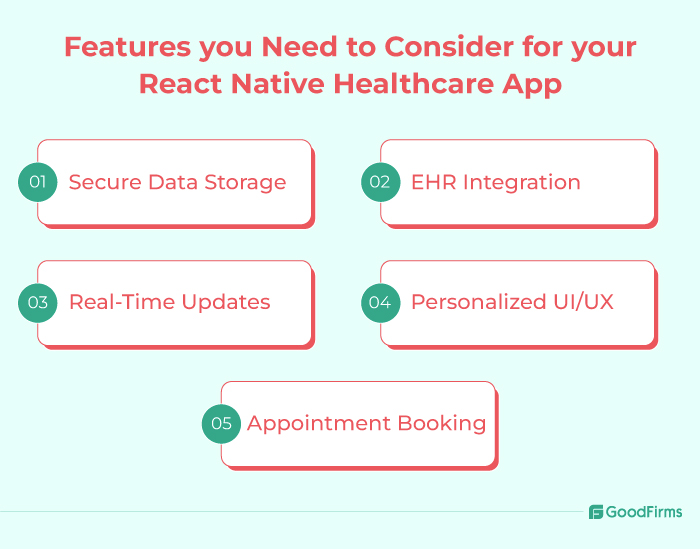
Let's have an in-depth look at these must-have features of a React Native healthcare app.
Secure Data Storage
When it comes to mobile apps for medical or healthcare purposes, secure data storage is extremely important. React Native’s AsyncStorage (storage system) can store the app data, including authentication tokens, user preferences, and settings, in a highly secure manner. Additionally, with the support of React Native for SQLite (a database management system), developers can design and maintain incredibly secure databases. Also, React Native Realm can be applied for quicker and higher-end data storage.
Appointment Booking
Appointment booking is one of the most significant features of a healthcare app. React Native healthcare apps enable patients to book appointments online from any corner of the world. So, no more standing in queues for booking appointments for a clinic, physician, or healthcare center. A healthcare app not only books appointments but also sends notifications and reminders so that treatments and therapies are conducted at their specific time.
Real-Time Updates
React Native powered mobile apps allow healthcare providers to track and manage the medical conditions of patients on a real-time basis and accordingly provide treatments and prescribe medicines. Also, real-time updates make it easier for physicians and doctors to monitor their patients regularly and enhance communication, and even save lives or prevent patients from going into critical and untreatable conditions..
Personalized UI/UX
User experience is one of the major factors that can decide the failure or success of a mobile app. With React Native, mobile app developers get the freedom to build highly personalized UX and UI, including layout, color scheme, and interactive components. This helps you in creating engaging mobile apps for healthcare with a user-centric design and approach.
EHR Integration
EHR (Electronic Health Records) refers to comprehensive information about the patient. React Native helps developers integrate EHR seamlessly into a mobile app, which enables healthcare providers to access and review comprehensive information about the patient. This integration can enhance patient care and high-quality healthcare services.
So, now that you know which features to include in your React Native health care app. Next question: How much will your healthcare project cost you? The cost of a React Native healthcare app would, of course, be based on the features, customizations, and complexities of your project. Also, the cost of a React Native app depends on the geographical region of the mobile app development company you hire.
Let’s have a look at how much a React Native healthcare app costs in detail.
How Much Can a React Native Healthcare App Cost?
Here’s a breakdown of the approximate cost of a React Native healthcare app.
| App Size/Type | Features | Approximate Cost | Timeline |
| Basic/MVP Healthcare App |
|
US$20,000 - 50,000 | 2-4 Months |
| Mid-Sized Healthcare App |
|
US$50,000 - 120,000 | 4-8 Months |
| Enterprise Level Healthcare App |
|
US$120,000 - 300,000+ | 6-12+ Months |
The cost of React Native healthcare app development can vary depending on the country of origin of the mobile app developers you hire and their level of experience. For example, an experienced React Native developer in India can cost you less than an intermediate-level React Native developer in the United States. You can select a React Native App development company based on your app complexity and budget.
Let’s have a look at the cost breakdown of hiring React Native app developers based on their geographical location and experience level.
| Country | Junior Level React Native Developer (0-2 Years) | Mid-Level React Native Developer (2-5 Years) | Senior Level React Native Developer (5+ Years) |
| U.S. | US$50-70/Hour | US$65-110/Hou | US$100-180+/Hour |
| Canada | US$30-45/Hour | US$45-70/Hour | US$70-90+/Hour |
| Germany | US$30-40/Hour | US$40-60/Hour | US$60-90+/Hour |
| Australia | US$40-65/Hour | US$55-80/Hour | US$80-120+/Hour |
| India | US$3-4/Hour | US$4-7/Hour | US$7-10+/Hour |
| Singapore | US$35-50/Hour | US$50-70/Hour | US$70-100+/Hour |
| China | US$25-35/Hour | US$35-50/Hour | US$50-70+/Hour |
| Pakistan | US$3-5/Hour | US$5-8/Hour | US$8-12+/Hour |
Besides the hourly cost of React Native app developers, there are many other factors that you need to consider while hiring one, like their communication skills, time zone, portfolio, technical expertise, and more.
Just go through the list of React Native development companies intricately curated by the Goodfirms’ team and select the one that suits you best as per your project requirements and budget.
Also, considering the below-mentioned latest trends in React Native for healthcare applications is important to ensure that your project doesn’t become obsolete soon and is scalable and reliable enough to attract and engage users.
Latest Trends in React Native for Healthcare Applications
2025 is about to end, and whether you plan to launch your React Native application for a new business or an already established one, you will always prefer it to be evolving and meeting the needs of audiences of all ages for a long time. So, here are some of the latest trends in React Native for healthcare applications that you need to consider.
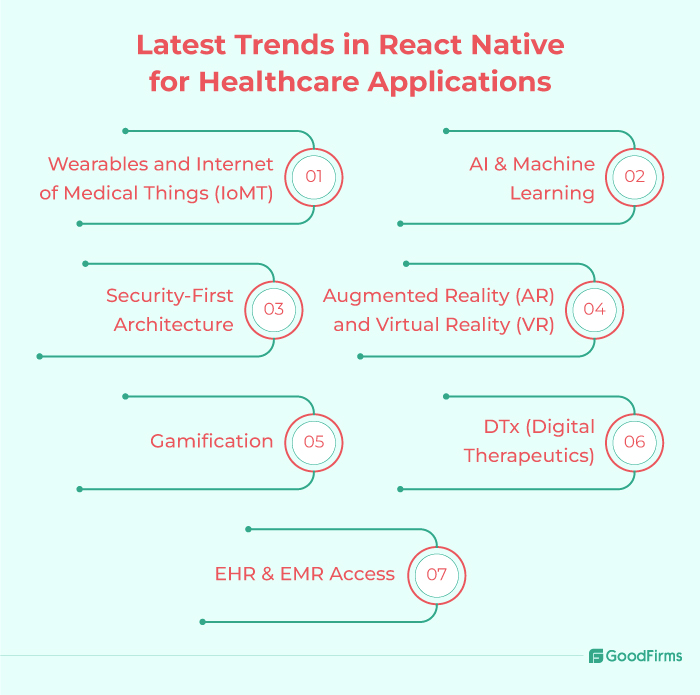
Let's have a look at these latest trends in React Native for healthcare apps in detail.
Wearables and Internet of Medical Things (IoMT)
The need for remote monitoring is rising with the increase in the aging population and the prevalence of chronic diseases in the current times. The Internet of Medical Devices is an interconnected system of Bluetooth-enabled healthcare devices that encourage and enable remote monitoring to a great extent. React Native developers are now creating healthcare apps that connect IoMT devices and wearables with mobile apps to provide updated patients’ medical conditions for quick treatments and life-saving instances.
AI and Machine Learning
AI and Machine Learning power healthcare apps with features like personalized recommendations, chatbots, predictive analytics, image recognition, and more, which are helping businesses to improve patient care and user experience. Whether it is about communication, gaining feedback, or performing accurate analysis, AI and Machine learning in React Native apps can provide many benefits.
Augmented Reality (AR) and Virtual Reality (VR)
React Native is being applied for building mobile apps that integrate Augmented Reality (AR) and Virtual Reality (VR), overlaying 3D models of patient anatomy enabling surgeons to gain enhanced visualization and guidance. Healthcare providers can now create simulations and experiment with new ways of treating diseases without experimenting with patients’ health and body.
Security-First Architecture
Security in healthcare apps is not at all optional. React Native’s security-first architecture enables biometric authentication, end-to-end encryption, runtime threat detection, and secure storage. React Native powered security-first architecture aligns with HIPAA, SOC2, and GDPR regulations, which enables healthcare providers to stay compliant within their industry and prevent any type of legal consequences.
Gamification
Integrating gamification features like badges, points, leaderboards, and challenges into healthcare apps can help improve patient engagement with healthcare service providers and enhance overall health outcomes. These features are now motivating patients to improve their lifestyle habits, fitness level, mental health, and manage chronic disease management.
DTx (Digital Therapeutics)
React Native is one of the most popular choices that helps in building apps that make digital therapeutics possible. Healthcare providers can now offer therapy, mental health support, and condition management through apps to their patients without personally meeting them.
EHR & EMR Access
React Native apps are being developed to provide convenient and secure access to Electronic Health Records (EHR) and Electronic Medical Records (EMR) stored on cloud-based systems. Patients and healthcare providers can now have all the data at their fingertips using their mobile devices.
In the current times, both patients and healthcare professionals depend on mobile apps, and therefore, they must include the latest trending features, while also being user-friendly and intuitive. Let’s now have a look at some real-world examples of React Native powered health care apps for a better understanding of this subject.
React Native Powered Healthcare Apps: Real World Examples
Some of the most popular React Native healthcare apps are Ada Health and Gyroscope. Let’s gain some brief information about the same.
Ada Health: It is a React Native powered health assessment and telemedicine app that enables patients to access health information, check symptoms, and communicate with healthcare service providers.
Gyroscope: It is a React Native fitness and health tracking app that provides users with insights into their health in the form of data visualization, after fetching data from wearables and IoT devices.
React Native Healthcare App: Success Story
A custom React Native contact center app with AI-driven automation and cloud integration has helped a healthcare insurance provider in the U.S. to achieve -
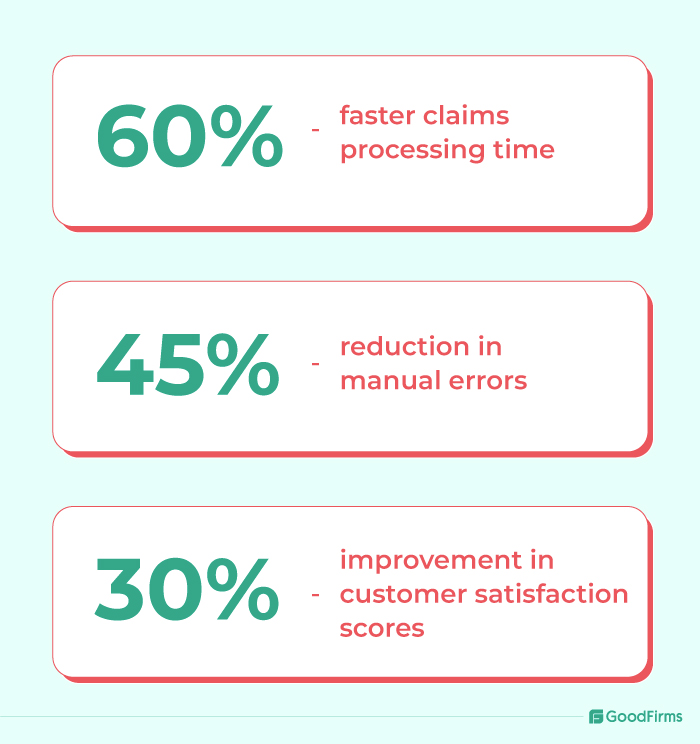
Source: (AmericanChase)
Conclusion - Hire the Right React Native App Developers
Using React Native in healthcare applications can be a perfect solution when -
- You need a mobile app for iOS and Android devices.
- Your healthcare app includes features like messaging, scheduling, real-time updates, and more.
- You just need to build an MVP to test a new idea.
- You want a scalable app that can be regularly updated.
You can consider React Native a perfect choice for your healthcare project if any two of the above conditions apply. Now, when you are planning to hire React Native app developers, Goodfirms is here to help. Just go through the list of the top mobile app development companies, and shortlist the ones that suit your budget and project requirements. In case you have any queries, you can directly contact your shortlisted React Native app development company and explain to them your healthcare project requirements to get a high-performing and revenue-generating app for your healthcare business.
Still have questions in mind on this subject? The following FAQs might help.
FAQs About React Native for Effective Healthcare App Development
Whether you’re planning a telemedicine platform, a fitness tracker, or a patient engagement app, making the right decisions regarding the choice of technology becomes imperative. These FAQs can help you solve your queries on this subject.
In which ways does React Native enhance user experience in healthcare apps?
Healthcare apps built using React Native have a native-like UI, which gives a smooth browsing experience to users and fast performance. These types of applications are preferred for the healthcare industry as they require responsiveness, reliability, and clarity to the core.
Does React Native Help in Reducing Mobile App Development Costs?
Yes, React Native can help in reducing mobile app development costs as you do not need to build a different app for iOS and Android platforms. A single React Native healthcare application works on both platforms, eliminating the need for coding, which saves developers’ time and money both.
Can React Native Help in Building Scalable Healthcare Apps?
Yes, React Native’s modular architecture makes it easy to upgrade its features as and when your healthcare business grows.
What do I need to do if I want my Healthcare business app to connect with wearable devices?
With the help of APIs like Apple HealthKit or Google Fit, you can enable the connection between a React Native app and wearable devices. Just ask your mobile app developer to include this feature in your React Native app for a technically sound experience.
Are React Native powered healthcare apps secure enough to store patient data?
Yes, React Native healthcare apps are secure enough to store patient data, provided you ensure proper encryption, HIPAA-compliant integrations, and secure logins.