Key takeaways
- 76.25% of marketers consider spam placement their biggest email marketing challenge.
- A successful email marketing strategy starts with consent, then segments, then behavior-based personalization.
- Authenticate with SPF, DKIM, and DMARC, and keep spam complaints under 0.30%.
- AI drafts fast, so add a human editor, since 56% of marketers worry about duplicate content.
- Track click-through, conversion, unsubscribe, bounce, and revenue per email, and treat open rate as a trend signal.
A well-written email that lands in the spam folder earns nothing. In Goodfirms’ 2025 Email Marketing Survey of 100+ marketing professionals, 76.25% named spam placement as their biggest email challenge, 27.5 points ahead of creating compelling content (48.75%).
AI writing tools have made good copy quicker to produce, so the harder question is no longer what to write but whether the email reaches the inbox. A clear email marketing strategy settles that before the first send.
This guide breaks an email marketing strategy into 10 components, from consent to measurement, drawn from the tactics professional email marketing companies use today. One rule near the end, the One Job Rule, ties them together, and a five-cause checklist shows where strategies most often break.
Compare the best email marketing software on Goodfirms to select the best one that suits your budget and business requirements.
How Do You Build an Email Marketing Strategy?
There are 10 components to building a successful email marketing strategy: consent, goals, segments, personalization, subject lines, mobile design, email types, frequency, deliverability, and measurement. Order matters because each component feeds the next. Start with a list of people who opted in, split them into segments, and use what each segment does to personalize your emails.
Component 1: Collect Consent First
Email consent means every address on your list belongs to someone who asked to hear from you. Lists built this way earn better engagement and protect your sender reputation, while purchased lists invite spam complaints and account suspensions. Platforms such as Mailchimp prohibit uploading bought contacts.
- Say what subscribers will get: put the content type and the frequency right beside the sign-up field.
- Use double opt-in when junk sign-ups pile up: you lose a few subscribers and avoid a stack of bounces.
- Know which law applies: GDPR covers subscribers in the EU, CAN-SPAM covers the US, and CASL covers Canada. Each follows the subscriber's location, so a US store emailing a customer in Germany complies with GDPR.
- Verify imported lists: run an email verification tool before the first send.
Component 2: Set One Goal Per Campaign
A campaign goal is the single outcome that tells you whether an email worked.
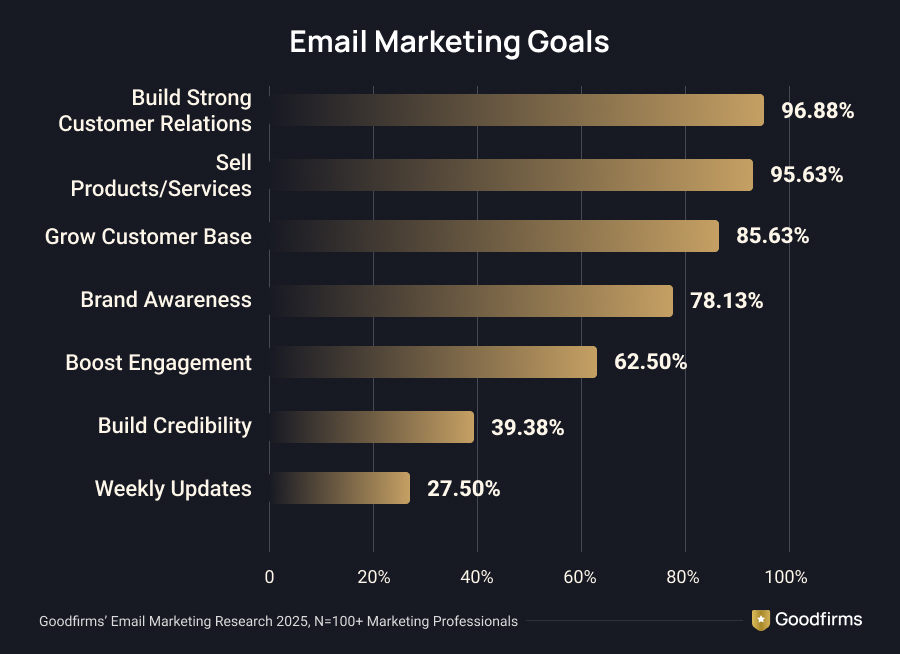
Source: Goodfirms’ Email Marketing Research May 2025, N=100+ Marketing Professionals
Most teams chase multiple goals in the same email, and the results blur.
Goodfirms’ Insight: A welcome email might aim for a first purchase within 14 days. A win-back email might aim to reactivate 10% of contacts who have been silent for six months. Write the job in one sentence at the top of every brief, and cut any element that does not serve it.
Component 3: Segment Before You Write
Segmentation means splitting your list into groups that receive different messages. Three layers cover most needs: who the subscriber is (industry, role, location), what the subscriber did (pages viewed, links clicked, items bought), and where the subscriber sits in the relationship (new, active, lapsed).
Start with four segments you can keep current. A pet store, for example, can send a restock reminder to customers who bought dog food six weeks ago and send nothing to everyone else. Group recipients by engagement level, then design a different campaign for each group.
Many platforms now update segments automatically as behavior changes, so check whether your email marketing tool offers dynamic segments before building lists by hand.
Component 4: Personalize Beyond the First Name
Personalization means shaping the content of an email around what a subscriber has done or chosen. A first name in the greeting no longer carries much weight. Sinch’s 2026 BFCM consumer survey of 2,501 consumers across eight countries found that 77% want personalized messages from brands, out of which 42% value them as long as they are relevant.
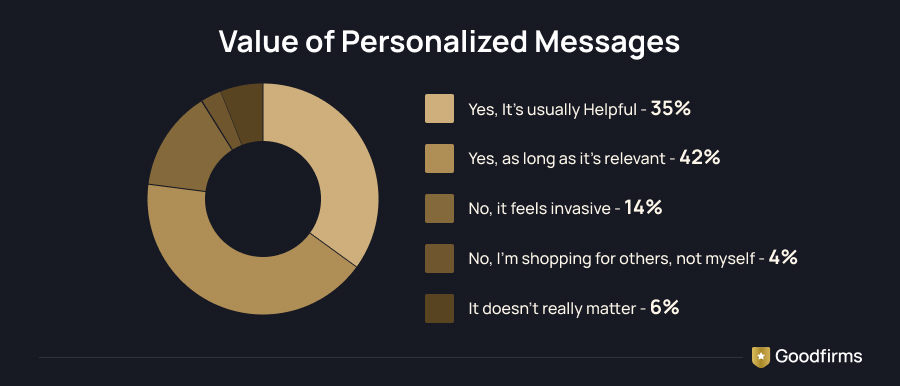
Source: Sinch 2026 Black Friday Cyber Monday consumer survey, 2,501 consumers across eight countries
Real personalization draws on behavior: a product left in a cart, an article read twice, a plan renewal date, a category browsed last week. A cart reminder that names the exact item left behind needs only one signal, and the subscriber instantly sees why it arrived.
Component 5: Pair Subject Lines With Preview Text
A subject line and its preview text appear together in the inbox, and together they decide whether the email gets opened. Short and crisp subject lines can improve email open rates.
- Put the point of the email in the first five or six words, because phone screens cut off the rest.
- Let the preview text add a new detail instead of repeating the subject line.
- Test two subject lines on a small slice of your list before sending to everyone.
Component 6: Design for Mobile, Build for One Action
Mobile email design means building for a small screen first and a desktop second. Mobile optimization is a priority now, as many people check email on the go. Use a single-column layout, buttons large enough for a thumb, and body text that reads without zooming.
Give each email one main call to action. Besides email responsiveness, it is also important to have efficient landing pages with calls to action. The email earns the click, and the landing page finishes the job, so match the offer, tone, and visuals between the two.
Component 7: Match Email Types to Customer Stages
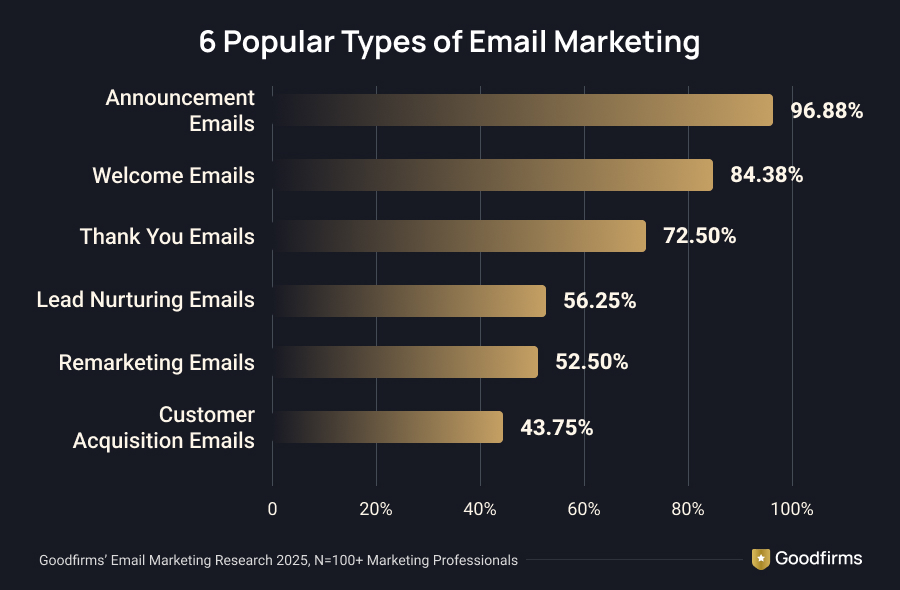
Each email type serves a different moment in the customer relationship. There are 6 popular types of emails:
Source: Goodfirms’ Email Marketing Research 2025
Marketers use announcement emails most, at 96.88%, followed by welcome emails (84.38%) and thank-you emails (72.50%). Lead nurturing emails (56.25%), remarketing emails (52.50%), and customer acquisition emails (43.75%) trail behind. The three least-used types serve people who have not bought yet or have gone quiet, so check those stages first when you audit your program.
|
Customer stage |
Email type |
Job of the email |
|
Prospect, not yet a customer |
Customer acquisition |
Win a first sign-up or purchase |
|
Interested, not ready to buy |
Lead nurturing |
Build trust with useful content until buying makes sense |
|
Just joined or just bought |
Welcome and thank-you |
Greet the person, confirm the action, and set expectations |
|
Active customer |
Announcement |
Share launches, news, and offers that fit the segment |
|
Gone quiet or abandoned a cart |
Remarketing |
Bring the person back with one reminder or one reason |
If your time is limited, start with the welcome stage, since every new subscriber passes through it. A welcome series is a set of three automatic emails sent after someone joins your list. The first introduces your brand, the second shares your best content, and the third offers one small next step. Transactional emails come next. These are automatic messages triggered by an action, such as an order confirmation or a password reset, and customers expect and read them.
Component 8: Pick a Send Frequency You Can Keep
Send frequency is how often a subscriber hears from you, and the right level is the one you can sustain without hurting engagement.
Weekly works as a sensible default for most programs. Tell subscribers what to expect at sign-up, stick to it, and watch unsubscribe and complaint rates after any change. A climb in either number means a segment is getting too much mail or the wrong mail.
Component 9: Keep Deliverability Healthy
Deliverability is the share of your emails that reach the inbox instead of the spam folder. Google's email sender guidelines set clear rules for anyone sending 5,000 or more messages a day to Gmail addresses, in effect since February 1, 2024. They call for SPF, DKIM, and DMARC authentication, one-click unsubscribe plus a visible unsubscribe link, and a spam rate under 0.30% in Google Postmaster Tools, with 0.10% as the recommended target. Smaller senders benefit from following the same rules.
Picture a campaign that took a week to write and shows almost no opens. The copy may be fine; the inbox placement may not be. Authentication and list hygiene are the first two places to look.
- Authenticate your sending domain with SPF, DKIM, and DMARC.
- Remove addresses that bounce, and retire contacts who ignored your emails for six months after one last re-engagement attempt.
- Keep volume steady, because sudden jumps look suspicious to mailbox providers.
- Make unsubscribing painless, since a quiet exit costs far less than a spam complaint.
Component 10: Automate, Test, and Measure
Automation handles the repeatable moments: welcome series, abandoned carts, post-purchase follow-ups, and win-back sequences. Testing and measurement tell you which of those automations deserve more investment.
AI now sits inside most of these workflows. Goodfirms' LLM survey found that 78% of marketers credit AI with faster content creation, while 26% credit it with better personalization. The same survey found that 91% plan to increase AI investment. Draft with AI if it saves time, but assign a human editor to every email, since 56% of respondents worry about duplicate content and 44% about losing brand voice.
Review these KPIs on a weekly or monthly basis:
- Click-through rate: shows whether the content and call to action work.
- Conversion rate: shows whether the click led to the outcome you wanted.
- Unsubscribe and spam complaint rates: show whether the right people get the right emails.
- Bounce rate: shows list health.
- Revenue or leads per email: connects the program to the budget.
- Open rate: Use open rate to watch direction, not to judge a single send. Apple Mail Privacy Protection can inflate opens, so open rate alone is not the only metric to measure the success of your email marketing campaign.
Why Does an Email Marketing Strategy Fall Short?
An email marketing strategy falls short when the emails serve the sender’s habits more than the reader’s needs. Five causes show up most often:
Emails with no single job
Marketers chase several goals at once, including customer relationships, product sales, customer growth, and brand awareness. When one email tries to serve more than one, it ends up with three offers, two links, a survey, and the campaign report. That email campaign cannot show which element earned the click.
One message for the whole list
Attentive’s Consumer Trends Report shows that 81% ignore marketing messages that are irrelevant to them. A single email sent to every subscriber is irrelevant to most of them by default.
AI drafts that sound alike
Goodfirms’ LLM survey 2026 found that 96% use large language models for content writing and 76% for campaign design. Of the same respondents, 56% worry about plagiarism or duplicate content, and 44% struggle to keep brand voice and originality. When thousands of senders draft with the same models, inboxes fill with emails that read the same.
Campaigns that rely only on scheduled sends
A program that sends emails only when the team is ready reaches subscribers at moments the team has picked, which are often not the moments subscribers care. Omnisend’s 2026 marketing report found that each scheduled email marketing campaign earned $0.18, while each behavior-triggered email earned $2.87. Triggered emails made up 2% of sends and produced 30% of email revenue. Without welcome, abandoned-cart, and follow-up emails, a campaign underperforms and misses its highest-return moments.
A list nobody keeps clean
ZeroBounce’s 2026 Email List Decay Report found that nearly 23% of email addresses become invalid within a year. Demand Gen Report’s 2026 benchmark survey shows why the problem persists: 72% of marketers cite lack of time and resources as a challenge in maintaining data quality. Segments and personalization built on stale records send the wrong message to the wrong person, or to no one.
Ann Handley, Chief Content Officer at MarketingProfs, offers a useful corrective as quoted in Salesforce’s 2024 roundup of marketing quotes:
“Understand your value to your customers. Focus on them relentlessly and with pathological empathy. Make the customer the hero of your story.” Ann Handley, Chief Content Officer, MarketingProfs.
Applied to every send, Handley’s advice becomes the One Job Rule: each email gets one reader segment, one action, and one metric.
Email Marketing Strategy FAQs
What is an email marketing strategy?
An email marketing strategy is a documented plan for who you email, what you send, when you send it, and how you measure the result. It covers consent, segmentation, content, send schedule, deliverability, and reporting, all tied to a business goal such as first purchases or renewals. A campaign is a single send or sequence, and the strategy decides which campaigns exist and why.
What is a good email open rate and click-through rate?
In Goodfirms’ survey of 100+ marketing professionals, marketers named 22.5% as a typical open rate and 4.2% as a typical click-through rate. Respondents added that both figures vary by region and industry. Apple Mail Privacy Protection can inflate opens, so judge a send by clicks and conversions, and compare results with your own last six months before any industry benchmark.
How much should you spend on email marketing?
Goodfirms’ survey respondents spend 12.09% of their total marketing budget on email marketing on average, with individual answers ranging from 2% to 30%. Campaign type, content needs, and list size drive that spread. Start near the average, then adjust using revenue or leads per email. Count software fees, design time, and list-cleaning costs in the total.
What are the biggest email marketing challenges?
Spam placement worries marketers most: 76.25% of Goodfirms’ survey respondents named it, 27.5 points ahead of creating compelling content (48.75%). Boosting open and click-through rates (33.13%), Promotions-tab placement (29.38%), and growing and retaining subscribers (12.50%) follow. Two of the top four problems are placement problems, so authentication, list cleaning, and content that matches the sign-up promise do the most work.
Which email marketing software do marketers use most?
In Goodfirms’ survey, Mailchimp led with 31.88% of marketers, followed by HubSpot at 26.25%, ActiveCampaign at 15.00%, Constant Contact at 13.13%, GetResponse at 7.50%, and ONTRAPORT at 6.25%. Popularity does not guarantee fit, so compare segmentation, deliverability tools, testing, and pricing against your list size. Goodfirms’ email marketing software directory lists verified user reviews for 282 products.
How often should you send marketing emails?
Send as often as you can keep a steady schedule, and let engagement set the ceiling. One email a week is a sensible starting point for most programs. Tell subscribers the frequency at sign-up, then watch unsubscribe and spam complaint rates after every change. A rise in either number means a segment is getting too much mail or the wrong mail, so cut volume for that segment before cutting it for everyone.
How do you measure email marketing success?
Measure email marketing success with click-through rate, conversion rate, unsubscribe and spam complaint rates, bounce rate, and revenue or leads per email, reviewed weekly or monthly. Treat open rate as a trend signal only, because Apple Mail Privacy Protection can inflate opens. Compare each metric with your own last six months first, then with industry benchmarks, and tie revenue or leads per email to the budget.
How do you choose the right email marketing software?
Choose email marketing software by checking five things: behavior-based segmentation, guided SPF, DKIM, and DMARC setup, A/B testing, triggered automation for welcome and cart emails, and pricing that fits your list size. Ask each vendor to demonstrate segmentation, deliverability tools, and testing in a live trial, and read verified reviews before shortlisting. Free versions and trials on Goodfirms listings let you test before you pay.
Should you hire an email marketing company or run campaigns in-house?
Run campaigns in-house when your list is small, your offer is simple, and someone has time for segmentation, testing, and deliverability checks. Hire an email marketing company when your list is large, inbox placement is slipping, or your team lacks hours or technical skills. Goodfirms had reviewed 13,241 email marketing agencies as of August 2026, so ask for results from campaigns similar to yours.
How do you grow an email list without buying contacts?
Grow an email list by giving people a clear reason to subscribe and an easy way to do it. Place sign-up forms in your site navigation, on content pages, and at checkout, state what subscribers will receive, and offer something useful such as a guide or early access. Add double opt-in to filter junk sign-ups, and never buy contacts, since purchased lists invite spam complaints and account suspensions.
Conclusion: How Do You Make an Email Marketing Strategy Work?
An email marketing strategy works when all ten components are in place and you review them on a schedule. Consent and a clean list come first, segmentation and personalization give each message a reason to exist, and authentication plus steady sending keep you out of the spam folder.
Pick the weakest component today and fix it this week. Then apply the One Job Rule to your next three sends: one reader segment, one action, and one metric. Review click-through rate, conversion rate, unsubscribe and complaint rates, bounce rate, and revenue per email every month, and change one component at a time so you know what moved the number.
If you want a second pair of hands with your email marketing strategy, compare verified reviews of the best email marketing software or shortlist the top email marketing companies on Goodfirms. Ask every vendor to demonstrate segmentation, deliverability tools, and testing before you sign.