In the early days of technology IT management referred to checking hardware and systems manually, and resolving issues as they arose. With paper-based systems of physical documents and filing, IT management offered basic infrastructure support that ensured smooth operations. Gone are the days when computers took time to load, and conked out without any clue!
Over time, technology evolved and enhanced the overall infrastructure by advancing further with robust cloud computing services where one can buy a virtual server using a pay-as-you-go model with AWS, GCP, and Azure. Today, IT asset management has been transformed with AI, enabling businesses to track and monitor the software and hardware resources seamlessly without any friction. The early days' struggle of managing and processing large and complex datasets has now been solved with big data and analytics advancements. AI-powered IT management software facilitates predictive, real-time monitoring, tracking, reporting & analytics effectively.
In the future days to come, the path to IT management is likely to improve much better with tools, technology and people constantly working to make it better and more accessible. The flaws and drawbacks of AI that is seen currently will certainly improve to make the management process smooth and efficient. The security aspect of IT management will also improve with AI mitigating potential threats and vulnerabilities from your IT infrastructure. With a large amount of data and previously found patterns, it will be easier to make decisions based on data insights.
This blog precisely discusses IT Management, allowing readers to understand who is the major contributor towards better IT Management - is it Humans, Tools or AI!
Earlier Days of Human-Driven IT Management:
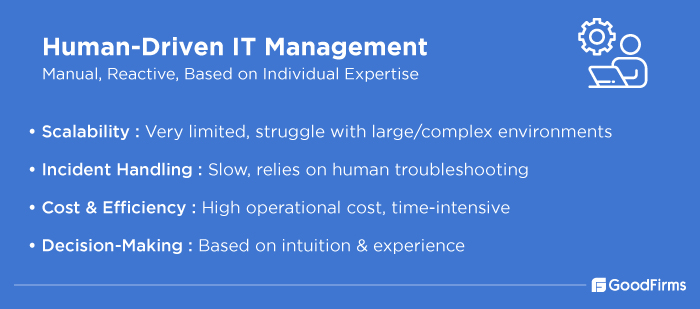
Pros of IT Management by Humans
Data Privacy
All the sensitive information and files were managed physically, enabling privacy of the data effectively. This allowed businesses to safeguard the organization from the fear of data theft. For example, all the data of a simple notepad and Excel sheet were protected with passwords which only the IT departments were able to manage.
No complex tools & No training
The early days of managing IT resources were defined by no complex tools, or if there were any, it was simply basic, without a complex interface and functionalities like a digital calculator. This allowed businesses to focus more on simple things that matter and solve issues as they arose. This allowed the workforce to offer more productive hours on priority tasks, as there is no training time involved in learning tools. For example, there are no complicated tools to learn for employees, and short & simple steps were written in the manual to start with.
Less Distractions
The old days of IT organizations didn't have social media, apps, hybrid work shifts, digital insecurity and constant notification alerts. The pre-advanced era of tech was running with simple devices and simple techniques to find the better solutions with no or minimal distractions. The less social digital engagement era was the peak era of productivity without pastimes.
Cons of IT Management by Humans
High Training Cost
Employees with no or little familiarity with IT resources need to be trained and equipped with knowledge which requires onboarding expenses. The tools and technologies are updated and upgraded with tech evolution which is why it is essential to fulfil continuous learning requirements. To manage IT infrastructure, there are concerns regarding employee turnover, skills gap, and specialized expertise.
Complex Setup
The challenges of setting up IT resources are complicated which is why there are possible errors and inconsistency is involved. If not configured properly and the potential risks are not addressed, it might cause potential security vulnerabilities. The complicated workflow reduces the work efficiency and increases the cost of managing IT assets of the business.
Maintenance Cost
All the IT resources in your business infrastructure needs to be maintained and upgraded frequently to keep the operations running smoothly. Workflow inactivity, higher error, and increased costs leads to inefficient manual processes of the business which influence challenges in managing complexity. With ineffective IT work the issue of rework and additional repairs arise.
Security Risks and Cyber Threats
According to Statista, human errors have contributed 28% of global data breaches which causes concern regarding inadequate security practices followed by the IT administration. A workforce without cyber training and guidance that uses weak passwords might expose potential vulnerabilities in the infrastructure. The potential risk of employees becoming the victims of social engineering might cause damages to the IT resources.
Fragility of Mismanaged Information
Ineffective and improper management of data can lead to security risks and cause negative impact. Configuration errors in IT resources leads to businesses failing to manage work efficiency and addressing the operational vulnerabilities. With mismanagement in IT administration, it becomes challenging to maintain accuracy and quality. The executional and missing deadline issues cause reputational damage on the business.
Outcome & Pain Points of Human-driven IT Management:
- Slower response times
- High error risk
- No visibility
- Costly downtime
- People dependency
Tool-Driven IT Management (Pre-AI Era):
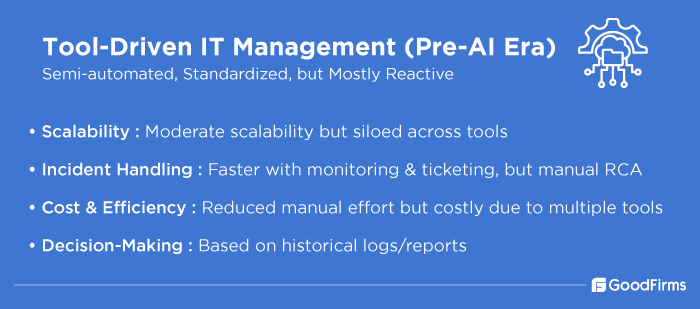
Pros of Tool-Driven IT Management (Pre-AI Era)
Real-time Collaboration
Managing IT resources with tools enables efficient, and real-time task allocation, management, monitoring, tracking and more. The cost of using these tools is valuable as they allow streamlining the workflow for operational efficiency. Real-time communication with tools nurtures team collaboration and enhances the productivity of the work. Recent time of technology evolution will take collaboration to the next level, integrating advanced AI features. For example, a manager can assign a new task from a fresh project to the remote work employee using real time collaboration tools to ensure efficient collaboration.
Facility to Manage Remotely
The cost spent on remote working tools legitimates the contribution it offers in tech support to ensure smooth and efficient operations. Remote management enables faster issue resolutions with remote access and communication enhancing team collaboration and synergy. Remote working software allows centralized management and monitoring to optimize IT resources for the business. For example, a healthcare organization facing EHR migration challenges can connect to IT help desk support with remote work tools to resolve the issue.
Easy to Track Progress in Real-time
Monitoring real-time activities with tools helps businesses with notification of critical alerts of over-utilization or compromise of any IT resources. The tech tools assist in tracking the visual progress which enables efficiency and productivity of the workflow. With all the necessary IT resources, it boosts overall morale and motivation of the workforce allowing operational efficiency. For example, an IT organization going through productivity challenges can utilize the progress tracking tools to find drawbacks and address these issues effectively.
Improved Efficiency
The areas of IT where human efforts lack proficiency, like time management, cost management, human errors, and performance inability can be optimized with IT tools. Human errors like misaligned priorities, communication voids, resource restrictions, etc. will be addressed through these tools to ensure productivity. For example, organizations running low on management staff can utilize management tools to address communications, time management, and priorities that cater to businesses in a robust way.
Security
IT risks and vulnerabilities can cause long-term damage, which is why investing time, money, and effort to secure IT management requires the utmost priority. Quick threat detection and response tools like SIEM (Security Information and Event Management), and SOAR (Security Orchestration, Automation, and Response) can lead to streamlining security processes. With stronger compliance and auditing, businesses can enhance the security of their IT infrastructure, mitigating potential risks & threats. With AI-powered tools & technology, the future holds new and advanced possibilities for IT management. For example, financial organizations and banking systems use SIEM & SOAR tools to identify any suspicious activities within the network to safeguard the data.
Cost Efficiency
Eliminating extra costs spent on unnecessary elements in your IT infrastructure enables smart spending on your IT resources. Managing and organizing paid tools can help in cutting down extra cost to optimize the workflow effectively. Spending on cloud utilization can be optimized enabling tools with notification alerts to manage the costs. For example, businesses that spend extra amounts on unnecessary IT resources can use expense management tools to cut down extra spendings.
Reporting and Analytics
IT administrative tools can enhance decision making using data and insight to provide predictive analysis for the businesses in a traditional way. By using technically programmed processes these tools can optimize IT resources ensuring smooth and effective daily operations. With data and insights report, eliminating the extra elements that no longer require ensure effective IT management. In the coming days, reporting & analysis will be enhanced with data being the centre point. For example, businesses can easily manage and resolve HR challenges with the assistance of analytical tools to provide accurate data information.
Cons IT Management by Tools (Pre-AI Era)
Limitations of Traditional Tools
Traditional tools have assisted the IT infrastructure at utmost capacity. However, these tools cannot address prior issues and are now becoming outdated as the tech world is moving towards Artificial Intelligence. Also, these tools face scalability and flexibility issues making it unreliable for the modern IT infrastructure. Managing data and integrating challenges arises as technology advances further.
Integration challenges
Integrating other IT tools can be risky and comes with third-party integration issues that bring potential vulnerabilities. The concerns of data being trapped in isolated systems and poor data quality rise with technical complexities in the tech infrastructure. The mismatch or incompatibility between software, hardware, and network components leads to inefficient operational activities. These tools bring cost, maintenance, budget, security, and compliance risks.
Data Accuracy issues
IT tools often fall under algorithm biases by developer category which is why it is challenging to rely on data insights. Also, the over reliance on automation processes makes false sense of data precision without any cross-check or verification via manual efforts. With different software & components having different requirements it is challenging to integrate tools into business IT infrastructure.
Complexity & Feature Overload
The intricacy in software & tools makes it difficult to navigate the user interface which constitutes unwanted time wastage. This leads to poor user engagement where users need to rely on a steep learning curve to navigate and use the IT resources. A lot of unnecessary features and functionalities gives birth to complications in the workflow optimizations.
Rapid pace of technological change
The modern tech world is changing at a rapid pace giving birth to challenges like misconfiguration, insecure APIs, broken authentication, insider threats, phishing email and other security vulnerabilities. System integration, API limitations, security & compliance, hardware & software conflicts and other compatibility issues arise with new-age technological change in IT infrastructure.
Outcome & Pain Points of IT Management by Tools (Pre-AI Era)
- Scalability Issues
- Reactive and not proactive
- Not data-driven
- Costly maintenance
- Limited automation
AI-Driven IT Management
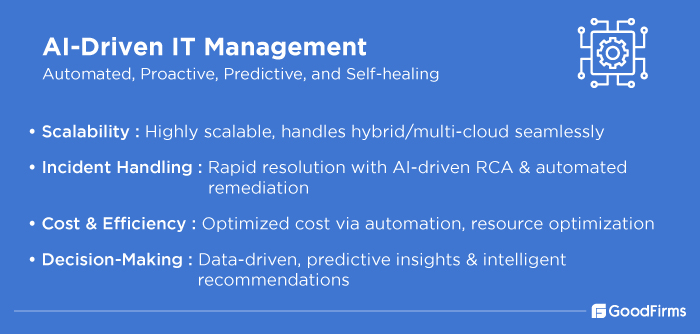
Pros of AI-Driven IT Management:
Automated Processes
AI-powered IT resources can make routine repetitive tasks easier by automating the processes efficiently. Artificial Intelligence can solve common IT tickets based on predictive analysis and previously found patterns. With automation and intense data driven insights, AI can eliminate human errors made due to fatigue, emotion or personal bias. IT resources driven by AI can reduce the overall labor cost and enhance work efficiency.
Proactive & Predictive Approach
Finding the core of the problem and proactively solving the issue becomes easier with the help of AI-powered IT resources. Managing the best security practices with cyber tools influenced by AI can help in responding to incidents more quickly than before. These tools can identify the threats much before, and notify with low, medium, high, and critical alerts to inform the IT infrastructure about any suspicious activities.
Optimization of Workflows
Routine tasks can be operated with the assistance of AI-powered automation that can boost productivity. AI enables quick processing time allowing faster operational activities within an organization. The tech evolution brings changes in the IT world and AI helps to adapt new tech trends with data driven insights and predictive analysis. AI-powered network-based IDS (NIDS) and host-based IDS (HIDS) tools can enable intrusion detection in your organization.
Reduced Costs
The cost of labor decreases due to automated processes through which AI can complete all the repetitive tasks. AI-powered tools can streamline the process of workflow within business to enhance the overall work efficiency. It allows businesses to allocate the resources according to the requirements with data-driven decision-making, which eliminates the cost of labor and unnecessary tools.
Faster Resolution
AI-powered tools and technologies have enabled the business infrastructure with a quick response to IT issues integrating automation. Any ticket support issues, network monitoring, and cloud solutions are now resolved faster than before using Artificial Intelligence. Complex and time-consuming tasks are being done rapidly to ensure work efficiency and enhance the productivity in the IT infrastructure with ease.
Reduced Human Error
AI tends to make decisions based on data, previously found patterns and set rules of algorithms which can eliminate the human errors made due to personal biases, or work fatigue. The businesses can streamline decision-making with AI-powered data insights that enable maintenance & issue resolution, which enhances work productivity. AI reduces the human bias and mismanaged data which increases work efficiency.
Enhanced Security
By identifying abnormal patterns in IT infrastructure and previously found patterns AI-driven tools can notify with alerts and respond with threat prevention. With the assistance of automation, routine tasks of monitoring network devices and framework enable robust security standards. AI-powered tools can perform analysis of logs and prevent false positives to shed lights on things that matter to safeguard the network and infrastructure.
Smart IT management
Using modern IT resources with automation, predictive analysis, data-driven preciseness can help businesses to optimize the workflow. AI-powered tools for security, cost management, HR, cloud, and other resources allow business to smartly manage the whole IT infrastructure enabling work efficiency.
Cons:
Over-Reliance and Skill Erosion
The over-reliance on AI kills creativity and comes with automation bias, which can lead to false information and critical errors. Discriminatory and poor data quality training can cause systemic failures, which cause inaccurate outputs. With AI relying on users and data, one false information can lead to cascading failures in the whole infrastructure. AI can disrupt the skill development cycle among the employees, leading to a lack of innovation and creativity.
Algorithm Bias
AI-powered data insights are not completely reliable because of data bias and non-representative data, which leads to inaccuracy. Mismanaged data can interrupt the IT infrastructure and cause reputational damage in the market. False information and unreliable AI-powered tools can cause operational inefficiencies in the whole IT infrastructure. Unfair systems and structures in tech have a negative impact on businesses, driving away trust and productivity.
Ethical and Privacy Concerns
Artificial Intelligence can not have any rules and regulation which raises the concerns regarding security and privacy. AI lacks consent and control over system, people, and tech infrastructure raising concerns regarding the protection of organization. AI integration tools are expensive and bring data security challenges making businesses less likely to rely totally on AI-powered technology.
Unpredictability and Inaccurate Information
The complex AI systems can influence businesses in a negative way causing operational insufficiency. With lack of transparency and explainability, AI can be influenced by misinformation and manipulation causing damages to the IT infrastructure. Poor data quality and inaccuracy is another thing that has been a rising concern for businesses using AI powered tools & technologies.
Lack of Human Touch
Artificial Intelligence that completes tasks can make the morals of employees down and bring uncertainty among the workforce. However, AI fails to handle sensitive and complex situations that require human touch making it unreliable for tech infrastructure. Lack of human centric approach in AI and other difficulties makes it vulnerable for businesses to rely totally on it.
Heavy Initial Investment
There are huge expenditures involved to upgrade hardware, software, and skillful individuals where IT project failure may lead to financial risks. Also, there are operation challenges like training employees to adapt AI technologies and how to get the most out of it. Misaligned strategies and over reliance on AI make it more difficult for businesses to achieve high productivity.
Core Technologies Involved in AI-Driven IT Management
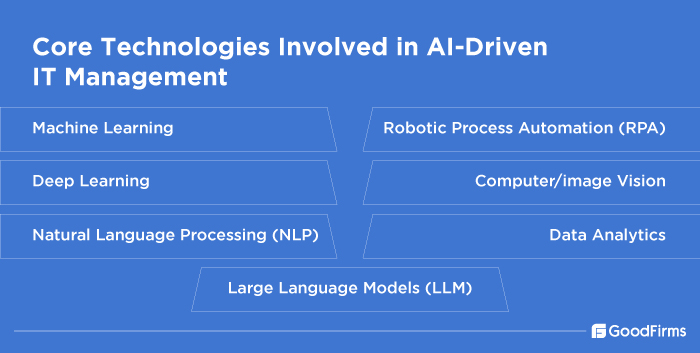
Machine Learning
Identifying patterns from data about the network, server, cloud, and other IT resources. ML enables enhanced decision-making, performance enhancement, and other things without being specifically programmed.
Deep Learning
With the assistance of layered Artificial neural networks, finding the best DL model from a huge amount of data to optimize the workflow. It is also known as a branch of machine learning by neural networks.
Natural Language Processing (NLP)
Understanding and generating human-like language becomes easier with NLP to address issues faster in the tech Infrastructure. NLP is also a subfield of computer science and Artificial Intelligence.
Robotic Process Automation (RPA)
A process of automation technology that utilizes software robots to perform tasks that are being done by humans. RPA enables accuracy, speed, and enhanced productivity.
Computer/image Vision
Understanding and decoding the perceptible world from digital images and videos is defined as computer/image vision. This technology can allow tech businesses to save cost, improve user experience, and provide real-time analysis.
Data Analytics
The process that involves inspection, scrubbing, transforming, and modeling of statistics is defined as data analytics. It helps in improving tech decisions, operational challenges, and identifying patterns.
Large Language Models (LLM)
LLMs referred to advanced AI technology that use deep learning and neural network processes to generate and manipulate human-like text. This allows generating other forms of content like text, code, or media files.
Finding the common ground with Humans, Tools, and AI
With evolving technologies, businesses today are also required to progress their IT management processes.
The IT management process can become robust and intuitive by clearly defining the roles of humans, tools, and AI. As we know that there are gains and drawbacks in each sector of IT management, adding value by addressing challenges from other aspects can surely enhance work efficiency. Like we have found that there is an issue of mismanaged information by humans which can be solved by using data management software. Also, limitations of this software can be addressed via AI-driven tools and technologies.
For example,
- Cisco has created AI infrastructure to address challenges of AI workloads in traditional data centres and tools to test new AI capabilities in Cisco products.
Humans, tools, and AI aspects can enhance IT management by filling the gaps and optimizing the tech infrastructure for the improvement of organization.
Conclusion
As the tech world is advancing further, the new trends, tools, and techniques are being introduced to manage IT resources. Challenges of IT asset management that were once relied totally on humans, and then with tools now strongly require the best of human expertise, traditional tools, and AI-powered technologies. In this era of uncertainty, learning new techniques and tactics that enable productivity is essential. Managing IT resources through free and open-source IT asset management software allows businesses to address challenges and find solutions to optimize the workflow.